If Catherine the Great Lived Today: The Empire Builder Who'd Run Everything from a Think Tank
If Catherine the Great lived today, she'd run a Geneva policy network, broker quiet diplomacy, and have three former partners on three different boards of directors.
Read Wikipedia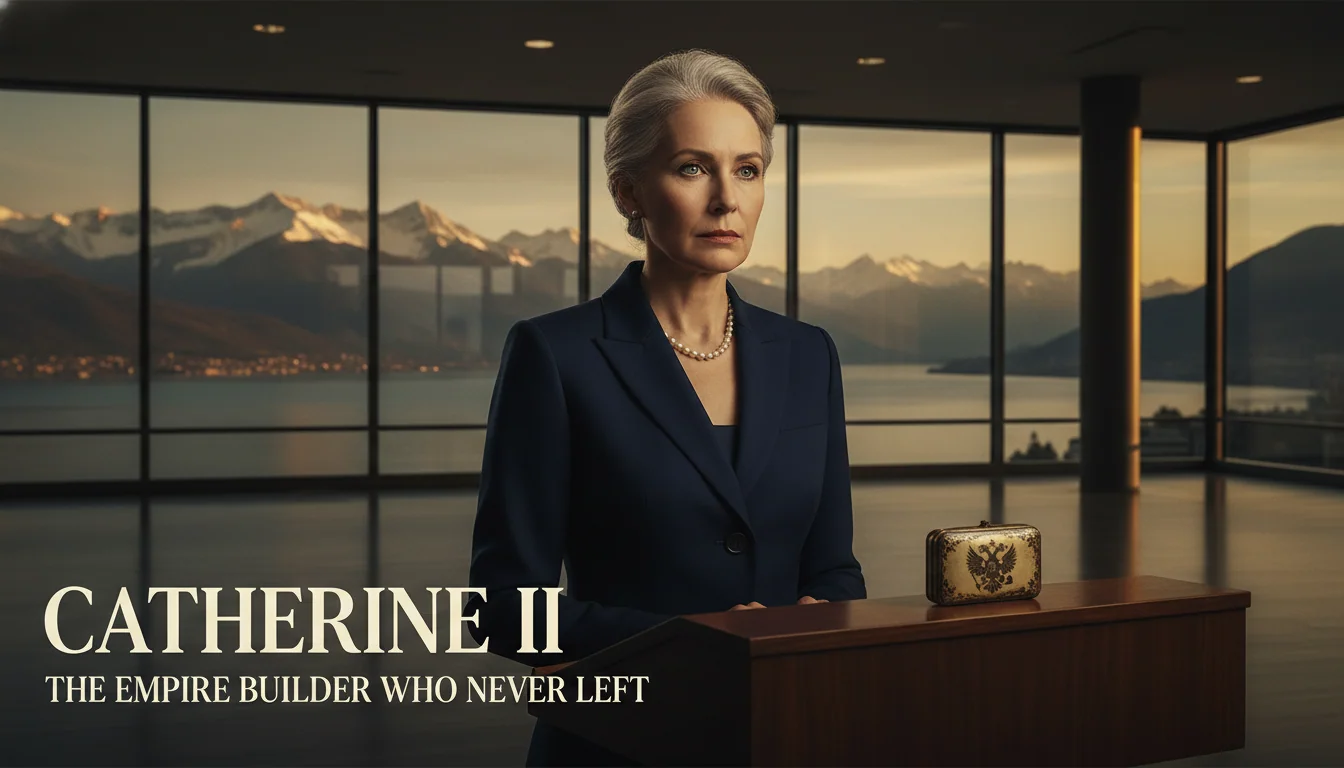
The biography sounds invented. A minor German princess sent to Russia at 15 to marry a man she had never met. Thirty-three years as a political wife, consort, and captive of a court that regarded her as a foreign nuisance. Then a coup, completed in a single morning with the loyalty of two regiments and the nerve to ride to Peterhof in a borrowed military uniform and demand her husband's abdication. Then 34 years of uninterrupted rule, during which she acquired Crimea, reorganized Russian law, built one of the greatest art collections in the world, and wrote more than 30,000 letters.
Sophie von Anhalt-Zerbst arrived in Russia speaking no Russian. She left as Catherine II, the most powerful woman in the world. The gap between those two positions was crossed entirely through intelligence, patience, and the willingness to move decisively when the moment came.
Drop that skill set into 2026 and the result is formidable and unsettling in equal measure.
The historical figure
Catherine was born in 1729 in Stettin (now Szczecin, Poland) to a Prussian general of middling rank and a Duchess of Holstein-Gottorp who was connected, distantly, to the Russian imperial family. The connection was enough. When Empress Elizabeth of Russia needed a bride for her nephew and heir, Peter, Catherine's mother pressed the case with Frederick the Great of Prussia, who saw value in placing a tractable German girl on the Russian succession. Catherine was 15 when she arrived in Saint Petersburg.
She was not tractable. She was methodical.
She learned Russian compulsively, converted to Orthodoxy as required, took the name Catherine, and began the long work of making herself indispensable to the court while her husband made himself a liability to it. Peter III was, by most accounts of the period, erratic, contemptuous of his Russian subjects, and obsessed with the Prussian military to the point of reversing Russian foreign policy immediately upon taking the throne in 1762 to benefit Frederick the Great. The officers of the guards regiments, who had real political weight in the Russian system, found him intolerable.
Catherine had been cultivating those officers for years. When Peter's behavior crossed a line in the summer of 1762 - accounts vary on the specific trigger - the coup took an afternoon. Catherine rode to the barracks, was acclaimed by the regiments, and accepted Peter's abdication at Peterhof. He died nine days later. She never spoke publicly about how.
For the next 34 years she governed Russia with a combination of reforming ambition and absolute pragmatism that made her the pivot point of European politics. She corresponded with the leading thinkers of the Enlightenment, commissioned the Nakaz (a 500-article codification of legal principles influenced by Montesquieu and Beccaria), reorganized provincial administration from 20 provinces to 50, and absorbed new territory with the systematic patience of a person who understood that empires are built over decades, not campaigns.
The Hermitage was her private collection, started with 225 paintings purchased from a Berlin merchant in 1764, expanded over the following decades to encompass thousands of works. She bought the Walpole collection, entire libraries, the collections of falling European houses. She had, by the end of her reign, assembled one of the greatest concentrations of art in European history.
She also had a series of lovers who were not merely personal relationships. Each significant partner - Sergei Saltykov, Grigory Orlov, Grigory Potemkin, Platon Zubov - was simultaneously a political figure, often elevated to positions of influence by her patronage. The relationship with Potemkin, the most consequential, lasted in its intimate phase only a few years but transformed into a political partnership that endured until his death in 1791. Potemkin administered her new southern provinces, negotiated the annexation of Crimea, and was effectively her co-ruler of the empire's southern expansion while remaining publicly her favorite.
The modern role
In 2026, Catherine does not become a head of state. That path is closed to foreign-born late arrivals in most democratic systems, and she would recognize quickly that the modern version of her original position - a minor foreign figure invited into an established political household - does not lead to a throne anymore.
What it leads to is something more durable and less visible.
She runs the Zerbst Foundation, a Geneva-registered international policy and cultural organization with offices in Brussels, Washington, and Singapore. The foundation's stated work is Eurasian governance reform, rule-of-law programs in post-Soviet states, and the management of a rotating contemporary art acquisition program that funds itself through strategic sales and lends to major institutions. The art program is real. It is also an excuse to have a reason to be in every major capital.
The Zerbst Foundation hosts two or three major conferences per year. The attendee lists are not published. The participants include serving foreign ministers, central bank governors, the heads of multilateral lending bodies, and a rotating cast of people whose official titles do not reflect their actual authority. Catherine chairs the meetings, sets the agenda, and - this is the point - privately brokers conversations that the participants cannot have in their official capacities.
She does not call this diplomacy. She calls it "facilitation." This is a choice.
The skills that translate directly
Her original advantage was learning a language and a culture not her own, completely, at speed, in a context where failure would have meant obscurity. In 2026 she speaks Russian, German, English, Mandarin, and French. She acquired the last two in her thirties with the same disciplined approach she brought to Russian at 15. She reads primary sources in the original, which gives her an advantage in meetings with officials who rely on translations of their own foreign-policy documents.
She was always a writer. The historical Catherine produced 30,000 letters, several plays, memoirs, and a 500-article legislative manifesto. In 2026 she has a Substack, two books with a major academic press, and a habit of writing public memos after significant multilateral meetings that are technically private but always leak. The leaks are not accidental. The memos shape the public framing of events she has just helped engineer in private.
The ability to wait is her most unusual quality. She lived under Peter III's erratic rule for six months and moved only when conditions were optimal. She cultivated the guards regiments for years before she needed them. She is constitutionally incapable of acting prematurely, which makes her baffling to counterparts who mistake patience for passivity.
The partnerships
Potemkin is the obvious template for her modern relationships, and the parallel is pointed. Each of her significant partners in 2026 is simultaneously a person she is attached to and a person she has placed strategically. Former partner number one runs a major sovereign wealth fund. Former partner number two holds a senior advisory position at a multilateral bank. Former partner number three is a cabinet minister in a mid-sized European country.
She attends their official events as a distinguished guest. They attend hers. Nobody finds this unusual, which is itself unusual.
The relationships ended personally but not politically, in every case. This was also true historically. Potemkin remained the administrator of New Russia until his death, eighteen years after the intimate phase of their relationship concluded. The modern version does not end partnerships when they become inconvenient. She converts them.
The Enlightenment problem
The historical Catherine was a genuine intellectual and a genuine authoritarian, and the tension between those two things was never resolved. She corresponded with Voltaire, who called her "the North Star." She invited Diderot to Saint Petersburg, housed him for months, and listened to his liberal ideas about serfdom with every appearance of agreement. She did not free the serfs. She extended serfdom to new territories. When the Pugachev Rebellion - the largest peasant uprising in Russian history - erupted in 1773, she crushed it with military force and had Emelyan Pugachev executed in Moscow.
She was not a hypocrite in the common sense. She genuinely believed in the Enlightenment framework and genuinely believed that Russia's specific circumstances required firm central control. She held both positions simultaneously without apparent distress. This is either a sophisticated political philosophy or the intellectual cover for autocracy, and depending on your view it is probably both.
In 2026, this resolves as follows: she is publicly committed to governance reform, the rule of law, and institutional transparency. She has written persuasively about all three. She is also the person who, privately, tells governments how to consolidate power without triggering international sanctions. The Zerbst Foundation does genuine rule-of-law work. It also has a confidential advisory practice.
What she would not be
She would not be famous in the tabloid sense. The historical Catherine had her scandals managed through a combination of censorship and social pressure. The modern Catherine manages them through complete control of what is actually documented. Her personal life has never been the subject of credible journalism because the access required to report on it simply does not materialize.
She would not be underestimated more than once. People who meet her for the first time often describe her as charming, intellectually serious, and somehow less dangerous than advertised. They describe this once, before they have seen her operate at the second or third meeting. After that, the tone changes.
She is 97 countries' idea of a perfect outside partner and three countries' idea of a serious problem. The overlap between those categories is larger than anyone likes to discuss at her conferences.
For other portraits of historical rulers reimagined in 2026, see if Napoleon lived today and if Cleopatra lived today.
Quick Answers
Common questions about this topic
Who was Catherine the Great?
Catherine II, known as Catherine the Great (1729-1796), was Empress of Russia from 1762 until her death. Born Sophie Friederike Auguste von Anhalt-Zerbst in what is now Poland, she was a minor German princess who came to Russia at 15 to marry the future Tsar Peter III. She deposed him in a coup six months after he became tsar and ruled in her own right for 34 years, becoming one of the most consequential rulers in Russian history.
How did Catherine the Great come to power?
Catherine engineered a palace coup in June 1762, six months after her husband Peter III took the throne. She cultivated the loyalty of senior guards regiments, particularly the Preobrazhensky and Izmailovsky regiments, and moved decisively when Peter's erratic behavior and unpopular policies created an opening. Peter III abdicated and died shortly afterward, officially from 'hemorrhoidal colic,' though murder by Catherine's allies was widely suspected then and since.
What did Catherine the Great accomplish as ruler?
She expanded Russian territory substantially through wars against the Ottoman Empire, acquiring Crimea and northern Black Sea coast access in 1783. She participated in the partitions of Poland in 1772, 1793, and 1795. She codified Russian law under the Nakaz, a reforming legislative document influenced by Enlightenment thinkers. She founded the Hermitage museum collection, reorganized provincial administration, and corresponded extensively with Voltaire, Diderot, and d'Alembert.
Would Catherine the Great be a head of state today?
Not directly. The modern equivalent of her path - a foreign-born outsider who takes power through elite institutional capture rather than dynastic right - does not cleanly map to democratic systems. More likely she would operate as an extremely powerful unelected figure: a policy network builder, multilateral institution architect, and the person whom heads of state call before major decisions, rather than a head of state herself.

Meet Them in Person
Chat with the historical figures behind these modern reimaginings.
Create your free account →No card required. Some figures and features require a paid plan.
Join the HistorIQly Club
Get smarter about the past.
Weekly stories, deep dives, and exclusive content straight to your inbox.