If Garibaldi Lived Today: The Guerrilla Who Unified a Country by Brand
If Garibaldi lived today, he would be the red-shirted populist celebrity general every unification movement wants and no government can fully control.
Read Wikipedia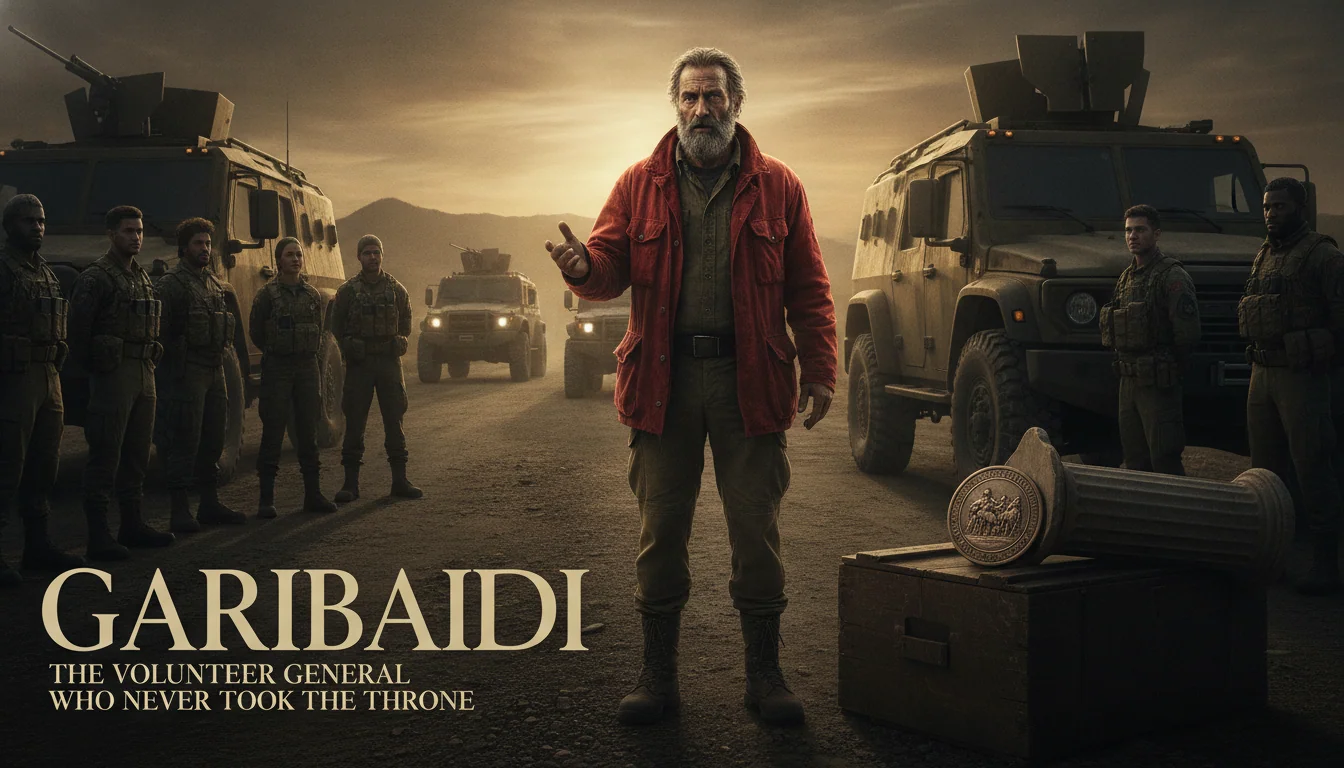
A guerrilla commander who fought in three different countries' civil wars before he turned forty. A man who conquered an entire kingdom with roughly a thousand volunteers, then simply handed it over to a king he had never formally sworn loyalty to and went home to farm on a small island. A global celebrity whose visit to London in 1864 drew larger crowds than any royal procession of the era. Giuseppe Garibaldi did not need modern media to become the most famous revolutionary of his century. Given modern media, he becomes something closer to unmanageable.
The historical figure
Garibaldi was born in Nice in 1807, then part of the Kingdom of Sardinia, to a family of merchant sailors. He went to sea young, became involved in republican conspiracies in the 1830s, was sentenced to death in absentia for his role in a failed uprising in Genoa, and fled to South America, where he spent over a decade fighting in the Ragamuffin War in southern Brazil and later the Uruguayan Civil War. It was in Uruguay that he first commanded the Italian Legion and adopted the red shirt, originally intended for slaughterhouse workers, as his men's uniform for lack of any other available supply.
He returned to Italy in 1848 amid the wave of European revolutions, fought for the short-lived Roman Republic in 1849, and became a European-wide symbol of republican and nationalist resistance even in defeat. His defining moment came in 1860, when he led roughly a thousand volunteers, the Expedition of the Thousand, in an invasion of Sicily against the much larger forces of the Kingdom of the Two Sicilies. Through a combination of tactical audacity, local uprisings his arrival triggered, and sheer momentum, he took the island, crossed to the mainland, and marched on Naples, effectively conquering an entire kingdom with a volunteer force a fraction the size of the army opposing him.
Then came the part that made him a legend rather than merely a successful general. Rather than establishing his own rule over the conquered territory, Garibaldi handed it to King Victor Emmanuel II of Sardinia, enabling the proclamation of the Kingdom of Italy in 1861, and retired to the small, rocky island of Caprera to farm. He would return to public and military life repeatedly over the following two decades, fighting for Italian causes and even offering his services to France during the Franco-Prussian War, but he never sought the personal political power his military reputation would easily have supported.
The modern role
Drop him into 2026 and Garibaldi is not a politician, not exactly, though every populist movement on three continents wants him to be one. He is the volunteer commander every self-determination struggle calls when the official channels have failed: a man with genuine combat credibility, an instantly recognizable personal brand, and, crucially, no permanent political affiliation to any single party or state.
His actual title changes by the year and by the cause. Sometimes he is advising a foreign legion. Sometimes he is the face of a humanitarian military intervention nobody in government wants to be formally associated with but everybody wants results from. He has a documentary crew following him more often than not, not because he hired them, but because every network wants the footage and he has stopped bothering to say no.
The red shirt persists, deliberately. In an era where every movement needs a visual identity to trend, Garibaldi already has the best one in the business: instantly recognizable, impossible to counterfeit convincingly, dating back nearly two centuries. His social media presence, when he bothers with it, is sparse and almost entirely photographs from the field rather than statements, which somehow generates more engagement than any polished campaign account could manage. He does not need to explain himself. The shirt does that.
The skills that translate
Momentum generation. The Expedition of the Thousand worked not because a thousand volunteers could defeat a kingdom's army in open battle, but because Garibaldi's landing triggered local uprisings that made his small force look like the vanguard of an unstoppable popular wave. The modern Garibaldi understands that a viral moment, the right video from the right front line, can generate more strategic effect than the actual size of his force would suggest. He has never needed overwhelming numbers. He has needed the story to spread faster than his enemies can respond to it.
Refusing the crown. Garibaldi's decision to hand the Two Sicilies to Victor Emmanuel rather than rule it himself is the single most important reason his legend survived intact. A conqueror who keeps the throne becomes a tyrant in someone's telling eventually. A conqueror who walks away becomes a myth permanently. The modern Garibaldi has learned this lesson from history itself, and it is why, unlike so many contemporary strongmen who cannot resist consolidating the power their movements hand them, he repeatedly declines the presidencies, the cabinet posts, the permanent commands. He takes the credibility and leaves before the compromises of governing can tarnish it.
Transnational credibility. Garibaldi fought for causes in Brazil, Uruguay, Italy, and nearly for the Union in the American Civil War. He was, in the truest sense, a citizen of revolution rather than of any single nation. The modern equivalent moves between conflicts and causes with a fluency that would be treated as suspicious in almost anyone else, but his personal mythology of selfless service, mostly earned, some of it self-mythologized, gives him a pass that a mercenary or a more ambitious figure would never receive.
The family
He marries more than once, each time to a woman who is, in her own right, formidable. His first wife, Anita, a Brazilian revolutionary in her own right, fought alongside him and died young during his retreat from Rome in 1849, a loss that shapes him permanently and that he refers to, rarely and only when pressed, in interviews decades later. The modern Garibaldi carries something of this same pattern, an early formative partnership with someone as committed to the cause as he is, followed by a life too itinerant for conventional domesticity to easily hold.
His children, when he has time for them, grow up mostly on Caprera, or its modern equivalent, a small isolated property he treats as his actual home in a life otherwise spent everywhere else. They are proud of him and exhausted by him in roughly equal measure, a common condition among the children of people whose primary marriage is to a cause.
Where he lives
Caprera, still, or somewhere very much like it: small, remote, agriculturally self-sufficient, reachable only with effort. It is a deliberate contrast to the life he could have, and the contrast is part of the brand, whether he intends it that way or not. Photographs of the world-famous general mending fences and tending goats on a windswept island generate more genuine public affection than any staged photo opportunity his advisors, if he tolerated advisors, could design.
He keeps a modest apartment in whichever city his current cause requires, but he never fully unpacks. Everyone who has ever hosted him for more than a week has some version of the same story: he is gone again before you expect it, called by a telegram, a phone call, a video message from somewhere the news has not caught up to yet.
What goes wrong
The historical Garibaldi's later career included real disappointments: failed attempts to seize Rome that embarrassed the government he had helped install, wounds sustained in skirmishes against his own country's forces when his ambitions outran official policy, and years of frustration watching the unified Italy he had helped create fall short of the democratic republic he had actually wanted.
The modern version faces the same structural problem in updated form. Every government that benefits from his celebrity eventually needs him to stop before he goes further than official policy can tolerate. He gets used, celebrated, and then quietly, politely, asked to stand down, again and again, by people who owe him more than they will ever formally acknowledge. He accepts this with more grace than most men in his position would manage, mostly because, unlike nearly everyone else who commands that kind of loyalty, he has never actually wanted the throne.
Why it matters
Garibaldi's genius, then and now, was understanding that legitimacy and power do not have to travel together, and that a man willing to walk away from power at its peak earns a kind of trust that no elected official or hereditary ruler can ever fully replicate. In an age of leaders who cannot resist one more term, one more consolidation, one more emergency power, the modern Garibaldi's refusal to keep what he conquers would look almost like a magic trick.
If Garibaldi lived today, he would not run for office. He would not found a party. He would show up, in the red shirt, wherever the cause of the moment needed a face the world already trusted, do what needed doing, and leave before anyone could make him a king.
For another 19th-century figure who built a nation through force and calculation rather than romantic sacrifice, see If Bismarck Lived Today, the statesman on the opposite side of the century's great argument about how unification should actually happen. For the general whose own conquered crown he refused to imitate, see If Napoleon Lived Today.
Quick Answers
Common questions about this topic
Who was Giuseppe Garibaldi?
Giuseppe Garibaldi (1807-1882) was an Italian military leader and nationalist who became the most famous guerrilla commander of the 19th century. He fought in South American civil wars in the 1830s and 1840s before returning to Italy, where he led the famous Expedition of the Thousand in 1860, conquering the Kingdom of the Two Sicilies and handing it to King Victor Emmanuel II, a decisive step toward Italian unification.
Why did Garibaldi's volunteers wear red shirts?
The red shirt originated in South America, where a shipment of shirts intended for slaughterhouse workers in Uruguay was instead issued to Garibaldi's Italian Legion for lack of any other uniform supply. He kept the red shirt as his forces' signature look for the rest of his career, and the Camicie Rosse, the Redshirts, became one of the most recognizable revolutionary uniforms in history.
Did Garibaldi ever hold political power in Italy?
No. Despite conquering the Kingdom of the Two Sicilies with a volunteer force of roughly a thousand men, Garibaldi voluntarily handed the territory over to King Victor Emmanuel II rather than ruling it himself, then retired to the small island of Caprera. He was repeatedly offered political and military positions in the new Kingdom of Italy and repeatedly turned most of them down or served only briefly.
Was Garibaldi famous outside Italy during his lifetime?
Yes, remarkably so. Garibaldi was one of the most internationally famous men alive by the 1860s, celebrated in Britain, the United States, and across Latin America. He was offered a senior command in the Union Army during the American Civil War, which he declined over disagreements about the terms offered, and crowds in London reportedly brought the city to a standstill during his 1864 visit.

Meet Them in Person
Chat with the historical figures behind these modern reimaginings.
Create your free account →No card required. Some figures and features require a paid plan.
Join the HistorIQly Club
Get smarter about the past.
Weekly stories, deep dives, and exclusive content straight to your inbox.