If Cardinal Richelieu Lived Today: The Spymaster Who Runs a Country From Behind the Curtain
If Richelieu lived today, he would be the most dangerous person in any government who never faced an election. The 17th-century spymaster rebuilt into 2026.
Read Wikipedia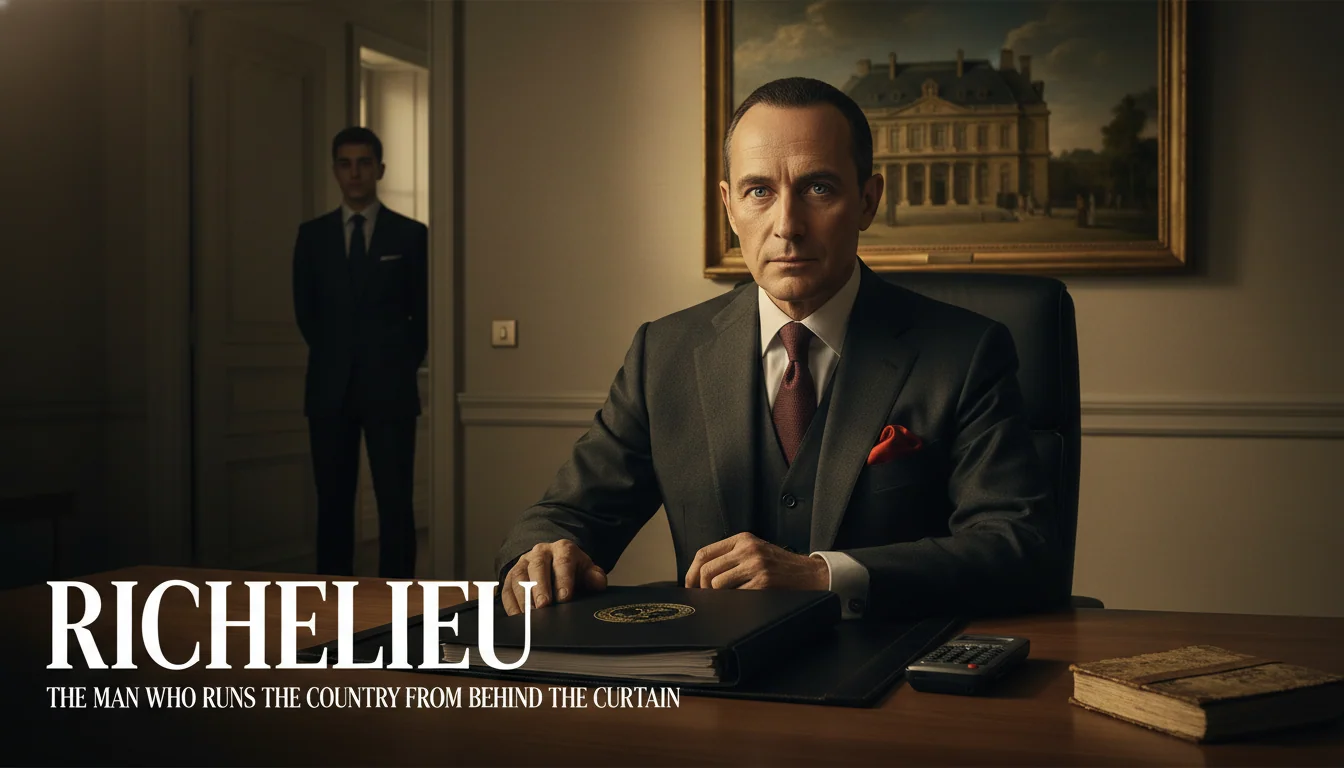
The king was weak and knew it. Louis XIII of France was a melancholy, indecisive man who suffered from poor health, distrusted most of his advisors, and found the actual work of governing a large fractious kingdom genuinely unpleasant. He was thirty-two years old and already exhausted when he made Armand Jean du Plessis his chief minister in April 1624.
What he got was someone who found governing France not just manageable but enjoyable. Richelieu held that position for eighteen years, until his death in 1642. He was never king. He was, in every functional sense, the government.
If Richelieu lived today, the title would change. The mechanism would not.
The historical figure
Richelieu was born in 1585 into a provincial noble family of middling status. His path to power ran through the Church, where he became Bishop of Lucon at the precocious age of twenty-one (with a papal dispensation for his youth) and quickly demonstrated a talent for institutional politics that the diocese was too small to contain. He appeared at the States General of 1614, caught the attention of the queen mother Marie de Medici, and began the long climb through the court's interlocking factions.
By the time he became the king's chief minister, he had survived exile, court intrigue, and the enmity of people who recognized what he was becoming. His position was never entirely secure. Louis XIII was jealous of strong personalities and liked to cultivate potential rivals to Richelieu as a check. The Day of Dupes in 1630, when the queen mother and the king's brother Gaston convinced Louis to dismiss Richelieu and the cardinal survived through a combination of cold calculation and perhaps luck, is the hinge moment of his career. After that day, every serious domestic rival was broken.
What Richelieu built over eighteen years was a state. Before him, French governance was a tangle of competing noble fiefdoms, Huguenot military strongholds guaranteed by treaty, the independent power of great families like the Guise and the Conde, and a royal administration that could not reliably project authority beyond Paris. He demolished every piece of this, not all at once but methodically: he ordered the destruction of noble fortresses not on the frontier, he besieged and took the Huguenot stronghold of La Rochelle in 1628 (a fourteen-month operation), he created the intendants, royal commissioners who bypassed local noble administration and reported directly to the crown, and he built the first professional officer corps of the French army.
He also founded the Academie Francaise in 1635, which is either an act of cultural patronage or an act of linguistic control depending on how you read Richelieu, and the honest answer is that both readings are accurate. He wanted French language standardized and he wanted it done under royal auspices.
His intelligence network was his personal instrument. He maintained a web of informants throughout France, at the courts of foreign powers, inside religious institutions, and within the households of his most prominent enemies. He read their mail. He planted sources in their personal staffs. He was better informed than any other figure in France, which is a form of power that does not require armies once you are sufficiently established.
The modern role
In 2026, the title is something like National Security Advisor with a combined portfolio that also encompasses foreign policy, domestic intelligence, and the permanent civil service in ways that no single title quite covers. He does not seek elected office. Elected office is contingent on constituencies, and Richelieu has never been comfortable with contingency.
The mechanism is familiar: find a capable but uncertain leader who needs someone to translate ambition into results, make yourself indispensable before the leader fully understands what has happened, and then quietly ensure that no alternative capable of replacing you can assemble sufficient credibility to do so. By the time anyone notices the arrangement, the arrangement has been functioning for five years and removing it would mean rebuilding the entire operating system of government from scratch.
He serves under a president or prime minister the way a head of surgery serves under a hospital administrator: with formal deference, complete professional control, and the private understanding that the administrator's reputation depends entirely on what happens in the rooms the administrator never enters. His mode of power has a long lineage: Machiavelli theorized it, and Catherine de Medici practiced it a generation before Richelieu in the same French court.
The skills that translate without modification
State construction. Richelieu had a theory of government that he could articulate and execute. His Testament Politique, written in the 1630s and published posthumously, is a practical manual for centralized governance that reads with uncomfortable clarity about power. In 2026 he writes policy memos that circulate under restricted distribution, that people two cabinet levels above their nominal author follow without quite knowing why they seem so obvious once read.
Intelligence as governance. The surveillance apparatus he built in 17th-century France was limited by the technology of the era. The logic behind it, knowing what everyone with any power over events is actually doing rather than what they tell you, translates without modification. He is an early and enthusiastic proponent of every legal and semi-legal intelligence collection capability available to a senior government official. His private database of compromising information about peers and potential rivals is organized, current, and never used publicly. It is only ever used as a reminder, delivered quietly in a private meeting, that using it publicly remains an option.
The indispensable man. He made Louis XIII feel understood and supported in a way that no one else at court could replicate, partly because he genuinely understood the king and partly because he arranged for the alternatives to be visibly inadequate. The 2026 version manages upward with the same dual strategy: genuine competence that delivers results, combined with a systematic discrediting of anyone who might substitute for him. The discrediting is never crude. It takes the form of assignments given to rivals that are slightly beyond their resources, of problems allowed to develop to a point where the rival's eventual handling of them leaves a visible record of inadequacy.
The church, in 2026
Richelieu was a genuine churchman as well as a politician. He took his theological obligations seriously and his pastoral responsibilities at the bishopric of Lucon less seriously, but the faith itself was not a costume. In 2026 he is a practicing Catholic, probably Opus Dei-adjacent without being formal about it, whose religious practice is private enough to be unassailable and present enough to provide a moral vocabulary that plays well in certain circles. The cardinal's red is replaced by whatever color communicates understated authority in the current sartorial environment. He dresses expensively and without ostentation. The suit is better than anyone else's in the room but you might not notice for the first hour.
The family and the household
Richelieu never married. His personal relationships were managed with the same cool calculation as his political ones. His niece, Marie de Vignerot, was his closest companion and eventual heir, and he elevated her deliberately as an extension of his own authority.
The 2026 Richelieu is unmarried, or married in a way that functions as a managed political relationship rather than an intimate one. He has protégés rather than friends, young officials of exceptional ability whom he advances deliberately and whose careers he shapes toward specific future roles in the architecture he is building. These relationships are genuine, in the sense that he does find talent interesting, but they serve a structural purpose. When one of his protégés eventually moves against him, which one does, it will be recognized as professionally predictable and personally disappointing in equal measure.
What goes wrong
Richelieu died in 1642 at fifty-seven, having worked himself into physical ruin keeping the state he built functional. The 2026 version drives himself the same way, because the state is never finished and the coalition holding it together is always a month away from fracturing if he stops attending to it.
The political enemies he neutralizes rather than destroys accumulate. The king he serves will eventually acquire a favorite who is not useful to Richelieu's architecture and cannot be dislodged without a confrontation that reveals the limits of Richelieu's power. The Day of Dupes arrives in some form for every person who operates the way he operates, the moment when the patron decides the patron can function without the indispensable man.
He survives that moment, probably, because he has planned for it longer than his enemies have. What he does not plan for is the health. The cardiovascular damage of sustained relentless work in high-cortisol environments is not something intelligence networks can fully offset.
Why it matters
Richelieu is the founding practitioner of a mode of power that has never gone away: the unelected permanent official who does the actual governing while the elected figure provides the face. His innovations, the professional civil service, the centralized intelligence function, the systematic marginalization of competing power centers, are the infrastructure of every modern state. He did not invent these ideas but he executed them at scale for the first time in France and did it well enough that his successors, including his own protégé Cardinal Mazarin, could continue the work after his death.
The troubling thing about a 2026 Richelieu is not that he would be unusually corrupt or cruel. He was not especially corrupt and his cruelty was instrumental rather than enthusiastic. The troubling thing is that he would be extraordinarily effective, and effectiveness without democratic accountability is a particular kind of danger that liberal institutions are not well designed to resist.
He would understand that completely, and find it a professional advantage rather than a moral problem.
Quick Answers
Common questions about this topic
Who was Cardinal Richelieu?
Armand Jean du Plessis, Cardinal-Duke of Richelieu (1585-1642), was the chief minister of France under King Louis XIII from 1624 until his death. He consolidated royal authority by suppressing the Huguenot political-military structure, dismantling noble independence, building a professional army and a centralized administration, and founding the Academie Francaise. He is widely considered the architect of the modern French state.
What made Richelieu unusual as a power broker?
He combined three roles that are normally kept separate: he was a cardinal of the Catholic Church, a senior royal minister running day-to-day government, and the head of France's intelligence apparatus. He simultaneously managed the King's emotional dependence on him, neutralized domestic enemies through a system of informants, and conducted foreign policy that allied Catholic France with Protestant powers against Catholic ones when it served French interests.
Would Richelieu be religious in 2026?
Almost certainly. The cardinal's robe was both a genuine vocation and a tool. He was ordained, took his faith seriously in a baroque theological tradition, and found the Church a useful institutional base that stood partly outside the factional politics he navigated. A 2026 Richelieu would likely maintain a serious but understated religious practice, probably Catholic, and use the moral authority it conferred without displaying it clumsily.
What contemporary figure does Richelieu most resemble?
The closest modern analogy is someone like Henry Kissinger: an advisor who outlasted multiple administrations by making himself the indispensable bridge between the elected politician and the actual levers of power, who operated simultaneously as diplomat, intelligence chief, and policy architect, and who was widely feared but rarely publicly opposed because the cost of removing him exceeded the cost of tolerating him.

Meet Them in Person
Chat with the historical figures behind these modern reimaginings.
Create your free account →No card required. Talk to anyone in history with 8 free credits a day. Some features require a paid plan.
Join the HistorIQly Club
Get smarter about the past.
Weekly stories, deep dives, and exclusive content straight to your inbox.