If Otto von Bismarck Lived Today: The Iron Chancellor in the Age of Everything He Hated
Bismarck unified Germany, invented the welfare state to undermine socialists, and held Europe together for twenty years. What would the Iron Chancellor do in 2026?
Read Wikipedia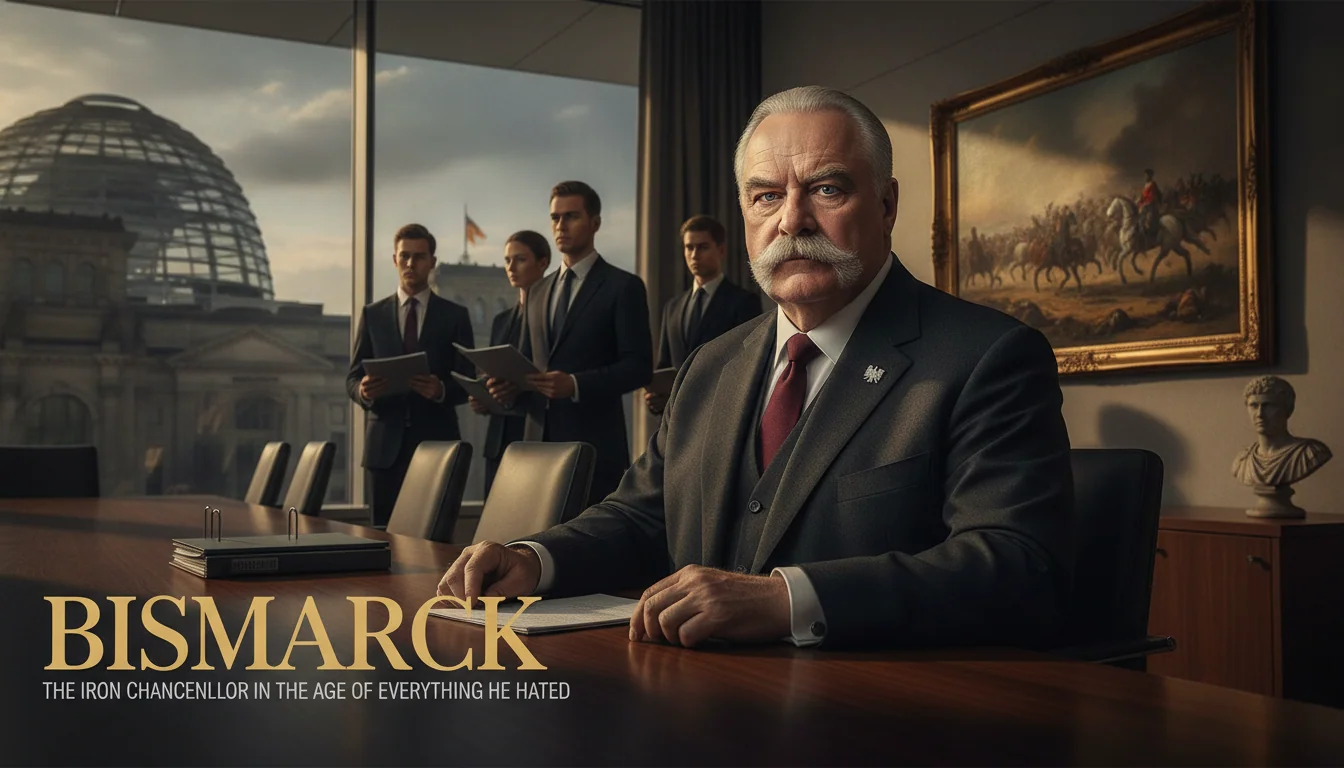
Otto von Bismarck spent forty years in politics and left behind a Germany, a welfare state, and a European balance of power so carefully engineered that it held together for roughly two decades after he left - and then, when the people who dismantled his system had finished with it, produced two world wars. The architecture worked. The problem was that it required Bismarck to operate it.
If Bismarck lived today, in 2026, the first question is not what he would do. It is what he would make of a world where ideology has colonized everything, cable news is continuous, and national interest has to be explained to the public before it can be pursued. He would find this irritating. He would adapt anyway.
The historical figure
Bismarck was born in 1815 to a Prussian Junker family - landed gentry, conservative, suspicious of liberal romanticism - and spent his early political career as the person in the Prussian parliament most reliably willing to say what no one else was willing to say. He was not subtle about his views. In 1862, appointed Minister-President of Prussia under King Wilhelm I, he delivered his most famous line within weeks: the great questions of the time would be settled not by speeches and majority decisions, but by blood and iron.
He meant it literally. The three wars he engineered - against Denmark in 1864, Austria in 1866, and France in 1870-71 - were not accidents of great-power rivalry. They were calculated operations aimed at specific outcomes. The Austro-Prussian War of 1866, the Seven Weeks' War that shocked Europe with its speed, ended with Prussia dominant in Germany and Austria excluded from German affairs. The terms Bismarck imposed on Austria were deliberately lenient: he wanted a neutralized neighbor, not an embittered enemy. When his generals wanted harsher terms, he overruled them. Future coalitions were already on his mind.
The Franco-Prussian War of 1870-71 produced the German Empire, proclaimed at Versailles with the German princes standing around the newly crowned Kaiser Wilhelm I while Bismarck, in his white cavalry uniform, stood to the side looking like a man who had just completed a complex piece of contractor work and was waiting to be paid. He had created Germany. He then spent nearly twenty years trying to keep the rest of Europe from destroying it.
The alliance system he built - the Dual Alliance with Austria-Hungary, the Triple Alliance adding Italy, and the Reinsurance Treaty with Russia that kept Berlin connected to both St. Petersburg and Vienna simultaneously - was a diplomatic structure of remarkable ingenuity, dependent on Bismarck being present to manage its contradictions. He kept France isolated. He kept Russia engaged. He kept Austria useful without letting it become dangerous. He did this through a combination of personal diplomacy, controlled press management, and a willingness to create crises he could then appear to resolve.
His welfare state is the other achievement that modernity tends to misread. He was not a progressive. He despised the Social Democrats and spent years under the Anti-Socialist Laws trying to suppress them through legal prohibition. When that failed, he tried the other option: delivery. The health insurance law of 1883, the accident insurance of 1884, the old-age pensions of 1889 were all explicitly designed to make socialist promises redundant by enacting them first, in a form the state controlled. The welfare state was political judo, and it worked.
The modern role
Drop Bismarck into 2026 and he does not run for office. Elections are a tool for other people. What he runs is the office behind the office.
The title on his business card, in the version of 2026 where he is a senior German official, reads: Federal Minister for Special Affairs, Chancellery - a role that exists in most chancelleries under various names, whose occupant has no fixed portfolio, unlimited access to the Chancellor's schedule, and the actual authority to make things happen. In the German system he would be most comfortable in, this maps to something like a super-ministerial chief of strategic affairs: the person who calls Berlin's ambassador in Washington at 11pm, who chairs the interagency meeting that nobody is supposed to know is happening, and who turns up at EU Council margins for thirty-minute private conversations that determine what the twenty-four public hours of meetings will formally ratify.
He would be in his early sixties in this imagining, which is the right age for Bismarck. The younger version - the blood-and-iron speechmaker of 1862 - is a different character: brilliant, volatile, operating at too high an amplitude. The older Bismarck of the 1870s and 1880s, the one who had already won and was now managing the board, is the more formidable one.
The skills that translate
Structural thinking. Bismarck's alliances were not just bilateral agreements - they were interlocking triangles designed so that the breaking of any one link would expose the party responsible to pressure from the others. He thought in systems. The modern Bismarck approaches EU negotiations, NATO burden-sharing arguments, and Indo-Pacific alliance architecture the same way: not as positions to win, but as structures to engineer so the equilibrium serves German interests whether anyone is paying attention or not.
Press management. Bismarck ran the Prussian and German press with a sophistication that editors of the era found difficult to distinguish from outright control. He leaked selectively, inspired articles through intermediaries, and planted stories timed to diplomatic operations. The modern equivalent involves less newspaper and considerably more encrypted messaging, but the underlying logic - that the story being told about events is as important as the events - is unchanged. He would be extremely good at it.
Welfare as weapon. His move in the 1880s was to steal the left's program before the left could execute it. The modern Bismarck scans the political landscape for the policy positions held by threatening movements and asks which of them can be delivered first, by the government, in a form that neutralizes the movement while binding its constituents to the state. This is uncomfortable to discuss in ideological terms. Bismarck was comfortable with uncomfortable things.
Controlling crises he created. The Ems Dispatch - the 1870 telegram he edited to make a routine Prussian diplomatic communication read like a French insult, thus providing the casus belli for the Franco-Prussian War - is the clearest single example of how Bismarck operated. He did not find crises. He found potential crises, shaped them to his requirements, and then appeared to resolve them. The modern equivalent is a European political operator who can manage the distance between how a situation is presented publicly and how it is actually being handled in private.
What he cannot stand
The media environment is the thing that would genuinely disturb him. Not because he was unwilling to manage the press - managing the press was one of his core competencies - but because the 24-hour cycle, the social media consensus-formation, and the requirement that senior officials explain their reasoning in public undermine the operational secrecy on which his entire method depended.
Bismarck worked best when only he understood what he was doing. The Reinsurance Treaty with Russia in 1887 was kept secret from his Austrian allies, his own cabinet, and much of the German diplomatic corps because he could not afford the political reaction if it became public. That kind of operation is structurally impossible in 2026's information environment.
He adapts. He learns to use public communication as misdirection - saying things openly that are designed to obscure the actual operation - but he finds it crude and exhausting compared to the quiet architecture he built in the 1870s.
The family
He marries once, early, and it lasts. Johanna von Puttkamer, in the historical record, was a devout and deeply loyal woman who accompanied Bismarck through fifty years of political upheaval and whom he credited in his memoirs with being essential to whatever sanity he retained. The modern Bismarck's marriage follows the same contour: a wife who is not publicly visible, who is enormously capable in ways that never get official recognition, and who is the single person whose judgment he actually trusts.
He is not tender with his children. He expects them to be useful. One of them will go into law or diplomacy and turn out unexpectedly brilliant; one will disappoint him in ways that make him grimly unsurprised; a third he will rarely mention. This is consistent with the historical record.
He has a dog. He has always had dogs. The Bismarck archive at Friedrichsruh contains more correspondence about his dogs than about most of the people he managed.
What goes wrong
The historical Bismarck was dismissed by a 29-year-old emperor who found his dominance intolerable and whose subsequent errors proved that the dominance had been justified. The modern version faces the equivalent: a new Chancellor, twenty years younger, who has watched from a distance and decided that Bismarck's method of operation is incompatible with democratic accountability.
The dismissal, when it comes, is technically a resignation. It is accepted with visible regret and decorated with a formal state honor. Within a year, the structures Bismarck built are being quietly dismantled by successors who understand the architecture less than they think they do.
His memoirs - Gedanken und Erinnerungen was the historical title, Thoughts and Memories - become, in the modern version, a three-volume memoir serialized in a serious newspaper and then published as a book that sells extremely well and makes every current official deeply uncomfortable. He describes, in cool analytical prose, what mistakes were made after he left and why. He is right about most of them. This does not make anyone more grateful.
He dies in his mid-eighties, at a property in rural Schleswig-Holstein, surrounded by his dogs, following the news with a precision that suggests he never stopped running the calculations. The obituaries call him the greatest German statesman of the modern era and the most alarming. Both are accurate.
For related profiles in how history's most calculating minds might operate today, see If Machiavelli Lived Today and If Napoleon Lived Today.
Quick Answers
Common questions about this topic
Who was Otto von Bismarck?
Otto von Bismarck (1815-1898) was the Prussian statesman who unified the German states into the German Empire in 1871 through three precisely calibrated wars against Denmark, Austria, and France. As Germany's first Chancellor, he dominated European politics for nearly two decades through a combination of strategic alliances, controlled crises, and diplomatic skill that kept the great powers from fighting each other while Germany consolidated its position.
What was Bismarck's most unexpected achievement?
Creating the world's first welfare state. In the 1880s, Bismarck introduced compulsory health insurance (1883), accident insurance (1884), and old-age and disability pensions (1889) - not from sympathy for workers, but to remove the appeal of socialist parties by delivering what they were promising. 'If there are people who argue that this is socialism,' he said, 'I do not share this fear.' It was the most effective conservative move of the 19th century.
Why was Bismarck dismissed?
Kaiser Wilhelm II dismissed him on March 18, 1890, a few months after becoming emperor. Wilhelm wanted personal control of German foreign policy and found Bismarck's insistence on managing every detail of alliance diplomacy intolerable. The famous Punch cartoon showed the pilot being dropped from a ship he had steered for decades. Within a few years, Wilhelm had discarded the Reinsurance Treaty with Russia that Bismarck considered essential to German security - the precise error Bismarck had warned against.
What is Realpolitik and did Bismarck invent it?
Realpolitik - politics based on practical power considerations rather than ideology or moral principles - was coined as a term by the writer Ludwig von Rochau in 1853, but Bismarck became its most famous practitioner. His foreign policy operated entirely on the question of what Germany's interest required, not what ideology demanded. He allied with Austria when useful, humiliated Austria when necessary, supported conservative monarchies in principle and destabilized them in practice whenever it served Berlin.

Meet Them in Person
Chat with the historical figures behind these modern reimaginings.
Create your free account →No card required. Talk to anyone in history with 8 free credits a day. Some features require a paid plan.
Join the HistorIQly Club
Get smarter about the past.
Weekly stories, deep dives, and exclusive content straight to your inbox.