If Henry VIII Lived Today: The Brand That Burns Everything It Touches
If Henry VIII lived today, he'd run a media empire - charming at launch, catastrophic by middle age, and leaving a trail of dissolved partnerships and institutions.
Read Wikipedia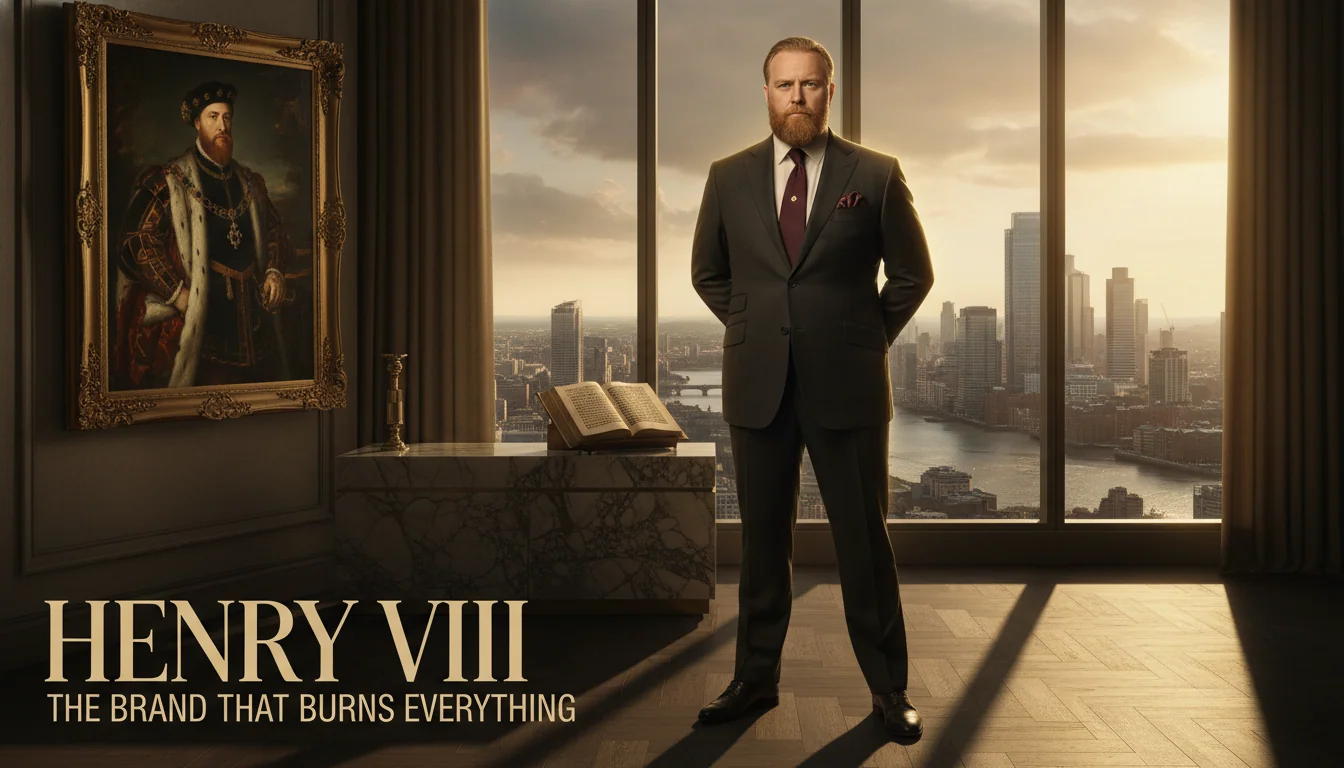
The year is 1509, and Henry VIII has just become King of England at the age of seventeen. The dispatches that reach European courts describe something extraordinary: a tall, athletic, copper-haired young man with genuine intellectual gifts, fluent in Latin, composing music of some quality, pious without being narrow, generous without being foolish. Erasmus, not easily impressed, calls him a universal genius. Thomas More writes breathlessly of the new golden age.
Thirty-eight years later, Henry is dead at 55, obese past movement, his leg rotting from a wound that will not heal, having executed two of his six wives, sent his two most trusted ministers to the block, dissolved a thousand years of English monastic civilization to fund a foreign policy vanity project, and spent his final years writing furious letters to subordinates about their insufficient loyalty.
The arc from golden boy to institution-destroyer is one of the most complete in the historical record. Drop it into 2026 and it lands with very little modification.
The historical figure
The second son of Henry VII, Henry was not supposed to be king. His older brother Arthur was the heir, trained from birth for the throne, and Henry was prepared for an ecclesiastical career - which explains both his genuine theological education and the particular ferocity with which he later turned that education against the church that had trained him.
Arthur died in 1502 from a sweating sickness contracted shortly after his marriage to Catherine of Aragon, the Spanish princess. Henry became heir at ten, king at seventeen. He inherited a stable kingdom, a full treasury carefully accumulated by his famously cautious father, and the goodwill of everyone who had found Henry VII's court too pinched and serious.
He promptly married Catherine of Aragon, whom he genuinely loved at this stage, and set about being the kind of king England had been waiting for: jousting, hunting, debating theology with scholars, writing an anti-Luther pamphlet serious enough to earn him the papal title Defender of the Faith - a title England's monarchs still technically hold.
The slide started in the mid-1520s. Catherine had not produced a male heir who survived infancy. Henry became convinced the marriage was cursed, found a scriptural argument in Leviticus to support the conviction, and asked Pope Clement VII for an annulment. The pope, effectively a hostage of Catherine's nephew Charles V after the 1527 sack of Rome, refused.
What followed was not negotiated or gradual. Henry had Parliament remake the constitutional relationship between England and Rome, had his new Archbishop of Canterbury grant the annulment the pope had refused, executed Sir Thomas More and Bishop John Fisher for refusing to swear to the new arrangement, and then executed Anne Boleyn on charges of adultery and treason that most historians consider fabricated.
The dissolution of the monasteries (1536-1541) redistributed roughly a quarter of England's land wealth from religious institutions to the Crown and then to the nobility who cooperated with the project. It was the largest transfer of property in English history since the Norman Conquest. The ostensible justification was corruption in the monasteries; the actual driver was the need for funds and the value of binding the new Protestant nobility to the changes through shared material interest.
Henry did not become Protestant in any doctrinally meaningful sense. He believed in transubstantiation until his death, had Protestants burned for heresy alongside Catholics executed for loyalty to Rome, and continued to pray in ways that would have been recognizable to the pope he had repudiated. He simply removed the institutional structure that had constrained him personally.
The modern role
Henry VIII in 2026 is the chairman and majority shareholder of HV Media Group, a privately held conglomerate that controls a cluster of television networks, a streaming service struggling against the major platforms, two tabloid newspaper brands, a sports rights portfolio, and a hotel chain whose properties are decorated in what the design brief called "palatial contemporary" and what guests call a lot of gold.
The company's headquarters is a glass tower in Canary Wharf with his name on the facade in letters large enough to read from the Thames. He considered having them larger and was talked out of it by his then-communications director, who was fired the following week for an unrelated reason.
His net worth is considerable and disputed. He does not use accountants who tell him things he does not want to hear, which creates a specific category of financial exposure that his general counsel has been managing, with varying success, for a decade.
The board is technically independent. This is technically accurate in the way that many technically accurate statements are.
The marriages
There have been five, which is already one ahead of the median and trailing the historical record only because the fifth wife is still alive at time of writing.
Marriage one was long, serious, and ended when the children it produced failed to meet Henry's privately held specifications. The divorce was expensive, publicly acrimonious, and accompanied by a sustained press campaign that retrospectively recast the marriage as an institutional rather than personal failure. His lawyers are excellent.
Marriage two received enormous media attention, accelerated the first divorce while still in progress, and ended approximately twenty-two months after the wedding in a way that the settlement agreement prevents either party from describing publicly. The narrative that emerged in the press reflected sources close to Henry.
Marriages three, four, and five follow a pattern that is recognizable to anyone who has followed the company's personnel decisions: an initial period of enthusiasm, a gradual shift in which the subject of the attention realizes the attention is a management technique rather than an emotion, and then an exit process that arrives much faster than anticipated.
The current wife is managing this situation with more awareness than her predecessors, which Henry finds simultaneously attractive and destabilizing.
What he destroys
The more useful frame for understanding Henry VIII in 2026 is not the marriages but the institutions.
Henry VII left his son a solvent kingdom and a functioning administrative apparatus. Within fifteen years of Henry VIII's reign, the apparatus had been rebuilt around the personal preferences of the man at its center, at the cost of nearly everyone who had built it.
HV Media Group was inherited from a media company founded by Henry's father, a careful and methodical operator who built it through cautious acquisition and long relationships with regulatory bodies. Henry doubled the company's size, restructured it three times, and now employs lawyers in four jurisdictions dedicated exclusively to managing the regulatory exposure his decisions have created.
The list of people who built significant parts of his operation and were then destroyed by it is long. Two separate chief financial officers have faced regulatory inquiries after departing. A long-serving head of strategy who was publicly described as indispensable resigned shortly after appearing in a profile that used the word "architect" in connection with the company's success. The head of legal was removed after giving Henry advice he considered insufficiently supportive of the position he had already taken.
What Henry VIII discovered in the 1530s and what his 2026 iteration understands intuitively is that the value of an institution lies partly in whether its participants believe the institution will still exist next year. Once you establish that you are willing to dissolve the monasteries, the clergy who remain cannot plan for the long term. Once you establish that two wives can be executed on fabricated charges, the remaining wives cannot assume good faith. The uncertainty is a management tool. It is not a conscious strategy; it is a character trait that functions strategically.
The contemporary peer
The contemporary peer question requires honesty. There are multiple living figures who share elements of the Henry VIII pattern - the golden-boy early promise, the institutional destruction for personal convenience, the outsized physical presence in early life and its later costs, the marriages as acts of acquisition rather than partnership, the conviction that loyalty to the man supersedes loyalty to anything the man is supposed to represent.
None of them are an exact match. Henry VIII is more interesting than any single contemporary equivalent because he combined genuine intellectual gifts with total moral flexibility, and because the specific institution he broke was one he had spent a decade defending in print. He was not a hypocrite who had never believed; he was a believer who discovered that belief was inconvenient and reconfigured his theology accordingly.
The 2026 version of this is not specific to media, or to politics, or to finance. The character exists at the intersection of capability and impunity - the combination that produces the most complete and least recoverable institutional damage.
The question of legacy
Henry VIII cared enormously about legacy and understood it as a problem to be managed rather than earned. He commissioned paintings, controlled his image with consistent attention, and had portraits produced that maintained his early athletic appearance long after the physical reality had changed substantially.
The HV Media Group chairman controls a considerable press apparatus. The coverage of his own career in outlets he owns is distinctive. Independent coverage he has attempted to manage through several legal strategies with mixed results.
The Tudor court portrait that hangs in the National Portrait Gallery shows a man occupying space with total confidence, his feet planted wide, his bulk presented as authority rather than excess. It is the most famous piece of personal branding in English history.
His 2026 equivalent has a portrait too, commissioned from a photographer he personally selected, displayed in the lobby of the Canary Wharf headquarters in dimensions that are larger than necessary and in a location that ensures everyone who enters the building sees it first.
The instinct is identical. The medium has changed. The size of the letters has not.
For more historical figures reimagined in 2026, see If Catherine the Great Lived Today and The Other Boleyn Girl vs. History.
Quick Answers
Common questions about this topic
Who was Henry VIII?
Henry VIII (1491-1547) was King of England from 1509 until his death. He is best known for his six marriages, two of which ended in the executions of his wives Anne Boleyn and Catherine Howard, and for breaking with the Roman Catholic Church to create the Church of England, an act driven primarily by his desire for an annulment that Pope Clement VII refused to grant. He also dissolved the monasteries (1536-1541), transferring enormous Church wealth to the Crown and to loyal nobles.
Why did Henry VIII break with Rome?
The immediate cause was his desire to annul his first marriage to Catherine of Aragon, who had not produced a male heir. Pope Clement VII refused to grant the annulment, partly under pressure from Catherine's nephew, Holy Roman Emperor Charles V, who controlled much of Italy. Rather than accept this refusal, Henry had Parliament pass the Act of Supremacy in 1534, declaring him the Supreme Head of the Church of England, effectively removing papal authority over English religious affairs.
How many of Henry VIII's wives survived him?
Two: Catherine of Aragon (his first wife, divorced) and Catherine Parr (his sixth wife, who outlived him). Two wives were executed: Anne Boleyn in 1536 and Catherine Howard in 1542. Jane Seymour died in 1537 shortly after giving birth to the future Edward VI. Anne of Cleves was divorced after six months and lived comfortably on a generous settlement.
What was Henry VIII like physically?
At his accession in 1509 Henry was considered one of the most handsome princes in Europe - athletic, around 6 feet 2 inches tall, fluent in Latin and French, an accomplished musician, and genuinely knowledgeable in theology. By his final decade he had become enormously obese, his waist measurement recorded at around 54 inches in later years. A leg ulcer from a jousting accident troubled him chronically. The physical transformation mirrored a psychological one: the confident Renaissance prince became increasingly paranoid, vindictive, and arbitrary.

Meet Them in Person
Chat with the historical figures behind these modern reimaginings.
Create your free account →No card required. Talk to anyone in history with 8 free credits a day. Some features require a paid plan.
Join the HistorIQly Club
Get smarter about the past.
Weekly stories, deep dives, and exclusive content straight to your inbox.