If Nostradamus Lived Today: The Prophet Who'd Own Every Algorithm
In the Nostradamus modern day scenario, the prophet runs a multi-platform content empire built on deliberate vagueness, where every new disaster matches a quatrain.
Read Wikipedia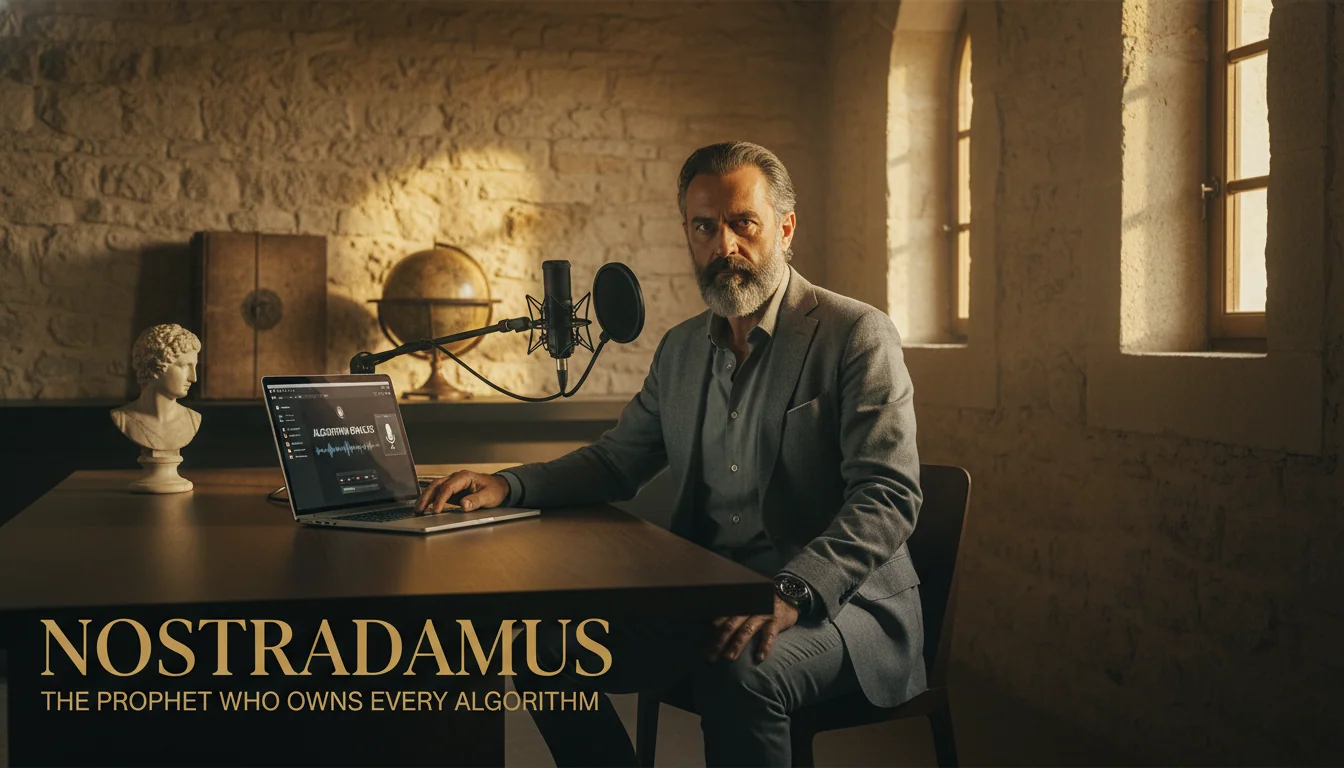
Michel de Nostredame spent the better part of his life doing useful work. He trained as a physician and apothecary at Montpellier, worked plague outbreaks in Provence with an approach so unconventional it was largely effective - clean water, fresh air, stay away from the standard treatment of bloodletting - and established a respectable medical practice in Salon-de-Provence. By his forties he was a successful physician with a wealthy second wife and a growing family.
Then he ruined all that by writing prophecies, and the world has not let him stop since.
In 1555, Nostradamus published the first installment of Les Propheties, a collection of four-line verses written in a deliberately opaque mixture of Old French, Latin, Greek, and invented terms. He claimed they foretold events centuries into the future. He lived another eleven years, was appointed court physician by Catherine de Medici, and died in 1566, leaving behind 942 quatrains that have since been applied, after the fact, to the French Revolution, Napoleon, Hitler, the September 11 attacks, the COVID-19 pandemic, and approximately every major earthquake since 1600.
Drop him into 2026 and the question is not whether he would survive the media landscape. The question is how quickly he would own it.
The historical figure
Nostradamus was genuinely brilliant in his medical practice, which makes the prophecy turn more interesting, not less. A man capable of grasping the principles of sanitation in the 1530s, when the official position was that miasma caused disease and the standard cure was to drain the patient's blood, was not a credulous mystic. He was an empiricist who understood evidence.
The prophecies, then, were not the product of a confused mind. They were a calculated act. Nostradamus understood his audience: a European aristocracy consumed by anxiety about the future, Catholic in name but deeply attracted to judicial astrology, numerology, and apocalyptic calculation. He wrote verses underdetermined enough to be matched to almost anything, placed them within a prophetic tradition that the Church found questionable but that the court found irresistible, and dedicated them to Catherine de Medici, who became his most powerful patron.
It was not science. It was product design.
The modern role
In 2026, Nostradamus runs Prophetie - a multi-platform content operation with a YouTube main channel, a Substack with 600,000 paying subscribers, a TikTok account running short-form cryptic verse interpretation with AI-assisted graphics, and a podcast called The Centuries, named after his original collected works, released every Tuesday.
He does not claim to predict the future. That would be falsifiable, and falsifiable is dangerous. He offers interpretation - a practice he describes in the podcast's opening as "pattern recognition in deep time, offered for your own discernment." This is, nearly word for word, what he wrote in the preface to Les Propheties in 1555, adjusted for a secular audience.
The content cycle runs like this: something happens. A market crash, a political upheaval, an unusual weather event, a papal resignation. Within hours, the Prophetie team - there are three researchers, a graphic designer, and a social media manager - publishes a quatrain alongside an analysis arguing that he wrote about this. It trends. It is shared by people who believe it and debunked by people who do not, and both groups drive the algorithm. The debunks are particularly valuable because they generate engagement without requiring Nostradamus to be correct.
He has never once identified something before it happened, in advance and in specific terms. His lawyers are prepared with a response to anyone who points this out, which is that prophecy is interpretive rather than deterministic, and that demanding journalistic precision from prophetic verse demonstrates a category error. This response is five centuries old and still works.
The skills that carry over
Two skills from the 16th century translate with almost no modification.
Deliberate vagueness as a product feature. The quatrains were not vague because Nostradamus could not write precisely. He was a physician who composed clear Latin medical notes and readable French correspondence. The prophecies were vague by design. The same text could apply to an earthquake in Southeast Asia or a coup in a Gulf state, which meant the text was always applicable. The 2026 Nostradamus writes posts in the same register: "When the great sky-voice falls silent, the markets of three nations shake." This can mean a satellite outage. It can mean an election result. It can mean a volcanic eruption. It means whatever the next significant event is, and the next significant event is always about to happen.
Patron management. The 16th-century Nostradamus worked the Catherine de Medici relationship with impressive skill - close enough to be useful, far enough away to avoid blame when his prophecies failed to prevent her husband's death in a jousting accident (the accident happened; the prophecy was matched to it afterward). The modern Nostradamus manages his relationship with alternative-media figures, conspiracy-adjacent podcasters, and the occasional politically prominent figure who privately wants a word - the same way. He is useful to them without being accountable to them, which is the only sustainable position.
The household
He is married. The historical Nostradamus married Anne Ponsarde in 1547, a widow with a respectable dowry, after his first wife and two children died during a plague outbreak. He was devoted to her within the conventions of the time.
The 2026 Nostradamus: married to a therapist who privately believes his work is sophisticated theater, which is also what he believes about it on his better days. They live in the Luberon in Provence, which is both where he was historically based and exactly where a successful French content creator would choose to operate in order to project authenticity. There are two children, one studying astrophysics - a form of prediction with better methodology, which Nostradamus regards with sincere respect - and one managing the merchandise operation.
The Luberon house is filmed frequently for the podcast. It has a study with the right books visible on the shelves, an appropriately atmospheric garden, and views of the dry hills that appear in many of the video thumbnails. The aesthetic communicates: this man lives outside ordinary time. The cellar is excellent.
What goes wrong
The skeptics are loud and well-organized. There is a Wikipedia article titled "Nostradamus skepticism" that is exhaustively sourced and updated within hours of any public claim he makes. Science communicators do episode-length debunks. Academic historians decline to engage, which he prefers - engagement would dignify the argument and force him to defend positions he holds with deliberate looseness.
The real crisis comes not from the skeptics but from the believers who push too far. One of his large-audience followers reinterprets a quatrain as predicting a specific attack on a specific city on a specific date. The quatrain contains no such specificity; the follower built it from implication. The date passes without incident. Nostradamus must spend two weeks clarifying that his work does not operate on that level of precision, which is the most honest thing he has said publicly in years, and he says it with the weary patience of a man who has had this conversation before, which he has - in the 16th century, with someone who misread his verses about the king's eye and a golden cage.
The contemporary peer he most resembles
There is no single modern figure who maps cleanly onto Nostradamus, which is appropriate. He was unique in his era and would be unique in this one. The closest functional parallel is somewhere between a prominent self-help author whose work rewards rereading precisely because it is underspecified and a geopolitical strategist who makes predictions in terms general enough that the record always looks better than it was.
Both types are very successful. Both produce work that is difficult to falsify and that generates significant audience attachment. Both have critics who note that unfalsifiable prediction is not prediction at all, and audiences who find that observation beside the point.
Nostradamus would recognize them both as operating in his tradition, and he would privately consider himself better at it than either of them. He would not be wrong.
Why it matters
The reason Nostradamus remains searched, shared, and argued about after five centuries is not that he was a fraud - or not only that. The demand for prophetic pattern-making is genuine, persistent, and not obviously irrational given the uncertainty of historical experience. Individuals and civilizations have always constructed frameworks for what is coming next, from oracles to astrology to macroeconomic modeling.
What Nostradamus understood, in the 1550s and what he would understand just as clearly in 2026, is that the demand for interpretive guidance is essentially unlimited, and the supply of deliberately ambiguous verses that enable it is entirely within his control. He did not invent the need. He figured out how to be the one who met it, and five centuries of readers have found the arrangement useful enough to sustain.
The Prophetie Substack will not close when he dies. He has already built a mythology designed to outlast its author. He knows this, and it is the one thing about the entire enterprise that gives him genuine satisfaction - not the prophecies, not the platform metrics, but the simple fact that he has arranged for his work to be misread productively long after he is gone.
He has been doing this since 1555. He is very good at it.
For another historical figure who would thrive on ambiguity and pattern-making in 2026, see If Rasputin Lived Today. For the scientist who operated in Nostradamus's exact era with a very different methodology, see If Galileo Lived Today.
Quick Answers
Common questions about this topic
Who was Nostradamus historically?
Michel de Nostredame (1503-1566) was a French physician, apothecary, and seer who published Les Propheties in 1555, a collection of 942 cryptic quatrains he claimed foretold future events. He served as court physician to Catherine de Medici and Charles IX of France, and treated plague outbreaks in southern France with unconventional approaches that emphasized fresh air and hygiene over standard bloodletting.
Have any of Nostradamus's predictions come true?
No prediction of Nostradamus has been verified in advance of an event. His quatrains are written in a deliberately vague combination of Old French, Latin, and invented terminology, making them susceptible to post-hoc interpretation against almost any historical event. Scholars note that his 'predictions' are only matched to events after those events have occurred - a practice called retrodiction, not prophecy.
Why is Nostradamus still famous after 500 years?
His staying power comes from ambiguity. Vague predictions that can be reinterpreted for each new disaster or political crisis keep his name in circulation permanently. Each major world event generates a fresh wave of Nostradamus content. He wrote enough quatrains (942) that pattern-matchers can always find something that sounds relevant, and the human desire for prophetic guidance does the rest.
Who would Nostradamus most resemble in 2026?
The closest modern parallel is a combination of a self-help guru, a geopolitical pundit, and a platform-native content creator - someone whose business model depends on maintaining perpetual relevance through deliberate vagueness and audience participation in interpretation. He would recognize the format instinctively. The distribution platform changed; the product is identical.

Meet Them in Person
Chat with the historical figures behind these modern reimaginings.
Create your free account →No card required. Talk to anyone in history with 8 free credits a day. Some features require a paid plan.
Join the HistorIQly Club
Get smarter about the past.
Weekly stories, deep dives, and exclusive content straight to your inbox.