If Lorenzo de Medici Lived Today: The Arts CEO Who Rules Without a Title
If Lorenzo de Medici lived today, he'd be the private equity founder who funds museums, chairs think tanks, and destroys his enemies from Florence.
Read Wikipedia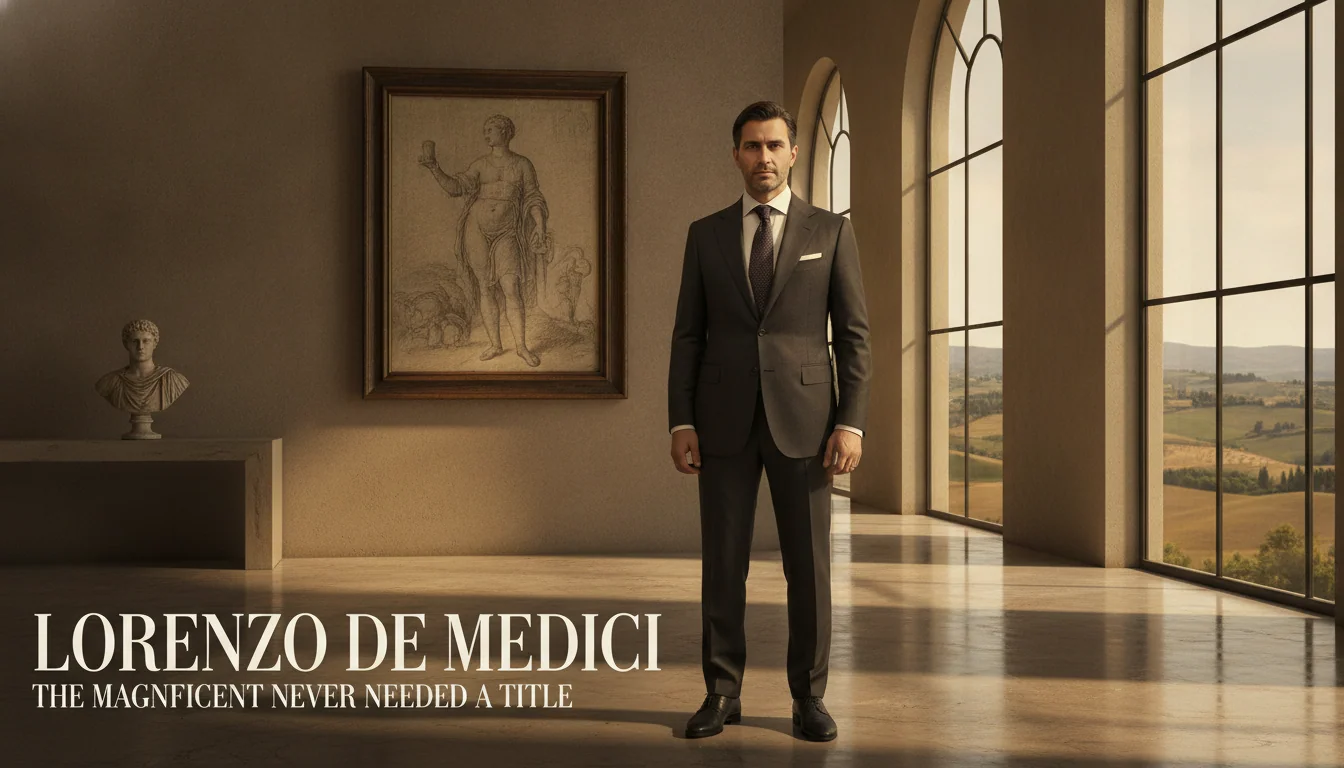
The word "patron" has been diluted almost to uselessness. In 2026 it means someone who bought a naming right for a concert hall lobby. In 1470 it meant the man who decided whether your city survived the next decade - who spoke for you to the pope, who controlled your access to capital, who had you executed if you crossed him at the wrong moment, and who also, incidentally, invited the most talented sculptor in the world to live in his house.
Lorenzo de Medici was not a king. He held no hereditary title in Florence and spent considerable political energy maintaining the useful fiction that he was merely a prominent citizen. He was, in practice, the city's effective owner, its most consequential art director, its most skilled diplomat, and the man who kept the Italian peninsula from tearing itself apart for twenty-three years through a combination of money, taste, and carefully calibrated violence. He was also a banker, a poet, a survivor of a murder attempt in a cathedral, and the most important patron of the visual arts in the history of Western civilization.
Put him in 2026 and the question is not whether he would thrive. It is how long before people understood who they were actually dealing with.
The historical figure
Lorenzo was born in 1449, the eldest son of Piero di Cosimo de' Medici, and the grandson of Cosimo, who had built the Medici Bank into the dominant financial institution in Europe. The bank had branches in Venice, Rome, Naples, Milan, Lyon, Geneva, Bruges, and London. It held the papal accounts. When the papacy needed financing for a building project or a military campaign, it went to the Medici. When merchants needed letters of credit from Barcelona to Constantinople, they went to the Medici. The bank was not just a business; it was an instrument of soft power that Lorenzo inherited at twenty and wielded with extraordinary precision.
He was not a military man. Gout ran in the family and he suffered from it young. He was not a gifted public orator. What he was - what contemporaries who observed him across different contexts consistently reported - was extraordinarily intelligent, a patient political operator, a gifted lyric poet whose verses were read seriously across Italy, and fully capable of a coldness that surprised people who had underestimated his ability to act.
The Pazzi Conspiracy of April 1478 provided the decisive test. Francesco de' Pazzi and other conspirators, backed by the rival Pazzi banking family and Pope Sixtus IV, struck during High Mass at Florence's cathedral. Lorenzo's brother Giuliano was stabbed nineteen times and died on the cathedral floor. Lorenzo was wounded in the neck but escaped into the sacristy and was surrounded by loyal companions. His response over the following weeks was methodical: Pazzi assets were confiscated, members of the family were executed or driven into exile, an archbishop was hanged in his vestments from a window of the Palazzo della Signoria, and the Pazzi name was legally erased from the Florentine record. The pope excommunicated Lorenzo and placed Florence under interdict. Lorenzo traveled in person to Naples and negotiated directly with King Ferrante to break the hostile alliance forming against him.
He returned victorious. He almost always did.
The modern role
The 2026 Lorenzo runs a private equity fund called Aurum Capital Partners, headquartered in New York with a working office in Florence that handles European relationships. The Florence office is not symbolic. He is there most of the year, in a house in the hills above the city that was purchased when the price was right and quietly renovated over three years.
Aurum Capital holds positions in financial services, media infrastructure, and technology. The assets under management are large enough to give Lorenzo meaningful influence over companies and institutions without requiring majority ownership. He does not need to own you to shape the decisions that determine your future.
The capital management is the engine, not the point. The point is the Lorenzo Institute for Advanced Studies, a foundation headquartered in Florence that funds art history, Renaissance philosophy, and the kind of interdisciplinary scholarship that major universities have stopped supporting because it cannot be monetized directly. The institute runs a small conference annually. The right 80 people in the world attend. The invitation is the signal; the conference is almost secondary.
Through the institute and through Aurum's network of portfolio relationships, Lorenzo has funded the political campaigns of three finance ministers across two countries. He does not do this for direct policy returns. He does it to maintain access. Nobody in this version of the story is exactly purchased. Everyone is, in a precise technical sense, an obligation.
The skills that translate
The Medici built and sustained power through what the period called patronage and what a 2026 analyst would call strategic relationship investment: the deployment of financial and cultural capital in exchange for loyalty, service, and prestige. The vocabulary has changed. The system operates on the same logic.
Lorenzo understands it intuitively because his family invented its modern form. He knows that inviting an artist into your household is worth more than commissioning a painting, because the household relationship says something about your cultural standing that a payment cannot. He knows that funding the restoration of a building in a political rival's city costs very little and generates goodwill that a direct financial offer would make suspicious.
He also knows, because he wrote seriously and was taken seriously, that prose and poetry still matter. In 2026 this means he writes - essays that appear in small prestigious venues, precise and occasionally devastating about whoever has most recently miscalculated with him. He does not use social media under his own name. The foundation has accounts, managed by an assistant. He considers direct public commentary beneath his operating level. His preferred medium is the essay, the long dinner conversation, and the private letter sent at exactly the moment the recipient needs to understand something.
The Pazzi problem, revisited
Every version of Lorenzo encounters a Pazzi. The 2026 version arrives in the form of a hostile shareholder group backed by a European sovereign wealth fund that has concluded Aurum Capital is directing too much management attention toward the cultural side of the portfolio and not enough toward short-term return optimization.
The challenge is formally correct. Aurum's cultural commitments are genuine and the fund's return profile reflects them. Two senior partners, both recruited by Lorenzo, align with the external shareholders. They have sufficient votes to force a restructuring that would, in practice, transfer operational control.
What happens next follows the 1478 playbook. Lorenzo presents an alternative restructuring that improves short-term returns in exchange for reinforcing his position. Two of three institutional investors accept. The European sovereign wealth fund does not. Within eight months, the fund is experiencing difficulties placing a secondary GP stake in a jurisdiction where Lorenzo has relationships with the relevant regulatory ministry. The challenge dissolves. One of the defecting partners moves to a smaller fund. The other returns. The terms of his return are not published.
No charges are filed. No blood is shed. The outcome is identical.
Where he lives
Florence, primarily - which irritates people who expected someone of his profile to be in New York or London full-time. A co-working arrangement at a private members club in London for European deal meetings. An apartment in New York for the fund's institutional relationships. August at a property in Fiesole, on the hillside above the city, where the garden has been under careful cultivation for eleven years.
He does not attend most of the events to which he is invited. He attends the ones that matter, always briefly, and always at a time when his presence will be most noticed. He acquired this discipline from his grandfather's documented practice and from watching how the people he most admires in his own time manage attention.
His contact list contains museum directors, prime ministers, cardinals (still, as in 1470, a relevant category), hedge fund founders, and at least two artists whose work he purchased before the market recognized them. He has no public profile in the conventional sense. His name appears in footnotes and board member lists. People who need to know who he is, know.
What history understands about Lorenzo
Lorenzo de Medici died in April 1492 at forty-three. His doctors could do little about the gout and probable kidney failure that took him. Within two years of his death, the French invaded Italy, the Medici were expelled from Florence, and the balance of power he had maintained for decades collapsed in months.
The modern Lorenzo does not face 15th-century medicine. He lives longer and works later into life than the original managed. But the structural lesson of the historical case holds regardless: the system he built is a system organized around one person's capacity to hold contradictions in tension, to charm adversaries and quietly threaten allies, to be indispensable to enough parties simultaneously that no single coalition can remove him. When the person is gone, the system does not reproduce itself.
He knows this. He has read Machiavelli, who studied him. He would prefer that you had not read either of them too carefully.
The same instinct for soft power disguised as culture defined Cesare Borgia's operating model, though Borgia's career ended rather more abruptly than Lorenzo's did.
Quick Answers
Common questions about this topic
Who was Lorenzo de Medici?
Lorenzo di Piero de' Medici (1449-1492), called 'il Magnifico,' was the de facto ruler of Florence from 1469 until his death. He held no hereditary title but controlled the city through the Medici banking network, strategic marriages, and the patronage of artists, scholars, and politicians. He is credited with maintaining the fragile balance of power among the Italian city-states and with sponsoring some of the defining works of the Italian Renaissance.
What was the Pazzi Conspiracy?
On April 26, 1478, attackers backed by the rival Pazzi banking family and Pope Sixtus IV struck during High Mass at Florence's cathedral. Lorenzo's brother Giuliano was stabbed nineteen times and killed. Lorenzo was wounded in the neck but escaped into the sacristy. His response was systematic and unsparing: the Pazzi family was destroyed, their assets seized, conspirators were executed, and an archbishop was hanged in his vestments from a window of the Palazzo della Signoria.
Which artists did Lorenzo de Medici sponsor?
Lorenzo sponsored Sandro Botticelli, whose Primavera and Birth of Venus were created within his cultural circle. He invited the young Michelangelo to live in the Medici household and recognized his talent before anyone else in Florence did. Leonardo da Vinci worked in Florence under Medici patronage before Lorenzo arranged for him to travel to Milan around 1482. Lorenzo also supported the philosopher Marsilio Ficino and the Platonic Academy.
How did Lorenzo maintain power without a formal title?
Through a system of obligations. The Medici Bank employed or indebted half the commercial class of Florence. Lorenzo controlled political appointments through loyal clients in the city's councils. He deployed cultural patronage to build prestige that formal power could not purchase. And when soft power failed, as in 1478, he used hard power without hesitation - executing conspirators publicly and traveling personally to Naples to break the hostile coalition forming against him.

Meet Them in Person
Chat with the historical figures behind these modern reimaginings.
Create your free account →No card required. Some figures and features require a paid plan.
Join the HistorIQly Club
Get smarter about the past.
Weekly stories, deep dives, and exclusive content straight to your inbox.