If Peter the Great Lived Today: The CEO Who Builds It Himself
If Peter the Great lived today, he'd be the 6-foot-8 CEO in the shipyard hard hat who fires half the board and imports engineers to build what his country cannot.
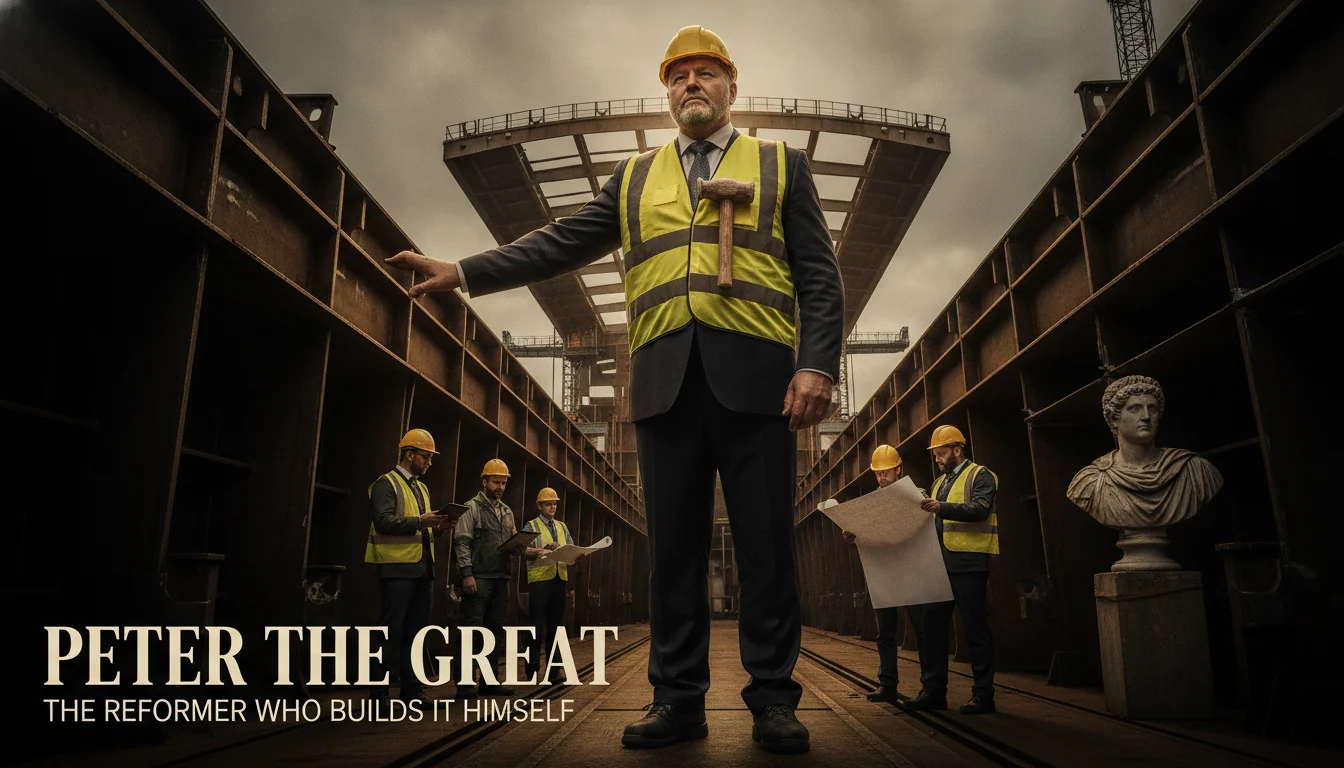
In the spring of 1697, the Tsar of All Russia boarded a ship at Riga and spent the next 18 months traveling through Western Europe not as a head of state but as a working man. He visited Dutch shipyards under the name Pyotr Mikhailov. He worked as a carpenter. He learned to pull rope, shape timber, and lay keel. He was 6'8" - an almost impossible height for the era - and could not remotely pass unrecognized, but he tried anyway, because the point was the work, not the concealment.
He came home in 1698, cut off the beards of his senior nobles at a dinner party with his own hands, began building a Baltic fleet that did not yet exist, and founded a new capital on a swamp because the old one was too far from the sea. He was 26 years old. He ruled for another 27 years after that, and by the time he died in 1725, Russia was a European naval power with a modernized army, a reformed bureaucracy, and a new city that his successors would inhabit for two centuries.
Drop Peter the Great into 2026 and the question is not whether he succeeds. He always succeeds, brutally and at enormous human cost, in whatever context you place him. The question is how long it takes someone to stop him.
The historical figure
Peter Alexeyevich Romanov was born in 1672 to Tsar Alexis and his second wife, Natalya Naryshkina. He came to power in a poisonous environment: a child tsar in a court divided between his mother's family and the family of his father's first wife, surrounded by scheming relatives and a Streltsy guard that twice in his childhood turned violent enough to be described as a massacre.
He grew up physically extraordinary - that documented height, enormous strength, boundless energy, a manual dexterity that led him to practice metalworking, dentistry, and carpentry for his own enjoyment - and intellectually voracious in the specific areas he cared about, which were ships, artillery, fortifications, and military organization. He was not a man who read philosophy or theology for pleasure. He read Dutch naval manuals and engineering treatises.
The Grand Embassy of 1697 and 1698 was his laboratory. He sent 250 Russians abroad to study European trades and brought back hundreds of Dutch, German, and British specialists: shipwrights, engineers, military officers, physicians, educators. He put them to work building the institutions Russia had not developed on its own. He taxed beards. He mandated Western dress for the nobility. He shifted the calendar from Byzantine to Julian reckoning. He founded the first Russian newspaper. He built St. Petersburg on the Neva delta using forced labor on a scale that killed thousands of workers, and moved the government there because proximity to the Baltic Sea mattered more to him than proximity to Moscow.
The Great Northern War against Sweden ran from 1700 to 1721. He lost badly at Narva in 1700, reorganized, studied what had gone wrong, and defeated Charles XII at Poltava in 1709 in one of the decisive battles of the early 18th century. By the end of the war, Russia was the dominant Baltic power.
The modern role
The 2026 version of Peter the Great is the founder and executive chairman of a major state-backed industrial and energy conglomerate, something that occupies the space between a sovereign wealth fund and a holding company: shipbuilding, LNG infrastructure, heavy manufacturing, and now a substantial and publicly stated ambition to move into advanced manufacturing and defense technology. The company was a legacy Soviet industrial entity when he took it over. His predecessors ran it as a patronage structure and a cash extraction mechanism. He arrived and announced that it was going to be a real company.
The announcement was not metaphorical. Within the first three years he had fired two-thirds of the senior management, moved the operational headquarters from the legacy industrial city to a purpose-built campus near a major port, hired 400 foreign engineers under explicit multi-year contracts, and made it mandatory that all internal technical meetings be conducted in English, a requirement that produced genuine fury among the domestic staff and a 30-percent attrition rate that he regarded as acceptable.
He does not have a chief of staff in the conventional sense. He has a technical advisor, a German naval architect he poached from a Scandinavian firm, who can keep up with him in conversation about structural engineering and who has learned that the only professional relationship that functions with Peter is one in which you tell him directly when he is wrong about something technical and accept that he will agree with you approximately half the time.
His title on the organizational chart is Executive Chairman. In practice, he runs the company the way Peter ran Russia: by showing up personally at the thing he wants to see happen and staying until it does.
The skills that translate
Three qualities from the 17th and 18th centuries carry over almost without modification.
The willingness to do the work himself. Peter worked in the Amsterdam shipyards. The 2026 version spends two weeks every year embedded with engineering teams at the operating level, not as an inspection but as a participant. He can read a construction drawing. He has opinions about welding specifications. His subordinates find this either inspiring or exhausting, sometimes simultaneously. It is authentic - the historical record does not suggest that Peter performed manual labor for effect - and it gives him a quality of technical judgment that is genuinely unusual at his organizational level.
The aggressive importation of foreign capability. Peter hired Dutch engineers, German officers, British shipwrights. The modern version hires Finnish logistics specialists, South Korean process engineers, American software architects, and Israeli defense-technology consultants. He does not particularly care where the capability comes from. He cares whether it works. This drives sustained conflict with domestic industrial interests who regard foreign hiring as a national embarrassment. He regards their objection as evidence that they have not built a domestic alternative worth protecting.
Reform by decree and by example simultaneously. Peter did not persuade the Russian nobility to abandon their beards and adopt Western dress; he told them and enforced it. The modern version does not make the same gestures, but the functional equivalent exists: performance metrics announced without negotiation, timelines that reflect his personal judgment of what is achievable rather than what his subordinates say is realistic, and a tolerance for the organizational chaos that results from moving faster than the system can absorb.
The family
He marries twice. The first marriage is arranged, to a woman from an appropriate background who provides social cover and a son he will ultimately find incompatible. The historical Alexei chose piety and tradition over his father's reforms and ended up charged with treason. The modern version: a son from the first marriage who went to a conservative business school, joined a traditional industrial firm, and gives interviews suggesting that his father's modernization program is "moving faster than the culture can sustain." Peter does not speak to him.
The second relationship - less formalized, politically sensitive, ultimately more functional - is with a woman of uncertain background who is practical, tough, and comfortable with power in a way that the first wife was not. The historical Catherine I rose from an obscure background to become Peter's wife and eventually his successor. The 2026 version occupies a comparable role, with better lawyers.
He has two other children who maintain very low profiles.
Where he lives
A compound near the shipyard campus that he built partly himself - he designed the floor plan, he specified the workshop. A maintained apartment in the capital for political meetings. An interest in a small technical research institute in the Netherlands that he has visited four times in the last eight years.
He does not vacation. He does not have hobbies in the conventional sense. He has projects. The projects run continuously. The staff have learned that the question "what are you doing this weekend" produces, reliably, a list of technical objectives.
What goes wrong
The problem with succession is the same problem it always was. Peter the Great died in 1725 without naming a clear heir, a failure that produced cascading political instability in Russia for decades afterward. The 2026 version has the same structural problem, expressed differently: a company built entirely around one person's technical judgment, energy, and willingness to override organizational consensus has no successor who can maintain it in the same form. The foreign engineers have contracts. The domestic staff have been selected for execution capacity, not strategic originality. The son is ideologically opposed. The company is, in the specific way that Peter has built it, a one-man institution.
He knows this. He has been told about it in three separate board presentations and has rejected all three proposed remediation frameworks. He regards succession planning as an invitation to start managing toward his own departure, which he declines to do.
Why it matters
Peter the Great's historical legacy is still being argued. He modernized Russia. He also did it using forced labor, arbitrary violence, and an autocratic machinery that normalized exactly the governance patterns that made Russia harder to reform in every subsequent century. The modernization and the brutality are not separable. The same tension echoes in other historical leaders reimagined for today: see our profiles of Napoleon and Julius Caesar, each of whom built systems that outlasted them in transformed but costly ways.
The 2026 version has a cleaner operating environment, by legal and institutional constraint rather than by personal inclination. But the underlying tension is the same: the person with enough vision and willpower to force a resistant system into transformation is almost never the same person who creates the conditions for what comes next. Peter's Russia outlasted Peter for 200 years. Whether it was the Russia he would have chosen is a different question.
If Peter the Great lived today, he would be the most productive person in any room he entered, the least comfortable collaborator, and the person most likely to build something extraordinary at a cost that the people around him would only fully understand after he was gone.
He would not change a thing about that. He never did.
Quick Answers
Common questions about this topic
Who was Peter the Great?
Peter I of Russia (1672-1725) was the tsar who forced Russia's transformation from a medieval Orthodox kingdom into a European-style state. He built a navy from nothing, founded St. Petersburg on a Baltic swamp as his new capital, sent thousands of Russians abroad to learn European trades and sciences, and imposed Western customs on the Russian nobility by decree - including a beard tax for those who refused to shave.
What made Peter the Great unusual as a ruler?
His willingness to do the work himself. During his Grand Embassy to Western Europe in 1697 and 1698, he traveled incognito as 'Pyotr Mikhailov' and actually worked in Amsterdam's shipyards as a carpenter and shipwright to learn naval construction firsthand. Few rulers in history have combined autocratic power with hands-on technical apprenticeship at the same scale.
What would Peter the Great's modern role be?
Peter would be the founder and executive chairman of a state-backed industrial conglomerate, most plausibly based in a resource-rich country undergoing forced modernization. He would be obsessed with building: shipyards, data centers, manufacturing capacity. He would hire foreign experts aggressively and have very little patience with domestic traditionalism.
What was Peter the Great's flaw?
His relationship with succession. Peter had his own son Alexei arrested for treason in 1718 after Alexei fled to Austria rather than support his father's reforms. Alexei died under interrogation in a St. Petersburg fortress. Peter never named a clear successor, and the question of who would inherit his transformed Russia became a destabilizing crisis that outlasted him by decades.

Meet Them in Person
Chat with the historical figures behind these modern reimaginings.
Start the ConversationJoin the HistorIQly Club
Get smarter about the past.
Weekly stories, deep dives, and exclusive content straight to your inbox.