If Mary Queen of Scots Lived Today: The Royal Exile Who Never Stops Scheming
If Mary Queen of Scots lived today, she would be the deposed royal turned Netflix documentary subject, still scheming her return from a comfortable English house arrest.
Read Wikipedia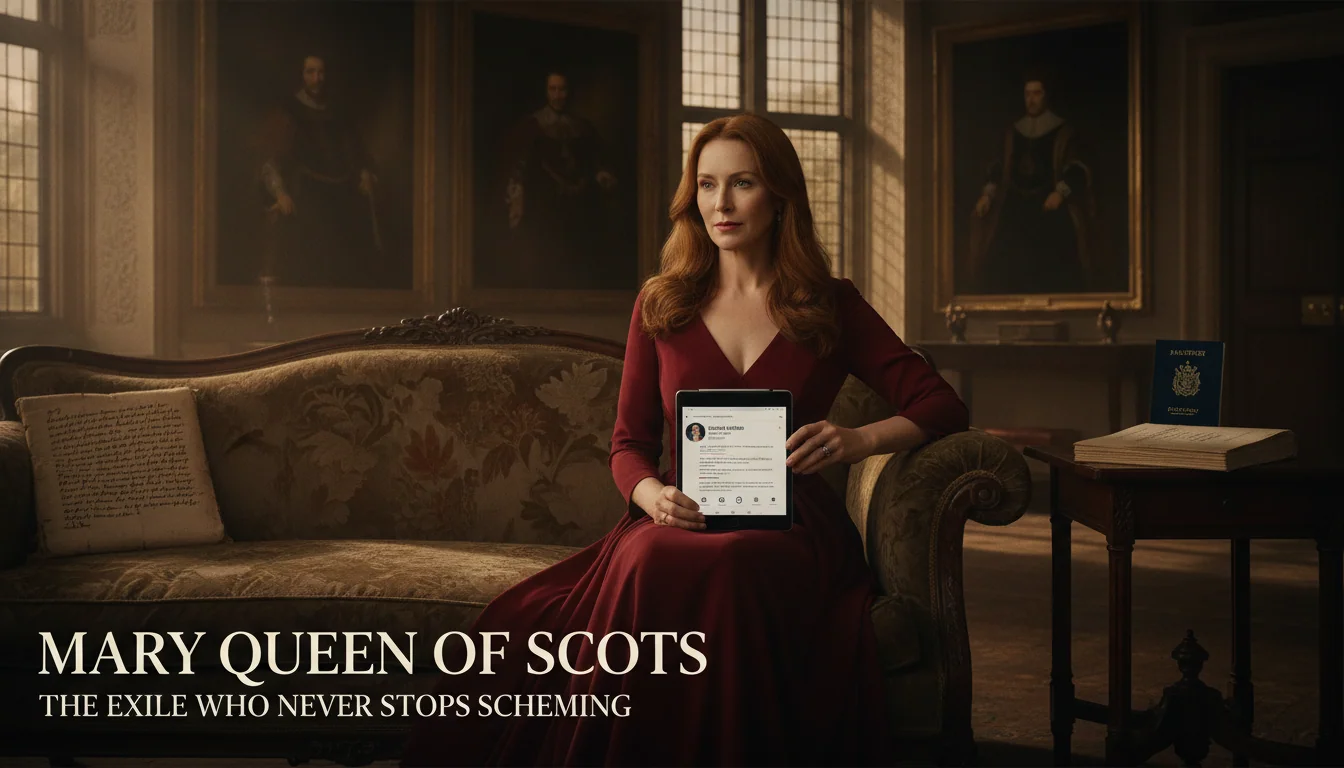
The instinct is to call Mary, Queen of Scots the most unlucky royal in British history. But unlucky implies that her catastrophes arrived from outside, the way weather arrives. Most of Mary's disasters were decisions. She made them, in several cases against explicit advice from people who knew better, and then spent the next two decades as her rival's comfortable prisoner while her son was raised by other people and her kingdom moved on without her.
This is not a criticism. It is actually a more interesting story than the unlucky version, and it is precisely what makes Mary so well suited to 2026.
The historical figure
Mary Stuart was born in December 1542 at Linlithgow Palace, the daughter of James V of Scotland and Marie of Guise. Her father died when she was six days old, making her Queen of Scotland before she could hold her own head up. Her mother ran the regency. At age five Mary was sent to France, where she would spend most of the next thirteen years at the French court, educated with the royal children, fluent in French, Latin, Italian, and Spanish, and eventually betrothed to the Dauphin Francis.
She married Francis in 1558. He became Francis II of France in 1559 and died in 1560, leaving Mary a widow at eighteen. France passed to his younger brother, under his mother Catherine de Medici's tight control. Mary, no longer queen of anywhere that wanted her, returned to Scotland in 1561.
Scotland in 1561 was in the middle of the Protestant Reformation. Mary was Catholic. She handled this better than her critics expected for the first few years, governed with reasonable competence, and consulted her Protestant advisor John Knox, who despite hating everything she stood for respected her enough to argue with her directly. The early Scottish years were not failures.
Then came the marriages.
Her first Scottish marriage, to her cousin Henry Stuart, Lord Darnley, in 1565, was a political disaster she walked into voluntarily against sustained opposition. Darnley was handsome, aristocratic, and had a decent claim to the English throne in his own right. He was also, by almost every contemporary account, vain, petulant, and unreliable. The marriage deteriorated rapidly. Darnley participated in the murder of Mary's secretary David Rizzio, whom he suspected of having too much influence over her, stabbed at a supper in front of Mary herself.
Darnley was murdered in February 1567 in an explosion at Kirk o' Field. Mary's involvement is disputed and was disputed at the time, but the circumstantial evidence around the Earl of Bothwell, who had Mary's favor, was not subtle.
Her third marriage, to Bothwell, in May 1567 - barely three months after Darnley's death - was the decision that ended her reign. The Protestant Scottish lords were already furious. Marrying the man most widely suspected of her previous husband's murder, three months after that murder, removed any remaining political defense she had. The Confederate Lords forced her to abdicate in July 1567 in favor of her infant son, who became James VI.
She escaped in 1568, gathered a small army, lost at the Battle of Langside in May, and fled south to England in the immediate aftermath of the defeat, intending to ask her cousin Elizabeth I for help.
Elizabeth gave her a comfortable house and a permanent armed escort and called it hospitality.
The modern role
In 2026, Mary Queen of Scots does not hold a formal title. The title is disputed - you can read the lengthy Wikipedia section about it - but no government recognizes it, and the lawyers who have been retained on the subject have not made progress since the last press cycle about them.
She is living in a country house in Northumberland, which is technically at the disposal of the Crown Estate but has been made available to her and her household on a long-term basis under terms that are not publicly disclosed. She has a staff of seven and a PR consultant who is, by all accounts, excellent. She does not comment on the terms of her residence.
Her Instagram has 4.2 million followers. The content is exceptional. It mixes obviously staged fashion imagery - she is still, at whatever age, extraordinary to look at - with quiet domestic scenes, historical commentary on her own family's portraits, and occasional posts about the castles and ruins she visits, which she annotates with personal family history. The caption literacy is real. She writes her own posts and it shows.
She has been on three major documentary projects. The first was a Netflix limited series called simply The Queen of Scots that traced her family history across five centuries and was very good television. The second was a BBC oral history project that she consulted on but did not front, about which she has publicly said nothing. The third is currently in production, and she has not confirmed or denied the subject matter, though speculation based on filming locations centers on either the Babington period specifically or a broader history of imprisoned European royals.
She is, in the language of the culture, a "royal in exile." The phrase is used to cover everyone from dispossessed monarchs in comfortable European hotels to figures whose exile is genuinely precarious. Mary's version is comfortable, constrained, and open-ended in a way that everyone involved seems to prefer to pretend is temporary.
The skills that translate
Three things carry over from 16th-century Scotland almost without modification.
Political theater. Mary understood, before the concept was named, that royal presence was a performance medium and that presence could move political reality. She rode out to meet hostile Protestant lords in silk and jewels when a more cautious sovereign would have sent an envoy. The effect was repeatedly to buy time, change moods, and shift the terms of confrontation simply by showing up and being herself. The 2026 version does this with the Instagram grid and with strategically timed appearances at events where she would not be expected. She turns up at a gallery opening at a key moment in a political negotiation she is not supposed to be involved in and simply stands there being the most interesting person in the room. It works the same way it always worked.
Generating sympathy. The historical Mary had a specific talent for being in political trouble in ways that made her sympathetic to people who should have known better. Elizabeth spent the first decade of Mary's imprisonment in England receiving letters from European monarchs, the Pope, and Philip II of Spain about the injustice of her situation. Many of these correspondents were rational actors who were also being worked by Mary's representatives. The 2026 version generates the same sympathy through media: every few months there is a story about the constraints of her living arrangement, the terms that govern her public appearances, the question of whether she will ever be permitted to travel freely. She never confirms the details of these stories and never denies them either.
Catastrophic romantic choices. This requires no translation. The 2026 version has been engaged twice since arriving in England, both times to men who were visually compelling and politically problematic. The first engagement ended when her representative disclosed, three months before the planned wedding, that there were legal complications with her status that had not been fully explored before the announcement. The second ended more quietly. She has not discussed either publicly. Her PR consultant has.
The family
She has one adult son from her second marriage, who was raised primarily by his paternal family during her years of constrained residence and who now has a career in international law and a conspicuous lack of public commentary about his mother. They have been photographed together twice in the past three years. She has posted one photograph with him, in a garden, from behind, without caption.
Her relationship with her counterpart on the other side of the border - Elizabeth I's modern equivalent - is a standing subject of public speculation and private entertainment. They have met formally three times and have been photographed together once, at an official event, with expressions that both of them have clearly practiced. What they actually say to each other in private is the subject of at least two unauthorized biographies, neither of which has sold particularly well.
The contemporary peer
The figure she most closely resembles in 2026 is not any single person but a type - think Catherine de Medici with better PR: the high-profile exile-celebrity who remains politically consequential without holding formal power, whose personal narrative generates constant media interest, and who is simultaneously the subject of sustained scrutiny and the author of her own very good story about what that scrutiny means.
She would find the 21st century in many ways less confusing than people assume. The basic architecture of her position - constrained residence, sustained surveillance, political significance that everyone politely declines to act on - is recognizable from her own historical experience. The difference is that in 2026 she can post about it, and forty-two thousand people will like the post within the hour.
The scheming continues. It always does. The question is whether it leads somewhere this time, or whether, as in 1586, someone is already reading the drafts.
Quick Answers
Common questions about this topic
Who was Mary Queen of Scots?
Mary Stuart (1542-1587) was Queen of Scotland from infancy, raised in France, briefly Queen of France through her marriage to Francis II, and then Queen regnant of Scotland from 1561. After three marriages, political catastrophe, and forced abdication, she fled to England hoping for support from her cousin Elizabeth I and instead spent 19 years as her prisoner before being executed in 1587.
Why did Mary Queen of Scots end up imprisoned by Elizabeth I?
Mary arrived in England in 1568 after fleeing Scotland, where she had been forced to abdicate and had been implicated in the murder of her second husband, Lord Darnley. Elizabeth I found herself in an impossible position: Mary had a claim to the English throne, was Catholic, and represented a focus for Catholic plots against Elizabeth's Protestant regime. Elizabeth's solution was to never give her refuge or send her away, but simply keep her under house arrest for nearly two decades.
What was the Babington Plot?
The Babington Plot of 1586 was a conspiracy, organized by Anthony Babington, to assassinate Queen Elizabeth I and place Mary on the English throne with Spanish support. Sir Francis Walsingham, Elizabeth's spymaster, had infiltrated the plot from the beginning and allowed it to develop long enough to produce written evidence of Mary's approval. Her letters authorizing the plot were the primary evidence used at her trial.
Why was Mary Queen of Scots executed?
Mary was executed on February 8, 1587 at Fotheringhay Castle after being convicted of treason for her involvement in the Babington Plot. The execution was politically complicated: as a sovereign queen, she argued that no foreign court had jurisdiction over her. Elizabeth I delayed signing the death warrant for months and reportedly claimed it was sent without her final authorization, though historians generally consider this implausible.

Meet Them in Person
Chat with the historical figures behind these modern reimaginings.
Create your free account →No card required. Talk to anyone in history with 8 free credits a day. Some features require a paid plan.
Join the HistorIQly Club
Get smarter about the past.
Weekly stories, deep dives, and exclusive content straight to your inbox.