If Elizabeth I Lived Today: The Last Person You Want to Negotiate With
If Elizabeth I lived today, she wouldn't hold elected office. She would run a political intelligence firm that every European government quietly feared and needed.
Read Wikipedia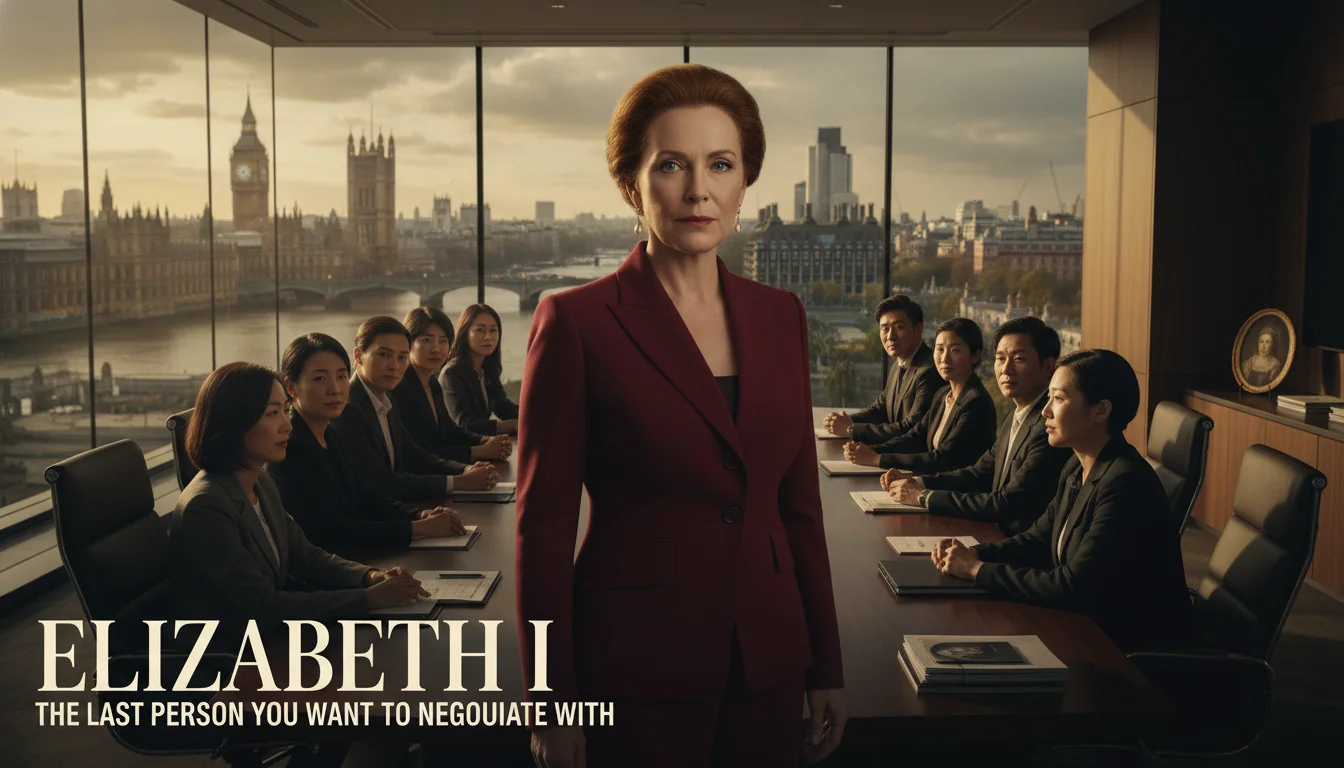
Her mother was executed when she was two. She was declared illegitimate at three. By the time she was twenty she had survived a reign of terror under a Catholic sister who considered her a heretic and a threat. She became queen at twenty-five and held power for forty-five years by ensuring that no one individual and no single institution ever had enough leverage over her to force her out.
If Elizabeth I lived today, she would not hold elected office. She never has and never will, because elected office involves giving a vote to someone else over your own future, and that is not a trade she makes.
The historical figure
Elizabeth I was born September 7, 1533, the daughter of Henry VIII and his second wife Anne Boleyn. She was nine months old when Henry decided he needed a son and began the process of disposing of her mother. Anne Boleyn was executed in May 1536 on charges of adultery and treason that most historians now regard as fabricated. Elizabeth was declared illegitimate under an act of Parliament and removed from the succession. She was not yet three.
Henry restored her to the succession in 1544, placing her third after her half-brother Edward and half-sister Mary. Edward VI, a committed Protestant, died in 1553. Mary I, a committed Catholic, spent five years reversing the English Reformation and burning Protestant heretics. Elizabeth, who was Protestant but politically careful about how she expressed it, spent most of Mary's reign navigating accusations of treasonous conspiracy. She was imprisoned in the Tower of London for two months in 1554 following the Wyatt Rebellion, which she had almost certainly known about but was careful never to confirm.
She survived by being useful and by being unconfirmable. That technique served her well for the next sixty years.
She became queen on November 17, 1558, when Mary died. She was twenty-five, red-haired, fluent in Latin, French, Italian, Spanish, and enough Greek to satisfy her tutors, and in full possession of the political education that comes from watching an entire dynasty rotate through power and destruction in the space of a single childhood.
She then reigned for forty-five years, outlasting every rival, most of her advisors, and all but one of her serious suitors. The Spanish Armada came in 1588 and she met it with the Tilbury speech that remains one of the most effective pieces of political rhetoric in the English language. Mary Queen of Scots was held prisoner for nineteen years and then executed in 1587 when it was no longer politically bearable to keep her alive. Robert Dudley, Earl of Leicester, was probably the only man she ever seriously loved, and she kept him useful rather than powerful until he died in 1588, the same year as the Armada, which may be why that year was the last one she found relatively uncomplicated.
She died on March 24, 1603, having outlived almost everyone who had known her young.
The modern role
Drop her into 2026 and she is 58. She runs a firm called Tudor Advisory Group, which has a listed London address, a small office in Singapore, and seventeen very senior people who cannot easily explain what they do. The website is three pages. The contact form goes to an email address that is checked by someone she trusts more than most people and less than anyone completely.
The firm does four things, formally. It provides political communications advisory to governments and institutions navigating complex reputational transitions. It provides geopolitical intelligence synthesis for a client list that is not public. It manages a private media portfolio that includes interests in one print publication, two digital platforms, and a documentary production company that has won a BAFTA and whose editorial independence she nominally respects and practically shapes. And it runs, without formal announcement, the most productive unofficial network in European policy circles: a series of dinners, retreats, and carefully structured conversations that have shaped more political decisions than any of the participants will confirm.
The skills that translate
Elizabeth's core skill set is not complicated, though it is very rare.
She understands that information is leverage and that leverage only works when deployed selectively. Her Tudor Advisory intelligence service does not generate reports for general circulation. It generates targeted briefings for specific clients at specific moments. A prime minister who receives a Tudor Advisory assessment of their exposure on a particular issue receives it because Elizabeth has decided it is more valuable to them than to their rival, that day. The calculation changes.
She has never, in her professional career, fully trusted anyone. This is not paranoia - it is historical memory. Walsingham was useful. Cecil was essential. Essex was her greatest error of judgment. She employs very good people. She does not give any of them the full picture. This means decisions flow upward to her on questions where she alone has enough context to decide, and no single person in her organization can replicate her network if they leave.
Her public image is a managed instrument. She does not have a personal social media presence under her own name. She does not give interviews to publications that she does not have some relationship with. Her public appearances are few and precisely calibrated: a Davos panel, a lecture at an institution she has supported, a limited-run conversation series with prominent figures that she hosts and edits before release. She controls the archive of herself. When asked about her private life, she gives an answer that is technically true and completely uninformative.
The family
She did not marry. This is not because she could not attract candidates - she has been proposed to, formally and informally, many times. She rejected all of them on grounds that range from the practical (marriage requires sharing access to information she does not share) to the personal (she watched what happened to her mother and drew conclusions).
She has a long-term companion who is described by those who know her well as the person she is closest to and by those who know her from the outside as her "close adviser." The relationship is not confirmed. It is not denied. It has been ongoing for more than twenty years. The companion is brilliant, twelve years older, has their own consulting career, and does not attend her professional events. They occasionally appear together at private dinners hosted by old friends and mutual institutional acquaintances. No photograph of them together has been published.
She has no children and does not discuss the subject when it is raised. She has been quietly developing six or seven very talented young people in her orbit who function, for anyone paying attention, as the next generation of something. Nobody calls it mentorship. Everyone understands what it is.
Where she lives
A substantial house in Kensington that she has owned for twenty-three years, purchased through a property vehicle that took legal researchers some effort to trace back to her. A leasehold apartment in Brussels. Access to a small house in Tuscany that belongs nominally to her companion and where she spends three weeks each August.
Her London house has a library that former guests describe as extraordinary and slightly alarming in its scope. The books are organized by her own system, which visitors cannot deduce. She has annotated many of them. She does not lend them.
What goes wrong
Elizabeth's version of this goes wrong the way it always did: the person she trusted most turns out to have an agenda she did not fully anticipate.
In the classical version, it was Essex. Robert Devereux, Earl of Essex, was charming, militarily gifted, personally close to her, and eventually willing to attempt a coup. She signed his execution warrant in 1601 and never publicly expressed regret for it, though people who knew her in her last two years said something had changed.
The 2026 version involves a different kind of betrayal, but the structure is identical. Someone she brought into her inner circle - a person she judged correctly on every technical dimension - turns out to have a separate loyalty she did not detect. Not to a foreign court. To an idea. A faction. A cause she did not take seriously enough to monitor. The information they take when they leave is not the kind that can be litigated or formally denied. It is the kind that changes how certain people think about her.
She recovers. She always recovers. The machinery of her operation is designed to survive the defection of any single node. But the recovery takes something from her that she does not publicly acknowledge.
Why it matters
Elizabeth I remained Queen of England for forty-five years by making herself simultaneously indispensable and irreplaceable. Every advisor, every suitor, every foreign king found that she would not fully surrender control, that the final decision stayed with her, that no marriage, no treaty, and no concession would reduce her to a purely ceremonial figure.
That quality made her very difficult to remove and very difficult to live with. Her court was permanently in negotiation with its sovereign. Her allies were permanently uncertain whether they were trusted. Her enemies were permanently unsure whether she knew what they were doing.
In 2026, the institutional structures that made that quality possible have changed entirely. There is no crown. There is no court. There is no mechanism by which forty-five years of uninterrupted power becomes a public institution.
But the underlying equation has not changed. The person who controls the narrative, who manages information selectively, who makes herself the necessary intermediary between competing power centers, and who never fully delegates the decisions that matter - that person, in any era, occupies a position that is very hard to destabilize from the outside.
The most powerful people in current European politics have her mobile number. Several heads of government have made decisions after a conversation with her that their press offices later attributed to different influences. She has never confirmed this. Neither have they.
She is 58. She shows no signs of slowing down. She has not chosen a successor, and she never will.
For other historical figures reimagined in the present, read about If Catherine the Great lived today - another ruler who consolidated power through intelligence and managed her image obsessively - and If Napoleon lived today, who would have a very different relationship with democratic institutions than Elizabeth did.
Quick Answers
Common questions about this topic
Who was Elizabeth I?
Elizabeth I (1533-1603) was the daughter of Henry VIII and Anne Boleyn, declared illegitimate after her mother's execution, restored to the succession by her father, and crowned Queen of England in 1558 at age 25. She reigned for 45 years without ever marrying, used her unmarried status as a permanent diplomatic instrument, patronized the arts and exploration, faced down the Spanish Armada, and executed her cousin Mary Queen of Scots. She died in 1603 having outlasted virtually every advisor, rival, and suitor she had ever known.
Why did Elizabeth I never marry?
The short answer is that marriage meant ceding power, which she was not prepared to do on anyone else's terms. She conducted elaborate marriage negotiations with European princes and English nobles for decades, using the promise of her hand as a foreign-policy tool, but always found a reason to delay or decline. She may also have had personal reasons rooted in watching what royal marriages had done to her mother and her stepmothers.
What made Elizabeth I an effective ruler?
She combined genuine intelligence and political instinct with a cultivated public image that functioned as a form of soft power. She spoke six languages. She was willing to make decisions slowly and then execute them without hesitation. She kept multiple advisors in competition with one another so none became indispensable. And she understood that controlling the narrative about herself was as important as controlling policy.
Who would Elizabeth I be compared to in 2026?
No single person captures her. She would have the media influence of a Rupert Murdoch-era press baron, the political durability of a long-serving European statesperson, the brand instincts of an elite PR architect, and the intelligence community access of a serious national security operator. The combination does not exist in 2026 in a single person. That is probably why she would build it herself.

Meet Them in Person
Chat with the historical figures behind these modern reimaginings.
Create your free account →No card required. Some figures and features require a paid plan.
Join the HistorIQly Club
Get smarter about the past.
Weekly stories, deep dives, and exclusive content straight to your inbox.