John Snow and the Broad Street Pump: The Map That Ended a Cholera Epidemic
In 1854 Soho, a doctor ignored miasma theory, mapped cholera deaths by hand, and traced an epidemic to one water pump. Epidemiology was born.
Read Wikipedia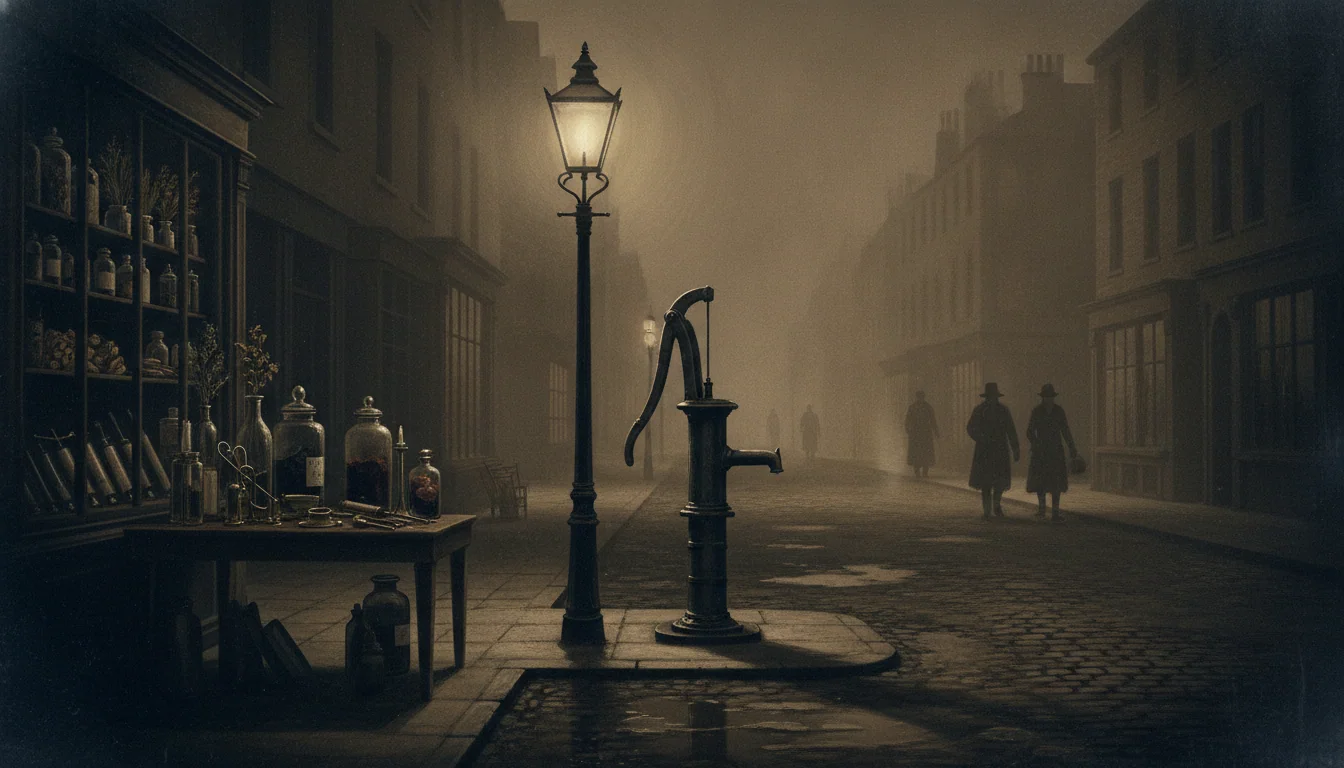
For most of the 19th century, doctors agreed on what caused cholera: bad air. Rotting matter, sewage, and general filth were thought to release a poisonous vapor, a miasma, that sickened anyone who breathed it. It was a reasonable theory for its time, consistent with what doctors could observe, and it was almost completely wrong. Proving that took a London doctor, a hand-drawn map, and one very specific water pump.
The arrival
In the final days of August 1854, cholera broke out in Soho, a crowded, working-class district of central London. The disease had already swept through Britain twice in earlier decades, killing tens of thousands, and Londoners had learned to dread its arrival: violent vomiting and diarrhea that could kill a healthy adult within a day through catastrophic dehydration.
This outbreak was different only in its speed and its concentration. Within the first three days, dozens of people living within a few streets of the Broad Street pump were dead. Within about two weeks, estimates commonly put the toll at more than 600 in that one Soho neighborhood, a horrifying number for an area only a few blocks wide. Entire families died within hours of one another. Whole households on Broad Street and the surrounding streets, Cambridge Street and Poland Street among them, were wiped out or fled in panic, leaving the district eerily empty by early September.
What people believed
The dominant medical theory of the day, miasma theory, held that diseases like cholera spread through foul air rising from decaying organic matter, sewage, graveyards, and general urban filth. It was not a stupid idea. Cholera outbreaks did correlate strongly with poor, overcrowded, badly ventilated, foul-smelling neighborhoods, and treating bad smells as dangerous led to real sanitary improvements even when the underlying theory was wrong. The problem was correlation mistaken for causation: those same neighborhoods also had contaminated water supplies, and it was the water, not the smell, that carried the disease.
Miasma theory was not a fringe belief. It was held by the era's leading sanitary reformers and by the General Board of Health, the government body responsible for public health. When a government-appointed inquiry investigated the Broad Street outbreak, it favored explanations rooted in foul air and local nuisances over any theory involving water, since the water from the Broad Street pump was, by all appearances, clear and reportedly pleasant to drink.
John Snow, a London physician already well known for his work on anesthesia (he had administered chloroform during royal childbirths), had a different, unfashionable idea. He had argued since a pamphlet published in 1849 that cholera spread through contaminated water, reasoning that the disease attacked the digestive system first, which fit an ingested poison far better than an inhaled one. The Broad Street outbreak, unfolding almost on his own doorstep, gave him a case concentrated enough to test the theory properly.
What Snow did, and what the doctors tried
Snow's investigation was patient and methodical rather than dramatic. He visited the General Register Office to obtain the addresses of the dead, then went door to door across Soho, asking grieving families where they got their drinking water. He plotted every death he could confirm as a small black bar on a street map of the neighborhood, building up what would become one of the most reproduced images in the history of medicine: a dot-and-bar map with the deaths clustering, unmistakably, around the pump at the corner of Broad Street and Cambridge Street.
The map also showed him the exceptions, and the exceptions mattered more than the pattern itself. Workers at a nearby brewery on Broad Street had almost no cases; they drank the beer they made rather than pump water, and the brewery drew from its own well. A workhouse close to the pump had a low death rate too, again because it had an independent water supply. And two deaths turned up far from Soho entirely: a widow who had once lived on Broad Street and liked the taste of its water so much she had it carted to her home in Hampstead, and a relative of hers in another part of the city who drank from the same delivered bottle. Both died. Neither had set foot near Soho in weeks.
Meanwhile, the medical treatments available to cholera patients in 1854 were largely useless and sometimes actively harmful. Doctors commonly prescribed bloodletting, calomel (a mercury compound), opium to slow the diarrhea, and brandy to fight shock, none of which addressed the disease's real killer: dehydration from fluid loss. A few physicians had experimented with saline injections to replace lost fluids, an approach that anticipated the correct modern treatment by decades, but the practice was inconsistent, poorly understood, and not widely adopted. Most patients who recovered did so despite their treatment rather than because of it.
Armed with his map and his interviews, Snow took his findings to the local Board of Guardians of St James parish on September 7, 1854. He had not yet identified how the well had become contaminated, only that it clearly had. The guardians were skeptical of his water theory but had little to lose from a simple, cheap intervention: the next day, September 8, they had the handle removed from the Broad Street pump so nobody could draw water from it.
Who got blamed
Cholera outbreaks in Victorian Britain rarely produced a single scapegoat the way plagues in earlier centuries, like the Great Plague of London, had produced accused poisoners or persecuted minorities. Instead, blame fell in a more diffuse but still damaging way: on the poor themselves. The era's sanitary reform movement, while it did genuine good in pushing for cleaner water and better drainage, was steeped in the assumption that disease clustered in slum districts because the people living there were dirty, intemperate, and morally careless, not because they had been given contaminated water and no alternative. Overcrowding and poverty were treated as character flaws rather than the infrastructure failures they actually were.
Official institutions share the blame too. The water companies supplying London denied responsibility, and the government's own scientific inquiry into the Broad Street outbreak concluded that Snow's water theory was unproven, favoring instead an explanation rooted in local atmospheric conditions. The parish guardians who removed the pump handle did so as a precaution, not a concession; most of them still believed in miasma. Snow's theory was treated, in his own lifetime, as an interesting minority opinion rather than a solved case.
What finally worked
The final piece of the Broad Street puzzle came from an unlikely source: Henry Whitehead, a local curate who initially set out to disprove Snow's water theory because he knew and trusted many of his parishioners who swore the pump water was fine. Whitehead's own careful, independent door-to-door survey ended up strengthening Snow's case, and it was Whitehead who traced the contamination to its origin: a leaking cesspit near a house on Broad Street where an infant had fallen ill with cholera symptoms days before the outbreak exploded. Water used to wash the baby's soiled diapers had been thrown into the cesspit, and the aging brickwork lining the nearby well let sewage seep in from just a few feet away.
Even with the mechanism identified, wide acceptance of waterborne transmission took years. Snow published an expanded account of his findings in 1855, but the medical establishment remained divided. Germ theory itself was still being worked out; the bacterium responsible for cholera, later named Vibrio cholerae, had actually been described by the Italian anatomist Filippo Pacini in 1854, the same year as the Broad Street outbreak, but his work was largely ignored for decades. Robert Koch's more famous isolation of the bacterium in the early 1880s is what finally cemented waterborne transmission as accepted medical fact. On the civic engineering side, London's chronic sewage-in-water-supply problem was addressed at scale only after the stench of the Thames itself became unbearable to Parliament in 1858, prompting the construction of a comprehensive new sewer system that finally separated the city's sewage from its drinking water.
The map's afterlife
Snow died in 1858, before his theory was widely credited, and before he could see London's water supply fully reformed. What survived him was the method as much as the man: a disease outbreak treated as a pattern to be mapped, tested, and traced to a single physical cause, rather than a moral or atmospheric mystery to be lamented. His Broad Street map is still reproduced in public health textbooks, museum exhibits, and epidemiology courses as the founding image of the discipline, a reminder that the questions "who got sick" and "where did they get their water" can be more powerful than any theory about foul air.
Quick Answers
Common questions about this topic
What caused the 1854 Broad Street cholera outbreak?
A public water pump on Broad Street in Soho, London drew from a well contaminated by sewage leaking from a nearby cesspit. An infant in a household next to the well had fallen ill with cholera, and water used to wash the baby's soiled diapers drained into the cesspit and seeped into the well just a few feet away.
How many people died in the Broad Street cholera outbreak?
Estimates commonly put the toll at more than 600 deaths in the streets around Broad Street within about two weeks, with the worst of it concentrated in the first three days after the outbreak began in late August 1854.
Did removing the pump handle actually stop the epidemic?
Not entirely on its own. The outbreak was already declining, largely because many residents had already fled the area, by the time the handle was removed on September 8, 1854. Historians credit the act with helping prevent a second wave rather than ending the first, but it became the defining symbolic gesture of the investigation.
Why is John Snow called the father of epidemiology?
Snow was among the first to treat a disease outbreak as a solvable data problem: he plotted every death on a street map, interviewed survivors, traced the cases to a single shared water source, and used that pattern to argue for a cause years before the germ responsible was widely accepted. That method, mapping cases to find a common exposure, is now a foundation of modern epidemiology.

Consult the Physicians
Chat with the healers and survivors who lived through history's outbreaks.
Create your free account →No card required. Some figures and features require a paid plan.
Join the HistorIQly Club
Get smarter about the past.
Weekly stories, deep dives, and exclusive content straight to your inbox.