King Richard vs. History: How Accurate Is the Williams Sisters Origin Story?
King Richard accuracy, checked: Will Smith's Oscar-winning film gets the Compton courts and 78-page plan right, but builds a heroic myth around a complicated man.
Read Wikipedia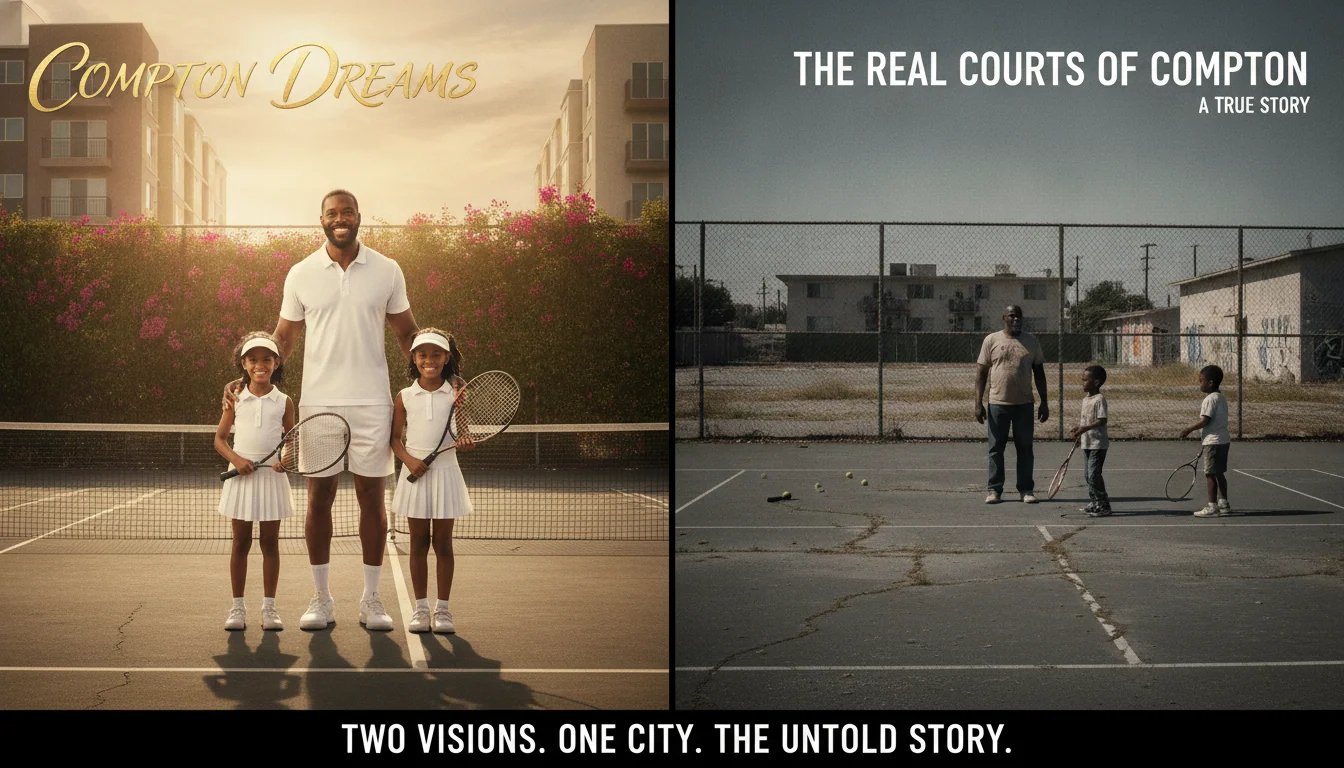
King Richard, released in 2021 and starring Will Smith, tells the origin story of Venus and Serena Williams from their father's perspective. It covers the improbable arc of Richard Williams: a man with no professional tennis background who drafted a detailed plan to produce two world champions, trained his daughters on cracked public courts in Compton amid gang activity, persuaded a Florida coach to take them on, and navigated the tennis world's skepticism with a combination of conviction and sheer stubbornness.
Will Smith won the Academy Award for Best Actor for the performance. The film was made with the Williams family's cooperation. Richard Williams and the sisters are executive producers.
That last detail matters more than it might seem.
What Hollywood Got RIGHT
The 78-page plan
The film's central premise - Richard Williams drafting a comprehensive coaching plan before his daughters were born - is real and documented. Williams has described the plan in interviews and in his 2014 autobiography. It covered tennis mechanics, character development, business strategy, and commercial endorsements. The detail that he wrote it before the girls were born, and that the plan preceded the sport's reality by years, is accurate.
This was genuinely unusual. Richard Williams learned tennis as an adult from instructional videos and books, then applied what he learned to daughters he had decided, in advance, would be champions. The film is not exaggerating the strangeness of this.
The Compton courts
The Williams sisters were raised in Compton, California, and they did train on deteriorating public courts in one of the most economically stressed cities in Los Angeles County during the 1980s and early 1990s. The film's depiction of cracked asphalt, makeshift equipment, and proximity to gang activity is grounded in accounts Venus and Serena have given in their own words.
Serena Williams has spoken in interviews about practicing while gunshots were audible nearby and about her father navigating confrontations on the courts. The Compton backdrop in the film is not Hollywood exaggeration - it reflects what the sisters have actually said about their upbringing.
Rick Macci and the Florida move
Rick Macci, a professional coach in Haines City, Florida who had previously trained Jennifer Capriati and Mary Pierce, saw Venus play at a tournament in the early 1990s and was immediately struck by her ability. He traveled to Compton, met the family, and offered to train both girls at his academy while covering their living costs and training expenses.
The family moved to Florida. The timeline and the basic structure of this arrangement - Macci's role, the move, the decision to leave Compton for professional training - are depicted accurately in the film. Jon Bernthal plays Macci with appropriate energy.
Keeping Venus off the junior circuit
One of the most criticized decisions Richard Williams made was keeping Venus almost entirely out of USTA junior circuit competition. Professional tennis has a standard development pipeline through junior tournaments, and the tennis establishment viewed his approach as either overprotective or strategically misguided.
He held to it. Venus played a handful of junior events and was then kept away from the circuit. When she made her professional debut in 1994 at age 14, the lack of junior tournament experience was a subject of widespread commentary. The film handles this accurately, including the professional skepticism it generated.
The Reebok deal before her first professional match
Before Venus had played a single professional match, Richard Williams negotiated a major endorsement contract with Reebok for his 14-year-old daughter, reportedly worth around $12 million. This was a remarkable feat of leverage: selling a tennis player's commercial future to a sportswear company before she had established any professional record. The deal was real. The film depicts it accurately.
What Hollywood Got WRONG
Oracene Williams is substantially sidelined
The film's most significant distortion is structural. Oracene "Brandy" Williams, played by Aunjanue Ellis, is nominally a central character but is consistently rendered as a moderating voice and homemaker while Richard carries all of the tactical and strategic agency. In reality, Oracene Williams was a deeply involved coaching presence with her own background in sports and a technical understanding of tennis that the film almost entirely ignores.
Both Venus and Serena Williams have, over the years, credited their mother extensively for her coaching contributions. Oracene ran drills, corrected technique, and was on the court with the girls through the same years the film covers. The film's decision to position Richard as the architect and Oracene as the skeptical-but-loyal spouse significantly misrepresents the partnership.
This is the film's most consequential historical failure. A story about two women athletes gives their success almost entirely to the vision of one man, while marginalizing the woman who was coaching them every day.
Richard Williams's personal life is absent
The film presents Richard Williams as a devoted, if demanding and eccentric, family man. The full historical record is considerably more complicated. He and Oracene divorced in 2002. His autobiography and various published accounts contain inconsistencies about the details of his earlier life, including prior family relationships. Various financial disputes over the years are not referenced.
None of this necessarily undermines the coaching achievement. But the film, by ending before the girls' careers had fully launched and by carefully selecting which years to cover, avoids the period that would require a more complicated portrait. It chooses the heroic arc and stops.
Rick Macci's contribution is minimized
Macci has been vocal about feeling that the film shortchanges his role. He trained Venus and Serena for several years in Florida - an intensive period of their development during their pre-teen and early teenage years. He has said in interviews that the film gives the impression his coaching was more peripheral than it was. He is not disputing the broad outline of the story, but the depth of his contributions is not captured in what the film shows.
This is a version of a common biographical-film complaint, but Macci has been specific enough in his account that it is worth noting as a documented discrepancy.
The film is hagiographic by design
King Richard is an authorized biography. Richard Williams and his daughters approved it, participated in it, and share producer credits. This creates a structural incentive to flatten complexity. The man portrayed is brilliant, dedicated, occasionally difficult but always correct in his instincts, fighting the establishment and winning at every turn.
The real Richard Williams made decisions that worked, but he is also a man whose self-accounting has not always been consistent, whose personal life does not fit the devoted-family narrative the film presents, and who could be, by accounts of people around him, far more difficult to work with than the film suggests.
The film is not dishonest about what it shows. It is selective about what it chooses to show, and the selection systematically resolves every ambiguity in Richard Williams's favor.
Historical Accuracy Score: 7/10
On King Richard accuracy overall, the film earns solid marks for the structural accuracy of the Venus and Serena story: the plan, the Compton years, the Florida move, the junior circuit decision, the endorsement deal. These core events are well-sourced and faithfully rendered. The broad shape of how two girls from Compton became the dominant players in the history of women's tennis is honestly conveyed.
The score falls for the treatment of Oracene Williams, the omission of Richard Williams's personal complications, and the authorized-biography smoothing that transforms a genuinely complicated figure into a prophet who happened to be right about everything.
What it gets most right: the tactical choices around Venus's early development and the authenticity of the Compton environment.
What it gets most wrong: the systematic sidelining of Oracene Williams's coaching role and the carefully chosen endpoint that avoids the film's subject at his most complicated.
The Williams sisters are two of the greatest athletes in the history of their sport. The story of how they got there is real and remarkable. It just has two coaches in it, and this film only lets you see one of them fully.
For another sports biopic that compresses a complicated relationship into a cleaner rivalry, see our review of Rush (2013), which covers the Ron Howard film about the Niki Lauda and James Hunt Formula 1 rivalry. For a sports biopic accused of a similar sidelining problem, see our review of I, Tonya, which has its own arguments about whose version of events gets to be the true one.
Quick Answers
Common questions about this topic
Is King Richard based on a true story?
Yes. King Richard (2021) is a biographical drama about the early years of Venus and Serena Williams and the role their father Richard Williams played in shaping their careers. Will Smith plays Richard Williams and won the Academy Award for Best Actor for the role. The sisters and their father are executive producers on the film.
Did Richard Williams really write a 78-page plan?
Yes. Richard Williams has described in interviews and in his autobiography writing a detailed coaching plan for his daughters before they were born. The plan covered not just tennis skills but character, sponsorships, and career trajectory. It is one of the best-documented elements of the Williams origin story and is treated accurately in the film.
Did Richard Williams really pull Venus off the junior circuit?
Yes. Richard Williams made the unusual decision to keep Venus away from the USTA junior tournament circuit almost entirely. She played very few junior events, which was criticized by the tennis establishment at the time. When she made her professional debut in 1994 at age 14, the lack of junior competition experience was widely discussed.
What did Rick Macci think of the film?
Rick Macci, the Florida-based coach who trained Venus and Serena for several years starting in 1991, has said publicly that the film underplays his own contributions. He has described the coaching work he did as more intensive and formative than the film suggests, and has noted that his role was minimized relative to what he considers the reality.

Debate the Accuracy with the Real Figures
Ask the real people what Hollywood got wrong about their lives.
Create your free account →No card required. Some figures and features require a paid plan.
Join the HistorIQly Club
Get smarter about the past.
Weekly stories, deep dives, and exclusive content straight to your inbox.