Mr. Burton vs. History: How Accurate Is the Richard Burton Mentor Film?
Mr. Burton is a 2025 Welsh drama about Philip Burton and the boy who became Richard Burton. Here is how mr burton film accuracy holds up to the historical record.
Read Wikipedia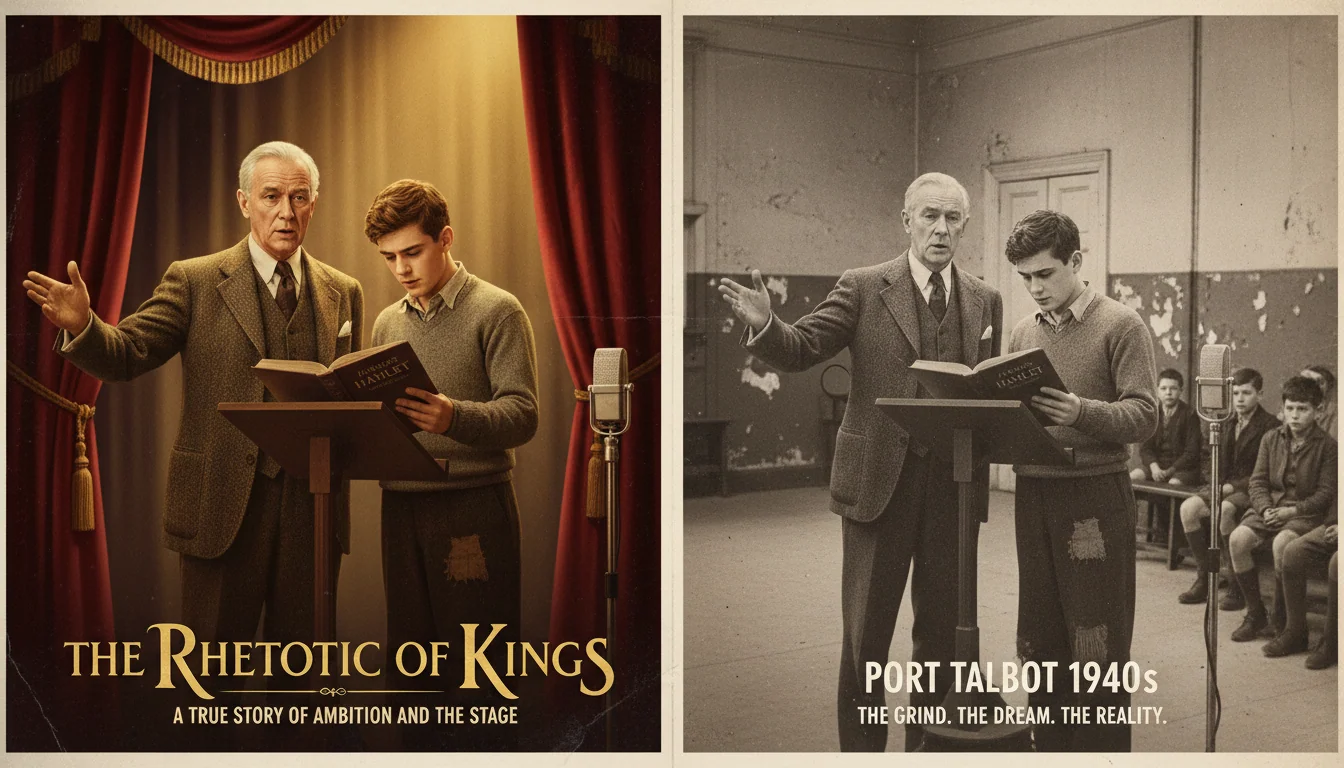
Richard Burton was arguably the finest classical actor of his generation who never won an Academy Award. His voice, described by contemporaries as sounding like a bronze bell being struck underground, became one of the most recognizable sounds of the 20th century. He threw himself at the stage and screen with terrifying energy and then, at intervals, threw himself at whisky with similar dedication. He married Elizabeth Taylor twice, was nominated for seven Academy Awards, and managed to generate approximately the same number of newspaper column inches as a small war.
He was also, before any of that, an unremarkable schoolboy from a South Wales mining village whose entire trajectory changed because one schoolmaster decided to take him seriously.
That relationship is the subject of the 2025 Welsh drama Mr. Burton - a film that approaches the Philip Burton-Richard Jenkins story with genuine ambition and arrives at something more interesting than a standard theatrical-genius-in-the-making biopic. The question, as always, is how closely the film's dramatic choices hold to what actually happened.
The historical record
The bare facts are extraordinary enough that they need no embellishment, which makes it all the more frustrating when dramatists embellish anyway.
Richard Walter Jenkins Jr. was born on November 10, 1925, in the village of Pontrhydyfen in what is now Neath Port Talbot, Wales. He was the twelfth of thirteen children born to Richard Walter Jenkins Sr., a coal miner, and Edith Maud Thomas, who died of puerperal fever when Richard was two years old. The family was rearranged by death and circumstance. Richard was largely raised by his older sister Cecilia and her husband Elfed James in Port Talbot.
Philip Hilton Burton was born in Cardiff in 1904, had studied at University College Cardiff, and by the early 1940s was working as a schoolmaster at Port Talbot Secondary Modern School while also producing drama for BBC Wales. He was a man of genuine intellectual force and evangelical commitment to verse-speaking and classical performance.
The two met around 1941-1943, when Richard Jenkins was in his middle teens. Philip noticed the boy's voice and raw intelligence. He arranged for Richard to participate in Port Talbot youth theatre productions, coached him in breath control and verse delivery, and saw in him something he believed would otherwise be wasted by Port Talbot and its alternatives.
In December 1943, Philip became Richard's legal guardian. Richard was 18. Because of the specific legal mechanisms available under Welsh and English law at the time, formal adoption was not straightforward, and Philip instead became his ward. Richard took Philip's surname. He would be Richard Burton for the rest of his life.
Philip then deployed every connection he had to get Richard to Oxford. He secured him a place at Exeter College on an RAF educational short-service commission. Richard arrived at Oxford in 1944, performed in university plays, and by the late 1940s was receiving serious critical attention in the West End.
What the film gets right
The film understands the essential dynamic: that Philip's investment in Richard was not purely pedagogical. Philip saw something that looked like genius or close to it, and he responded to it with the ferocity of a man who has been waiting for something to apply himself to. That emotional charge - the older man who has found the vehicle for his own unlived ambitions - is rendered with more honesty than most mentor biopics attempt.
The Port Talbot background is handled with appropriate lack of sentimentality. The town was industrial, poor by conventional measure, and culturally alive in ways that surprised southern English visitors. Welsh choral tradition, chapel oratory, and community theatre were serious business in the valleys, and the film grasps that Philip was not importing culture from outside but developing something that already existed in concentrated form.
The voice work in the film earns its place. The scenes depicting Philip's methods - drilling Richard on breath support, on projecting to a back wall without sounding pushed, on the specific demands of Shakespeare's verse rhythm - reflect techniques that contemporary accounts and Philip's own memoir confirm. Richard later described Philip's training as the foundation of everything he could do technically.
The legal guardianship and the name change are handled accurately. Richard Jenkins became Richard Burton in December 1943. The film does not dramatize this as a casual decision, which is correct: it was a significant step, a deliberate severance from one identity and a formal adoption of another. Richard's birth family remained the Jenkins family. Richard himself used both names in personal correspondence throughout his life, signing letters to family as Dick Jenkins.
Philip's career as a BBC producer is correctly depicted as running parallel to his teaching rather than being incidental to it. Philip's BBC connections were part of what gave him credibility and range beyond the school. He was not simply a schoolmaster with a hobby.
What the film compresses or invents
The film's most significant dramatic liberty is the compression of a relationship that developed over two to three years into a more dramatically concentrated arc. This is standard practice and not especially dishonest, but it does create the impression that Philip's decision to become Richard's guardian followed more rapidly from their initial meetings than the historical record suggests.
Philip's inner life is necessarily speculative. Philip Burton wrote a memoir, but memoirs are not confessions, and the precise nature of his attachment to Richard has been a subject of academic and biographical discussion without resolution. The film's version of Philip is coherent and dramatically grounded; whether it matches the real man's experience is something no dramatist can responsibly claim certainty about.
The film depicts Richard's family in Port Talbot primarily through his sister Cecilia and brother-in-law Elfed, who raised him in the absence of their parents. The emotional texture of that household is plausible but necessarily reconstructed. What Elfed James actually thought about Philip Burton's intervention in the family, and what negotiations accompanied the guardianship arrangement, are not documented in any source available to the filmmakers.
Richard's time at Oxford is compressed. The film follows the story through to Richard's departure for university and frames that as the culmination of Philip's project, which is structurally satisfying and historically defensible. What it cannot easily convey is that Philip remained involved in Richard's career for years afterward, and that their relationship, while it changed character as Richard became famous and then impossibly famous, never entirely dissolved.
The relationship question
Several of Richard's biographers have noted that Philip Burton's attachment to his ward had an intensity that sits somewhat outside the conventional mentor-pupil frame. Philip never married again after an early and brief first marriage. He directed much of his personal energy toward Richard's development and then, after Richard outgrew the need for active mentorship, toward other projects and other students.
Philip wrote about Richard with evident depth of feeling. Richard, for his part, acknowledged Philip's importance publicly and consistently while occasionally being less consistently attentive privately. Biographers note that Richard's letters to Philip thin out as his career accelerates.
Mr. Burton handles this dimension with enough ambiguity to avoid claiming more than the record allows. That is the right call. The claim that Philip's motives were purely pedagogical would be as unsupportable as claiming the opposite.
Historical accuracy score: 7/10
The film earns its score by taking the history seriously. Port Talbot, the Jenkins family background, the BBC, the legal arrangements around the guardianship, and the specific texture of Philip's training methods are all handled with more care than most biopics of this kind. The speculative elements are presented as speculation rather than documented fact.
Where it loses points is in the standard biopic compressions that make for a tidier story than the documented one, and in the inevitable gap between Philip Burton as a dramatic character and Philip Burton as a private human being. The man left a memoir that is remarkably candid on some subjects and notably reserved on others. The film does not pretend to have resolved what the memoir deliberately left open.
What Mr. Burton does well, and what matters most, is establish why this relationship was extraordinary: a grammar school boy with an exceptional voice and no resources whatever became Richard Burton because one person saw what that voice could become and refused to let it go unheard. That is true, documented, and more improbable than most screenwriters would dare invent. For other biopics that balance a musician or performer's mythic arc against the documented record, Bohemian Rhapsody vs. History and Walk the Line vs. History offer useful comparisons.
Quick Answers
Common questions about this topic
Who was Philip Burton?
Philip Burton (1904-1995) was a BBC radio drama producer and schoolmaster in Port Talbot, Wales who became the legal guardian and mentor of Richard Jenkins, later known as Richard Burton. Philip arranged for Richard to take his surname in 1943 and secured him a place at Oxford, effectively launching one of the 20th century's greatest theatrical careers.
Why did Richard Jenkins change his name to Richard Burton?
Richard Jenkins took the name Richard Burton in December 1943, when Philip Burton formally became his legal guardian. Philip was not able to adopt Richard outright because of his age at the time - instead, Richard became his ward. Richard chose to take Philip's surname as a mark of gratitude and loyalty. He used the name professionally for the rest of his life.
Did Philip Burton outlive Richard Burton?
Yes, by eleven years. Richard Burton died on August 5, 1984, in Celigny, Switzerland, aged 58. Philip Burton lived until September 28, 1995, dying in Key West, Florida at 91. Philip later wrote about their relationship in his memoir 'Richard and Philip: The Burtons.'
What did Richard Burton consider his greatest theatrical influence?
Richard Burton consistently credited Philip Burton as the decisive influence on his craft. Philip drilled him in voice production, breath control, and classical verse speaking, building the resonant baritone delivery that would become one of the most recognized voices of the 20th century. Without Philip, the historical consensus is that Richard Jenkins might have remained in Port Talbot.

Debate the Accuracy with the Real Figures
Ask the real people what Hollywood got wrong about their lives.
Create your free account →No card required. Talk to anyone in history with 8 free credits a day. Some features require a paid plan.
Join the HistorIQly Club
Get smarter about the past.
Weekly stories, deep dives, and exclusive content straight to your inbox.