Magellan vs. History: How Accurate Is the 2026 Circumnavigation Epic?
Examining the 2026 Magellan movie accuracy: the circumnavigation epic gets the terror and tragedy right, but quietly buries the man who actually finished the job.
Read Wikipedia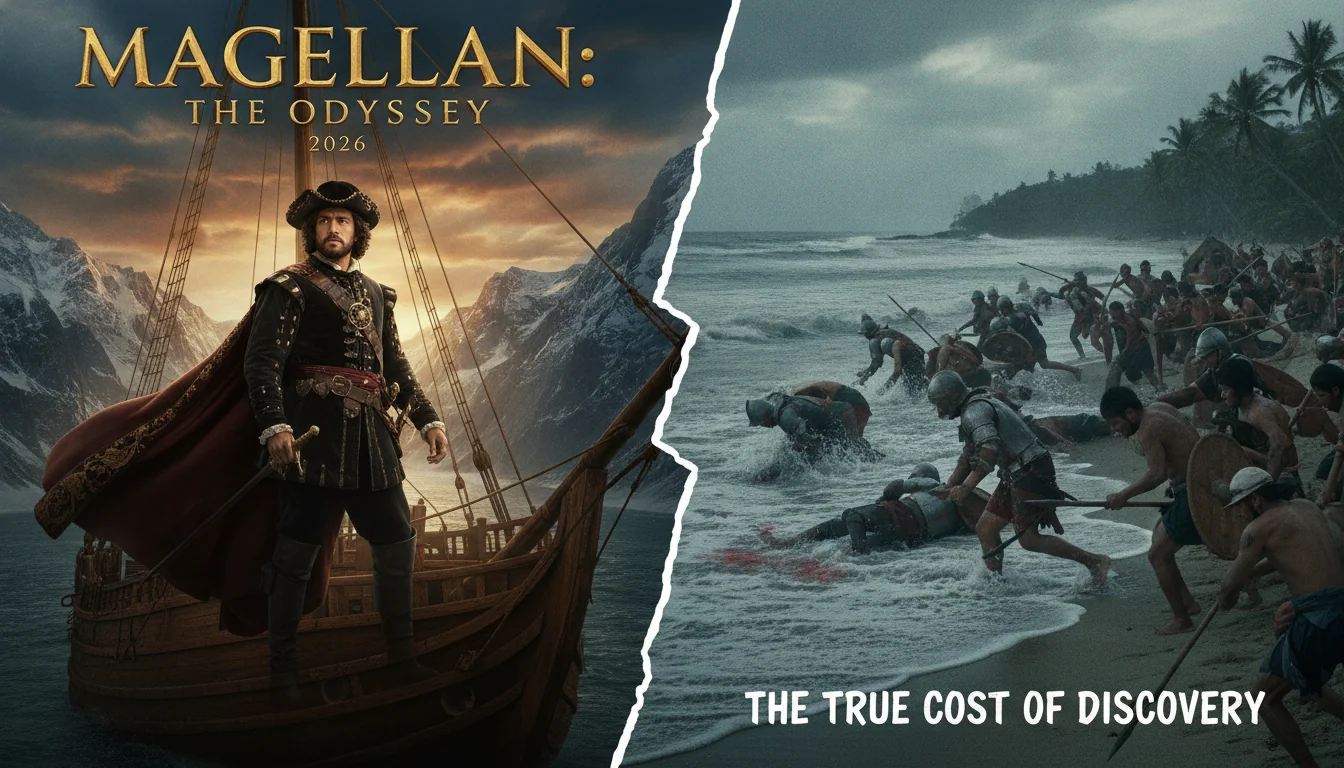
Every few decades, Hollywood produces an Age of Exploration epic, and every such film faces the same structural problem: the story it wants to tell is heroic and singular, while the history it draws on is contingent, collective, and full of people who did not survive long enough to receive credit. The 2026 Magellan film handles this problem better than most. It is visually committed, dramatically serious, and honest about the violence and privation of one of the most extraordinary voyages in recorded history. It is also, in the quiet way of maritime epics, better at celebrating the man who started the journey than at acknowledging the one who finished it.
The expedition of 1519 to 1522 is remarkable enough that no embellishment is needed. Five ships and roughly 270 men departed Spain intending to reach the Spice Islands of Southeast Asia by sailing west, which had never been done. One ship returned, carrying 18 survivors and a hold full of cloves sufficient to pay for the entire voyage. The distance traveled was about 42,000 miles. It took three years. Magellan died less than halfway through.
What the film gets RIGHT
The scale and the audacity
The expedition departed Sanlúcar de Barrameda on September 20, 1519, with five ships: the Trinidad, San Antonio, Concepción, Victoria, and Santiago. The crew was multi-national in the way that maritime ventures of the period typically were - Spanish, Portuguese, Italian, Greek, French, English, German, and African sailors, all answerable to a Portuguese captain sailing under Spanish authority. Magellan himself had been passed over for promotion by the Portuguese crown and had transferred his service to King Charles I of Castile.
Nobody aboard had any reliable knowledge of the Pacific Ocean's width. Magellan believed it would take a few weeks to cross after passing through the South American straits. It took ninety-nine days. The film does not spare this detail. Men ate leather, sawdust, and rats. Scurvy hollowed out the crew. Two sailors were put ashore on the Patagonian coast as punishment for mutiny and not collected. The accounting of who died and how is handled without sentimentality.
The Strait and the mutinies
The passage now called the Strait of Magellan runs for roughly 600 kilometers through channels, glacial squalls, unpredictable currents, and permanent fog. Magellan navigated it in thirty-eight days in October and November of 1520, after spending months in a Patagonian anchorage at Port Saint Julian while three of his five captains mutinied.
The mutiny sequences are the best scenes in the film, and they are essentially accurate. Three captains - Gaspar de Quesada, Juan de Cartagena, and Luis de Mendoza - attempted to seize control and turn the expedition back to Spain in April 1520. Magellan responded by having Mendoza killed, Quesada executed, and Cartagena marooned. He then proceeded. The cold calculation required to manage 270 men of different languages and nationalities in a situation where turning back was existential failure is one thing the film understands clearly about its subject.
The death at Mactan
Antonio Pigafetta, an Italian scholar who sailed with the expedition and survived it, left a detailed account of the Battle of Mactan on April 27, 1521, that is one of the earliest firsthand European accounts of combat in Southeast Asia. The film follows it closely. Magellan inserted himself into a dispute between local rulers and led about sixty men, some of them in water up to their knees, against a Mactan force that Pigafetta estimated at more than a thousand. The attack was badly planned. Magellan was hit by a bamboo spear in the leg, then by poisoned arrows, then overwhelmed when his men retreated. Pigafetta stayed close until the final moments.
The film does not make this heroic in the conventional sense. Magellan waded into shallow water against poor odds because he believed his authority and his God would protect him, and they did not. That is accurate, and it is more honest about the nature of European overconfidence in this period than most films of this kind manage.
What the film gets WRONG
The erasure of Elcano
Juan Sebastian Elcano is the figure the film cannot quite accommodate. He appears in the narrative as a capable officer - his actual role as one of the original mutineers at Port Saint Julian, who was then pardoned and restored to command, is acknowledged in passing - but his fifteen months of navigation after Magellan's death are compressed into an epilogue.
What Elcano actually did deserves its own film. After Magellan's death, the remaining expedition killed or lost its next two commanders, burned the Concepción because they lacked the crew to sail three ships, and managed to reach the Moluccas in late 1521 and load a cargo of cloves. Two ships attempted to return: the Trinidad tried to cross the Pacific eastward and was captured by the Portuguese. Elcano took the Victoria south and west, around the Cape of Good Hope, up the Atlantic, and into Sanlúcar de Barrameda on September 6, 1522.
He brought back 18 men, the cloves, and the completion of the first documented circumnavigation of the globe. Charles I awarded him the motto Primus circumdedisti me, which is not ambiguous. The king knew which man had sailed the full circuit.
The problem of credit
Most Western tellings of this story, and the 2026 film is no exception, treat the circumnavigation as Magellan's achievement because he conceived and commanded the expedition. This is the logic of credit by intention: Magellan meant to go around the world, therefore he circumnavigated it, even though an arrow killed him in the Philippines.
By the same logic, you could award the medal to Amerigo Vespucci for a continent he never crossed, or to Columbus for an ocean route he used but a continent he never properly understood. The convention is not impossible to defend - expedition leadership was the historic form of credit for geographic discovery - but it flattens a much more interesting story in which the man who finished the job was not the man who started it. The same structural flaw runs through the genre: in U-571, a 2000 naval thriller, American forces received on-screen credit for capturing an Enigma device that British sailors had actually secured first, prompting a formal parliamentary apology to veterans.
The invisibility of Enrique
The most interesting person on the Magellan expedition appears in the film as a minor background figure: Enrique of Malacca, an enslaved man Magellan had purchased around 1511 in the Malay trading city of Malacca and brought back to Europe. Enrique traveled west from Southeast Asia to Lisbon, then onward to Spain, then back east across the Atlantic, through the Strait of Magellan, across the Pacific, and to the Philippine islands in 1521.
When the fleet reached the Philippines and Enrique was able to communicate directly with local people, he had, depending on his origin point somewhere in or near Malacca, potentially completed a full circle of the globe - ten years before the formal expedition, and without any of the credit that Magellan and Elcano would receive. He disappears from the historical record after Magellan's death. No film has given him more than a walk-on part.
Pigafetta's arithmetic
The expedition's most vivid source is Pigafetta's journal, which the film draws on throughout. Pigafetta was a perceptive observer and his descriptions of peoples, customs, and landscapes he encountered are historically valuable. His numbers are not reliable. The enemy force at Mactan was almost certainly not as large as he recorded. Casualty figures throughout the journal conform to a literary convention of the period that favored dramatic asymmetry. The film inherits these exaggerations uncritically, which is a standard problem in any cinematic adaptation of a primary source.
Historical Accuracy Score: 7.5/10
The 2026 Magellan film is more honest about death and failure than most adventures of its scale - closer in spirit to the approach taken by Master and Commander than to the typical adventure epic. It does not pretend the voyage was a clean success. It depicts the mutinies, the starvation, the violence, and the disastrous battle at Mactan with reasonable fidelity to the documentary record. It earns its points for tone and texture.
It loses points for two structural problems that are probably inseparable from the commercial logic of a film with one name in the title: the credit problem and the Elcano problem. The first circumnavigation of the globe is actually the story of a Portuguese navigator killed in the Philippines, a Basque mariner who brought the ship home, and a Malay-speaking man who may have been the first human being to travel the full circuit. That is a better story than the one the film tells. It just requires the title to read differently.
Quick Answers
Common questions about this topic
Did Magellan circumnavigate the globe?
No. Magellan was killed at the Battle of Mactan in the Philippines on April 27, 1521, before the expedition completed its return to Spain. Juan Sebastian Elcano commanded the surviving ship Victoria back to Sanlúcar de Barrameda, arriving on September 6, 1522. The man who organized the voyage and the man who finished it are different people, and most films about this subject credit the wrong one.
Who actually completed the first circumnavigation?
Juan Sebastian Elcano, a Basque mariner serving under Magellan, commanded the Victoria back to Spain with 18 surviving men from an original crew of about 270. King Charles I granted him a coat of arms featuring a globe with the Latin motto Primus circumdedisti me, meaning 'you were the first to circle me.' The king knew who had actually finished the job.
Why was Magellan killed at Mactan?
Magellan inserted himself into a local political dispute in the Philippines between Rajah Humabon of Cebu, who had converted to Christianity and allied with the Spanish, and Datu Lapu-Lapu of Mactan island, who refused to submit. Magellan led an assault on Mactan with about 60 men against a force that vastly outnumbered them. He was killed in the fighting on April 27, 1521.
Who was Enrique of Malacca?
Enrique was a Malay-speaking enslaved man purchased by Magellan in Malacca around 1511, who traveled west with him to Europe and then returned east with the expedition. When the fleet reached the Philippines in 1521, Enrique could communicate with local people, suggesting he had traveled full circle - making him arguably the first person to circumnavigate the globe, ten years before the expedition's formal completion.

Debate the Accuracy with the Real Figures
Ask the real people what Hollywood got wrong about their lives.
Create your free account →No card required. Some figures and features require a paid plan.
Join the HistorIQly Club
Get smarter about the past.
Weekly stories, deep dives, and exclusive content straight to your inbox.