Nuremberg vs. History: How Accurate Is the Rami Malek Trial Drama?
Nuremberg movie accuracy check: does the 2025 Rami Malek drama get Robert Jackson, Goering's cross-examination, and the trials' legal innovations right?
Read Wikipedia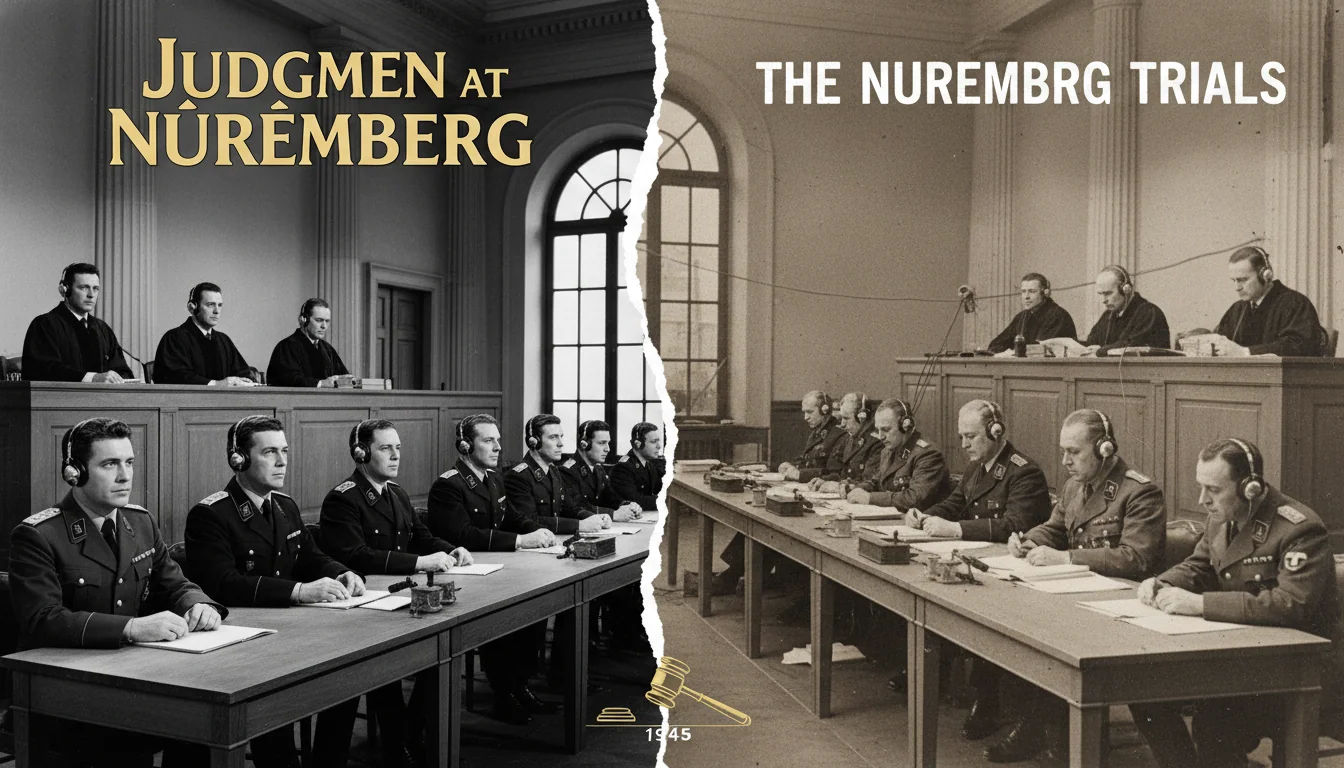
The case for putting the Nuremberg Trials on screen has always been obvious. The setting is a shattered German city. The defendants are the leadership of a regime that murdered millions. The prosecutors are improvising a new branch of international law in real time. The lead counsel for the United States is a sitting Supreme Court Justice who left the bench to argue the most consequential criminal case in modern history. And the defendant who runs rings around him in cross-examination was once the second most powerful man in the Third Reich.
The 2025 film "Nuremberg," with Rami Malek as Robert H. Jackson, takes this material and builds a courtroom drama around the prosecution's journey from the opening statement of November 1945 through the verdicts of October 1946. It is a film with obvious ambitions and a subject that demands exactness. The history rewards the effort. It also complicates it.
What Hollywood got RIGHT
Robert Jackson's opening statement is genuinely extraordinary
The film's opening set piece, Jackson's address to the International Military Tribunal on November 21, 1945, is one of the most celebrated speeches in legal history. The real text reads: "The privilege of opening the first trial in history for crimes against the peace of the world imposes a grave responsibility. The wrongs which we seek to condemn and punish have been so calculated, so malicious, and so devastating, that civilization cannot tolerate their being ignored because it cannot survive their being repeated."
Any dramatization that captures even a portion of that language is working from authentic material. Jackson's actual opening statement ran to hours and set out the prosecution's novel legal theory that waging aggressive war was itself a crime, not merely a political act. The speech established the moral and legal framework the tribunal would use for the next eleven months.
Hermann Goering dominated his cross-examination
The film's central dramatic problem is historically accurate: Jackson, one of the finest legal minds of his generation, was outmaneuvered by Goering during cross-examination in March 1946. Goering had been preparing for months, coached by his defense attorney Otto Stahmer and by his own formidable intelligence. He had studied the prosecution's documents, anticipated the lines of questioning, and prepared speeches that turned each question into an opportunity to reframe the Nazi narrative.
When Jackson asked whether Goering understood that the German rearmament program was a violation of the Treaty of Versailles, Goering answered with a lecture on why Germany had been right to reject the treaty's terms and how the Allies had failed to honor their own disarmament commitments. Jackson tried to cut him off and was overruled by the tribunal. He appealed to the bench to restrict Goering's answers to yes or no, which Soviet and British observers noted was not standard practice for cross-examination of a defendant who had a right to explain his answers.
The Jackson-Goering confrontation is accurately treated in most serious accounts of the trial as a prosecution setback, one the film apparently does not shy away from.
The defendants were a genuine cross-section of the Nazi leadership
The film accurately represents the variety of people in the dock. The Nuremberg defendants were not all war criminals in the same sense. Rudolf Hess, who had flown to Scotland in 1941 on a bizarre solo peace mission, was clearly mentally diminished by the time of the trial. Albert Speer, Hitler's architect and later armaments minister, mounted a defense based on claimed ignorance of the Holocaust that many observers found implausible but strategically effective, and received a prison sentence rather than death. Hans Frank, the Governor-General of occupied Poland, was forthright about the killings in his jurisdiction in ways that made his conviction straightforward. Julius Streicher, who had no direct administrative role in the Holocaust but had published virulently antisemitic propaganda for decades, was condemned purely for incitement.
The tribunal had to develop law on the spot to handle each category. That tension is historically authentic.
What Hollywood got WRONG
Jackson's cross-examination failure was more public and more damaging than dramatizations usually show
The film may compress or partially rehabilitate Jackson's performance in cross-examination. In reality, the episode was a significant blow to his standing. Legal observers at the time, including some within the American prosecution team, were openly critical. Telford Taylor, who assisted Jackson and later wrote the definitive account of the trials, described the cross-examination as a strategic failure that let Goering control the proceedings for days.
Jackson himself was embarrassed. He wrote to his son that Goering had proved a more capable opponent than he had expected. The three-judge panel declined to intervene on Jackson's behalf in the way he had hoped, and Goering continued to respond at length to questions designed to produce one-word answers.
The real Jackson recovered by returning to document-based presentation and by leaving subsequent cross-examinations to his subordinate prosecutors, who handled defendants like Speer more effectively.
The "crimes against humanity" framework was more contested than it appears
Films about Nuremberg often present the legal innovations as a natural, broadly endorsed step forward in international law. In fact, the Allied prosecutors disagreed significantly among themselves about the proper legal basis for the trial. The Soviet delegation wanted to include charges related to the invasion of Finland and the Molotov-Ribbentrop Pact's secret protocols dividing Eastern Europe, subjects that the Western Allies quietly resisted for obvious reasons. British and American prosecutors differed on whether "conspiracy" as a standalone charge was appropriate under European legal traditions.
The final indictment was a compromise document, and not everyone who helped draft it was satisfied with it. The subsequent accusation of "victor's justice" from German legal scholars was not simply propaganda: some of the procedural innovations at Nuremberg were genuinely novel applications of law to circumstances that existing legal frameworks did not cover.
Three defendants were acquitted
Films about Nuremberg almost never spend time on the acquittals, which is a meaningful omission. Three defendants were found not guilty: Hjalmar Schacht, who had served as Reichsbank president and Economics Minister; Franz von Papen, who had been Vice Chancellor under Hitler in 1933; and Hans Fritzsche, a senior official at the Reich Ministry of Propaganda.
The acquittals were surprising and controversial. The Soviet judge dissented in all three cases. Schacht had left the government in 1937 after conflicts with Goering over economic policy, and the tribunal concluded that the prosecution had not proven his knowledge of or participation in criminal plans. Von Papen had helped Hitler become Chancellor, a fact that many observers felt should have been sufficient for conviction. Fritzsche's acquittal in particular suggested that propaganda alone, however vicious, did not meet the tribunal's threshold for criminal liability.
The acquittals complicated the narrative of Nuremberg as a clean exercise in justice, which is probably why dramatizations tend to gloss over them.
Historical Accuracy Score: 7.5/10
The Nuremberg Trials are so thoroughly documented - in transcripts, memoirs, journalism, and scholarly accounts - that the basic factual record is hard to distort without drawing immediate criticism. The film appears to hold to the documented outline of events: the opening statements, the Goering confrontation, the weight of the documentary evidence strategy that the prosecution ultimately relied upon when live witnesses disappointed.
What drama naturally tends to do with this material is streamline the legal complexity, compress the eleven-month proceedings, and give Jackson a more coherent arc of personal reckoning than the historical record fully supports. The real Robert Jackson was a gifted legal writer who found the demands of courtroom examination more difficult than anticipated, who presided over a sprawling multinational team that sometimes pulled in different directions, and who returned to the Supreme Court after Nuremberg with his reputation complicated rather than enhanced.
The trials themselves were genuinely historic. The legal framework they established, flawed and improvised as it was, became the foundation for the Geneva Conventions of 1949, the International Criminal Court, and every subsequent war crimes tribunal. Jackson's opening statement, even if he stumbled in cross-examination, remains one of the foundational texts of postwar international law.
Any film that treats the Nuremberg defendants as individuals rather than as a single mass, that acknowledges the prosecution's difficulties, and that does not reduce the event to a simple morality play is doing more justice to the history than most audiences expect.
For other films about World War II decision-making checked against the record, Darkest Hour covers the Allied leadership from Churchill's perspective. Valkyrie dramatizes the German resistance and gets the conspiracy's timeline and cast largely right.
Quick Answers
Common questions about this topic
Who was Robert Jackson at the Nuremberg Trials?
Robert H. Jackson was an Associate Justice of the U.S. Supreme Court who took a leave of absence to serve as the chief American prosecutor at the International Military Tribunal in Nuremberg from 1945 to 1946. He delivered the opening statement for the prosecution, conducted the cross-examination of Hermann Goering, and helped craft the legal framework that defined crimes against humanity and crimes against peace.
What were the main charges at the Nuremberg Trials?
The International Military Tribunal charged defendants under four counts: conspiracy to wage aggressive war, crimes against peace (waging aggressive war), war crimes, and crimes against humanity. The final two categories were largely new to international law and were established at Nuremberg itself.
Did Hermann Goering really outperform Jackson in cross-examination?
Yes. Goering's cross-examination by Jackson in March 1946 is widely considered a prosecution embarrassment. Goering was well-prepared, composed, and frequently turned Jackson's questions to Nazi Germany's advantage, citing Allied parallels and challenging the legitimacy of the tribunal. Jackson appealed to the court to restrict Goering's answers, which was seen by observers as a sign that the cross-examination had gone badly.
What happened to the Nuremberg defendants?
Of the 22 defendants tried, 12 were sentenced to death, three were acquitted, and the rest received prison sentences ranging from 10 years to life. Hermann Goering was condemned to death but committed suicide with a cyanide capsule the night before his scheduled execution. Ten others were hanged on October 16, 1946.

Debate the Accuracy with the Real Figures
Ask the real people what Hollywood got wrong about their lives.
Create your free account →No card required. Some figures and features require a paid plan.
Join the HistorIQly Club
Get smarter about the past.
Weekly stories, deep dives, and exclusive content straight to your inbox.