The Eyes of Tammy Faye vs. History: Historical Accuracy of the PTL Scandal Drama
The Eyes of Tammy Faye historical accuracy: Jessica Chastain's Oscar-winning performance nails the makeup and tears, but compresses the PTL financial fraud.
Read Wikipedia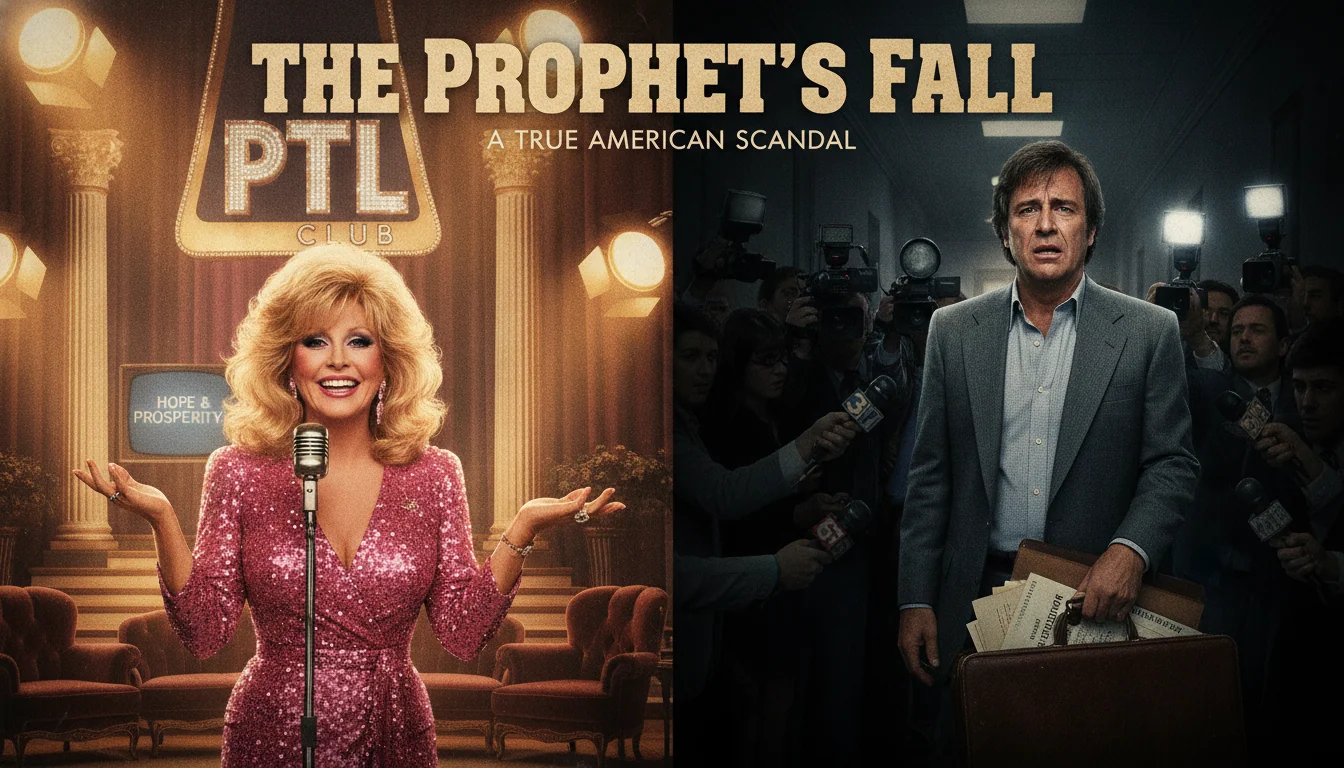
Jessica Chastain won an Academy Award for playing a woman most of America remembers, if it remembers her at all, as a punchline: the televangelist's wife with the raccoon-eyed mascara who cried on cue and asked for money. The Eyes of Tammy Faye set out to complicate that memory, and largely succeeds on the historical accuracy front, though it does so by softening some of the harder financial edges of the real PTL story.
The setup: PTL and Heritage USA
Jim and Tammy Faye Bakker built PTL, short for Praise The Lord (and, in its own promotional material, People That Love), into one of the largest televangelism operations in the United States by the early 1980s. Their signature project was Heritage USA, a Christian theme park and resort complex in South Carolina that at its peak drew millions of visitors a year, complete with water slides, a shopping mall, and a hotel tower.
The film accurately depicts the sheer scale of that ambition: a couple who started with puppet shows on a local Christian station building an empire that combined broadcast ministry, real estate development, and merchandising into something closer to a media conglomerate than a church.
From puppet shows to a television empire
The film's early stretch, following young Jim and Tammy Faye touring small Pentecostal churches with hand puppets before landing a slot on Pat Robertson's fledgling Christian Broadcasting Network, reflects the couple's actual origin story reasonably closely. Both had grown up in modest Pentecostal households, met at North Central Bible College, and married young against the wishes of their families, who worried neither of them had a stable income. Their puppet ministry genuinely was their entry point into religious broadcasting, and Tammy Faye's puppet characters became popular enough with young viewers to give the couple a recognizable brand years before PTL existed in any developed form.
Andrew Garfield's portrayal of Jim Bakker leans into the charisma and the anxious hustle that colleagues from the period have described: a man who was, by most contemporary accounts, a genuinely gifted broadcaster and fundraiser who came to see ever-larger capital projects as proof of divine favor rather than financial risk. That reading of his personality lines up with how business partners and PTL insiders characterized him both before and after the scandal broke.
What the film gets right
Chastain's performance is anchored in real documented behavior, the same grounding-in-the-record instinct that carries a biopic like A Complete Unknown when it takes on its own real-life subject. Tammy Faye's on-air emotional openness, her willingness to cry, sing, and speak candidly about depression and medication in an era when religious broadcasting demanded a curated image of stability, is well supported by archival footage and by the 2000 documentary the film is adapted from. The makeup, exaggerated as it looks, closely mirrors Tammy Faye's actual signature look, which she maintained even later in life, including through cancer treatment, as a matter of personal identity rather than vanity alone.
The film's handling of Tammy Faye's advocacy for people with AIDS is also grounded in fact. Her 1985 interview with a gay pastor living with AIDS, in which she embraced him on camera and urged compassion, was a genuinely unusual moment in the religious broadcasting landscape of the period, and it did earn her a devoted following in the LGBTQ community that persisted long after PTL's collapse.
The broad arc of Jim Bakker's downfall is also faithfully rendered: the 1987 revelation of a payoff to church secretary Jessica Hahn following an encounter years earlier, the resulting resignation, the rival televangelist Jerry Falwell taking over PTL's leadership and then declining to hand it back, and Bakker's eventual criminal prosecution for financial fraud tied to Heritage USA's oversold "lifetime partnership" packages.
What the film compresses or softens
Where the movie pulls its punches is in the financial mechanics of the fraud itself. PTL sold hundreds of thousands of lifetime partnerships promising annual stays at Heritage USA lodging that the resort could never physically accommodate, a scheme prosecutors characterized as a pyramid-like structure funding lavish executive compensation rather than the ministry's stated charitable purposes. The film gestures at extravagant spending, the air-conditioned doghouse has become the most quoted detail, but it spends comparatively little time on the accounting structure that actually put Jim Bakker in federal prison, the same narrative shortcut that scandal-era dramas like All the President's Men also take when compressing the paperwork behind a real institutional collapse.
Tammy Faye's degree of awareness about that financial engine is one of the more contested points in the real story, and the film resolves the ambiguity in her favor more cleanly than the historical record fully supports. She maintained until her death that she was focused on the ministry and the show, not the books, and several biographers have accepted that account largely at face value. But contemporaries closer to PTL's operations were more skeptical, noting that she lived at the center of an enterprise whose spending patterns were difficult to miss even without direct access to the ledgers.
The film also somewhat streamlines the timeline around Jim Bakker's prison sentence and Tammy Faye's subsequent divorce and remarriage to contractor Roe Messner, the man who had built much of Heritage USA and who was later separately convicted of bankruptcy fraud in a matter connected to his own construction business. The real sequence involved years of separate legal proceedings that the film compresses into a tighter emotional throughline.
After PTL: the part the film only gestures at
The movie ends its main narrative not long after Bakker's downfall, but the real Tammy Faye lived nearly two more decades afterward, a period the film compresses into a brief coda. She divorced Bakker in 1992 while he was still incarcerated, remarried Messner, and spent much of the 1990s and 2000s rebuilding a public identity separate from PTL, including a stint co-hosting a talk show and a memorable, widely covered appearance on a celebrity reality series in the early 2000s that introduced her to a younger audience with no memory of the original scandal. She was diagnosed with colon cancer in the mid-1990s and later with a recurrence that ultimately proved terminal, and she continued to give interviews from her home almost until her death in 2007, still in her trademark makeup, still describing her faith as unshaken by everything PTL had cost her.
That late-life chapter, arguably as important to how Tammy Faye is remembered today as the PTL years themselves, gets only glancing treatment in the film's closing minutes. It is an understandable choice for a two-hour biopic built around a single rise-and-fall arc, but it means audiences leave the theater with a clearer picture of Tammy Faye the scandal survivor than Tammy Faye the unlikely later-life icon.
The score: 7/10
The Eyes of Tammy Faye earns credit for resisting the easy version of this story, the one where Tammy Faye is simply a co-conspirator or a naive dupe, and instead building a portrait consistent with how she described herself and how many who worked with her remembered her: genuinely devoted to the ministry's emotional mission, genuinely uncomfortable with some of PTL's harder-edged politics, and genuinely unwilling, whether by choice or self-protection, to look closely at where the money went.
Where it loses points is in how little screen time goes to the actual financial fraud that ended Jim Bakker's ministry and put him behind bars. Viewers who only know the PTL scandal from this film will understand the personal betrayal and the public humiliation vividly. They will come away with a much thinner sense of how the lifetime-partnership scheme worked, why federal prosecutors treated it as a serious crime rather than a moral failing, and how many ordinary donors lost money trusting a promise the resort could never keep. That gap between emotional truth and financial detail is common in biopics built around a sympathetic central performance, and it is exactly the gap here.
Quick Answers
Common questions about this topic
Is The Eyes of Tammy Faye based on a true story?
Yes. The 2021 film, directed by Michael Showalter and starring Jessica Chastain, is based on the real rise and fall of Jim and Tammy Faye Bakker's PTL television ministry, and it draws its title and much of its research from a 2000 documentary of the same name.
Did Jim Bakker really go to prison?
Yes. Bakker was convicted in 1989 on fraud and conspiracy charges tied to oversold Heritage USA lifetime partnerships and was sentenced to 45 years, later reduced on appeal. He served roughly five years before his release in 1994.
Did Tammy Faye know about the financial fraud?
The film largely portrays her as removed from the financial mechanics of PTL, focused on the ministry's public and emotional side rather than its accounting. Tammy Faye herself maintained for the rest of her life that she was not aware of the extent of the fraud, though some contemporaries were skeptical that she was as uninvolved as she claimed.
Why did Tammy Faye Bakker become a gay icon?
In the 1980s and 1990s, at a time when much of the American religious broadcasting world treated the AIDS crisis with hostility or silence, Tammy Faye publicly and tearfully advocated for compassion toward people with HIV and AIDS on her own show, a stance that won her lasting affection in the LGBTQ community long after PTL collapsed.

Debate the Accuracy with the Real Figures
Ask the real people what Hollywood got wrong about their lives.
Create your free account →No card required. Some figures and features require a paid plan.
Join the HistorIQly Club
Get smarter about the past.
Weekly stories, deep dives, and exclusive content straight to your inbox.