Nyad vs. History: How Accurate Is the Cuba-to-Florida Swim Film?
The 2023 Netflix film Nyad captures Diana Nyad's 2013 Cuba-to-Florida swim. Here is what nyad netflix accuracy gets right - and what it quietly leaves out of the story.
Read Wikipedia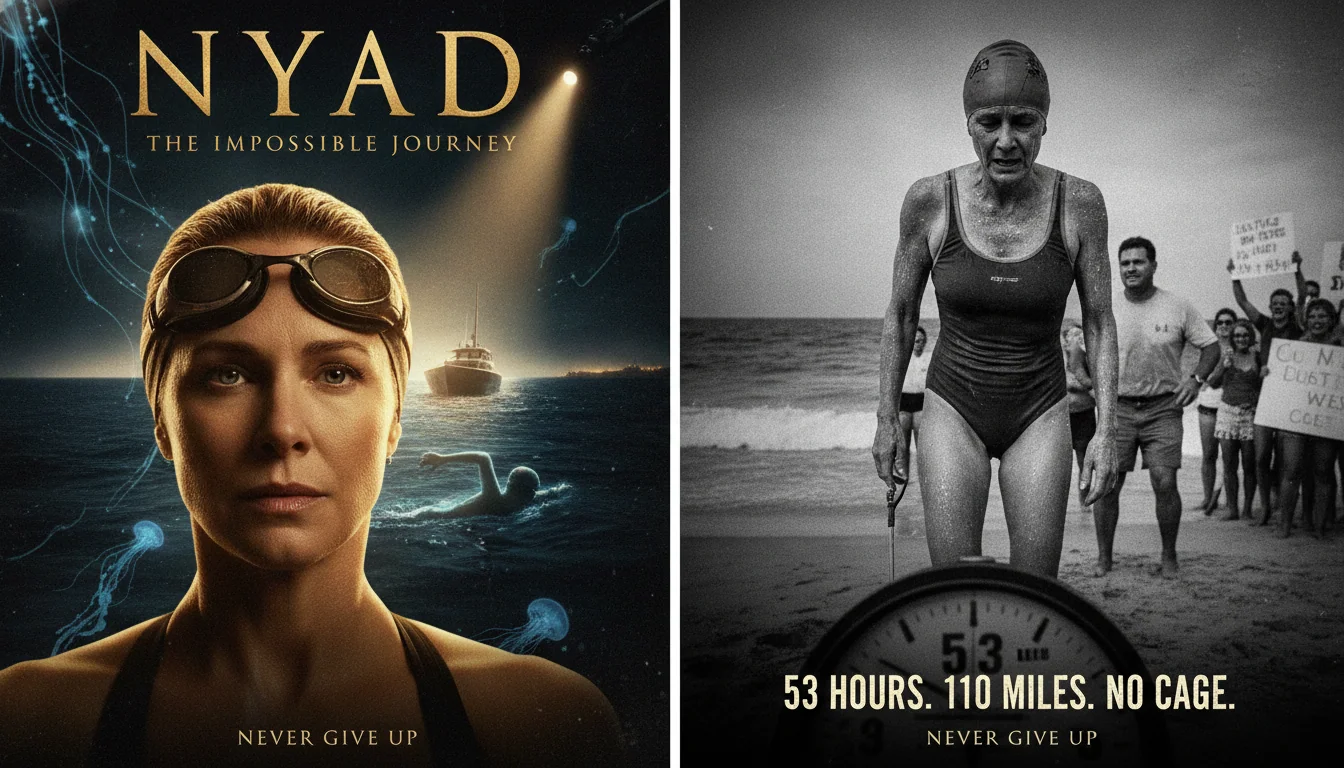
Diana Nyad was 64 years old when she walked out of the sea at Key West on September 2, 2013, after nearly 53 hours in the water. She had swum from Havana without a shark cage, without mechanical assistance, without drafting behind a vessel. She had been stung by jellyfish, battered by asthma attacks, and was barely coherent when she reached the beach. The words she delivered in her first public minutes - about pursuing dreams at any age, about never giving up - became the most-shared footage of her career.
The Netflix film "Nyad," directed by Jimmy Chin and Elizabeth Chai Vasarhelyi, the team behind Free Solo, takes that story and turns it into a portrait of obsession, female friendship, and the specific madness of returning to something that has broken you multiple times. Annette Bening plays Diana Nyad. Jodie Foster plays Bonnie Stoll, Nyad's best friend and the logistical architect of all five crossing attempts. Released in November 2023, the film received two Academy Award nominations and strong critical praise.
It is, on the whole, an honest film. But it makes choices that compress, simplify, or quietly sidestep some of the harder questions around Nyad's achievement.
What Hollywood Got RIGHT
The 1978 first attempt and the decades-long pause
The film correctly establishes that Nyad's Cuba-to-Florida obsession predates 2013 by decades. In 1978, at age 28, Nyad attempted the crossing inside a shark cage - the format in which all previous attempts had been made. She swam 102 miles in about 27 hours in that configuration, the longest open-water swim in history at the time, but was pushed off course by currents and did not complete the Cuba-to-Florida crossing. For roughly 30 years she set the swim aside. The film's framing of her 2010 return as a confrontation with unfinished business in her early 60s is accurate to what Nyad herself has described.
The jellyfish
Nyad's 2011 and 2012 attempts both failed largely because of box jellyfish. The species, Chironex fleckeri and related varieties, can produce stings capable of triggering anaphylactic shock in sensitive individuals. During one of the 2012 attempts, Nyad's face swelled severely from repeated contact. The film's depiction of the jellyfish problem - including the specially designed full-face silicone mask and gloves her team developed for the 2013 attempt - is accurate to the engineering solutions that eventually allowed the crossing to proceed.
Bonnie Stoll's role
Jodie Foster's portrayal of Bonnie Stoll is one of the film's clearest assets and one of its most accurate elements. Stoll ran the support operation across all five attempts, managed the rotation of support swimmers and crew, made calls about weather windows, and provided the emotional stability for a swimmer who, by her own account, could be difficult to work with during extended physical distress. Both Stoll and Nyad have confirmed publicly that the friendship at the film's center is depicted truthfully.
The physical reality
The film does not prettify the crossing. Nyad's hallucinations are depicted - the brass band she later described hearing playing somewhere underwater around hour 30, the visual distortions that intensified in the final hours. Her speech is visibly deteriorating when she reaches the beach. The swelling is visible on her face. The film's commitment to showing how a human body looks after 53 hours in salt water without normal sleep is accurate, and is one reason the finale carries emotional weight rather than generic triumph.
The historical achievement
The core facts are correct. Nyad entered the water at Havana on August 31, 2013. She swam the open crossing to Key West, arriving September 2, in approximately 52 hours and 54 minutes. She was accompanied by a support team and boat crew but swam entirely unassisted, with no mechanical aids and no drafting. She was 64 years old, the oldest person to complete any version of the Cuba crossing, and the first to complete it without a shark cage.
What Hollywood Got WRONG (or Smoothed Over)
The navigator controversy
The film's most significant omission is the dispute around John Bartlett, Nyad's navigator for the 2013 attempt. After the swim, serious observers in the marathon-swimming community raised questions about the route data. The GPS track disclosed publicly was incomplete, showing gaps at key points. Critics noted that Nyad's track appeared to enter favorable Gulf Stream currents in ways that would have shortened the effective swimming distance below the advertised 110 statute miles. Bartlett and Nyad disputed the criticisms, but the Marathon Swimmers Federation - the governing body for open-water marathon swimming - declined to officially ratify the swim, citing insufficient independent verification.
The film acknowledges none of this. Bartlett appears as a competent but occasionally uncertain navigator facing genuine conditions. The organized skepticism of the marathon-swimming community, documented in multiple post-swim analyses, does not appear.
The compression of the 2012 attempts
The film condenses two separate 2012 attempts into a single dramatic beat. In reality, Nyad made two distinct attempts in 2012, separated by recovery periods. The first ended after roughly 41 hours due to jellyfish stings and asthma. The second, later in the season, ended after about 67 miles due to strong opposing currents and additional jellyfish. Combining them simplifies the cumulative physical and psychological toll, which was considerable.
The older record dispute
The film treats Nyad's pre-2013 achievements as straightforward. Her 1979 swim around Manhattan and several other long-distance claims have generated long-running disputes in the marathon-swimming community over documentation and verification. The film shows none of this context, which would complicate the portrait of Nyad as someone whose records have always been accepted rather than argued over.
Nyad's self-presentation
The film portrays Nyad as driven and occasionally insufferable - which matches the accounts of several people who worked with her - and then suggests she achieves some meaningful personal transformation by the end. The woman who delivers the beach speech about age and possibility is real. The version of Nyad who has fully resolved the ego that generated most of the conflict along the way is somewhat idealized. People who know her well have been gentle but consistent on this point in interviews.
The broader context the film skips
One element the film touches only briefly is the sport of marathon swimming itself and how deeply divided its practitioners were about Nyad's crossing. Open-water marathon swimming has its own culture, its own verification standards, and its own history of disputed claims. The community's skepticism about Nyad was not simple jealousy or gatekeeping. It reflected genuine concern about whether the verification of the 2013 swim met the standards applied to other records in the discipline. The film presents that community mostly as an obstacle to Nyad's triumph rather than as people with legitimate professional questions.
The directors Chin and Vasarhelyi made Free Solo with Alex Honnold, another elite athlete who operated on the margins of what most people considered survivable and whose relationship with his own sport's culture was complex. They are clearly drawn to people who push past institutional boundaries. That sympathy shapes what Nyad shows the audience and what it doesn't.
Historical Accuracy Score: 7/10
"Nyad" is an honest film about the core of what Diana Nyad did. The swim was real. The jellyfish were real. The years of failure were real. The friendship between Nyad and Stoll is rendered with evident care and confirmed by both women. What the film omits - the navigation controversy, the skepticism of the governing body in her own sport, the full weight of the two 2012 failures - keeps it from being a complete portrait. It is a film about human endurance that earns its tribute to a genuine achievement, while allowing Nyad to tell her own story largely in her own terms. That is, ultimately, the kind of thing a subject-approved biopic does. For films about record-breaking achievements where the cinematic version simplifies the institutional reality, First Man vs. History and Apollo 13 vs. History offer useful comparisons.
Quick Answers
Common questions about this topic
Is the Nyad film based on a true story?
Yes. Nyad (2023) dramatizes Diana Nyad's 2013 swim from Havana, Cuba to Key West, Florida - 110 miles without a shark cage - which made her the first person to complete that crossing unaided. The film stars Annette Bening as Nyad and Jodie Foster as Bonnie Stoll, her longtime coach and closest friend.
How long did Diana Nyad's 2013 swim actually take?
Nyad completed the crossing in approximately 52 hours and 54 minutes, entering the water in Cuba on August 31, 2013 and arriving at Key West on September 2. The film's portrayal of the swim's duration and physical toll is broadly accurate.
Was there controversy about Diana Nyad's swim?
Yes. Several long-distance marathon swimmers raised questions about whether Nyad benefited from favorable currents, whether her route deviated in ways that shortened the effective distance, and whether the navigator John Bartlett's route management was fully disclosed. The Marathon Swimmers Federation declined to officially ratify the swim. Nyad and her team disputed all of these criticisms.
Who was Bonnie Stoll, played by Jodie Foster?
Bonnie Stoll was Diana Nyad's closest friend and support team leader, a former professional racquetball player. She organized the logistics for multiple attempts, provided emotional support through years of failure, and was central to the 2013 success. Both Stoll and Nyad have said the friendship depicted in the film is accurate.

Debate the Accuracy with the Real Figures
Ask the real people what Hollywood got wrong about their lives.
Create your free account →No card required. Talk to anyone in history with 8 free credits a day. Some features require a paid plan.
Join the HistorIQly Club
Get smarter about the past.
Weekly stories, deep dives, and exclusive content straight to your inbox.