Origins: Who Really Invented Anesthesia
Who invented anesthesia? A Georgia doctor used ether in surgery in 1842, but a Boston dentist got the credit in 1846, and the priority war destroyed everyone involved.
Read Wikipedia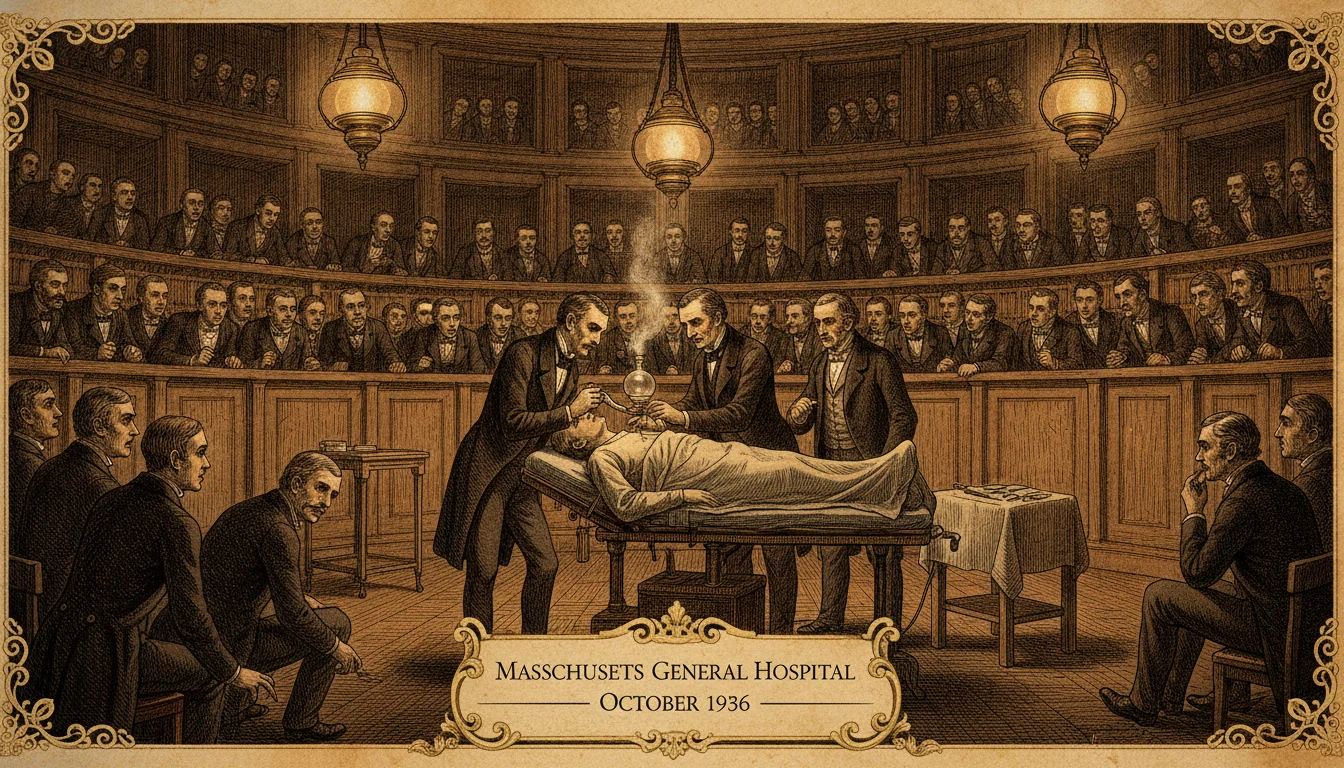
Before anesthesia, the great constraint on surgery was not skill. It was time. A patient awake and in agony will only be still for so long before pain and shock overwhelm everything else. Surgeons in the early 19th century were therefore evaluated primarily on speed. The Scottish surgeon Robert Liston, operating in London in the 1840s, was famous for completing a thigh amputation in under ninety seconds from first incision to bandage. He held the knife in his teeth to free both hands. Speed was mercy. A slower, more careful surgeon was a crueler one.
The operating theaters of the pre-anesthetic era were not quiet rooms. They were rooms where patients screamed, and where the screaming was understood as a necessary part of what was happening.
The discovery that changed this came, in its several independent versions, from a drug that had already been available for decades and had been used primarily as a party entertainment.
The entertainments that preceded the discovery
Diethyl ether was synthesized in the 16th century by Valerius Cordus, a German botanist, though early chemists called it by various names and its precise history is confused by inconsistent nomenclature across several centuries of records. By the early 19th century it was a known substance, commercially available, and used recreationally.
"Ether frolics" were a documented social phenomenon in the United States and Britain in the 1830s and 1840s. Groups of students, medical men, and curious parties would inhale ether from soaked cloths for the euphoric, dissociative, and occasionally hilarious effects. The participants were typically uninjured even when they fell or struck things, because ether's analgesic properties prevented them from registering impact as pain. This was noticed and remarked upon. Nobody appears to have immediately connected it to surgery.
Nitrous oxide had a parallel and even more visible career as entertainment. Humphry Davy, the British chemist, had documented its pain-relieving properties as early as 1799 in a published work that explicitly mentioned its potential surgical application. He wrote that it might be useful in operations requiring some loss of consciousness. The suggestion was ignored for more than four decades while nitrous oxide became a fixture of popular science demonstrations and traveling shows. A showman named Gardner Colton was touring American cities in the 1840s, charging admission for demonstrations of "laughing gas" that were a mixture of chemistry lecture and comedy performance.
The gap between Davy's 1799 suggestion and the first serious surgical application is approximately 45 years. In that interval, ether parties and nitrous oxide shows were common enough that most educated people in the English-speaking world had either attended one or heard about them.
Crawford Long in Jefferson, Georgia
On March 30, 1842, a physician named Crawford Williamson Long removed a small cyst from the neck of a patient named James Venable at his practice in Jefferson, Georgia. Venable had previously attended ether frolics and was familiar with the substance's effects. He had been reluctant to have the cyst removed because of the expected pain. Long, who had also attended ether frolics and had observed their analgesic properties, suggested ether inhalation as an alternative to simply bearing the pain.
Venable inhaled ether from a cloth, lost consciousness, and the cyst was removed. He reported no pain. Long charged 25 cents for the ether.
Long performed several additional operations using ether over the following years, charging modest fees and keeping records. He did not publish his results. His reasons were practical and cautious: he wanted more cases before making a public claim, and he was uncertain whether to attribute the results to ether specifically or to a combination of factors including the power of suggestion. This caution, which was professionally reasonable, meant that when he finally published in 1849, four years after Morton's public demonstration had already changed medicine, Long was entering a priority dispute he had technically won but publicly lost.
The historical consensus among medical historians is that Long did it first. The scientific community of 1846 did not know that.
Horace Wells and the failed demonstration
Horace Wells was a dentist practicing in Hartford, Connecticut, who attended one of Gardner Colton's nitrous oxide shows in December 1844. During the demonstration a volunteer who had inhaled the gas injured his leg on a bench and seemed not to notice the wound. Wells, who had been observing as a professional rather than a participant, immediately grasped the implication.
He arranged for a tooth extraction while under nitrous oxide the following day, with Colton providing the gas and a dental colleague performing the extraction. It worked. Wells felt nothing. Over the following weeks he used nitrous oxide for more than a dozen extractions in his Hartford practice.
In January 1845 he traveled to Boston to demonstrate the technique before medical students at Harvard Medical School, with the prominent surgeon John Collins Warren in attendance. The demonstration failed. The patient, a young man, groaned or cried out during the extraction. Whether he was genuinely in pain or was reacting to the extraction process while still adequately sedated is disputed. Warren, unimpressed, dismissed the demonstration. The students reportedly jeered.
Wells returned to Hartford. The Harvard demonstration had discredited nitrous oxide as a surgical tool in the estimation of Boston's medical establishment precisely when it needed endorsement.
William Morton and Ether Day
William T.G. Morton was a Massachusetts dentist with commercial instincts and a long record of disputed dealings with partners and creditors. He had been briefly a student of Horace Wells's and was aware of the nitrous oxide experiments. By 1846 he had shifted his attention to ether.
Morton consulted with Charles Thomas Jackson, a Boston chemist, about the properties of ether, a consultation that would later become the subject of an extraordinarily bitter dispute about who deserved credit for what. Morton conducted private experiments on himself and on his dog. By September 1846 he was satisfied enough to use ether on dental patients.
He then requested permission to demonstrate ether before the surgical staff at Massachusetts General Hospital. John Collins Warren, the same surgeon who had watched Wells's failed demonstration, agreed to provide a patient.
October 16, 1846. The operating theater at Massachusetts General Hospital, in the room now called the Ether Dome. A 20-year-old patient named Gilbert Abbott, who had a vascular tumor on his jaw. Morton arrived late, having been detained finishing a dental appliance to hold the ether-soaked sponge in place for the inhalation. Warren had been about to begin without him.
Morton administered the ether. Abbott lost consciousness. Warren removed the tumor. Abbott reported no pain during the procedure.
Warren turned to the assembled observers and said, in the account that has been repeated in every history of anesthesia since: "Gentlemen, this is no humbug."
The word and the war
The physician Oliver Wendell Holmes Sr., better known as a poet and essayist than a medical figure, wrote a letter to Morton in November 1846 proposing names for the new state. He suggested "anesthesia" from the Greek, meaning insensibility. The word was adopted immediately and has been the technical term ever since.
The priority war that followed the success of the demonstration was one of the most prolonged and damaging disputes in the history of medicine. Morton spent years seeking a government payment for his role in the discovery, convinced that he had been cheated of proper recognition and financial reward. Charles Jackson, his onetime consultant, filed competing claims. Horace Wells, who had been first with nitrous oxide, competed for recognition until his death in 1848 - by suicide, in circumstances that suggested profound psychological deterioration. Crawford Long waited until 1849 to publish his 1842 cases and found himself entering a dispute that had already been decided by public events.
Morton died in 1868 in relative obscurity, still pursuing recognition. Jackson spent his final years in an asylum. The priority dispute left all of its major participants worse off than they had been before the demonstration succeeded.
James Young Simpson, the Scottish obstetrician who introduced chloroform as an anesthetic in 1847, sidesteps most of this dispute by being a different person in a different country using a different drug. Queen Victoria's use of chloroform during the birth of her eighth child in 1853 effectively legitimized surgical anesthesia for the British public in the way that no professional debate had managed.
What changed
The transformation of surgery in the years following 1846 was not gradual. It was rapid enough to be visible in a single surgical generation. Operations that had been considered too slow, too painful, or too traumatic to attempt became standard procedure. Surgeons who had spent careers perfecting speed as the measure of mercy could now spend time on precision. Internal surgery, where speed was structurally impossible, moved from the realm of occasional desperate attempts to routine possibility.
The death toll of surgery dropped. Survival rates improved. The entire discipline changed its standards because the fundamental constraint had been removed.
Crawford Long is honored with a statue in the United States Capitol's National Statuary Hall, representing Georgia. William Morton's tombstone at Mount Auburn Cemetery in Cambridge, Massachusetts, carries an inscription identifying him as the discoverer of anesthesia. Both inscriptions are defensible. Neither is complete.
The discovery was made at an ether frolic, applied first in a Georgia country practice, and announced to the world from a Boston operating theater by a man who was almost late. That is how it actually happened.
For more origins stories in the history of science and technology, see Origins: How the Clock Was Invented and Origins: The History of Soap.
Quick Answers
Common questions about this topic
Who invented anesthesia?
The priority dispute has never been fully settled, but the documented firsts are: Crawford Long used diethyl ether on a surgical patient on March 30, 1842 in Jefferson, Georgia - the earliest known use of chemical anesthesia in surgery. William T.G. Morton gave the first widely publicized public demonstration at Massachusetts General Hospital on October 16, 1846. Long did not publish his results until 1849, which is why Morton's demonstration became the event the medical community built its history around.
What happened on Ether Day?
On October 16, 1846, at Massachusetts General Hospital in Boston, dentist and entrepreneur William T.G. Morton administered diethyl ether to a patient named Gilbert Abbott, who then had a tumor removed from his neck by surgeon John Collins Warren. Warren, who had been skeptical, reportedly said afterward: 'Gentlemen, this is no humbug.' The operating theater where this happened is still known as the Ether Dome and can be visited today.
What was surgery like before anesthesia?
Patients were fully conscious. They were held down or restrained by assistants. Surgeons were valued primarily for speed - the fastest could amputate a limb in under two minutes. Patients sometimes died of shock from pain alone. Operations were limited to what could be completed before the patient's struggles made it impossible to continue. The entire practice of surgery was constrained to brief, violent interventions.
Why did nitrous oxide take so long to become a surgical anesthetic?
Humphry Davy described nitrous oxide's pain-relieving properties in 1799 and even suggested it might be useful in surgery. But for roughly 45 years, laughing gas became an entertainment, used at parties and public demonstrations where the comedic side effects were the attraction. It took Horace Wells's 1844 tooth extraction and Crawford Long's independent 1842 experiments to move it back toward medicine - and even then, a botched demonstration by Wells at Harvard Medical School in 1845 set the cause back by appearing to prove it did not work.

Ask the Inventors Themselves
Chat with the people who were there when familiar things began.
Create your free account →No card required. Talk to anyone in history with 8 free credits a day. Some features require a paid plan.
Join the HistorIQly Club
Get smarter about the past.
Weekly stories, deep dives, and exclusive content straight to your inbox.