Origins: Who Really Invented Chocolate
Who invented chocolate? The Olmec drank it bitter and cold. The Aztecs made xocolatl. Europeans added sugar. The first candy bar came in 1847. The full story.
Read Wikipedia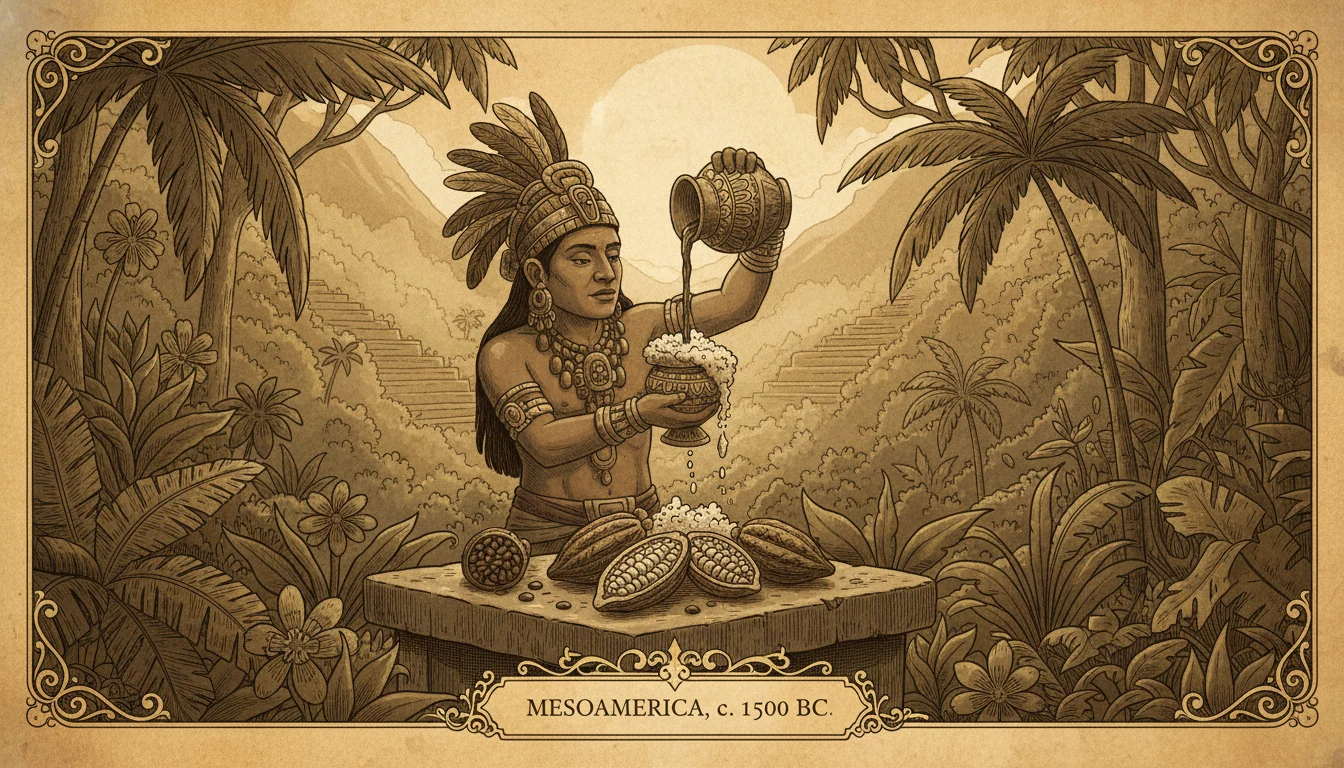
The word "chocolate" in 2026 refers to a sweet, solid, milky confection consumed by the ton. The word "xocolatl" in 1519 referred to a cold, bitter, frothy beverage made from ground cacao seeds, water, chili pepper, and various plant flavorings, consumed at the Aztec imperial court and used as a form of currency. These two things share an ingredient. They are otherwise almost entirely different products.
The history of chocolate is the history of that transformation - from bitter ritual drink to global commodity - and almost every popular origin story about it gets the sequence wrong.
The plant
Theobroma cacao, the species that produces all modern chocolate, is native to the tropical lowlands of Mesoamerica. Linnaeus gave it the genus name Theobroma, meaning "food of the gods," in 1753 - a piece of flattery that stuck. Modern genetic analysis suggests the center of cacao domestication was in the western Amazon basin and that cultivated strains spread northward into Mesoamerica over millennia.
The cacao tree produces large, ridged pods directly from its trunk and branches, each pod containing 20 to 50 seeds embedded in a sweet white pulp. The pulp is edible and mildly pleasant. The seeds, raw, are intensely bitter. Turning them into anything palatable requires fermentation, drying, roasting, and grinding - a sequence of steps that someone, somewhere, had to discover and transmit.
Who discovered it, and when, is what the archaeological record is still working out.
The earliest evidence
The oldest confirmed chemical evidence for cacao use comes from pottery residue at Puerto Escondido in the Ulua Valley of Honduras, dated to approximately 1100 BC. The residue contains theobromine, an alkaloid found in cacao that is not produced by any other plant common to the region. Similar traces have been found at Paso de la Amada in Chiapas, Mexico, in pottery potentially as old as 1900 to 1500 BC.
These are not Aztec or Maya sites. They are associated with the Mokaya culture and later the Olmec sphere, the civilizations that preceded and partially overlapped with the classic Maya. The implication is that cacao was being processed and consumed - most likely as a fermented beverage made from the sugary pulp rather than the seeds - more than three thousand years ago.
Linguistic evidence supports an Olmec origin: most historians of Mesoamerican languages believe the word "cacao" derives from an early Olmec root, possibly "ka-ka-w," which then passed into Mayan and Nahuatl vocabularies. The plant name traveled with the cultural practice.
The Maya: cacao as civilization
By around 300 AD, the Maya were keeping detailed records of cacao. The word "kakaw" appears in inscriptions on ceramic vessels from this period. The Dresden Codex, a surviving Maya book from the 13th century, includes multiple depictions of the cacao deity - typically shown with a cacao pod emerging from his body - in ritual contexts. The Madrid Codex connects cacao to the rain god and to agricultural fertility. Cacao appears in the Popol Vuh, the Quiche Maya creation text, as one of the materials from which humans were formed.
Maya chocolate preparation involved grinding fermented and roasted cacao seeds on a stone metate, combining the resulting paste with water, chili, achiote (for color and flavor), vanilla, and aromatic flowers. The mixture was then poured from one vessel to another raised to shoulder height, producing a thick foam on the surface of the receiving vessel. The foam was considered the best part - a refinement that persisted into the Aztec period.
Cacao was not an everyday beverage. It was associated with ritual, with elite consumption, and with specific ceremonial occasions including funerals, betrothals, and the preparation of warriors for combat. Maya burial sites include ceramic vessels whose residue analysis confirms they contained cacao-based liquids placed as grave goods.
The Aztec empire and xocolatl
When the Aztec empire absorbed and connected the trading networks of Mesoamerica from roughly the 14th century onward, cacao moved with it. The Aztec state incorporated cacao into its tribute system - conquered territories paid cacao in assessed quantities - and into its monetary economy. Standardized cacao beans functioned as small-denomination currency throughout Mesoamerican markets: a tamale cost roughly one bean, a turkey cost approximately 100, a slave could be purchased for several hundred.
Montezuma II, emperor at the time of the Spanish arrival, reportedly consumed large quantities of chocolate daily. The Spanish soldier Bernal Diaz del Castillo, who was present at the Aztec court, described the emperor being served cacao in golden cups, drinking it before visiting his wives. The image of Montezuma drinking chocolate from a golden cup became, centuries later, a foundational element of European chocolate mythology - often retold inaccurately as hot chocolate.
The Aztec version was cold, or sometimes at room temperature. It was bitter. It contained chili. It was foam-topped and complex in flavor. It tasted nothing like what would later be called chocolate in Europe.
The Spanish transformation
Hernan Cortes landed on the Mexican coast in 1519 and reached the Aztec capital of Tenochtitlan later that year. He and his forces encountered xocolatl at the imperial court and found it, by most accounts, unpleasant. Accounts from the conquest period describe the Spanish struggling with its bitterness. Peter Martyr d'Anghiera, summarizing Spanish reports in 1530, described it as "a most wholesome drink" that was nonetheless an acquired taste.
The transformation happened through addition. Sometime in the 16th century - the exact moment and location are disputed, and may have occurred in Mexico among Spanish colonists, in Spain itself, or through Jesuit missionaries - someone added sugar and cinnamon to the cacao preparation and served it hot. The result was dramatically more palatable to European tastes. By the 1590s, sweetened hot chocolate was fashionable in Spain. It was still a beverage, and still associated with the wealthy.
The popular myth that Spain kept chocolate secret from the rest of Europe for a century is probably overstated, but Spain did have a head start in its development. Anne of Austria, daughter of Philip III of Spain, reportedly introduced chocolate to the French court when she married Louis XIII in 1615. The first documented English chocolate house opened in London in 1657. By 1700, drinking chocolate was available in coffeehouses across northwestern Europe, though it remained more expensive than coffee or tea.
Van Houten and the press
Everything that followed depended on a single Dutch invention. In 1828, a chemist named Coenraad van Houten patented a hydraulic press that could remove most of the cocoa butter from roasted, ground cacao seeds. What remained was a dry cake that could be powdered into fine cocoa. The powder dissolved much more evenly in liquid than the traditional fat-heavy paste, producing a smoother, milder, more consistent drink.
The press also produced a useful byproduct: separated cocoa butter. This waxy fat, isolated by the press, could be added back to cocoa powder in controlled amounts along with sugar, producing a mixture that could be melted, poured into molds, and allowed to set as a solid. The solid would melt in the mouth at slightly below body temperature.
Joseph Fry and Sons in Bristol understood this in 1847 and produced the first commercial eating chocolate. They sold it as a novelty; the dominant form of chocolate consumption was still the drink.
Milk chocolate and the modern industry
The solid chocolate bar became the definitive form through a series of late 19th-century refinements. Daniel Peter, a Swiss confectioner, spent years trying to incorporate milk into chocolate but found that the water content in fresh milk caused the mixture to seize. His neighbor in Vevey, Switzerland was Henri Nestle, who had developed condensed milk. Peter used Nestle's condensed milk - its water largely removed - to produce the first commercially successful milk chocolate in 1875.
Rodolphe Lindt invented the conching machine in 1879, a device that mixed chocolate continuously for hours or days, producing a smoother texture than anything previously possible. Cadbury refined the milk chocolate formula for the British market in the 1890s. By 1900, chocolate had moved from aristocratic luxury to mass-market confection, produced in factories and sold in standardized bars.
What got transplanted and what got lost
Modern cocoa production has almost entirely abandoned Mesoamerica. West Africa - primarily Ivory Coast and Ghana - now produces roughly 60 to 70 percent of the world's cacao, a transplantation that began with Spanish and Portuguese colonial agriculture and accelerated through the 19th-century commodity trade. Cacao grown in the Ivory Coast is processed in European and American factories and consumed globally under brand names that have no obvious connection to Olmec Honduras or Aztec Tenochtitlan.
The cacao tree that Mesoamerican civilizations domesticated, refined, and built complex ritual cultures around now anchors a global industry worth roughly $150 billion annually. The people who first discovered how to turn its bitter seeds into something a human being would willingly consume have been almost entirely written out of the product's identity. The name "Theobroma" - food of the gods - at least preserves the original reverence, translated into Latin by a Swedish botanist who never tasted xocolatl and would not have enjoyed it if he had.
The Aztec emperor drinking his cold, foamy, chili-spiced cacao from a golden cup would not recognize what is sold in airports under the same name. That gap - between the bitter sacred drink and the sweet industrial bar - is the actual history of chocolate, and it is considerably more interesting than the one on the back of the wrapper.
For other everyday objects with similarly surprising origin stories, see the histories of the alphabet and glass.
Quick Answers
Common questions about this topic
Who invented chocolate?
No single person or civilization invented chocolate because what we call chocolate has changed radically over time. The earliest documented use of cacao dates to around 1100 BC in Honduras among cultures contemporary with the Olmec. The Maya developed elaborate cacao ritual and trade by around 300 AD. The Aztecs refined it into the cold, bitter xocolatl. The Spanish sweetened it and brought it to Europe in the 16th century. The first eating chocolate - solid, sweet - was created by Joseph Fry and Sons in Bristol in 1847. Each of these is a different invention.
Did the Aztecs invent hot chocolate?
The Aztec version of chocolate was typically served cold, not hot. Xocolatl was a mixture of ground cacao, water, and various flavorings including chili, achiote, and flowers. It was often poured between vessels from a height to create a foam, which was considered the most desirable part. Hot chocolate as most people imagine it was a European adaptation, developed after the Spanish added sugar and began serving the drink warm.
Did Christopher Columbus bring chocolate to Europe?
Columbus encountered cacao on his fourth voyage in 1502 but did not understand what he had found. His son Ferdinand wrote that the crew observed Mesoamerican traders carrying the beans and treating them as extremely valuable, but Columbus's expedition never learned to prepare the drink. The systematic introduction of cacao to Spain came through Hernan Cortes and the colonial apparatus in the 1520s to 1540s.
When was the first chocolate bar made?
The first solid eating chocolate was created by Joseph Fry and Sons in Bristol in 1847, when the company discovered that mixing cocoa powder back with cocoa butter and sugar produced a moldable paste that could be cast into bars. The cocoa powder itself had been made possible by Coenraad van Houten's 1828 hydraulic press, which removed most of the cocoa butter from roasted cacao, making soluble, smooth drinking chocolate and eventually solid chocolate possible.

Ask the Inventors Themselves
Chat with the people who were there when familiar things began.
Create your free account →No card required. Some figures and features require a paid plan.
Join the HistorIQly Club
Get smarter about the past.
Weekly stories, deep dives, and exclusive content straight to your inbox.