Origins: How Photography Was Invented - and Who Really Deserves the Credit
The history of photography invention begins before Daguerre. A Burgundy landowner made the first fixed image earlier, and France suppressed a third inventor.
Read Wikipedia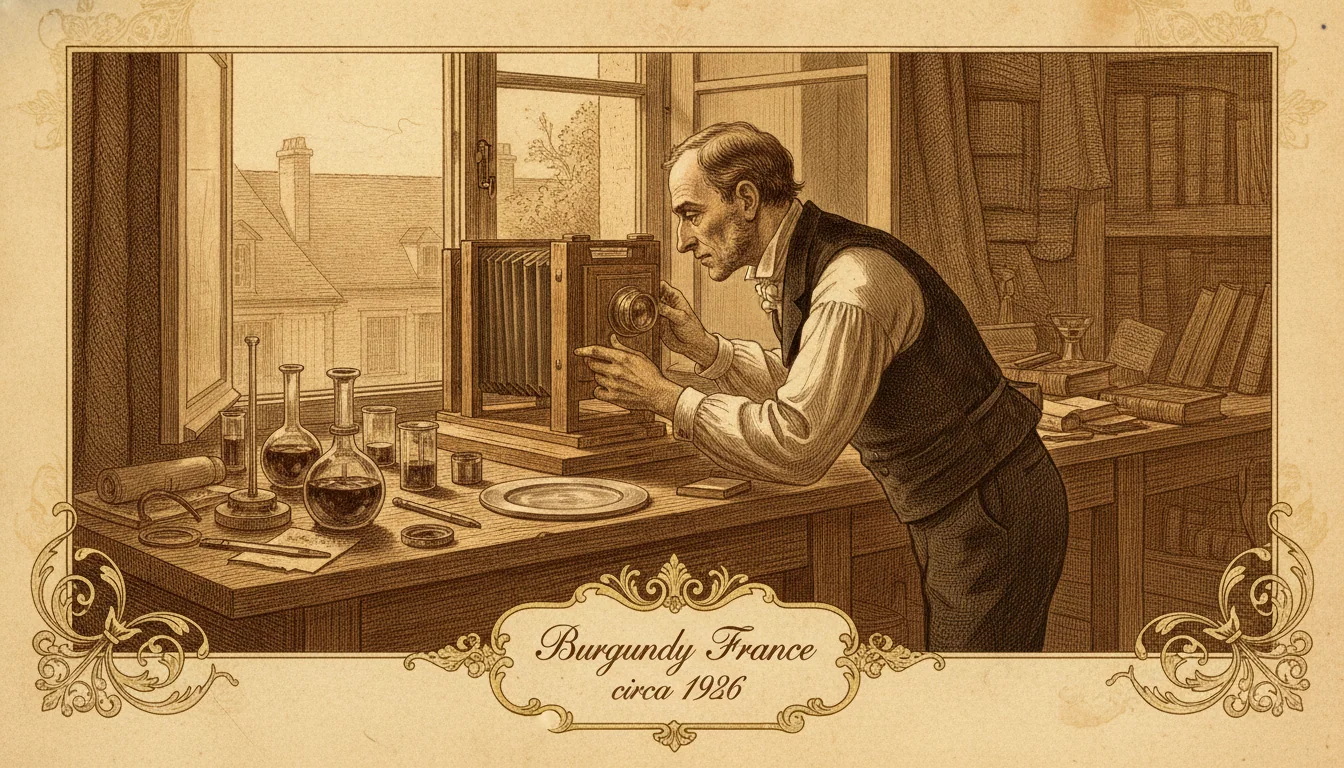
The founding myth of photography has a clean shape and a memorable date. In January 1839, Louis Daguerre demonstrated his process to the French Academy of Sciences. The French government purchased the patent and declared photography a gift to the world, free for anyone to use. The era of the photograph had begun.
The myth is not entirely wrong. January 1839 is a real moment, and Daguerre's announcement did change what most people understood to be possible. But Daguerre did not invent photography. He perfected one form of it, made it practical enough for portrait studios, and had the political connections to get France to buy it. The actual history involves a rivalry between inventors that began a decade earlier, a third claimant France effectively suppressed, and a technical fork in 1839 whose outcome determined which version of photography we use today.
The camera obscura and the missing ingredient
The camera obscura - a darkened box or room with a small hole on one face that projects an inverted image of the outside world on the opposite surface - was understood for centuries before anyone figured out how to make it capture an image permanently. Aristotle described the optical principle. Ibn al-Haytham gave it a rigorous mathematical treatment in the early 11th century. Leonardo da Vinci used one for perspective studies. By the 17th century it was a common artist's tool.
The other ingredient - light-sensitive chemistry - was also broadly understood. As early as 1727, the German physicist Johann Heinrich Schulze demonstrated that silver salts darkened when exposed to sunlight. By the early 19th century, several experimenters had observed that sunlight could produce faint images in silver-salt preparations. The problem was fixing them: any image produced by light continued to darken when exposed to further light, ultimately destroying itself. Everyone who tried to capture a camera obscura image before 1820 or so produced something that disappeared shortly after it appeared.
What nobody had done was combine them into a stable, permanent image - and solving that took most of a decade.
Burgundy, 1826-1827: the first fixed image
Nicephore Niepce was a French inventor living at Chalon-sur-Saone in Burgundy, interested in fixing the images produced by a camera obscura for the practical reason that he wanted a way to reproduce lithographic prints without the drafting skill that traditional printmaking required. Through the early 1820s he tried various light-sensitive materials and various substrates. Bitumen of Judea - a naturally occurring asphalt that hardens when exposed to light and can be dissolved by solvent where it remained soft - proved the most promising.
Around 1826 or 1827 (the precise date is uncertain and has been argued over for decades), Niepce placed a pewter plate coated with bitumen into a camera obscura mounted in the upper floor of his estate and pointed at the courtyard and rooftops below. He left it for approximately eight hours. What emerged was faint, barely legible, but real: a permanent record of light. The surviving image, now called "View from the Window at Le Gras," shows vague shapes of roof and courtyard under what appears to be simultaneous illumination from both the east and west because the long exposure captured the sun's arc across the sky.
It is the earliest surviving photograph in the world. It is also an unsatisfying image by any subsequent standard - indistinct, contrasty, lacking fine detail - and Niepce knew it. His process, which he called heliography, required exposure times measured in hours and produced a result with limited tonal range. He continued refining it.
The partnership with Daguerre
Louis Daguerre was a theatrical entrepreneur and painter who had made his name with the Diorama, a Paris spectacle theater that used transparent painted screens and shifting lighting to create illusions of movement and depth for paying audiences. He was not a scientist. He was, however, an acute observer of what audiences found astonishing, and he had been experimenting independently with light-sensitive chemicals since the early 1820s.
Niepce and Daguerre began corresponding in 1826 and formalized a ten-year partnership agreement in 1829. Niepce died in 1833, before the partnership had produced a breakthrough. Daguerre continued alone, working with silver-coated copper plates sensitized with iodine vapor. The chemical process he eventually developed - iodine vapor to sensitize, mercury vapor to develop the latent image, and salt solution to partially fix it - produced images of extraordinary clarity and tonal richness in exposures measured in minutes rather than hours.
According to a story that Daguerre himself circulated and that most historians treat with appropriate skepticism, the mercury development step was discovered by accident: he reportedly left an exposed plate in a cabinet that contained a broken thermometer, and found the following day that mercury vapor had developed a remarkably detailed image. Whether or not the story is true, the mercury development process was Daguerre's most important discovery, and it transformed heliography's crude results into the sharp, detailed daguerreotype.
January 1839: the announcement race
On January 7, 1839, the astronomer and politician Francois Arago announced Daguerre's process to the French Academy of Sciences and the Academy of Fine Arts. Arago was a powerful figure in French intellectual life, a friend of Daguerre's, and the man who brokered the deal by which the French government purchased Daguerre's process and offered it free to the world - in exchange for annual pensions to Daguerre and to Niepce's son Isidore.
The announcement was not fully public in its technical details. Arago described the results but withheld the method, pending completion of the government purchase. This unusual arrangement - announcing an invention while concealing its specifics - was intended to protect the commercial value while building public excitement.
In London, seventeen days later on January 25, the scientist and mathematician William Henry Fox Talbot rushed to present his own photographic process to the Royal Institution. Talbot had been working independently since 1835, when he produced what he called "photogenic drawings" - images made by placing objects on sensitized paper in sunlight. He had shown these to a small audience in 1835 but had not publicized the process, intending to refine it first. Arago's announcement changed his calculus immediately: he needed to establish priority before Daguerre's method was fully revealed.
The two processes that emerged from this announcement race were technically different in ways that turned out to matter enormously. The daguerreotype was a direct positive: one plate, one image, irreproducible. Its detail was extraordinary. A daguerreotype portrait shows individual hairs, fabric weaves, the glint in an eye - a resolution not surpassed in commercial photography for many decades. But each image was unique. There were no copies, no prints, no distribution.
Talbot's calotype, the refined version of his process patented in 1841, used a paper negative from which any number of positive prints could be made. The images were softer than daguerreotypes, less detailed, more susceptible to grain from the paper fibers. But they were reproducible. One negative, many prints. The logic of the negative-positive process is the logic of all photography that followed it - film photography, darkroom printing, and the underlying concept if not the technology of digital imaging.
The third inventor France suppressed
Hippolyte Bayard was a French civil servant and amateur inventor who independently developed a process for making direct positive paper prints - distinct from both Daguerre's and Talbot's methods - sometime in early 1839. His process was genuinely different: sensitized paper exposed in the camera directly as a positive, not through a negative intermediate. The results were reasonably sharp and required exposures of only minutes.
Bayard wished to demonstrate his process publicly alongside Daguerre's announcement in January 1839. Arago, according to several accounts, privately pressured him to delay. The government's arrangement with Daguerre was the priority; a competing French process announced simultaneously would complicate the propaganda of the "gift to the world" narrative. Bayard agreed to wait. He later recorded his frustration in a deadpan caption for a self-portrait showing himself posing as a drowned man: he claimed to have been told the world had no use for his discovery and that he had despaired.
Bayard eventually exhibited his photographs in June and July 1839, to favorable reception. He was eventually awarded a small government sum in recognition of his contribution. He is not on the short list of photography's inventors in most accounts, despite having a legitimate claim to a third independent path to the same result.
Herschel and the words we use
John Herschel, the English astronomer and chemist, is the person responsible for most of the vocabulary of photography. He coined the terms "photography," "negative," and "positive" in early 1839, having quickly replicated both Daguerre's and Talbot's processes after the announcements. He also solved the fixation problem independently: sodium thiosulfate, which he called "hypo," dissolved the unexposed silver salts that continued to darken images after exposure, making permanent fixation practical. He shared the hypo discovery with both Talbot and Daguerre without commercial restriction.
What the popular history erases
Daguerre became the name because France spent money and credibility promoting his process. The deal Arago brokered was politically clean, commercially astute, and historically distorting. The daguerreotype was technically superior in sharpness but practically inferior in reproducibility. The calotype's negative-positive logic was the approach that governed all subsequent photographic development. Niepce, who made the first fixed image before Daguerre ever had a working process, is remembered in captions but rarely in the founding narrative.
Photography was not invented in a single flash of inspiration. It was the convergence of two bodies of knowledge - optics and chemistry - that had been approaching each other for two centuries, brought together in the 1820s and 1830s by several people independently. The camera was old. The chemistry was old. What was new was the specific combination, refined through trial and error in Burgundy and on the Boulevard des Capucines and in Lacock Abbey in Wiltshire, each inventor adding the piece the others lacked.
Daguerre got the pension and the fame. Talbot got the process that mattered. Niepce got there first, died before seeing the result, and had his name spelled wrong in half the accounts that mentioned him at all. The same pattern of contested credit and state-promoted founding myths appears in the history of the printing press and the internet - both inventions that also involved multiple simultaneous contributors whose contributions got flattened into a single heroic name.
Quick Answers
Common questions about this topic
Who really invented photography?
Nicephore Niepce produced the earliest surviving photograph around 1826-1827 using a process he called heliography. Louis Daguerre, who had partnered with Niepce before Niepce died in 1833, announced the daguerreotype in January 1839. William Henry Fox Talbot, working independently in England, announced a different photographic process in the same month. All three have legitimate claims. Daguerre received the most credit largely because the French government promoted his method as a 'gift to the world.'
What was the first photograph ever taken?
The earliest surviving photograph is known as 'View from the Window at Le Gras,' taken by Nicephore Niepce around 1826 or 1827 from the upper floor of his estate in Burgundy. The exposure took approximately eight hours and was made on a pewter plate coated with bitumen of Judea. The image shows rooftops and courtyard visible from Niepce's workroom. It is now held at the Harry Ransom Center at the University of Texas at Austin.
What is the difference between a daguerreotype and a calotype?
A daguerreotype was a one-of-a-kind positive image on a silver-coated copper plate - highly detailed and sharp, but impossible to copy. A calotype, Talbot's process, used a paper negative from which multiple positive prints could be made. The daguerreotype was technically superior in sharpness; the calotype was practically superior in reproducibility. Most modern photography descends from Talbot's negative-positive logic, not from Daguerre.
What did John Herschel contribute to photography?
Herschel is credited with coining the words 'photography,' 'negative,' and 'positive' as technical terms. He also discovered that sodium thiosulfate - hypo - could fix photographic images permanently by dissolving unexposed silver salts. This discovery, made in 1839, solved a fundamental problem that both Niepce and Talbot had struggled with. Herschel generously shared his findings with both Talbot and Daguerre.

Ask the Inventors Themselves
Chat with the people who were there when familiar things began.
Create your free account →No card required. Talk to anyone in history with 8 free credits a day. Some features require a paid plan.
Join the HistorIQly Club
Get smarter about the past.
Weekly stories, deep dives, and exclusive content straight to your inbox.