Origins: How Armies Were Invented
The origins of armies trace to Sumerian formations, Bronze Age Egypt, and Macedonian drill, not eternal human nature. Professional armies only feel timeless.
Read Wikipedia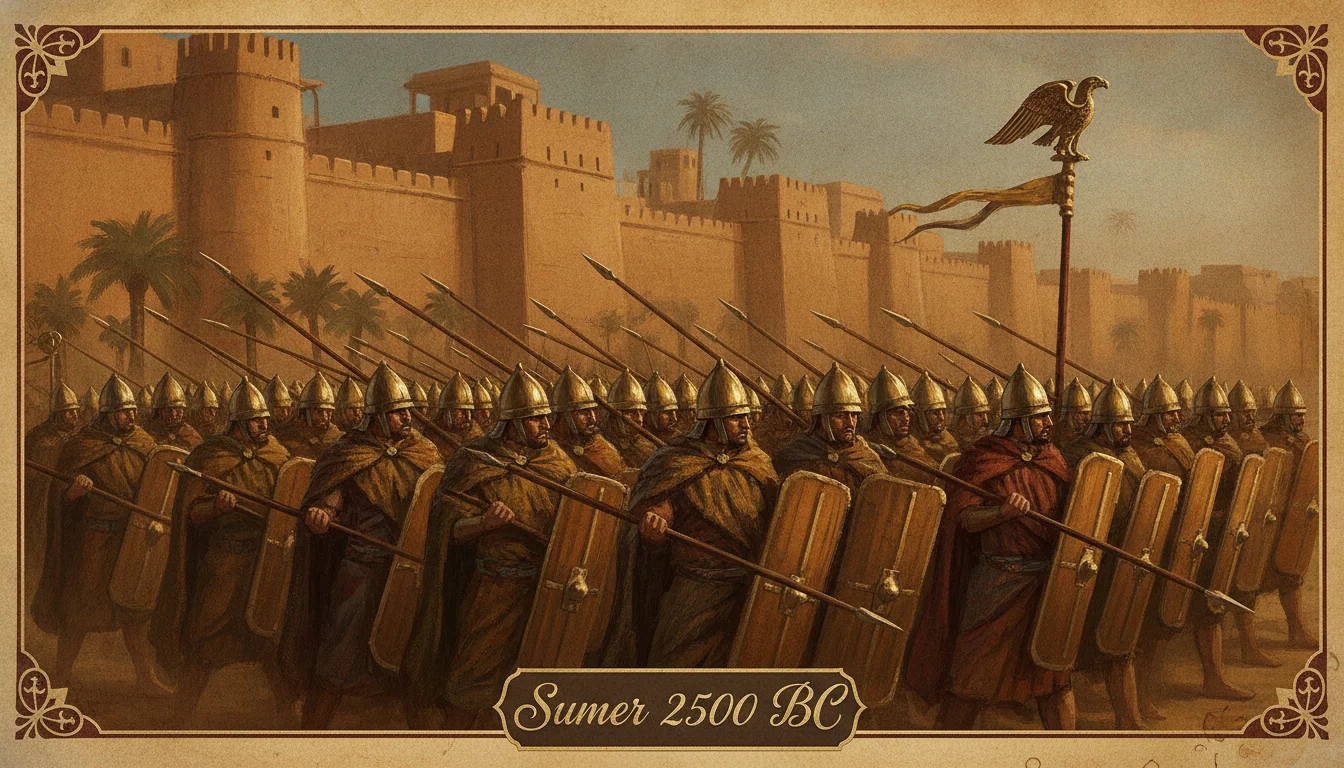
The popular image of ancient warfare is a timeless one: men have always grabbed weapons and fought in packs, the story goes, so "the army" is simply human nature scaled up. It is a comfortable idea, and it is wrong. The origins of armies lie in a traceable starting point, not an eternal feature of human society: organized, disciplined, state-supplied military formations are an invention. Before that invention, conflict likely looked like raiding and skirmishing among loosely organized bands, not the marching ranks familiar from later history.
The actual record, pieced together from stone carvings, administrative tablets, and the archaeology of early states, shows something more specific and more interesting than a mob with spears.
The myth of eternal organized war
Popular history and plenty of documentaries treat war as a constant across all of human existence, with only the technology changing. Cavemen with clubs, ancient tribes with spears, medieval knights with swords: same basic activity, different props.
But "organized war" is not just violence. It requires formation discipline, a command hierarchy, standardized equipment, and logistics to keep fighters fed and supplied while away from their normal work. Evidence for that kind of organization does not stretch back to prehistory. Skeletal evidence of group violence exists from the Mesolithic period, including mass graves that suggest intergroup conflict, but nothing in that evidence points to drilled ranks or a command structure. What we call "armies" in the institutional sense appears to be a product of early cities and states, not a universal human default.
Sumer and the first drilled ranks
The earliest strong evidence for formation warfare comes from southern Mesopotamia in the 3rd millennium BC, the age of Sumerian city-states like Lagash, Umma, and Ur.
The Stele of the Vultures, a fragmentary limestone monument commissioned by Eannatum, ruler of Lagash, to commemorate a victory over the rival city of Umma, is probably the single most cited piece of evidence. Scholars generally place it somewhere in the 25th century BC, though the exact date is debated. One surviving panel shows a tight block of helmeted infantry advancing shoulder to shoulder, shields overlapping, spears leveled in unison. It looks, unmistakably, like a phalanx, centuries before the Greek formations that usually get credit for inventing the idea.
The Standard of Ur, a small inlaid box of uncertain function (it may have been a musical instrument's soundbox, a standard, or something else entirely) found in the Royal Cemetery of Ur and generally dated to around 2600-2400 BC, tells a similar story from the other side. Its "war panel" shows infantry in ranks, four-wheeled battle carts pulled by donkeys or onagers, and soldiers organized distinctly by equipment: some with cloaks and axes, others with spears. That kind of visual sorting suggests real organizational categories, not just an artist's flourish.
Neither object is a photograph, and both are propaganda commissioned by a victorious ruler, so some exaggeration should be assumed. But the consistency between the two, made in different cities, is hard to explain unless formation fighting was already a recognizable practice in Sumer, not an artist's invention.
Egypt: from levies to a professional corps
Old and Middle Kingdom Egypt, roughly the 3rd through the early 2nd millennium BC, fought wars mostly with conscripted levies: farmers and laborers called up under regional or provincial command for a campaign season, then sent home once the harvest needed them. It worked, but it was not a standing institution.
That appears to change in the New Kingdom, conventionally dated from around the 16th century BC onward. Egypt had recently experienced the rule of the Hyksos, foreign rulers in the Nile Delta associated with the introduction of the horse-drawn chariot into Egyptian warfare, and the trauma of that period seems to have pushed the reunified Egyptian state toward maintaining permanent, professional forces rather than relying purely on seasonal levies. New Kingdom military organization, known mostly from temple reliefs, administrative papyri, and tomb inscriptions, shows divisions named for gods, ranked officers, dedicated chariot corps, and something resembling career soldiers rather than farmers with borrowed spears. Campaign records from rulers such as Thutmose III describe logistics: grain depots, water stations, and supply lines stretching into the Levant, the connective tissue that turns armed men into an army.
This is the shift worth underlining: professional soldiering, as a distinct occupation supported by the state, is a documented Bronze Age development, not something that simply always existed alongside farming and pottery.
Macedon and the end of the amateur citizen-soldier
By the classical period, Greek city-states fought with hoplite phalanxes: citizens who owned their own bronze armor and spears, trained informally, and fell into formation for a campaign before returning to their farms and workshops. It was organized, but still fundamentally a part-time, citizen-militia system.
Philip II of Macedon, ruling from 359 to 336 BC, did not invent the massed infantry formation. What he built, and what his son Alexander the Great refined during his campaigns from 336 BC until his death in 323 BC, was something closer to a permanent professional army: soldiers drilled year-round, paid a wage, equipped with the sarissa (a pike reportedly several meters longer than the traditional hoplite spear), and organized into combined-arms units that integrated infantry, cavalry, and siege capability under a single command structure. Sources describing the exact sarissa length and Philip's specific reforms vary and were partly written generations later, so precise figures should be treated cautiously. The broader picture, though, is well supported: this was drill and standing readiness as a deliberate state investment, not seasonal citizen mobilization.
The effect on the rest of the Greek world was closer to obsolescence than mere defeat. At battles such as Chaeronea in 338 BC, Macedonian forces beat coalition armies of Greek city-states that were still organized on the older citizen-militia model. Within a generation, the loosely drilled hoplite levy as the dominant model of Greek land warfare was effectively finished, replaced by the professional, state-funded standing force that Macedon had pioneered and that Hellenistic kingdoms would inherit and expand after Alexander's death.
What actually had to exist first
None of this could happen without underlying conditions that took millennia to develop. A state needs a food surplus reliable enough to feed men who are not farming. It needs a taxation or tribute system to convert that surplus into coined wages, grain rations, or equipment. It needs metallurgy advanced and standardized enough to arm hundreds or thousands of men with broadly similar weapons rather than whatever each person happened to own. And it needs record-keeping, the cuneiform tablets of Sumer and the administrative papyri of Egypt among the earliest examples, to track who is owed what and who owes service.
Put together, those requirements explain why organized armies cluster in the same times and places as the first cities, the first writing systems, and the first tax collectors. War did not need to wait for cruelty or ambition, which presumably existed long before. It needed bureaucracy.
The gap between the myth and the record
The comfortable version of military history skips straight to battles and generals, treating the army itself as a constant backdrop. The documented version is stranger: organized warfare is a technology, invented gradually by early states that needed a way to convert farmers and food surplus into a controllable fighting force. Sumerian rulers carved the earliest clear evidence of drilled ranks into stone to boast about it. Egyptian administrators wrote the logistics of a professional corps onto papyrus. Macedonian kings turned drill itself into a weapon that made the old citizen-soldier obsolete.
The mob-with-spears image is not history. It is what came before history's first armies, and it disappeared from the historical record for a reason.
Quick Answers
Common questions about this topic
What is the earliest evidence of an organized army?
The strongest early evidence comes from Sumer in the mid-3rd millennium BC. The Stele of the Vultures, commissioned by the ruler Eannatum of Lagash, shows infantry marching in tight, overlapping-shield ranks behind a spear line, and the war panel of the Standard of Ur shows soldiers and chariots organized by equipment type. Both suggest drilled, formation-based fighting rather than a loose mob of armed men.
Did ancient Egypt have a professional standing army?
Not at first. Old and Middle Kingdom Egypt relied mostly on conscripted levies raised for a campaign and then sent home. A recognizably professional military, with standing units, officer ranks, and dedicated logistics, is best documented in the New Kingdom, roughly starting in the 16th century BC, after Egypt's encounters with Hyksos rulers and their chariot warfare pushed the state to maintain permanent forces.
Did Philip II of Macedon invent the phalanx?
No. Massed spear formations existed in Greece for centuries before him, most famously the hoplite phalanx of classical city-states. Philip II's contribution, developed further by his son Alexander the Great, was to lengthen the spear into the sarissa, drill part-time citizen soldiers into full-time professionals, and integrate infantry with cavalry and combined-arms tactics, which made older citizen-militia armies obsolete almost overnight.
Why didn't organized armies exist earlier in human history?
Organized armies require a state capable of feeding, arming, and coordinating large groups of men away from their farms for extended periods. That needs surplus grain, systems of taxation or tribute, metallurgy for standardized weapons, and record-keeping to track supplies and personnel. Those conditions did not exist before the first cities and states formed in Mesopotamia and Egypt in the 4th and 3rd millennia BC, so large-scale warfare before that point was almost certainly conducted by informal raiding parties rather than organized armies.

Ask the Inventors Themselves
Chat with the people who were there when familiar things began.
Create your free account →No card required. Some figures and features require a paid plan.
Join the HistorIQly Club
Get smarter about the past.
Weekly stories, deep dives, and exclusive content straight to your inbox.