Origins: Who Invented the Coin
Who invented the coin? Not Croesus, not China. Lydian smiths stamped the first coins from electrum around 600 BC, the invention that became the most copied in history.
Read Wikipedia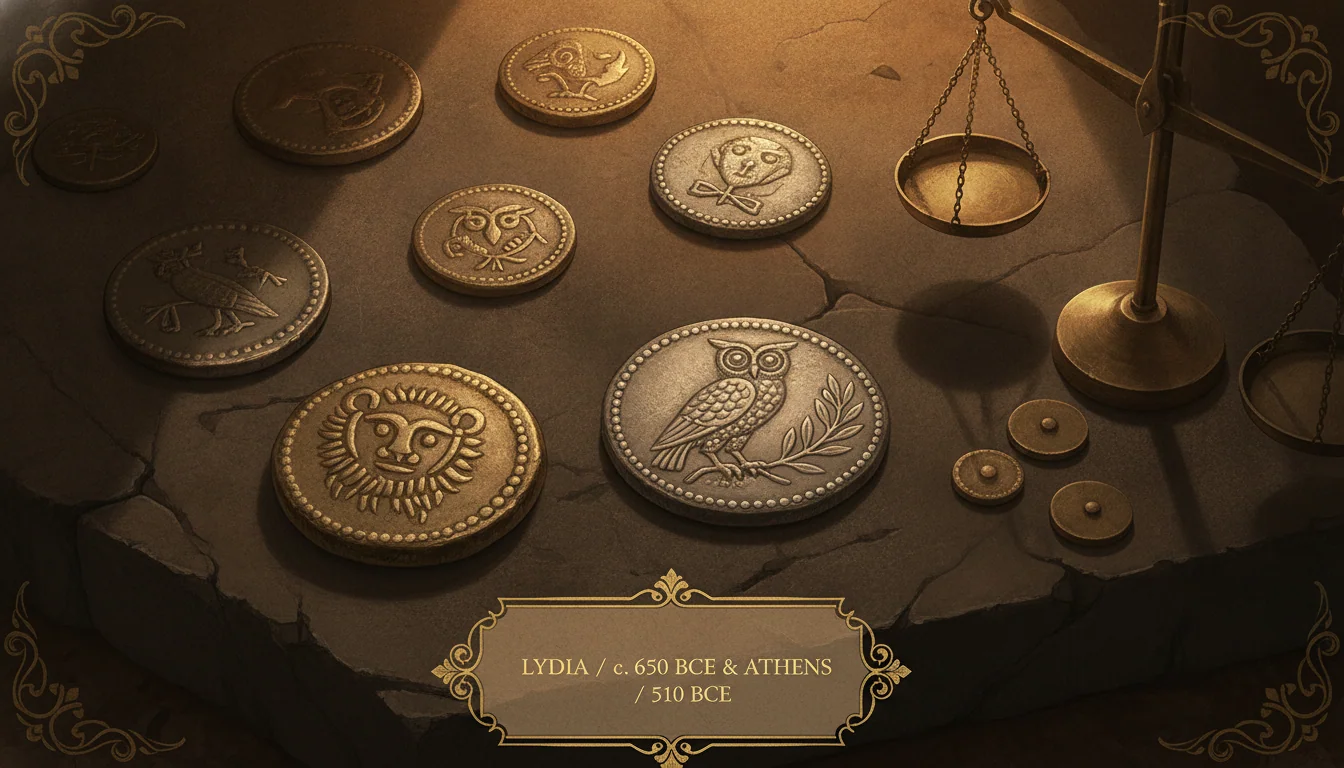
The oldest coins in the world were found in 1904 and 1905 during British excavations at the Temple of Artemis at Ephesus, on the Aegean coast of what is now western Turkey. They are small, irregular lumps of yellowish metal, roughly bean-shaped, each stamped with a rough lion's head on one face. Some carry a few lines scratched into the other face. They were deposited under the foundation of the temple sometime around 600 BC, probably as a votive offering.
These are Lydian electrum staters. They are the earliest physical evidence of coined money.
The story of who invented the coin, why, and what the invention actually changed is more complicated than any single origin myth allows. It is also more interesting.
Before coins: commodity money and its problem
The coin did not invent money. That invention belongs to a far older and murkier set of practices reaching back to the earliest agricultural civilizations.
Mesopotamian temples were using weighed silver as a medium of exchange by at least 3000 BC. The shekel - a word that persists today in Israeli currency - was originally a weight unit of roughly 8.3 grams, used to standardize the value of silver in commercial contracts, bride prices, and temple tithes. The Code of Hammurabi, from around 1750 BC, lists prices in shekels of silver throughout. No coins existed. Merchants carried scales and tested every payment.
Egypt used grain, copper, and cloth as commodities with recognized exchange value. The Shang dynasty Chinese used cowrie shells around 1200 BC. Various cultures used cattle, salt, and iron as stores of value. What all of these systems shared was the problem the coin eventually solved: verification.
Every transaction in a commodity money system requires confirmation that the commodity is genuine and at the stated weight. Weighed silver might be adulterated with lead. Copper might be alloyed with cheaper metals. Grain could be damp. Testing takes time and requires expertise. In a trading society where merchants are conducting hundreds of transactions across long distances, often with strangers they will never see again, the cost of verification is not trivial.
The coin was a specific solution to this specific problem.
Lydia and the river Pactolus
Lydia was a kingdom in western Anatolia centered on the city of Sardis in the valley of the Hermus River. By the late 7th century BC, it occupied a commercial crossroads between the Greek cities of the Aegean coast and the Persian and Mesopotamian worlds of the east. Lydian merchants moved cloth, wool, luxury goods, and metal across some of the busiest trade routes of the ancient world.
The river Pactolus, a small tributary that ran through Sardis, deposited naturally occurring electrum - an alloy of gold and silver found mixed in certain geological formations, typically running 70-80 percent gold with the remainder in silver and trace metals. The ratio varied from deposit to deposit but was consistent enough to be commercially useful. The name Pactolus became, in antiquity, a synonym for fabulous natural wealth.
At some point during the reigns of the Mermnad dynasty kings - probably during the reigns of Alyattes or his predecessor Gyges in the late 7th or early 6th century BC - Lydian officials began to standardize the electrum into uniform weights and stamp each piece with a mark guaranteeing its content. The stamp was the crucial innovation. Anyone who received a Lydian electrum stater with the lion-head stamp could trust, without weighing or testing it, that the coin met the Lydian standard.
The stamp was a promise backed by the authority of a state.
This is simpler and more profound than it might sound. It transferred the cost of verification from every individual transaction to a centralized institution that guaranteed the standard and bore the reputational cost if the standard failed. Modern monetary systems still work on this logic. The technology has changed; the principle has not.
Croesus and the refinement
Croesus, the last Lydian king, who reigned from approximately 560 to 547 BC, is the figure most prominently associated in ancient sources with Lydian wealth and coinage. He was real, genuinely wealthy, and a genuine innovator in monetary policy - but he did not invent the coin. He refined it.
What Croesus achieved was the separation of the electrum. The natural alloy from the Pactolus varied in its gold-to-silver ratio from one batch to another, which created complications for anyone trying to establish fixed exchange rates between gold and silver. Croesus introduced a bimetallic system: pure gold coins and pure silver coins, each with a fixed weight and a guaranteed composition. This required the ability to refine raw electrum into its constituent metals - a process using salt cementation that Lydian metallurgists had developed.
The gold coins Croesus introduced are called Croeseids. They circulated across the Aegean world and gave him the currency of legend. When the Delphic Oracle told him that if he attacked Persia, a great empire would fall, he received this as encouragement. He crossed the Halys River. He lost. The empire that fell was his own.
The Persians under Cyrus captured Sardis in 547 BC and Croesus became a prisoner. The Persians adopted what they found. Within a generation, the Persian gold daric - a pure gold coin with a standardized weight showing a running archer - was circulating across the Achaemenid Empire from the Aegean coast to the borders of India. The Lydian invention had become the monetary infrastructure of the ancient world's largest state.
How Greek cities took the idea
Greek cities on the Aegean coast were in regular commercial contact with Lydia throughout the period when Lydian coinage was developing. The idea of the stamped coin spread quickly to the Greek world. Aegina, the island trading city near Corinth, is usually credited as one of the earliest Greek states to mint coins, beginning around 550-560 BC, using a silver turtle design that became one of the most widely recognized coins in the ancient Mediterranean.
Athens followed, and the Athenian silver tetradrachm - bearing Athena's helmeted profile on one face and the city's sacred owl on the other - became the dominant trade currency of the Mediterranean world for the following two centuries. The owl was accepted from Egypt to the Black Sea not through legal compulsion but through trust: everyone who received an Athenian owl knew what the coin was, what it was worth, and that the silver content would be consistent with every other Athenian owl they had ever handled.
This is the mechanism by which coinage spread: not simply the concept of stamped metal, but the circulation of trusted identities. A coin is only useful if the receiver trusts the issuer, and trust in a currency is a function of the issuer's reputation for consistency. Athens maintained that consistency for generations. The owl paid for Athenian grain imports, Athenian mercenaries, Athenian allies, and Athenian tribute exactions, all on the strength of a reputation built one reliable payment at a time.
China and the parallel invention
At roughly the same historical moment that Lydian smiths were stamping electrum in western Anatolia, craftsmen in the Zhou dynasty states of China were making coins of an entirely different kind.
Chinese bronze coins began as stylized versions of objects that had already functioned as exchange media in earlier periods. Spade money mimicked the shape of agricultural tools that had been traded as valuables. Knife money mimicked bronze knives that had served similar exchange functions. These were cast in ceramic molds rather than struck from dies. They bore Chinese inscriptions rather than pictorial stamps.
By the late Zhou period (roughly 475-221 BC), the competing Chinese states had developed several distinct coin types, varying by region and by the style of the issuing state. Standardization came later and by force: the first Qin emperor, Shihuangdi, who unified China in 221 BC, abolished the competing coin types of the former kingdoms and mandated a single design across the new empire. The round bronze coin with a square hole - square because the earth was square in Chinese cosmology, round because heaven was round - remained the Chinese monetary standard for more than two thousand years.
The Chinese and Lydian traditions developed independently and in parallel. There is no evidence of contact or mutual influence. Two civilizations at opposite ends of the Eurasian continent arrived at the same fundamental solution to the same fundamental problem of exchange at roughly the same historical moment. The convergence is not coincidental - it reflects something about what large, complex trading societies require - but the paths were separate.
What the coin actually invented
The coin did not invent money. It invented the certified standard.
Before coins, large-scale commercial transactions required personal trust, institutional relationships, or both. Merchants knew their regular counterparties. Temple networks backed exchange within their sphere of influence. Tribute systems operated through enforced relationships. None of these mechanisms extended easily to anonymous commercial exchange between strangers at scale.
The coin broke that dependency. Two people who had never met and never would meet again could complete a transaction in seconds because both parties trusted the stamp that an issuing authority had placed on the metal. The trust was not in each other. It was in the institution that guaranteed the coin.
This is a genuinely transformative idea. Every credit instrument, every banknote, every wire transfer, every digital payment that has happened since operates on the same underlying logic: a trusted third party certifies a standard, and individual transactions build on that certification rather than establishing it from scratch.
The electrum bean found under the Temple of Artemis at Ephesus - lumpy and irregular and stamped with a crude lion's head - carries that logic in embryonic form. The technology has changed beyond recognition. The principle has not moved.
For more on the ancient origins of financial institutions, see our piece on the origins of taxes, which traces how the first organized states converted agricultural surplus into institutional power and eventually into the first recorded budget disputes.
Quick Answers
Common questions about this topic
Who invented the coin?
The earliest known coins were produced in Lydia (modern western Turkey) around 610-560 BC. They were made of electrum, a natural alloy of gold and silver found in the river Pactolus. The earliest Lydian coins bore a lion's head design and were used to standardize commercial exchange. Croesus, the last Lydian king, later introduced pure gold and silver coins around 560 BC, but he refined coinage rather than invented it.
Did China invent coins independently?
Yes. Chinese bronze coinage developed independently from the Lydian tradition, beginning around 600-500 BC with cast bronze objects shaped like spades, knives, and other tools. These were poured into molds rather than stamped from a die. The two traditions are unconnected and represent parallel inventions of the same fundamental concept in geographically distant civilizations.
Were coins the first form of money?
No. Commodity money - grain, cattle, weighed metal, cloth - preceded coins by thousands of years. Mesopotamian temples used weighed silver as early as 3000 BC, and the shekel was a weight standard before it was ever a coin. Coins are better understood as a specific technology for certifying the value of metal, not as the invention of money.
Why did Lydians invent coins?
Lydia was a trading crossroads between the Greek Aegean world and the Persian and Mesopotamian east. The river Pactolus deposited electrum naturally, giving Lydian merchants consistent access to a gold-silver alloy. Stamping a state guarantee of weight and quality onto lumps of metal solved a specific problem in a high-volume trading society: it removed the need to weigh and test every payment.

Ask the Inventors Themselves
Chat with the people who were there when familiar things began.
Create your free account →No card required. Some figures and features require a paid plan.
Join the HistorIQly Club
Get smarter about the past.
Weekly stories, deep dives, and exclusive content straight to your inbox.