Origins: How Taxes Were Invented
The origins of taxes lie in temple grain stores, not government mandates: Sumer collected barley 5,000 years ago, and how that became income tax is odder than expected.
Read Wikipedia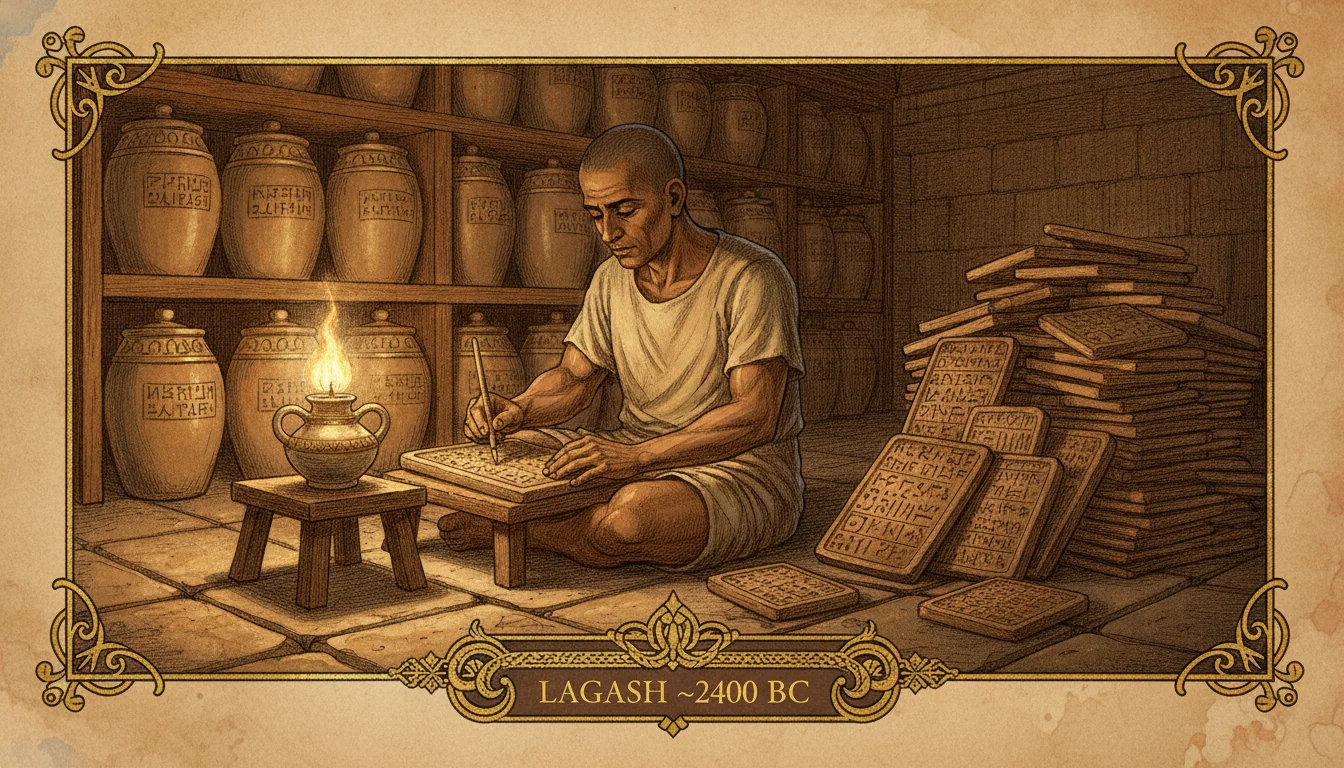
The oldest tax document in human history is not a piece of paper. It is a clay tablet, fired in a kiln in the city of Lagash in Mesopotamia around 2400 BC, covered in wedge-shaped marks recording the quantities of barley, fish, wool, and silver contributed to the temple estate by the city's inhabitants. The scribe who pressed those marks into wet clay was doing something that has not stopped since: calculating what the population owes to the institution in charge, writing it down, and keeping the record.
Taxation is older than most other government functions. It predates professional armies in some polities. It predates coinage in every one. The state, to whatever extent the earliest states can be called that, grew around the administrative need to collect and redistribute grain. The origins of taxes lie in temple bookkeeping, not government mandate - the tax office came before the throne room.
The temple economy of Sumer
The city-states of ancient Sumer - Ur, Lagash, Nippur, Eridu - operated under what archaeologists call a temple economy. The ziggurat complex at the center of each city was not merely a religious building. It was a storehouse, a redistribution center, a bank, and an administrative archive. Priests and scribes managed the flow of grain into and out of the temple store, and the contributions made by farmers, fishermen, craftsmen, and herders constituted the economic basis of the city's operation.
The cuneiform records from Lagash under the ruler Urukagina, around 2350 BC, are particularly detailed. They list taxes on divorce, on burial, on the use of water, on transactions that required a scribe to witness. Urukagina's records are famous partly because he appears to have reduced some of these levies and presents himself as a reformer lightening the burden of ordinary people. Tax reform is also, then, among the oldest recorded political positions.
What proportion the Sumerian tithe represented is debated, but contemporary estimates based on surviving accounts suggest something in the range of 10 to 20 percent of agricultural output. The tithe as a concept - one tenth contributed to the religious-administrative center - appears across multiple early civilizations, from Mesopotamia to Greece, and later becomes formalized in the Levitical law of the Hebrew Bible as a specific 10 percent contribution to the Levites and the temple.
The connection is probably not coincidental. The Hebrew concept of the tithe may have absorbed Mesopotamian administrative practice during the Babylonian exile of the 6th century BC, just as it had absorbed much else from the cultures the Israelites encountered in the ancient Near East.
Egypt: everything belongs to Pharaoh
The Egyptian taxation system operated on a different conceptual premise. In Sumerian polities, the individual farmer had some relationship with his field that the tax extracted a portion from. In the Egyptian ideological framework, the pharaoh owned everything: the land, the water, the harvest, and the labor of every person on it. What farmers retained was technically the pharaoh's allowance.
In practice this meant an annual grain assessment rather than an annual grain payment. Scribes traveled the country after the Nile flood receded to estimate the harvest from soil moisture and seedling density, then calculated what each village owed. The Rhind Mathematical Papyrus, from around 1550 BC but likely copying older material, includes extensive worked examples of the arithmetic needed to compute grain contributions from fields of different shapes and sizes. Tax calculation was a significant intellectual exercise that drove the development of practical geometry.
Egyptian taxation also collected labor. The corvee system required households to contribute a certain number of days of work per year to state projects: construction, irrigation canal maintenance, quarrying, monument building. The pyramids at Giza were not built by slaves, as popular mythology insists. The physical evidence - the workers' villages, the ration records, the medical attention provided to injured workers, and the pride inscribed in graffiti by work gangs with names like "Friends of Khufu" - indicates that the workforce consisted largely of rotating teams of ordinary Egyptian farmers fulfilling labor tax obligations during the agricultural off-season.
Rome: the invention of tax farming
The Roman republic created one of the most consequential institutional innovations in fiscal history: the systematic contracting of tax collection to private enterprise. The state auctioned the right to collect taxes in a given province for a set period, typically five years. The winning bidder, a consortium of Roman equestrian investors called a societas publicanorum, paid the agreed sum upfront to the treasury and then dispatched collectors to extract from the local population. Whatever they collected above their payment was profit.
The system worked well for the state and catastrophically for provincial populations. The publicani had every incentive to squeeze as much as possible above their payment obligation, and Roman law provided limited protection to provincials against collectors who demanded more than was legally due. Cicero's prosecution of the Sicilian governor Verres in 70 BC documents in extensive detail the variety of ways in which a provincial administration could systematically plunder the people it was supposed to administer, often in coordination with the publicani.
The New Testament's hostility to tax collectors reflects their social position in Roman Palestine: local Jewish men who had contracted with the occupying power to collect the tributum capitis, the head tax imposed on provincials, and who enriched themselves through the process. The Gospels record that Jesus ate with tax collectors and that at least one of his disciples, Matthew (also called Levi), had been one. The social statement was deliberate. Tax collectors were not merely disliked. They were considered collaborators and moral traitors.
The episode in which Jesus is shown a denarius and asked whether Jews should pay tribute to Caesar is a carefully laid trap. If he says yes, he endorses submission to Rome. If he says no, he can be reported for sedition. His answer - that what bears Caesar's image belongs to Caesar - sidesteps the trap with a precision that has kept interpreters arguing for two thousand years about what, exactly, he meant about the separation of religious from civil obligation.
The medieval tithe and secular taxes
After the fall of the western Roman Empire, the Catholic Church absorbed the tithe concept into canon law. Every Christian in a parish was required to contribute one-tenth of their agricultural produce - and eventually income from other sources - to the local church. The ecclesiastical tithe and the secular taxes demanded by nobles and kings became parallel systems, both mandatory, both enforced with legal mechanisms, and both resented in proportion to how efficiently they were collected.
Medieval secular taxation was largely ad hoc and event-driven: a king needed money for a war or a ransom or a marriage and extracted a levy from his nobility, who in turn extracted it from their tenants. The English exchequer, established in the 12th century under Henry I, was an early attempt to regularize and audit royal income. The Domesday Book of 1086, commissioned by William the Conqueror 20 years after the Norman conquest, was fundamentally a tax census: a survey of every landholding in England and what it was worth, conducted so the new king would know what he could legitimately demand.
The concept that taxation required some form of consent from those being taxed emerged slowly and unevenly. Magna Carta in 1215 established that the English king could not levy certain taxes without the consent of the barons. The English Parliament's evolution from a consultative body into a governing one was substantially driven by its control over tax authorization. "No taxation without representation," the battle cry of the American Revolution, was not a new idea in 1776. It was the culmination of a constitutional argument the English had been having with their kings for more than five centuries.
The income tax and the modern era
The thing that most people today understand as a tax - a percentage of annual income paid to the central government - did not exist in anything like its current form until the 19th century. William Pitt the Younger introduced the first British income tax in 1799 as a temporary emergency measure to fund the war with France. The rate was 10 percent on incomes above 60 pounds per year, with lower rates for incomes below that threshold. Pitt called it "an assessed tax," and Parliament passed it on the understanding that it would end with the war.
It was abolished in 1802, reinstated in 1803, abolished again in 1816 after Waterloo, and reintroduced permanently in 1842 under Robert Peel to fund the repeal of the Corn Laws. The modern British income tax is Peel's 1842 measure, never again allowed to expire.
The United States did not have a permanent federal income tax until the Sixteenth Amendment to the Constitution in 1913, which allowed Congress to levy income taxes without apportioning them among the states. Before that, the federal government ran largely on tariffs and excise taxes. The income tax introduced in 1913 applied to about 2 percent of the population.
What 5,000 years produced
The line from the Lagash barley records to a modern tax return is unbroken, even if it is considerably longer and more complicated. Every institutional element that appears in ancient tax systems - assessment, collection, enforcement, exemption, avoidance, reform, resentment - appears in modern ones, scaled to the complexity of industrial economies but structurally identical.
What changed is not the basic transaction but the scale of what it funds. The Sumerian temple redistributed grain to the city's workforce and maintained the irrigation canals. The modern state funds hospitals, militaries, pension systems, court systems, diplomatic missions, and the machinery of a hundred other obligations that no ancient city-state could have imagined. The clay tablet with the wedge marks recording barley contributions to the temple of Ningirsu is, in some formal sense, the first ancestor of the form you file every year.
The scribe who pressed those marks into wet clay almost certainly did not enjoy the job either.
For more origins of the institutional furniture of everyday life, see our pieces on how prisons were invented and the invention of the flag.
Quick Answers
Common questions about this topic
When were taxes first invented?
The earliest documented tax system appears in Sumer in Mesopotamia around 3000 to 2500 BC. Cuneiform tablets record grain, fish, livestock, and labor contributions to temple and palace institutions. The Lagash tax records from around 2400 BC are among the most detailed surviving examples, listing contributions by category and by contributor.
What did 'render unto Caesar' mean?
The phrase comes from a question posed to Jesus in the Gospels of Matthew, Mark, and Luke: whether Jews should pay the Roman tributum, the provincial head tax. Jesus was shown a denarius coin bearing Caesar's image and replied that what bore Caesar's image should be returned to Caesar. The exchange has been interpreted variously as endorsing tax compliance, separating religious and civil obligation, or neatly avoiding the political trap the questioners intended to set.
What was the Roman publicani system?
The Roman republic contracted tax collection to private companies called societates publicanorum, whose members were called publicani. The companies bid for the right to collect taxes in a province, paid the agreed sum upfront to the treasury, and then collected what they could from the population. The profit was whatever they could extract above what they had paid. The system was famously corrupt, and the publicani appear throughout Roman literature and the New Testament as bywords for extortion.
When was income tax invented?
The first modern income tax was introduced in Britain in 1799 by Prime Minister William Pitt the Younger as a temporary wartime measure to fund the conflict with Napoleonic France. It was set at a flat rate of 2 shillings per pound - 10 percent - on incomes above 60 pounds per year. It was abolished in 1802 at the Peace of Amiens, reinstated in 1803, and abolished again in 1816 after Waterloo. Britain reintroduced it permanently in 1842.

Ask the Inventors Themselves
Chat with the people who were there when familiar things began.
Create your free account →No card required. Some figures and features require a paid plan.
Join the HistorIQly Club
Get smarter about the past.
Weekly stories, deep dives, and exclusive content straight to your inbox.