Origins: Where Modern Banking Was Actually Invented
The origins of banking trace to medieval Italian merchants who invented the bill of exchange - moving wealth across borders without carrying dangerous gold through bandit-controlled roads.
Read Wikipedia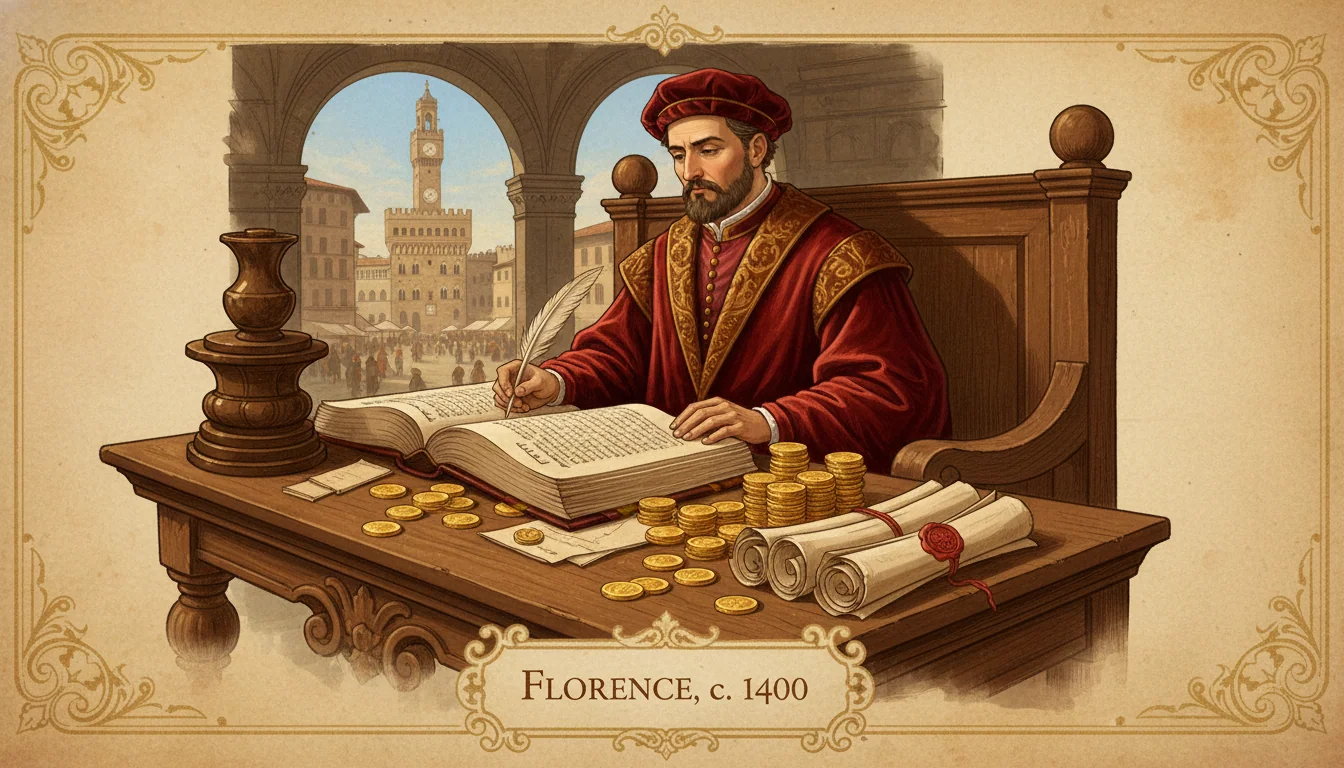
The popular story of money's origins usually begins with barter and progresses tidily through commodity money, coinage, and paper currency to the modern bank. This story is not wrong, exactly, but it skips something important: the invention of banking as a system, not just an institution, required solving a specific medieval problem that most people today don't think about.
The problem was this: you are a Florentine wool merchant in 1350. You need to pay a supplier in Bruges. The distance is roughly 1,500 kilometers. The roads between Italy and Flanders pass through territories controlled by various dukes, bishops, and robber barons, all of whom are happy to relieve a merchant of his coin. Moving physical gold from Florence to Bruges is dangerous, expensive, and slow. But you need to pay, and your supplier needs to receive.
The solution to this problem - the device invented to move value without moving metal - is the foundation of modern banking. Everything else followed from it.
Before the Italians: the ancient precedents
Banking, understood as the practice of accepting deposits and making loans, is ancient. Mesopotamian temples in the third millennium BCE received grain and silver on deposit and issued loans at interest. The Babylonian Code of Hammurabi, written around the 18th century BCE, includes clauses regulating deposit contracts, partnerships, and loan practices - suggesting that banking disputes were already common enough to require standardized law.
The ancient Greeks had trapezitai - literally "table men" - who operated in port cities, exchanged currencies, made loans, and accepted valuables for safekeeping. Athens, with its diverse trading relationships across the Mediterranean, needed people who could handle multiple currencies and provide credit to merchants. The trapezitai did this, and papyrus records from Alexandria show that by the Hellenistic period something like checking transfers between accounts already existed.
Rome had argentarii, money-changers and bankers who operated from stalls in the Forum and later from dedicated premises, took deposits, made loans, issued letters of credit, and kept records of transactions. Roman banking was sophisticated enough that Cicero, in letters to his lawyer Atticus, writes casually about banking arrangements in the way a modern person might discuss a wire transfer.
But all of this ancient banking shared a limitation: it was local. The Athenian trapezites handled transactions for merchants in Piraeus. The Roman argentarius managed accounts within the Roman system. When Rome fell and its monetary system fragmented, the institutional infrastructure went with it. The medieval Italian cities had to rebuild the machinery from near-scratch, and what they built was better.
The medieval breakthrough: the bill of exchange
The core instrument of medieval Italian banking was the bill of exchange, lettera di cambio. In its basic form, it worked like this:
A merchant in Florence deposits a sum with a banker. The banker issues a document stating that the correspondent bank in Bruges should pay an equivalent amount, in local currency at the current rate of exchange, to the named recipient. The merchant travels to Bruges, presents the document, and receives his money. The two banks settle the net balance of such documents between themselves periodically, through a combination of offsetting claims and occasional physical transfer of metal.
The bill of exchange did several things at once. It eliminated the physical transport of coin over dangerous roads. It incorporated currency exchange (the rate was embedded in the bill). It created credit (the time between issuance and payment allowed the banker to invest the deposit). And it distributed risk (if the Bruges correspondent failed, the liability was shared according to the terms of the correspondent relationship).
The Italian cities that dominated the wool and spice trade in the 13th and 14th centuries - Florence, Genoa, Venice, Siena, Lucca - developed this instrument into a highly refined international system. The great fairs of Champagne in France became periodic clearing houses where Italian banking families would meet to settle the accumulated bills of the previous trading season. By the 14th century, a Florentine merchant could conduct business across Europe without ever carrying coin.
The Bardi, Peruzzi, and the first international banking crisis
The most powerful Italian banking houses of the early 14th century were the Bardi and Peruzzi families of Florence. Between them, they operated as the primary financiers of the English crown, lending enormous sums to Edward III to fund the beginning of the Hundred Years War. When Edward defaulted on his debts in the 1340s, both banks collapsed. Contemporary Italian chroniclers described it as a catastrophe that darkened the entire Italian economy.
The Bardi-Peruzzi failure was not just a banking disaster. It was the first major demonstration that sovereign lending - loans to kings - was a categorically different risk from commercial lending, because kings could not be sued, could not be foreclosed upon, and could simply refuse to pay. This lesson was learned and then forgotten and then relearned by European bankers for the next several centuries.
The Medici and the system that worked
From the wreckage of the 1340s, Florentine banking rebuilt around a new model. Rather than making enormous concentrated loans to a single sovereign borrower, the new model used a network of branch offices - each technically a separate partnership - to distribute risk and capital across multiple markets and clients simultaneously.
Giovanni di Bicci de' Medici founded the Medici Bank in 1397 and built it into the dominant financial institution of 15th-century Europe. His son Cosimo de' Medici expanded the branch network to include offices in Rome, Venice, Milan, Geneva, Bruges, and London. Each branch was a separate legal entity with its own partnership agreement, its own local manager, and its own accounts. They shared the Medici name and reputation but not their capital, which meant a failure in one branch did not automatically bring down the others.
The Rome branch was particularly lucrative. The Catholic Church, with its vast international income from tithes, indulgences, and revenues from across Christendom, needed a financial intermediary to move money from distant dioceses to Rome. The Medici held the papal account and earned the privilege of managing these flows, which gave them information, access, and capital on a scale no purely commercial bank could match.
The profits financed everything we associate with the Medici name: the patronage of Botticelli, Donatello, and Michelangelo; the building of the Basilica di San Lorenzo; the political domination of Florence; and, eventually, the rule of two popes and the queens of France. The Medici were not primarily artists or politicians. They were bankers who bought everything else with banking profits.
Double-entry bookkeeping: the silent revolution
Running a bank across six cities in four countries, with multiple correspondent relationships and dozens of partnership accounts, requires keeping track of an enormous number of simultaneous obligations. The Medici and their predecessors solved this with a technique that the Venetian monk Luca Pacioli described and systematized in his 1494 work on mathematics and accounting.
Double-entry bookkeeping records every transaction twice: once as a debit in one account, once as a credit in another. The two sides of the ledger must balance at all times. An error in recording shows up as an imbalance. Fraud requires manipulating both sides of an entry simultaneously, which is more difficult than manipulating a single record.
This technique, which Pacioli documented from existing Italian merchant practice rather than invented, is the accounting system that all modern businesses use. The trial balance, the balance sheet, the profit and loss statement - all derive from the Italian innovations of the 14th and 15th centuries. When we talk about modern financial accountability, we are describing a technology developed by merchants who needed to manage risk across medieval Europe without telephones or computers.
Amsterdam and the first central bank
The Medici Bank declined and closed in the late 15th century, a victim of bad loans to the French crown and the political chaos of the Italian Wars. But the techniques it had developed - the bill of exchange, the correspondent network, the double-entry ledger - had spread across Europe.
The next major institutional innovation came from Amsterdam. In 1609, the Dutch city established the Wisselbank, the Bank of Amsterdam, to solve a different but related problem: Amsterdam's booming trade had attracted such a diversity of currencies - Spanish reals, German thalers, English shillings, local Dutch guilders - that every commercial transaction required calculating exchange rates and quality of coin, which was subject to debasement and clipping. The Wisselbank accepted deposits in all currencies and issued bank money, a standardized unit of account, in return. Merchants could then pay each other in bank money without worrying about the physical state of the coin.
The Wisselbank was not a lending institution in the modern sense. It provided a stable monetary base for the Amsterdam economy that allowed the city to function as the world's leading trading center through most of the 17th century. Its model directly influenced the founding of the Bank of England in 1694, which added the element of lending to the state and issuing banknotes - paper currency backed by the institution's credit.
What the bench became
From the money-changer's physical bench in a medieval Italian market square, one thread leads to the international correspondent banking network, double-entry accounting, the bill of exchange, the deposit bank, the central bank, and eventually to the digital infrastructure that processes trillions of dollars per day across a global system that no individual or institution fully controls.
The origins of banking come down to a single question the medieval Italians answered better than anyone before them: how to move value without moving metal. The modern financial system solves the same problems across greater distance and greater complexity. The specific instruments have changed. The underlying architecture has not.
The word bankrupt still means what it meant when a Florentine money-changer's bench was broken in the market square: the thing that held the transactions together has been destroyed, and the people depending on it must start again.
For related origins deep-dives, read about the origins of the stock market - where the Dutch innovations that followed medieval Italian banking created the modern exchange - and the origins of the printing press, whose spread ran in parallel with the commercial revolution that banking made possible.
Quick Answers
Common questions about this topic
Where does the word 'bank' come from?
The word bank derives from the Italian banca, meaning bench or table - the physical surface on which medieval money changers conducted their transactions in the market squares of Italian trading cities. When a money changer went bankrupt and his trading table was broken up by creditors, it was called banca rotta - 'broken bench' - which gives us the English word 'bankrupt.'
Who invented the bill of exchange?
The bill of exchange was not invented by a single person but developed gradually in 13th and 14th-century Italy, particularly among the merchant families of Florence, Genoa, and Venice. It allowed a merchant in one city to deposit money with a banker there and receive a written document that could be cashed in a different city, eliminating the need to transport gold across roads controlled by bandits and rival powers. It was the foundational instrument of medieval international finance.
What was the Medici Bank?
The Medici Bank, founded by Giovanni di Bicci de' Medici in Florence in 1397, was the largest and most sophisticated banking institution of the 15th century. It operated through a network of branch offices in major European cities, including Rome, Venice, Geneva, Bruges, and London, and pioneered the use of the bill of exchange at international scale. Its profits funded the Medici family's political power and their patronage of Renaissance art and architecture.
When was the first modern bank created?
The Banco di San Giorgio in Genoa, established in 1407, is often cited as the first institution with features recognizable as a modern bank: it accepted deposits, made loans, and operated with some degree of state oversight and accountability. The Bank of Amsterdam, founded in 1609, is regarded as the first to operate as a true central bank, offering deposit services and currency exchange at scale for an entire trading economy.

Ask the Inventors Themselves
Chat with the people who were there when familiar things began.
Create your free account →No card required. Talk to anyone in history with 8 free credits a day. Some features require a paid plan.
Join the HistorIQly Club
Get smarter about the past.
Weekly stories, deep dives, and exclusive content straight to your inbox.