Origins of the Stock Market: How It Was Invented
The origins of the stock market trace to 1602 Amsterdam, where the Dutch East India Company created the first company whose shares anyone could freely buy and sell.
Read Wikipedia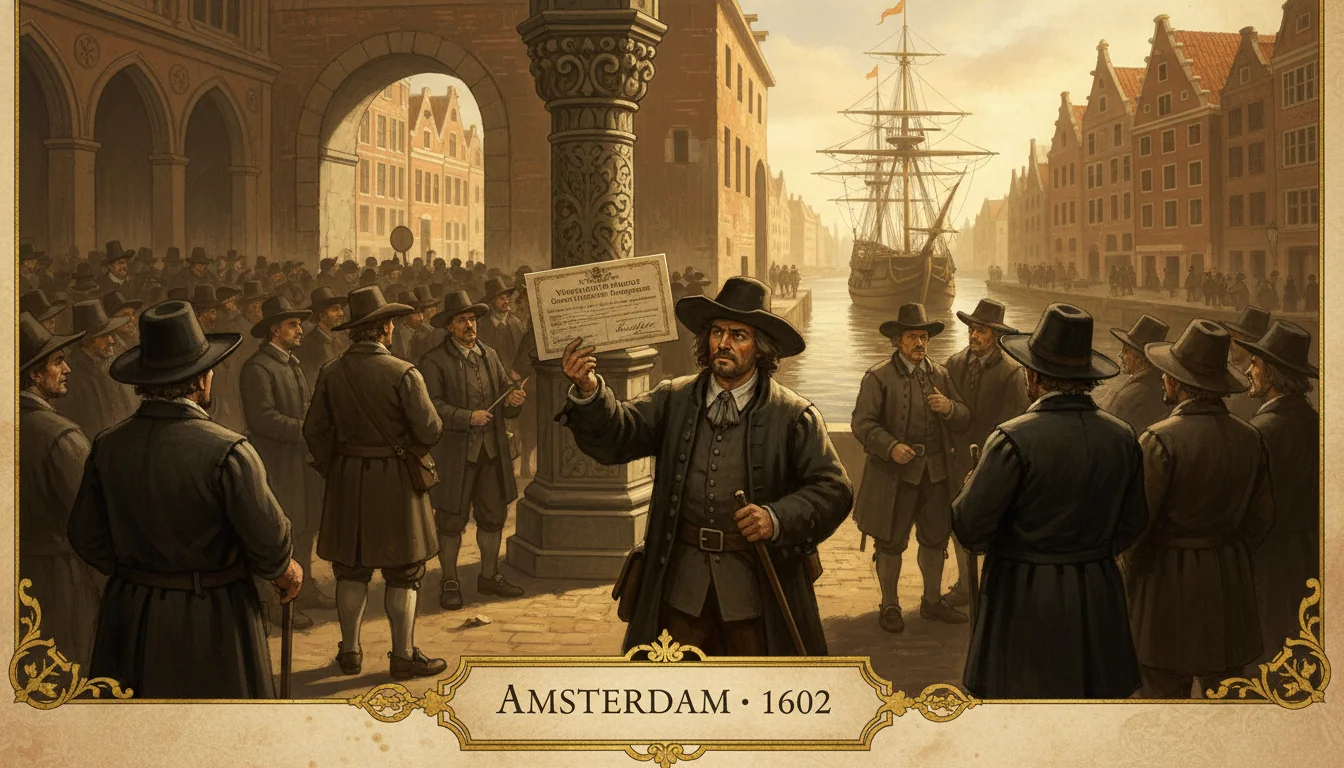
The popular version of the stock market's invention goes something like this: a group of Dutch merchants, unwilling to risk their own fortunes on a single spice voyage to the East Indies, hit on the idea of pooling their money and selling shares to the public. In 1602 the Amsterdam Stock Exchange opened, the modern financial system was born, and the rest followed naturally.
This version is not wrong, exactly. It is just missing several centuries of context that make the 1602 moment both more comprehensible and more genuinely remarkable.
The problem that the stock market solved
Long-distance trade in the medieval and early modern periods was extraordinarily profitable and extraordinarily dangerous. A voyage from Lisbon to the Spice Islands of the Indonesian archipelago could take two years and might return with cargo worth ten times its cost - or it might not return at all. Ships sank. Crews died of disease. Pirates intercepted cargoes. Wars closed ports. The individual merchant who financed a single voyage was betting everything on a single throw.
The solution that Italian merchants developed in the 12th and 13th centuries was the commenda, a temporary partnership in which one investor provided capital and another provided labor and expertise. Profits were divided when the voyage concluded, and the partnership was dissolved. This shared the risk but created no permanent institutional structure. Every voyage required a new agreement, new negotiations, and a new circle of trust.
By the 14th and 15th centuries, Genoese and Florentine banks had developed more sophisticated instruments. The monti - government bond issues backed by municipal revenue - were traded between investors in Italian city-states and established the concept of a liquid secondary market in financial instruments: you could sell your government bond to someone else rather than waiting for it to mature. This is the ancestor of the bond market, and it proved influential.
The Portuguese and Spanish, financing their oceanic expansion in the 15th and early 16th centuries, used a combination of royal monopoly, private capital, and church financing that worked but did not democratize risk. Columbus's voyage was financed by the Spanish crown. Vasco da Gama's was a state enterprise. The profits flowed to monarchs, not shareholders.
Antwerp: the first exchange building
Before Amsterdam, there was Antwerp. The Antwerp Bourse, established around 1531, was the first purpose-built exchange building in Europe - a large courtyard where merchants could gather daily to conduct business under a single roof. The Italian word "borsa," meaning purse, gave European exchanges their name.
Antwerp's exchange was real and important. But it did not trade company shares. Merchants gathered there to exchange bills of credit, negotiate commodity futures, and deal in government bonds. The gathering place - the infrastructure of a secondary market - existed. The instrument that would make it famous worldwide did not yet.
Antwerp's primacy ended when the Spanish sack of the city in 1576 and the subsequent economic disruption pushed its financial community to Amsterdam, carrying their expertise, their networks, and their habits northward.
The Dutch East India Company: the first IPO
The Vereenigde Oost-Indische Compagnie, the VOC, was chartered by the Dutch States-General on March 20, 1602. Its purpose was to conduct trade with Asia, specifically to challenge the Portuguese dominance of the spice routes. The charter granted it a trade monopoly in Asia, the right to make treaties with local rulers, and the authority to build fortresses and field armies.
What made the VOC structurally different from everything that had come before was its capital structure. It issued shares to investors across the Dutch Republic in a public subscription. Merchants, craftsmen, and widows in Amsterdam, Middelburg, Delft, and other cities could buy shares in increments as small as 3 guilders, making it genuinely accessible to people of moderate means rather than only to the wealthiest merchants.
The total capital raised was approximately 6.5 million guilders - an enormous sum by the standards of the time, and one that dwarfed anything any single family or partnership could have assembled. The English East India Company, founded two years earlier in 1600, was also a joint-stock venture, but its capital structure was more restrictive and its shares less readily tradable. The VOC's design was more open and its secondary market more active.
Crucially, VOC shares were not tied to individual voyages. The company was permanent. It did not dissolve after each expedition and distribute profits; it retained capital across voyages, reinvested earnings, and paid dividends from overall performance. Investors who wanted to exit did not need to wait for a voyage to conclude - they could sell their shares to another buyer. This created the secondary market that is the defining feature of a stock exchange.
The first speculations and the first regulations
The ink on the VOC charter was barely dry before investors found ways to profit from share price movements rather than from dividends. By 1609 - seven years after the founding - a merchant named Isaac Le Maire had organized what historians now recognize as the first recorded short-selling conspiracy. Le Maire and his associates sold VOC shares they did not own, betting that they could buy them back later at a lower price and pocket the difference.
To drive the price down, they spread negative reports about VOC performance. The VOC's directors petitioned the Dutch government. In 1610, the States of Holland issued a ban on short selling. The ban was widely ignored, and short selling continued under the creative accounting of traders who saw it as a natural feature of a liquid market.
The same period produced the first book dedicated entirely to stock market speculation: Confusion de Confusiones, written by the Amsterdam merchant Joseph de la Vega and published in 1688. The book describes option contracts, futures trading, market manipulation, and the psychology of herd behavior with a sophistication that reads as remarkably contemporary. De la Vega understood that the exchange was not merely a place to buy and sell but a mechanism for pricing uncertainty, and he recognized that this mechanism attracted both genuine investors and sophisticated gamblers. His observation that market prices are driven as much by expectation and fear as by underlying value has not become less true in the centuries since.
Tulips and the limits of euphoria
The tulip mania of 1636 to 1637 was not a stock market event, but it used the same infrastructure. Tulip bulb contracts - futures agreements to buy or sell specific rare bulbs at specified prices - were traded in Amsterdam's taverns and exchanges. Prices for the most prized varieties, including the Semper Augustus, rose to extraordinary levels before collapsing in February 1637.
The mania illustrates both the power and the pathology of liquid secondary markets. The exchange infrastructure created by the VOC and Amsterdam's financial culture made it easy to trade contracts on almost anything. When a speculative bubble formed in tulip futures, the same mechanisms that allowed efficient price discovery in VOC shares allowed irrational price escalation in bulbs. The crash was rapid once it started.
Modern historians have revised the scale of the tulip mania downward from its legendary extreme, noting that the extreme prices were paid by a small number of speculative traders rather than by ordinary citizens who mortgaged their houses. But the pattern it established - bubble formation in a newly liquid market, followed by crash, followed by regulatory examination - would repeat in London, Paris, and eventually everywhere that exchanges operated.
London, Paris, and the spread of the model
The Amsterdam model diffused rapidly. The Bank of England was founded in 1694 and issued shares that traded on London's informal exchange network. The London Stock Exchange formalized its operations in the early 18th century, just in time for the South Sea Bubble of 1720, in which shares in the South Sea Company were driven to absurd valuations before collapsing and ruining thousands of investors including Sir Isaac Newton, who reportedly lost a substantial portion of his personal fortune and observed that he could calculate the motions of heavenly bodies but not the madness of people.
Paris had its own parallel crash in the same year, the Mississippi Bubble organized by John Law, the Scottish financier who served as France's controller-general of finances and who demonstrated that a government willing to back financial speculation could accelerate a bubble to extraordinary dimensions before the inevitable collapse.
The pattern of the 1602 VOC model - public share issuance, secondary market, speculation, regulation, crash, reform, and eventual stabilization - had replicated itself across every major European financial center within a century.
What Amsterdam actually invented
The origins of the stock market did not lie in Amsterdam alone in 1602. The pieces that made it possible - partnership structures, secondary markets in bonds, commodity exchanges, transferable financial instruments - had been assembled over centuries by Italian bankers, Flemish merchants, and Hanseatic traders. Amsterdam's contribution was not the invention of any single element but the combination of all of them, at scale, in a single instrument that was genuinely open to wide participation.
The VOC share was the first financial instrument that let an ordinary Dutch citizen participate in the profits of oceanic trade with a limited, defined risk. You could lose your investment. You could not lose more than your investment. This limited liability, combined with genuine liquidity - the ability to sell whenever you needed the money - created something the world had not seen before.
The Beurs van Hendrick de Keyser, the building that housed Amsterdam's exchange from 1611, was demolished in 1835 and replaced. The institution it housed was by then three centuries old and had already replicated itself across the world. The model born in the Dutch spice trade now prices every public company on earth. The same era of oceanic expansion that produced the stock market also gave us inventions like the printing press and the magnetic compass.
Quick Answers
Common questions about this topic
When was the first stock market created?
The Amsterdam Stock Exchange, which began operating in 1602 alongside the founding of the Dutch East India Company (VOC), is generally considered the first stock exchange where shares of a publicly traded company could be freely bought and sold. The exchange moved into a purpose-built building - the Beurs van Hendrick de Keyser - in 1611, but secondary trading in VOC shares was happening informally from the moment the company issued shares in 1602.
Was the Dutch East India Company really the first publicly traded company?
It was the first to issue shares that were freely transferable on an open secondary market. Earlier joint-stock companies, including the English East India Company founded in 1600, raised capital from multiple investors, but share transfers were more restricted. The VOC was the first to combine a large share issuance with a permanent capital structure and genuinely open secondary trading, creating the recognizable architecture of modern public equity.
What came before the stock market?
Medieval merchants used partnership structures called commenda, in which one party provided capital and another labor, with profits split at the end of a voyage. Italian city-states, especially Genoa and Venice, issued government bonds called monti that were traded between investors. The Antwerp Bourse, founded around 1531, was the first permanent exchange building where merchants gathered to trade commodities, bills of exchange, and government bonds - but not company shares.
Who was the first stock market speculator?
The Dutch merchant Isaac Le Maire is often called the first recorded short seller. In 1609, just seven years after the VOC's founding, he organized a bearish consortium that sold VOC shares short - selling shares they did not own in anticipation of buying them back at a lower price. The VOC lobbied the Dutch government to ban short selling. The ban was passed and ignored. The pattern of financial innovation followed by regulatory response and evasion was established almost immediately.

Ask the Inventors Themselves
Chat with the people who were there when familiar things began.
Create your free account →No card required. Talk to anyone in history with 8 free credits a day. Some features require a paid plan.
Join the HistorIQly Club
Get smarter about the past.
Weekly stories, deep dives, and exclusive content straight to your inbox.