Origins: When Flags Were Actually Invented
When were flags invented? Not in antiquity - the national flag as a symbol of sovereignty is a European invention that barely predates the 1700s.
Read Wikipedia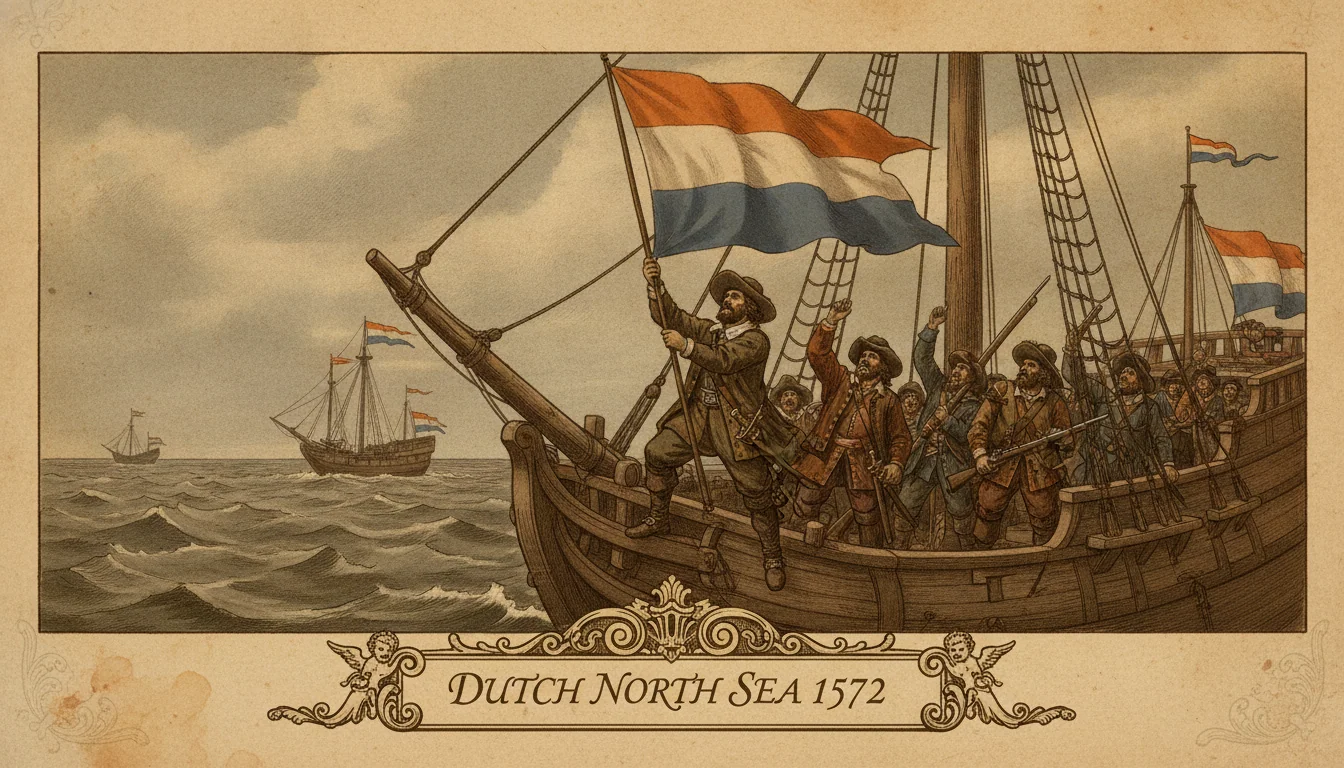
The popular image of ancient warriors marching under their nation's flag is almost entirely backward. Ancient armies marched under unit markers. Nations in the modern sense did not exist yet. And the specific technology of a cloth rectangle on a pole, representing a sovereign state rather than a military unit or a dynasty, barely predates the age of exploration.
So when were flags invented? Not as far back as most people assume. Flags are a medium-old invention that has been projected backward onto history by everyone who assumes that because flags are ubiquitous now, they must always have been ubiquitous.
The actual history is more interesting.
What came before flags
Ancient militaries needed to solve a specific problem: how do you tell your own side from the enemy at a distance, keep a unit from routing, and give soldiers a physical point to rally around in the chaos of hand-to-hand combat? They solved it with vexilloids - objects mounted on poles that functioned as unit identifiers and command markers, one of many organizational problems covered in Origins: The Invention of the Army.
The word vexillology, the study of flags, comes from the Latin vexillum, and the vexillum was one of the most distinctive of these devices. It was not quite a flag in the modern sense. The Roman vexillum was a square or rectangular cloth suspended from a horizontal crossbar attached to a vertical pole. Each unit had its own design. Legions under a vexillum detached from their main force for a specific campaign were called vexillationes.
The legionary eagle - the aquila - was something different again: a standard, not a flag, a three-dimensional object atop a pole that represented the legion's honor in a nearly sacred sense. Losing the aquila in battle was a catastrophe. The pursuit of legionary eagles lost to Germanic tribes during the disaster at Teutoburg Forest in 9 AD consumed Augustus for years. No one would have described the aquila as a flag.
Chinese armies used silk pennants from at least the Han dynasty, roughly 200 BC onward. These were military identification devices in a system where large armies needed to communicate unit identity across noisy, dusty battlefields. Egyptian New Kingdom armies used pole-mounted emblems carved or cast to represent different gods or animals. None of these were national symbols. They were operational tools.
The medieval battle standard
In medieval Europe, the closest things to flags were battle standards, gonfalons, and heraldic banners. These were highly personal objects, representing a lord or a dynasty rather than a territory. A king's banner showed his heraldic device - a lion, an eagle, fleur-de-lis - and rallied his vassals, but it did not represent England or France in any modern sense. It represented the king's person.
The Oriflamme, the sacred battle standard of French kings, was a red silk banner kept at the Abbey of Saint-Denis and brought out only for major campaigns. It was the king's banner, not France's flag. When a different dynasty took power, the symbol changed. Nations did not have flags because the concept of a nation as a distinct political entity with a continuous identity separate from its current ruler had not yet fully arrived.
Heraldry developed in the 12th century partly to solve the practical problem of identifying knights whose faces were covered by helmets. A system of standardized symbols on shields and banners let armies distinguish friend from enemy at a distance. This created the visual grammar that later flags would draw on, but heraldry belonged to individuals and houses, not to geographic units.
The Danish exception and the oldest claim
Denmark's Dannebrog - a white cross on a red field - is widely accepted as the world's oldest national flag still in continuous use. Its legendary origin is vivid: according to the tradition, the red banner with a white cross fell from the sky during the Battle of Lyndanisse in Estonia on June 15, 1219, during a Danish crusade. Outnumbered and losing, the Danes rallied around the fallen banner and turned the battle.
The first problem with this account is that it was written down for the first time more than a century after the supposed event. The second is that no contemporary source corroborates it. The legend almost certainly belongs to a category of origin stories invented or elaborated long after the fact to give a symbol's use a sacred warrant it did not historically possess.
What the historical record does confirm is that the Dannebrog appears in a 14th-century German armorial as the Danish royal emblem, that it was in documented use as a national symbol by the 15th century, and that it has been used continuously since. Whatever its true origin, it is old. The argument for it being the oldest flag in continuous national use is strong.
The birth of the national flag
The context in which national flags actually emerged is 16th and 17th century maritime Europe. When ships from different political entities crossed the same ocean, the ability to identify a vessel's political allegiance at a distance - before anyone could speak to its crew - became a matter of life and death. War and peace at sea depended on correctly identifying who was flying what.
The Netherlands provides the clearest example. The Dutch Revolt against Spanish Habsburg rule began in 1568. The rebel forces under William of Orange adopted a tricolor of orange, white, and blue - the Prince's Flag, or Prinsenvlag - as their emblem. It flew over their ships. It identified their cause. Over time, the orange faded or was replaced with red - the chemistry of orange dye was not reliable at sea - and the resulting red-white-blue tricolor became the Dutch national flag. It is one of the oldest flags used continuously in the modern national sense.
The English developed their naval ensigns - the red, white, and blue ensigns still in use today in various forms - during roughly the same period. The Union Jack as currently known did not come together until 1801, when the cross of St. Patrick was added for Ireland, but its foundation, the combination of the English cross of St. George and the Scottish saltire of St. Andrew, dates from the 1606 union of the crowns.
The Westphalian moment
The political framework that made national flags genuinely meaningful arrived with the Peace of Westphalia in 1648. That series of treaties ended the Thirty Years' War and codified the concept of sovereign states with recognized borders and exclusive authority within them. Before Westphalia, Europe's political geography was a tangle of overlapping loyalties: dynastic, religious, feudal, and commercial. After Westphalia, the modern state system began to solidify, and states needed symbols.
National flags followed the concept of the nation, not the other way around. Once it was settled that France was a thing with a border that persisted regardless of who currently sat on its throne, a French flag made sense in a way it had not quite made sense before - the same shift in thinking about sovereign borders that eventually produced Origins: The Invention of the Passport.
The United States, founded in 1776 and 1777, is one of the first states to deliberately design its own flag as an expression of national identity from scratch. The Stars and Stripes was designed by committee in 1777, with the resolution specifying thirteen stars and stripes for thirteen states. It is a consciously invented symbol, not an evolved one, which makes it representative of the modern flag's nature: a political technology, designed for political purposes, by people who knew exactly what they were doing.
The modern system
By the 19th century, as nationalist movements reshaped Europe and colonial empires claimed territory that required differentiated administration, national flags proliferated rapidly. The tricolor design - France's blue, white, and red - spread as an emblem of liberal nationalism, spawning the Italian, Romanian, Belgian, and Irish flags among others. The Ottoman crescent and star combination was standardized in roughly its current form in the mid-19th century. Most of Africa and Asia acquired flags in their current forms during the decolonization period of the 1950s and 1960s.
The United Nations now recognizes 193 member states, each with a flag. Most of those flags were designed within the last 200 years. The ancient warrior marching under his nation's flag is a projection. The actual ancient warrior marched under a unit emblem representing his commander's house or god, which served its purpose and meant nothing to anyone beyond the valley where the battle was fought.
The flag as a portable symbol of collective identity is a European invention, barely 400 years old, and one of the most successful political technologies ever devised.
Quick Answers
Common questions about this topic
When were flags invented?
Fabric or fabric-like objects on poles - called vexilloids - were used in ancient China, Egypt, and Rome as military signals and identity markers. But these were unit identifiers, not national symbols. The national flag as a symbol representing a sovereign state emerged in Europe during the 16th and 17th centuries, with the Netherlands and Denmark holding the strongest claims to the earliest continuous use of a recognizable national flag.
What is the oldest national flag still in use?
Denmark's Dannebrog, a white cross on a red field, is generally accepted as the world's oldest national flag in continuous use. Its legendary origin is a 1219 battle in Estonia. The earliest confirmed historical documentation of the Dannebrog as a Danish emblem dates from the 14th century, and it has been in continuous documented use as a national symbol since the 15th century.
Did ancient armies use flags?
Ancient armies used vexilloids - devices on poles that functioned as unit markers and rally points - but these were not flags in the modern sense. Roman legions used the aquila (eagle standard) and the vexillum (a square of cloth on a crossbar). Chinese armies used silk pennants. Egyptian armies carried pole-mounted emblems. These were battlefield identification systems, not symbols of national identity.
Why did national flags emerge when they did?
National flags emerged alongside the modern nation-state system in 16th and 17th century Europe. Naval warfare and trade created the practical need to identify ships by political entity at a distance. The Peace of Westphalia in 1648, which codified the concept of sovereign states with recognized territorial boundaries, created the political framework within which a national symbol made sense. Before Westphalia, allegiance was to dynasties, city-states, and churches, none of which required a standardized fabric symbol.

Ask the Inventors Themselves
Chat with the people who were there when familiar things began.
Create your free account →No card required. Some figures and features require a paid plan.
Join the HistorIQly Club
Get smarter about the past.
Weekly stories, deep dives, and exclusive content straight to your inbox.