Origins: Who Actually Invented the Marathon?
The origins of the marathon: a legend invented 600 years after the battle, a distance set by a Windsor estate, and the real run that went to Sparta.
Read Wikipedia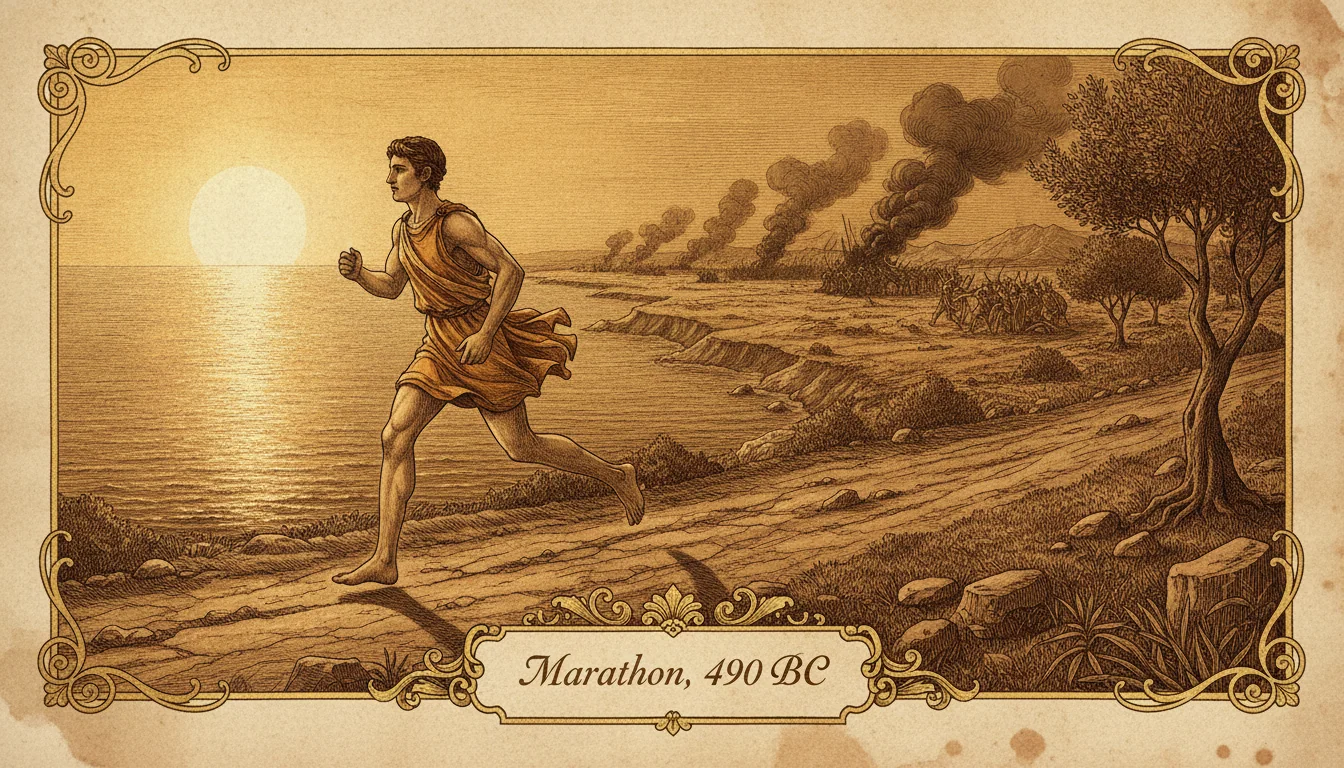
The story goes like this: in 490 BC, after the Greek army defeated the Persian invasion force at the Battle of Marathon, an Athenian messenger named Pheidippides ran the approximately 40 kilometers from the battlefield to Athens, burst into the assembly, announced "We have won!" and immediately died of exhaustion.
It is a perfect story. It has a single hero, a single moment, a single poetic death. It explains why the race exists, gives it a founding tragedy, and connects a modern athletic event to the glory of ancient Greece. The International Olympic Committee has been leaning on it since 1896.
Almost none of it appears in the oldest sources.
What Herodotus actually wrote
Herodotus is the closest thing to a primary source for the Battle of Marathon. He was born around 484 BC, probably within living memory of people who had participated in the events of 490 BC, and his Histories constitute the main ancient account of the Persian Wars. He writes at some length about Marathon. He mentions a runner.
The runner he mentions did not run from Marathon to Athens after the battle. He ran from Athens to Sparta before it.
Herodotus names the messenger Philippides (though different manuscript traditions give the name as Pheidippides, and the confusion has persisted). His mission was to run to Sparta to request Spartan military assistance before the Persians arrived. The Spartans were obligated to wait for a full moon before campaigning, and they arrived at Marathon two days after the battle was already over. This run, Athens to Sparta, is roughly 240 kilometers across mountainous terrain and Herodotus says it was accomplished in about two days, which corresponds to known feats of ultra-distance running.
Herodotus says nothing about a run from Marathon to Athens. He says nothing about a messenger dying after delivering news of victory. The famous scene does not appear in his text.
The gap between Herodotus and the legend
The run-to-Athens story appears, in a form close to the modern version, in the works of Lucian of Samosata, a Syrian-Greek satirist writing in the 2nd century AD. His dialogue Pro Lapsu inter Salutandum mentions the runner Pheidippides dying after delivering the news of victory. Plutarch, writing slightly earlier in the late 1st and early 2nd century AD, also references the story. Both are writing more than 600 years after the event.
The version that became canonical in the modern world was largely consolidated by the Victorian era, which was obsessed with classical Greece and with heroic death as a culminating gesture. Robert Browning's 1879 poem Pheidippides fixed the story in popular imagination, conflating the Sparta run with a post-battle death-dash to Athens and placing the dying declaration "Rejoice, we conquer!" in the runner's mouth. Browning was not writing history. He was writing a poem. But the poem proved more durable than the historical record.
Michel Breal and the 1896 Olympics
The origins of the marathon as a modern race trace to one man's decision. Michel Breal was a French linguist and classical scholar, one of the founders of modern semantics, who was involved in the revival of the Olympic Games under Pierre de Coubertin. In 1894, planning the 1896 Athens Games, Breal proposed a long-distance footrace from Marathon to Athens, specifically to honor the legend he had absorbed from Plutarch and Browning. He personally offered a silver cup to the winner.
The proposal was accepted. The race was organized. The course ran from the village of Marathon to the Panathenaic Stadium in Athens, a distance of roughly 40 kilometers by the roads of the day. Twenty-five men started on April 10, 1896. The early leaders were a Frenchman named Albin Lermusiaux, who had been leading for much of the race and then collapsed, and an Australian named Edwin Flack, who had won the 800 and 1500 meter events at the same Games and whose late-race collapse was reportedly dramatic.
The race was won by Spiridon Louis, a 23-year-old Greek water carrier from the village of Marousi. He entered the stadium to a roar that eyewitnesses described as the loudest sound the new Games had yet produced. Two Greek princes reportedly ran onto the track to escort him to the finish line. He was a national hero within hours. He reportedly returned to farming and never ran a major race again.
The Greeks had won no track or field events at the 1896 Games before Louis crossed the finish line. The marathon, the event most associated with Greek national mythology, was the one Greeks won.
The distance that kept changing
The distance of the marathon race was not fixed in 1896, and it was not fixed for another quarter century.
At the 1896 Athens Games, the course measured approximately 40 kilometers, depending on which road was taken. At the 1900 Paris Games, the distance was approximately 40.26 kilometers. At the 1904 St. Louis Games, the course was approximately 40 kilometers. At the 1906 Athens interim Games, it was 41.86 kilometers. Every Olympic marathon before 1908 was a different length.
The 1908 London Olympics introduced the distance that eventually became standard, though not for reasons of historical accuracy. The original London course was planned at approximately 25 miles, from the start at Windsor Castle to the Olympic stadium in Shepherd's Bush. When the course was laid out, the finish line was moved to position it directly in front of the royal box in the stadium, adding 385 yards. The total distance was 26 miles 385 yards, or 42.195 kilometers.
This specific distance became fixed permanently not because it honored the Greek legend but because the 1908 race itself was extraordinarily dramatic. The Italian runner Dorando Pietri entered the stadium first but collapsed repeatedly before the finish line and had to be helped across by race officials - which led to his disqualification. The scene was photographed, discussed internationally, and made Pietri temporarily more famous than the actual winner, the American John Hayes. The distance associated with that race gained a kind of narrative gravity that later iterations reinforced.
The International Association of Athletics Federations standardized the marathon at 42.195 kilometers in 1921. The distance had been determined by the dimensions of a Windsor estate and the preference of a royal family about where to sit.
The Sparta run's modern revival
The historical run that Herodotus actually described - Athens to Sparta, roughly 240 kilometers - was not forgotten entirely. In 1982, a group of enthusiasts established the Spartathlon, an ultramarathon that follows the approximate route of the run Herodotus attributed to Philippides, from Athens to Sparta. The race covers about 246 kilometers and must be completed within 36 hours.
It is a genuinely brutal event, run across mountain terrain, and far closer to what the ancient sources actually describe than the 42.195 kilometer race that bears the marathon name. The Spartathlon averages about 40 percent completion rates annually. The marathon, by comparison, has roughly 80 percent completion rates at most major events.
The harder run, the one with actual historical documentation, is the one almost nobody has heard of.
The mythology's persistence
The marathon origin myth has survived decades of historical clarification for the same reason most founding myths survive: it is useful. It gives the race a story, the story has a hero, and the hero's death makes the finishing line feel earned in a way that "a French philologist proposed a race in 1894" does not.
The Battle of Marathon itself was real and consequential. The Persian invasion of 490 BC was the first major attempt to absorb Greece into the Achaemenid Empire, and its defeat influenced the trajectory of Greek civilization in ways that later shaped the Roman, Byzantine, and European traditions in sequence. Something worth remembering happened on that coastal plain.
What worth remembering did not include, as far as the evidence reaches, was a man running 40 kilometers to announce it and then dying on the spot. Herodotus, who would have known the story if it had been widely circulating in his lifetime, did not mention it. The man who apparently did run, the one sent to Sparta before the battle, went the distance that requires ultramarathon training to replicate and lived to report back.
The 26.2 miles that millions of people run every year, in events on every continent, is measured from a Windsor Castle gate to a position in front of a royal box that has been demolished. The Greek messenger it commemorates may not have existed. None of which makes the finish line any easier to cross.
Quick Answers
Common questions about this topic
Did Pheidippides really run from Marathon to Athens?
Almost certainly not in the form the legend describes. Herodotus, writing closest to the Battle of Marathon in 490 BC, describes a runner sent from Athens to Sparta before the battle to request military help - a run of roughly 240 kilometers. The famous run from Marathon to Athens after the victory, and the runner's death on arrival, does not appear until Lucian in the 2nd century AD, over 600 years after the event.
When was the modern marathon race invented?
The modern marathon race was invented for the 1896 Athens Olympics by Michel Breal, a French classical scholar who proposed a long-distance race to honor the ancient legend. The first Olympic marathon was run on April 10, 1896, from Marathon to Athens - a distance of approximately 40 kilometers.
Why is a marathon 26.2 miles?
The 26.2-mile distance derives from the 1908 London Olympics. The original course was planned at roughly 25 miles, but the start was moved to Windsor Castle and the finish was positioned in front of the royal box in the Olympic stadium, producing a final distance of 26 miles 385 yards. This distance was standardized by the International Association of Athletics Federations in 1921.
Who won the first modern Olympic marathon?
Spiridon Louis, a Greek water carrier from the village of Marousi, won the 1896 Olympic marathon in a time of 2 hours, 58 minutes, and 50 seconds. He became a national hero in Greece and was the only Greek to win a track or field event at those Games. He reportedly never ran a major race again after his Olympic victory.

Ask the Inventors Themselves
Chat with the people who were there when familiar things began.
Create your free account →No card required. Some figures and features require a paid plan.
Join the HistorIQly Club
Get smarter about the past.
Weekly stories, deep dives, and exclusive content straight to your inbox.