Origins: How the Barbershop Was Invented
The origins of the barbershop trace to a place where the same man cut your hair, pulled your teeth, and amputated a limb. The pole encodes blood, not heritage.
Read Wikipedia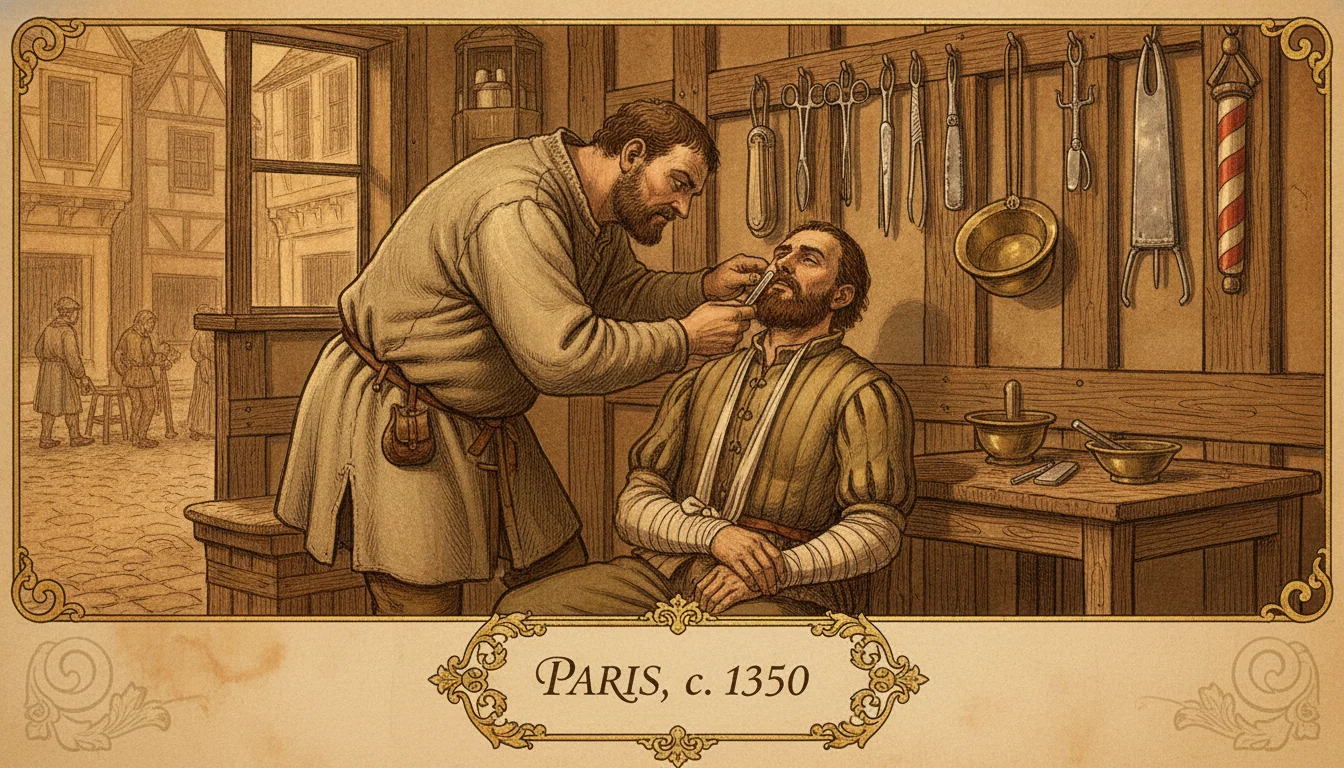
The origins of the barbershop are stranger than the modern storefront suggests. Walk into a barbershop today and you get a haircut, maybe a beard trim, maybe a hot towel if the place is trying hard. Walk into a barbershop in medieval Europe and you might get all of that plus a tooth pulled, a boil lanced, or an arm amputated, performed by the same man with the same set of blades. The modern barbershop's cheerful red-and-white striped pole is not a decorative flourish. It is a leftover advertisement for surgery.
Before Europe: Egypt, Greece, and Rome
Organized barbering predates the medieval barber-surgeon by thousands of years. In ancient Egypt, ritual purity and hygiene made close shaving a serious social and religious matter. Priests shaved their entire bodies regularly, and the wealthy employed dedicated barbers using bronze razors that appear in the archaeological record as early as 3000 BC. Barbering tools have been found among Egyptian grave goods, suggesting the trade carried enough social weight to accompany its practitioners, or their clients, into the afterlife.
Ancient Greece developed barbering into a recognizably social institution. Greek barbershops, agorai for gossip as much as grooming, were gathering places where men discussed politics and local news while getting shaved, a pattern later Roman and medieval European barbershops would repeat almost exactly. Alexander the Great is credited, likely apocryphally in its full detail but plausibly in substance, with ordering his soldiers to shave their beards so enemies could not grab them in close combat, a practical justification for a fashion that stuck.
Rome formalized the trade further. The Roman tonsor worked from an open shop, the tonstrina, that functioned as a genuine social hub, not unlike the coffeehouses that would emerge in later centuries for a similar purpose. Roman barbers cut hair, shaved beards, trimmed nails, and, notably, were already sometimes called upon for minor medical tasks given their access to sharp instruments and steady hands, an early hint of the surgical role barbers would formalize centuries later in medieval Europe.
The medieval fusion: barber and surgeon become one trade
The specific institution known as the barber-surgeon crystallized in medieval Europe, particularly from around the 12th century onward, for a straightforward practical reason: trained physicians, educated at university in Latin medical texts and humoral theory, were rare, expensive, and in many church-influenced medical traditions actually forbidden from performing procedures that involved cutting or bloodshed.
The Catholic Church's 1163 Council of Tours decree, sometimes summarized as ecclesia abhorret a sanguine, the church abhors blood, discouraged clergy and university-trained physicians, many of whom were clerics, from surgical procedures involving bloodletting. This created a genuine practical gap. Someone still needed to perform bloodletting, pull rotten teeth, lance abscesses, and stitch wounds. Barbers, already equipped with sharp razors, steady hands, and a trade built around working directly on the human body, filled that gap by default rather than by any formal medical training.
Bloodletting itself rested on humoral theory, the ancient medical framework, inherited largely from Galen, holding that the body contained four humors, blood, phlegm, black bile, and yellow bile, and that illness resulted from an imbalance among them. Draining blood was believed to restore that balance for an enormous range of ailments, from fevers to headaches to melancholy. It was, by modern standards, medically useless or actively harmful in most cases it was applied to, but it was the dominant therapeutic intervention available across Europe for centuries, and barbers were its most widely accessible providers.
By the late medieval period, a visit to the barber could include a haircut, a shave, tooth extraction, bloodletting, minor surgery, wound treatment, and even enema administration. The barber-surgeon was, in practical terms, the primary healthcare provider for the vast majority of ordinary people who could never afford or access a university-trained physician.
Formal guilds and the widening professional gap
As the trade grew, it organized. England's Worshipful Company of Barbers received its first royal charter in 1462. In 1540, Henry VIII formally merged the barbers' guild with the smaller, more elite Company of Surgeons to create the Worshipful Company of Barber-Surgeons, formally recognizing what practice had already established: the two trades operated in overlapping territory and needed shared regulation.
Even within this merged company, a hierarchy existed. Surgeons, who by this point increasingly pursued more formal anatomical training, handled major procedures, while barbers were restricted mainly to bloodletting, tooth pulling, and minor cuts. The 1540 act creating the joint company explicitly limited barbers' surgical scope, an early sign that the two professions, despite the merger, were already drifting toward separation rather than convergence.
That separation became formal in England with an act of Parliament in 1745, splitting the joint company into the Company of Barbers and the Company of Surgeons, the latter eventually evolving into the Royal College of Surgeons. Surgery was, by this point, increasingly grounded in anatomical study following figures like Andreas Vesalius in the 16th century, and the profession sought to distance itself from a trade still associated with shaving and haircutting. Similar separations unfolded gradually across continental Europe through the 17th and 18th centuries as formal medical and surgical education expanded and professionalized.
The pole that remembers the surgery
The barber pole is the clearest surviving artifact of this shared history, and its most common explanation is also its most literal. The red represents blood. The white represents the bandages used to bind a patient's arm after bloodletting. Some versions of the pole include blue, sometimes explained as representing veins, sometimes as a later decorative addition with no consistent medical meaning, and American barber poles frequently add a gold cap or ball with no established symbolic origin at all, likely a purely decorative flourish adopted once the pole's original medical meaning had faded from common memory.
The pole's physical shape carries its own echo of the practice. Patients undergoing bloodletting would grip a staff or rod tightly, a motion that made the veins in the forearm more prominent and easier for the barber to access. When the procedure ended, the blood-soaked bandages were sometimes hung outside the shop to dry, twisting in the wind around a pole in a spiral pattern that some historians connect directly to the spiral stripe design still used today, though this specific visual origin story is harder to document with certainty than the color symbolism itself.
Why the split finally happened
The professional divergence between barbers and surgeons was not simply about hygiene squeamishness or class snobbery, though both played a role. It reflected a genuine and widening gap in underlying knowledge. Surgery, as anatomical science advanced through the 16th, 17th, and 18th centuries, increasingly demanded formal education that a barber's apprenticeship, focused on practical shaving and cutting skill, simply did not provide. A barber could learn to competently pull a tooth or open a vein through years of hands-on practice. Understanding the anatomical basis of an appendectomy or a complex fracture repair required a different kind of training entirely.
By the time formal medical schools and surgical colleges were well established across 18th-century Europe, the barber-surgeon's dual role had become an anachronism the profession itself wanted to shed. Surgeons pursued the prestige of the emerging scientific medical establishment. Barbers retreated to the grooming trade that had, in fact, been their original and more consistent specialty all along.
The barbershop after the split
Freed from its surgical duties, the barbershop did not disappear. If anything, it thrived in its narrower, purely cosmetic form, retaining much of the social function it had carried since Roman times: a place where men gathered, talked, and passed time, now without the accompanying risk of a poorly sterilized blade opening a vein for medically dubious reasons.
In the United States, particularly within Black communities from the 19th century onward, the barbershop developed into an especially important social and economic institution, a rare Black-owned business space that functioned as a hub for community organizing, information sharing, and mutual support in an era of widespread exclusion from other public institutions. That social role, distinct from the surgical one that originally justified the trade's existence, is arguably the barbershop's most enduring inheritance from its medieval roots: not the bloodletting, but the gathering.
The next time you see a barber pole spinning outside a shop, you are looking at the fossilized advertisement of a trade that once amputated limbs and pulled teeth between haircuts, a reminder that the line between grooming and medicine was, for most of European history, barely a line at all.
For another everyday institution with roots in unexpected medical practice, see our history of how surgery was invented, and for the story of the institution barbers eventually ceded their surgical patients to, see our exploration of the origins of the hospital.
Quick Answers
Common questions about this topic
What does the barber pole actually represent?
The red and white stripes represent blood and the bandages used to bind wounds, dating from the era when barbers performed bloodletting and minor surgery alongside haircuts. Some versions add blue, representing veins, or gold, a later American addition with no clear medical meaning. The pole itself echoes the staff patients gripped during bloodletting to make their veins more visible.
When did barbers stop performing surgery?
The formal split between barbers and surgeons in England came with a 1745 act of Parliament that separated the Company of Barber-Surgeons, uniting the two crafts since 1540, into the Company of Barbers and the Company of Surgeons. In France, a similar separation developed gradually through the 18th century as formally trained surgeons pushed to distinguish themselves professionally from barbers.
Did ancient civilizations have barbershops?
Something resembling organized barbering existed in ancient Egypt, where priests and the wealthy insisted on close shaving for hygiene and religious purity, and dedicated barbers used bronze razors as early as 3000 BC. Ancient Greece and Rome both had established barbering as a public, social trade, with Roman tonsores working in open-air shops that functioned as informal social hubs.
Why did barbers perform bloodletting?
Bloodletting was rooted in the ancient humoral theory of medicine, which held that illness resulted from an imbalance of the body's four humors and that draining blood could restore balance. Barbers had the sharp instruments, steady hands, and practical skill already required for shaving and haircutting, which made them a natural, widely available substitute for the far smaller number of university-trained physicians in medieval Europe.

Ask the Inventors Themselves
Chat with the people who were there when familiar things began.
Create your free account →No card required. Some figures and features require a paid plan.
Join the HistorIQly Club
Get smarter about the past.
Weekly stories, deep dives, and exclusive content straight to your inbox.