Origins: The Real History of Surgery
The history of surgery starts long before Joseph Lister: 7,000-year-old trepanned skulls and Sushruta's 6th-century BC rhinoplasty manual prove it.
Read Wikipedia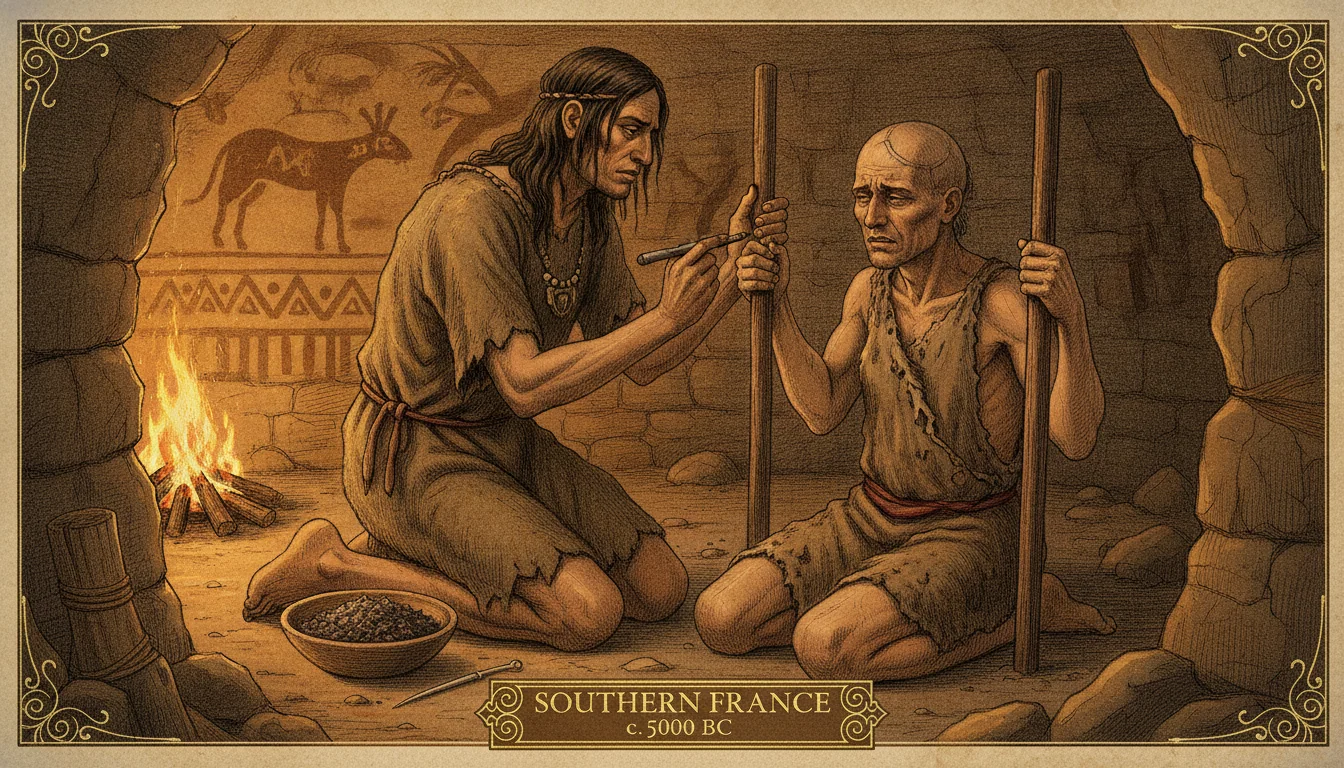
The popular story of surgery before the modern era goes something like this: until Joseph Lister introduced antiseptic technique in 1867, surgery was essentially a form of institutionalized torture practiced by barbers on desperate patients who were usually better off refusing. The surgeon's main qualification was speed. The operating theater was a demonstration space for amputation. Survival was luck.
This narrative has a satisfying darkness to it. It is also, on examination, substantially wrong.
Surgery has been practiced for at least 7,000 years, and in some places, at some periods, with outcomes that the myth of universal pre-modern brutality cannot easily explain. The skulls do not lie.
The oldest operation
In 2020, archaeologists working in Borneo announced they had found evidence of a surgical amputation performed around 31,000 years ago - the lower leg of an individual who had survived the procedure and lived for years afterward, based on the healed state of the bone. If confirmed by further analysis, this would be the oldest known surgery by an enormous margin.
But even setting that case aside, the evidence for ancient deliberate surgery is extensive. Trepanation - the deliberate cutting, drilling, or scraping of holes through the skull - has left physical evidence at sites across Europe, the Americas, and Asia dating back at least 7,000 years. A skull from Ensisheim in Alsace, dated to around 5100 BC, shows two trepanation holes, both healed, indicating the patient survived the operation and lived for some time afterward. Similar skulls have been found in France, Spain, Ukraine, Peru, and pre-contact North America.
The survival evidence is remarkable. Studies of large trepanation skull assemblages from Neolithic Europe have found healed bone - indicating survival - in anywhere from 50 to 90 percent of cases depending on the population and the archaeological site. These were not deaths on the operating table. These were people who had a hole cut in their skull and then went home.
Why it was done remains partly speculative. Some cases involve depressed skull fractures where surgery would have provided real medical relief by reducing intracranial pressure. Others show no obvious trauma and may reflect ritual or spiritual purposes. In some pre-contact Andean societies, the evidence suggests trepanation was practiced so frequently and competently that it looks more like a skilled craft than an emergency intervention.
Egypt and the clinical tradition
Around 1600 BC, an Egyptian scribe copied a medical text onto papyrus. The original source material the scribe was working from appears to date to around 2500 BC, based on the archaic language and the references in the text. The resulting document, known today as the Edwin Smith Papyrus after the American dealer who purchased it in 1862, is the oldest known surgical text.
It describes 48 cases of traumatic injury, systematically organized from head injuries to spinal trauma. Each case follows the same structure: examination, diagnosis, prognosis, and treatment. The prognosis categories are strikingly modern in their honesty: "an ailment I will treat," "an ailment I will contend with," and "an ailment not to be treated" - a triage classification that recognizes when intervention will not help.
The Smith Papyrus does not invoke supernatural causes for any of the conditions it describes. It is a clinical document. Cases include skull fractures, jaw fractures, dislocated shoulders, and cervical vertebra injuries with observed paralysis below the wound. For a text from 2500 BC, its recognition that damage to the cervical spine can produce loss of feeling and movement below the injury site is significant.
Egyptian surgeons used instruments recognizable as surgical tools: copper and later bronze blades, forceps, retractors, and needles. They sutured wounds. They packed fractures with linen. The medical papyri as a group - Smith, Ebers, Kahun - show a tradition of systematic clinical observation that does not fit the myth of pre-modern medicine as pure superstition.
Sushruta and the first surgical manual
The most remarkable text in the pre-modern history of surgery is the Sushruta Samhita, attributed to the Indian physician Sushruta and compiled in Sanskrit approximately around 600 BC. It is not a collection of case notes. It is a surgical curriculum.
The Sushruta Samhita describes over 300 distinct surgical procedures, more than 120 types of surgical instrument, and eight categories of surgical operation including incising, excising, scarifying, probing, extracting, and draining. Sushruta distinguishes between types of wounds and their expected behaviors. He describes post-operative care, diet for recovery, and the management of complications.
The specific procedures that draw the attention of modern surgeons are the rhinoplasty and the cataract operation. Sushruta's rhinoplasty technique - reconstructing a damaged or missing nose using a flap of skin cut from the cheek or forehead, rotated and sutured into place - is a recognizable ancestor of techniques still in use. The reconstructive need was real: nose amputation was a punishment in ancient India, and the demand for surgical repair existed. Sushruta met it with a technique sophisticated enough that British surgeons, encountering it in India in the late 18th century, were sufficiently impressed to publish accounts that contributed to the development of modern reconstructive surgery in Europe.
His description of cataract couching - using a curved needle to displace the clouded lens out of the line of sight - represents one of the earliest documented ophthalmic surgical procedures. It does not restore normal vision, but it does restore functional vision in patients who are otherwise blind. The technique was still being used in parts of the world in the early 20th century.
The Greek and Roman contributions
The Hippocratic tradition of 5th and 4th century BC Greece contributed systematic thinking about wounds, fractures, and joint injuries. The Hippocratic Corpus - a body of texts produced by various authors within that tradition - includes works on fractures, joints, and injuries that describe reduction techniques for dislocations and approaches to wound treatment that are clinically coherent.
Galen of Pergamon, working in the 2nd century AD and serving as physician to the gladiators at Pergamon before his career in Rome, had access to a continuous supply of traumatic injury cases and performed what amounted to systematic anatomical research on living patients. His gladiatorial work gave him direct experience with the management of deep wounds, severed tendons, and joint injuries. His anatomical writings shaped European medical education for over a thousand years, which created their own problems - Galen's errors were preserved as faithfully as his insights - but the clinical experience behind the texts was genuine.
The barber-surgeon gap and the myth of pre-modern butchery
Medieval European surgery developed an institutional split that still confuses people about what surgery was actually like. University-trained physicians, working within a Latin scholastic tradition, considered it beneath their dignity to cut. Surgeons, who did the actual operating, were classified with barbers - the barber-surgeon guild in England dates to 1540 - and were regarded as craftsmen rather than learned men.
This split created a gap between learned medical theory and practical surgical knowledge that lasted for centuries. But it did not mean that surgery was ineffective. Barber-surgeons who trained extensively and accumulated experience could achieve results that the scholarly frame doesn't credit. Ambroise Pare, the 16th-century French barber-surgeon who stopped treating gunshot wounds with boiling oil - a practice based on the incorrect theory that gunpowder was itself a poison - and replaced it with egg yolk, rose oil, and turpentine dressings, did not have a medical degree. He had observation and the willingness to change practice when the observation contradicted the theory.
What Lister and Morton actually changed
The twin revolutions of anesthesia and antisepsis in the 1840s and 1860s were genuinely transformative. Before William Morton demonstrated ether anesthesia at Massachusetts General Hospital in 1846, surgeons operated on conscious patients who had to be physically restrained. Speed was not an aesthetic preference but a mercy. Lister's antiseptic technique, developed from Pasteur's germ theory and applied from 1867 onward, addressed the wound infection that killed far more surgical patients than the operations themselves.
But these revolutions changed the conditions under which surgery could be safely performed at scale, not the basic act of surgical intervention. Trepanation had been survivable for 7,000 years before Lister. Sushruta's rhinoplasty produced functional noses 2,500 years before Morton. The problem was not that ancient surgeons didn't know how to cut - it's that the biological consequences of cutting without germ theory were unpredictable and frequently lethal in ways that nobody yet understood how to prevent.
The history of surgery is not a story of barbarism giving way to science. It is a story of craft knowledge accumulated across millennia, mostly lost and rediscovered, constrained by ignorance about infection and pain but not by ignorance about anatomy or technique, finally joined to the biological framework that made the accumulated craft reliable at scale.
The oldest trepanned skull in France is 7,000 years old. The patient lived. The surgeon knew what they were doing.
Quick Answers
Common questions about this topic
Who invented surgery?
No single person invented surgery. The earliest evidence of deliberate surgical intervention comes from trepanation - drilling holes in skulls - practiced at least 7,000 years ago in Neolithic Europe and the Americas. The earliest known medical text describing surgical procedures is the Edwin Smith Papyrus from ancient Egypt, based on material dating to around 2500 BC. The Indian physician Sushruta, writing around 600 BC, produced the first comprehensive surgical manual.
What is trepanation and why was it performed?
Trepanation is the practice of drilling, scraping, or cutting a hole through the skull. Skulls with healed trepanation holes, indicating the patient survived the procedure, have been found at sites from France to Peru dating back to at least 5000 BC. Reasons likely ranged from treating skull fractures and relieving intracranial pressure to ritual or spiritual purposes. The survival rates suggested by healed bone indicate the procedure was often successful.
What was the Sushruta Samhita?
The Sushruta Samhita is an ancient Sanskrit medical text attributed to the physician Sushruta, compiled around 600 BC in what is now northern India. It describes over 300 surgical procedures, more than 120 surgical instruments, and 8 categories of surgery. It includes detailed instructions for rhinoplasty (nose reconstruction), cataract surgery, and the removal of bladder stones. It is considered one of the foundational texts of surgery.
Was surgery really barbaric until Joseph Lister?
This is one of the great myths of medical history. Surgery before anesthesia and antisepsis was genuinely brutal by modern standards, but skilled surgeons across history achieved remarkable results. Trepanned skulls show survival rates comparable to some modern neurosurgical procedures in some populations. Sushruta's rhinoplasty technique is recognizable to modern plastic surgeons. The real revolutions were anesthesia (ether, 1846) and antisepsis (Lister, 1867), not the basic act of surgical intervention itself.

Ask the Inventors Themselves
Chat with the people who were there when familiar things began.
Create your free account →No card required. Some figures and features require a paid plan.
Join the HistorIQly Club
Get smarter about the past.
Weekly stories, deep dives, and exclusive content straight to your inbox.