Origins: Who Invented the Hospital?
Who invented the hospital? Baghdad, 805 AD - not medieval Europe. The Islamic bimaristan offered organized care to patients of any faith, class, or background.
Read Wikipedia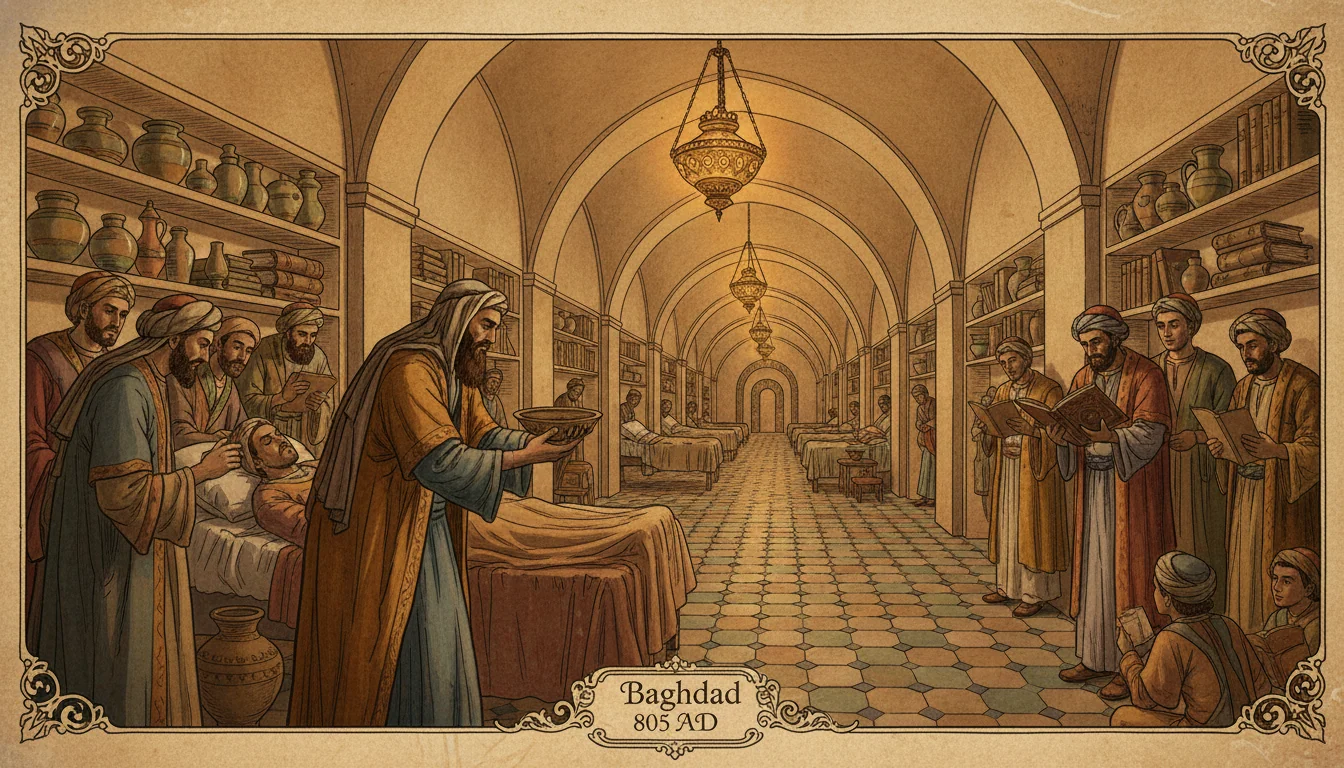
The word "hospital" derives from the Latin hospes, meaning host or guest, which also gives us "hotel," "hospitality," and "hospice." The shared etymology is not accidental. For most of human history, the building where sick people gathered was primarily a hospitality institution rather than a medical one - a place that provided shelter, food, and spiritual care, with medicine as a secondary consideration. The organized treatment of illness by trained professionals in a dedicated public building is a later development, and it arrived from a direction that most Western popular histories of medicine underemphasize.
The question of who invented the hospital has a clearer answer than most histories provide. The hospital as a functional medical institution - a building where sick people receive diagnosis and treatment from qualified physicians, organized by type of illness, accessible regardless of social class or religion, with the specific purpose of therapeutic outcome - was not invented in Christian medieval Europe, not invented in classical Greece, and not invented in Rome. It was invented in the Islamic world, in a sequence of innovations running from the late 8th century through the 10th, and the most transformative examples were in Baghdad.
What came before
Precursors existed across several civilizations, and understanding what they lacked illuminates what the bimaristan provided.
In ancient Greece, the Asclepieia were healing sanctuaries dedicated to Asclepius, the god of medicine. Sick people traveled to them seeking divine intervention, slept in the temple precincts, and hoped to receive guidance through dreams. Priests interpreted those dreams. Some Asclepieia employed physicians, and the sanctuary at Cos - associated with the tradition that produced the Hippocratic corpus - was a genuine center of medical learning and practice. But the Asclepeion's organizing principle was religious, not therapeutic. Treatment was primarily ritual. Access depended on the ability to travel and the willingness of the sanctuary to receive you.
Rome built valetudinaria, which translates roughly as "places for the infirm." These were military field hospitals, established at permanent Roman forts from the 1st century AD onward, designed to maintain legionary capacity between campaigns. The valetudinarium at the fortress of Neuss on the Rhine, excavated by modern archaeologists, shows a sophisticated layout: wards arranged around a central courtyard, distinct rooms for different conditions, drainage channels, and storage for medical supplies. Injured soldiers were brought there, treated by army physicians, and returned to service when recovered.
The Roman valetudinarium was architecturally impressive and practically effective. It was also closed to everyone who was not a soldier. Roman civilian medicine was a private transaction between patient and physician. There was no public building where an ordinary Roman citizen with a fever or a wound could walk in and receive treatment. The concept simply did not exist in the Roman institutional vocabulary.
Byzantium created the xenodochion, a charitable institution combining elements of hospital, pilgrim hostel, and poorhouse, typically attached to a church or monastery. The xenodochion provided food, shelter, and basic physical care to the sick and destitute. It was organized around Christian principles of mercy and was staffed partly by monks and partly by lay workers. It provided genuine relief to the sick poor of Byzantine cities. It was not a medical institution in the sense of organized diagnosis, pharmaceutical treatment, or professional physician practice. The organizing logic was religious charity, not therapeutic outcome.
Emperor Basil I is credited in Byzantine sources with establishing a more formal institution at Constantinople in the 9th century, but even this advanced Byzantine example remained primarily a charitable house. The gap between Byzantine xenodochion and Islamic bimaristan is the gap between organized mercy and organized medicine.
Baghdad, 805 AD: the first bimaristan
The Abbasid caliph Harun al-Rashid established a hospital in Baghdad around 805 AD. It was directed by Jibrail ibn Bakhtishu, a member of the Bakhtishu family that had served as court physicians to the Abbasid caliphate across several generations. The Bakhtishu were Nestorian Christians, physicians trained in a tradition that had preserved, extended, and applied Greek medical learning across Mesopotamia and Persia for centuries.
This background matters. The intellectual foundation of Islamic medicine in its early development was the Nestorian Christian and Persian scholarly tradition, which had translated and practiced Galenic and Hippocratic medicine while Greek learning was declining in the West. The Abbasid court under Harun al-Rashid and his successor al-Mamun actively funded translation of Greek, Persian, and Indian medical and scientific texts into Arabic, a project that moved through Baghdad's House of Wisdom. What distinguished the bimaristan from its predecessors was that this translated medical learning was now institutionalized - applied systematically by trained professionals in a structured public setting.
The Baghdad bimaristan admitted patients regardless of their religion. Muslim, Christian, Jewish, and Zoroastrian patients were treated in the same building, which was exceptional in the 9th century. It organized patients by condition, with separate wards for those with fevers, those with infections, and those requiring surgical care. Its physicians examined patients, recorded case histories, and prescribed treatments based on diagnosis rather than ritual. It held a pharmacy dispensing compounded medicines. It trained younger physicians through supervised clinical observation of real cases.
These features, taken together, constitute what we mean by a hospital. The Baghdad bimaristan of 805 AD is the first documented institution that meets this definition.
The Adudi Hospital and the mature form
The bimaristan model developed rapidly through the 9th and 10th centuries. Major Islamic cities built hospitals: Baghdad had at least three by the 10th century, Cairo's first bimaristan appeared in the 9th century, and Damascus, Cordoba, and other centers of Islamic civilization followed.
The Adudi Hospital in Baghdad, established in 981 AD under the Buyid ruler Adud al-Dawla, is the most thoroughly documented early Islamic hospital. Medieval Arabic sources describe it as employing twenty-four physicians on staff, including specialists in eye conditions, orthopedics, and mental disorders. It maintained a library, a pharmacist, and separate wards for men and women. Students completed clinical rotations. Medical examination boards certified competence before allowing a physician to practice.
Al-Razi, the 9th-century physician known in Europe as Rhazes and whose medical writings would later be translated into Latin and taught in European universities, reportedly chose the site of an earlier Baghdad hospital by hanging raw meat in different parts of the city and observing where it decomposed most slowly - an intuitive attempt to identify the least polluted air. The method was imprecise but the instinct was public health reasoning, not religious prescription.
The psychiatric ward at Islamic hospitals deserves specific attention. Mental illness was treated in the bimaristan as a medical condition requiring professional care rather than as a spiritual failing requiring exorcism. Patients with mental disorders were admitted alongside physically ill patients and treated with medicines, baths, music, and what we might today call occupational therapy. Medieval European approaches to mental illness would not reach equivalent sophistication for several centuries.
How the Crusades transferred the model to Europe
The Crusades were, among many other things, a mechanism for the transfer of medical knowledge from the Islamic world to Europe. Crusader knights, soldiers, and pilgrims who were treated in Islamic bimaristans in the Levant encountered institutions far more sophisticated than anything available in Western Europe at the time. The Knights Hospitaller, founded in Jerusalem in the early 12th century to provide care for sick pilgrims, organized their hospitals in part on the bimaristan model they had observed firsthand.
By the 12th and 13th centuries, Arabic medical texts - including the influential works of Ibn Sina, known in Europe as Avicenna, and of al-Razi - were being translated into Latin by scholars working in Sicily, Spain, and southern Italy, where Islamic, Christian, and Jewish intellectual traditions had coexisted long enough to produce genuine cross-cultural scholarship. These translations entered the curriculum of the first European medical schools at Salerno, Montpellier, and Bologna. The institutional model followed the texts, gradually.
The Hotel-Dieu in Paris, the oldest hospital in continuous operation in Europe, was reorganized and expanded multiple times through the 12th and 13th centuries in ways that reflected the increasing influence of Arabic medical learning. The transition from charity house to medical institution was slow, uneven, and varied by city and by century. But the bimaristan model - organized care by condition, professional physician staff, separation of patients by type of illness - was a persistent influence on the European hospital's evolution.
What popular memory omits
The standard Western account of hospital history tends to begin in medieval Christian Europe, with monastic infirmaries and institutions like the Hotel-Dieu, and treats Greek antecedents as philosophical foundations rather than institutional predecessors. The Islamic bimaristan, when mentioned at all, is presented as a curiosity or a parallel development rather than as the primary institution from which the modern hospital descends.
The actual sequence is more complex than either narrative accommodates. The Greek Asclepieia provided medical theory without institutional public medicine. Rome provided institutional sophistication without public access. Byzantium provided public access without organized medical practice. The Islamic bimaristan synthesized elements from all three traditions, added the Nestorian Christian and Persian clinical inheritance, and produced the first institution that meets the modern definition: a public building, professionally staffed, admitting patients of any background, organized by medical specialization, and oriented toward therapeutic outcome rather than charity or ritual.
The word "hospital" is Latin. The institution it describes was invented in Baghdad.
For related histories of institutions with surprising origins, see Origins: Who Invented the University? and Origins: Where the Library Began.
Quick Answers
Common questions about this topic
Who invented the hospital?
No single person invented the hospital, but the institution as we recognize it - a dedicated building where sick people receive organized medical treatment regardless of religion or social class - traces most directly to the Islamic bimaristan of the 9th century, particularly the hospital established in Baghdad around 805 AD under the Abbasid caliph Harun al-Rashid.
Was the Hotel-Dieu in Paris the first hospital in Europe?
The Hotel-Dieu, founded around 651 AD by Saint Landry, Bishop of Paris, is often cited as the oldest continuously operating hospital in Europe. But the early Hotel-Dieu was primarily a Christian charity house providing food, shelter, and spiritual care to the sick poor, not a medical institution in the sense of organized diagnosis and treatment by trained physicians.
What was a bimaristan?
A bimaristan was an Islamic hospital, the word deriving from the Persian bimar (sick person) and stan (place). Bimaristans admitted patients regardless of religion, gender, or social class. They featured separate wards for different conditions, employed trained physicians, maintained medical libraries, and served as teaching institutions - a model far beyond the contemporary European charitable house.
Did the Romans have hospitals?
The Romans built valetudinaria, military field hospitals attached to permanent legionary forts, to keep soldiers fit for service. These were architecturally sophisticated with separate wards and drainage systems. They were not open to civilians. Roman civilian medicine was practiced entirely by private physicians working in their own premises or visiting patients at home.

Ask the Inventors Themselves
Chat with the people who were there when familiar things began.
Create your free account →No card required. Talk to anyone in history with 8 free credits a day. Some features require a paid plan.
Join the HistorIQly Club
Get smarter about the past.
Weekly stories, deep dives, and exclusive content straight to your inbox.