Origins: How the Coffeehouse Was Invented
The history of the coffeehouse begins in 16th-century Ottoman Constantinople, not Paris or Vienna. A room for sober argument that became the engine of the Enlightenment.
Read Wikipedia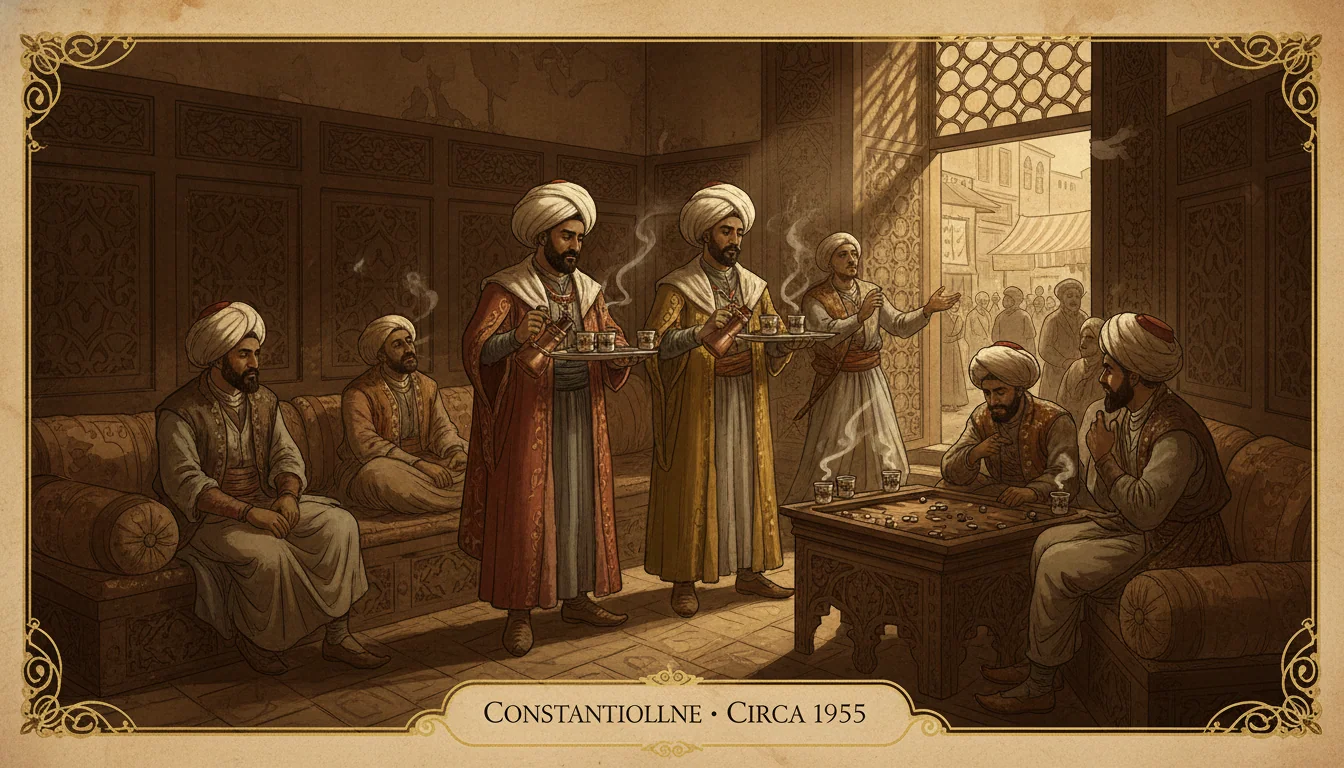
The coffeehouse was not designed. No architect planned it, no monarch commissioned it, no religious authority sanctioned it. It emerged, in the early decades of the 16th century in the Ottoman world, from a simple collision between a new beverage and a need for a place to drink it that was not a mosque, a home, or a tavern. The room it produced turned out to be one of the most consequential social inventions in the history of western civilization.
The beverage itself had been invented a generation earlier - Sufi mystics in 15th-century Yemen had pioneered brewing roasted coffee beans as a drink, using it to stay awake through long nighttime prayer sessions (the full origins of coffee trace back to those same Sufi circles). By the early 16th century, coffee had spread through the Hejaz and into the great cities of the Ottoman Empire. The question was where to drink it.
The Ottoman qahvehane
The answer was a new kind of room. The Arabic word was maqha; the Turkish was qahvehane - literally a coffee-house, or a house of coffee. The first documented examples appeared in Mecca, sometime in the 1510s or 1520s, in the commercial districts that surrounded the Haram Mosque. By 1532, Cairo had enough coffeehouses that its governor felt compelled to ban them. By 1554, two Syrian merchants - their names are sometimes recorded as Shams and Hakim - had opened the first coffeehouses in Constantinople, in the Tahtakale commercial district near the Spice Bazaar.
The Constantinople coffeehouses spread with remarkable speed. Within a decade, Venetian ambassadors were describing hundreds of them across the city. By the later 16th century, a traveler's guide to Istanbul would have been incomplete without a section on the qahvehane, which had become one of the most visible features of Ottoman urban life. Our time traveler's guide to Ottoman Istanbul in 1555 puts you in the city where the qahvehane was already an established institution.
The physical design was specific. A qahvehane was typically a low-ceilinged room with benches or cushions running along the walls, arranged so that customers could see and speak to each other across the space. There was a fireplace or brazier where coffee was prepared in long-handled copper cezve pots and served in small handleless ceramic cups called fincan. The floor was often covered in rugs or sawdust. There was no food normally served - this was not a restaurant. There was no alcohol - this was not a tavern. The qahvehane was a room with a single product and a single purpose: sober sociality.
What happened in these rooms was unprecedented in Islamic urban culture. Men from different social classes could sit together. Merchants, students, government officials, travellers, storytellers - the meddah, itinerant performers who made their living spinning narratives - all shared the same benches. Backgammon boards were available. Poetry was read aloud. News moved through the room faster than it moved anywhere else in the city. The qahvehane was, in the vocabulary of a later era, a media space: a room where information was produced, exchanged, and debated, faster and more freely than the traditional alternatives allowed.
Why every ruler tried to close them
The bans tell the story. The governor of Mecca, Khair Beg, convened physicians and Islamic jurists in 1511 to declare coffee an intoxicant and therefore forbidden under Islamic law. The coffeehouses were shut. The beans were burned in the streets. Customers were punished. The Mamluk sultan in Cairo, when news of the ban reached him, overruled it within months. Coffee was not intoxicating. The coffeehouses reopened.
Cairo itself banned them in 1532. The ban lasted very briefly. The Ottoman sultan Murad IV banned coffeehouses in Constantinople in 1633, reportedly on pain of death, and walked the city in disguise to enforce the edict personally. His successor quietly allowed them to reopen.
The pattern reveals what each ruler correctly intuited: the coffeehouse was not threatening because coffee was a drug. It was threatening because the room was a new kind of public sphere, and new public spheres are inherently difficult for established power to manage. Wine houses produced stupor and brawling. The mosque produced piety and compliance. The palace produced hierarchy and deference. The qahvehane produced sober, collective, egalitarian argument, and nobody in authority had a mechanism for controlling that.
Charles II of England, issuing his proclamation against London coffeehouses in December 1675, used almost exactly the words the Meccan governor had used a century and a half earlier: these places were "seminaries of sedition," where idle men spread "false, malicious, and scandalous reports" to the detriment of good government. His ban lasted eleven days before the merchant community's fury forced a climbdown. The coffeehouses stayed open.
Oxford, 1650
Coffee reached Europe primarily through Venetian trading connections, with bulk shipments arriving around 1615 via Levantine intermediaries. The first European coffeehouses appeared in Venice in the mid-17th century. But it was England that developed the institution most intensively.
The first English coffeehouse opened in Oxford in 1650. It was operated by a man named Jacob, described in contemporary sources as a Lebanese Jewish or Syrian entrepreneur, at the Angel Inn in the parish of St Peter-in-the-East. Oxford's university culture made it a natural first market: students and scholars wanted somewhere to argue that was not a tavern, and the new beverage's reputation as a brain-sharpening stimulant suited an academic environment.
London followed in 1652, when Pasqua Rosée - an Armenian or Greek servant of a Levant Company merchant named Daniel Edwards - opened a stall in St Michael's Alley in Cornhill. Rosée had spent time in Smyrna with Edwards and had learned the Turkish preparation method. The stall became a shop, the shop became a fixture, and the fixture was soon one among hundreds.
By 1700, London had somewhere between two thousand and three thousand coffeehouses, serving a city of perhaps half a million people. The ratio - roughly one coffeehouse for every hundred adult men - was not matched in any other European city. The reasons were cultural and commercial: English coffeehouses were notably open in their admission policies, accepting customers regardless of rank or trade, and the city's commercial culture created an enormous demand for a place where business could be conducted over a neutral table.
How coffeehouses built modern institutions
The commercial history of the London coffeehouse is the history of several institutions that now seem unrelated to the question of where people drank coffee in the 17th century.
Lloyd's of London - the insurance market that underwrites ships, aircraft, satellites, and celebrity body parts - began as a coffeehouse on Tower Street in the 1680s owned by Edward Lloyd. Ship owners and merchants gathered there because Lloyd pinned maritime news to the walls, kept a list of vessels and their captains, and made his house the recognised meeting place for those involved in the shipping trade. Insurance contracts began to be concluded across his tables. Lloyd's moved, formalised, became a syndicate, became an institution - but the origin was a room with a coffee pot and a noticeboard.
The London Stock Exchange grew from Jonathan's Coffee House, where brokers gathered to trade shares in the joint-stock companies that were beginning to proliferate in the late 17th century. Share prices were posted on the wall. Deals were made at the tables. Jonathan's eventually reorganised itself into a formal exchange, but for decades it was simply the coffeehouse where you went to buy or sell stock.
The Royal Society, founded in 1660 as the first major scientific society in English history, operated through coffeehouse networks. Scientists gathered at Garraway's Coffee House and at other venues across the city to read papers aloud, argue about experiments, and exchange the correspondence that was the primary medium of scientific communication before journals were established. The coffeehouse was where Robert Hooke discussed his microscopy, where Edmund Halley organised the funding for Newton's Principia Mathematica, and where the culture of open, peer-reviewed scientific argument was first practiced as a social norm.
Vienna: the siege windfall
Vienna's coffeehouse culture has its own origin myth, and like most origin myths it has been partly inflated. When the Ottoman siege of Vienna failed in September 1683, the retreating army left behind enormous stores of supplies, including large quantities of unfamiliar green beans. A Polish-born soldier and interpreter named Franciszek Kulczycki, who had spent years in Ottoman territory and recognised the beans, claimed the haul as his reward for services and used it to open one of Vienna's early coffeehouses.
Later Viennese historians have argued that an Armenian merchant named Johannes Diodato actually obtained the first Viennese coffeehouse license in 1685, and that Kulczycki's heroic role has been retrospectively amplified. Either way, the beans came from the abandoned Ottoman camp, and the Viennese cafe tradition - the melange, the kaffeeklatsch, the hours spent over a single cup with a newspaper - traces its origin to the same Ottoman institution that had already transformed Cairo, Constantinople, and London.
What the room changed
The coffeehouse's contribution to the social history of the last four centuries is difficult to overstate because it created something that had not previously existed in European urban life: a public space where private people could meet as equals, sober, and argue about anything.
The tavern existed for centuries before the coffeehouse, but it produced a different kind of conversation - shorter, louder, less precise, often more violent. The coffeehouse produced a culture of sustained argument, of reading aloud, of collective reasoning about matters of public concern. That culture fed directly into the Enlightenment's characteristic institutions: the learned society, the periodical press, the public intellectual, the commercial law firm, the insurance syndicate, the stock market.
Those institutions grew up in the same cities where coffeehouses flourished, in the same decades when coffeehouses gave literate men a neutral ground for sustained, sober argument that produces institutions.
The history of the coffeehouse, from those first Ottoman rooms to Lloyd's of London and the Royal Society, is the story of an accidental invention that refused to stay small. The Syrian merchants who opened their first shop in the Tahtakale district of Constantinople in 1554 were not thinking about the Enlightenment. They were thinking about rent and the price of green beans. The room they built, however, had a logic that nobody planned: a space where anyone could sit, for the price of a cup, and argue with anyone else. That logic turned out to be one of the more powerful social technologies in European history.
Quick Answers
Common questions about this topic
Where was the first coffeehouse?
The earliest documented coffeehouses appeared in Mecca in the early 16th century, following coffee's spread from Yemen through the Hejaz. By 1554, two Syrian merchants had opened the first coffeehouses in Constantinople, in the commercial district of Tahtakale. Within a decade, the Ottoman qahvehane had become one of the defining social institutions of the empire.
Why did rulers keep banning coffeehouses?
Every ban on coffeehouses - Mecca 1511, Cairo 1532, Constantinople 1633, London 1675 - was about the room, not the drink. A space where sober men could sit for hours, exchanging news and argument, without the stupefying effect of wine, was unlike anything that had existed before. Rulers found it threatening for the same reason later rulers found the printing press and then the internet threatening: it was a new medium for information that they did not control.
What was the penny university?
In 17th-century London, coffeehouses charged a penny for admission, which entitled the customer to a cup of coffee, use of the premises, and access to the newspapers and pamphlets posted on the walls or stacked on the counter. For a penny, a tradesman, a merchant, or a student could sit in the same room as a lord or a scientist and engage in the same conversation. The nickname 'penny university' reflected the sense that coffeehouses were democratising access to information and argument.
Which major institutions grew out of coffeehouses?
Lloyd's of London began as a coffeehouse owned by Edward Lloyd on Tower Street in the 1680s, where ship owners and underwriters gathered to trade marine insurance. The London Stock Exchange evolved from Jonathan's Coffee House, where brokers posted share prices. Several early newspapers were read aloud in coffeehouses before printing made them widely available. The coffeehouse was not merely a place to drink - it was where the commercial and intellectual infrastructure of early modern Europe was assembled.

Ask the Inventors Themselves
Chat with the people who were there when familiar things began.
Create your free account →No card required. Talk to anyone in history with 8 free credits a day. Some features require a paid plan.
Join the HistorIQly Club
Get smarter about the past.
Weekly stories, deep dives, and exclusive content straight to your inbox.