Origins: How the Corporation Was Invented
The origins of the corporation trace to 1602 Amsterdam, where Dutch merchants invented limited liability and tradeable shares, creating the modern business world.
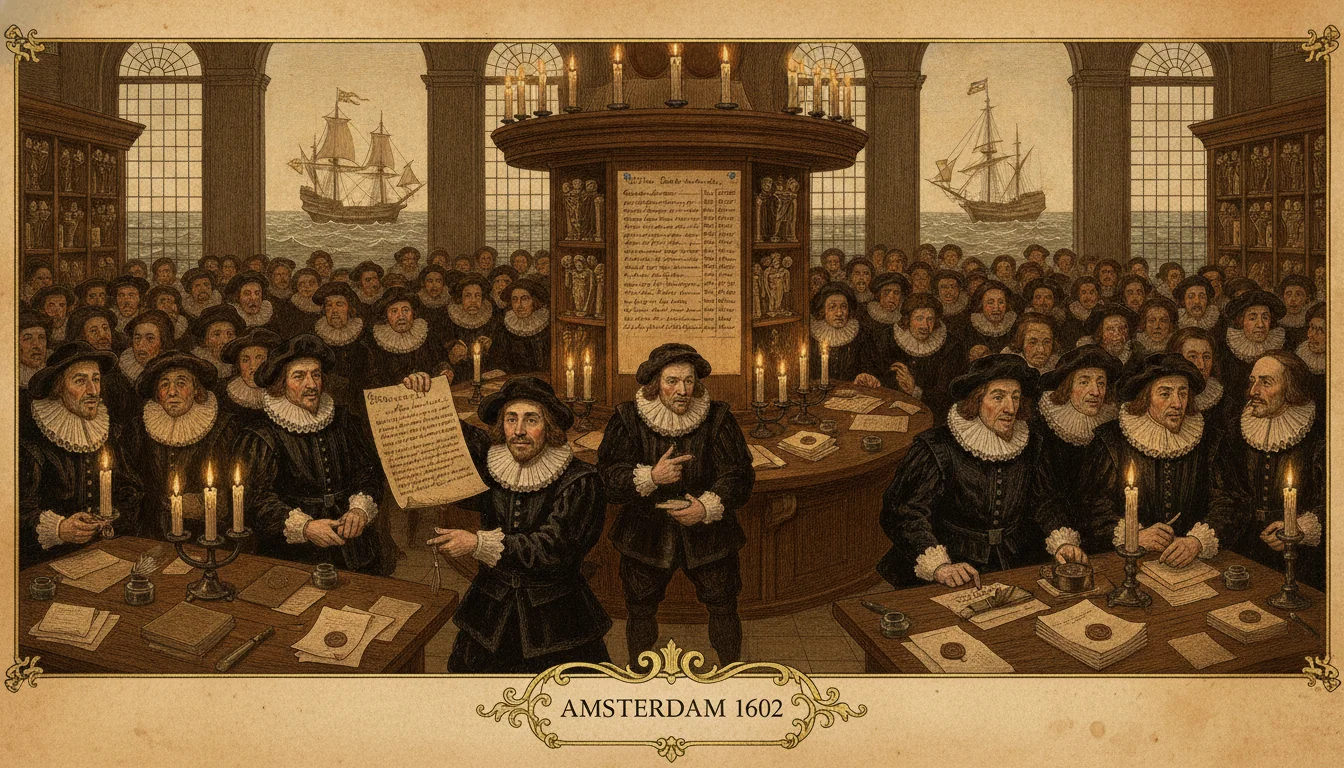
The standard story of the corporation's invention assigns it a clean address: March 20, 1602, Amsterdam, a royal charter signed by the States-General of the Dutch United Provinces, establishing the Vereenigde Oost-Indische Compagnie - the Dutch East India Company, known to history by its abbreviation, VOC.
That address is accurate enough. What the story usually omits is everything that had to be invented before the charter was worth signing: the concept of permanent capital, the mechanism of the tradeable share, the legal wall between a shareholder's personal assets and the company's debts, and the Amsterdam exchange that made shares worth holding in the first place. The 1602 charter did not create a corporation in empty space. It crystallized a century of financial experiment into a single legal instrument and aimed that instrument at the richest trade routes in the world.
The result was the most powerful commercial entity in history to that point, and also the template for every corporation that followed it.
What came before
The precursors to the modern corporation are real and important, but each falls short in specific ways that matter.
Roman law recognized the societas publicanorum, a company of public contractors that collected taxes and supplied the legions. These entities issued shares, could survive the death of an individual member, and sometimes accumulated significant capital. But they were tied to specific public contracts rather than permanent enterprise, and their liability structure was never clearly defined in ways that protected individual investors.
Medieval and Renaissance Italy produced the commenda, a contract by which an investor supplied capital for a single trading voyage in exchange for a share of the profit. The investor, called the commendator, contributed funds; the traveling merchant contributed labor and management. If the voyage failed, the commendator lost the investment but not personal assets beyond it. This resembles limited liability, and in a single-voyage sense it was. But it dissolved with each voyage. There was no permanent entity, no tradeable share, and no accumulation of capital between expeditions.
The Florentine compagnia of the 14th and 15th centuries was more sophisticated: a partnership between family members or associates, often running for years, with common accounts and a shared trading name. But partners in a compagnia were personally liable for the firm's debts. When the Bardi and Peruzzi banks collapsed in the 1340s after extending loans to Edward III of England that were never repaid, the partners lost not just their investment but their personal estates and their families' futures.
The gap was always the same: no permanent capital, or no limited liability, or no tradeable share. Without all three simultaneously, the modern corporate form remained incomplete.
England almost got there first
The English East India Company was founded by royal charter on December 31, 1600, two years before the VOC. It is a plausible claimant to the title of first modern corporation, and some economic historians argue for it on those grounds. But the early English company raised money voyage by voyage, closing its accounts between expeditions and distributing profits before the next subscription opened. There were no permanent shares that could be bought and sold on a secondary market. The company was a recurring partnership, not a self-perpetuating entity with continuous capital. The features that made the VOC revolutionary - permanent capital and tradeable shares - only arrived in English corporate life later in the 17th century.
This is not a close historical contest. The VOC's structural innovations were specific and documented. The English company followed a different model for its early decades.
What made 1602 different
The founders of the VOC faced a practical problem of coordination. Competing Dutch trading companies sending ships to Asia were undercutting each other's prices, straining the limited pool of experienced captains and sailors, and weakening the Dutch negotiating position against entrenched Portuguese and Spanish competitors in the spice trade. The States-General wanted a single unified company. The merchant towns - Amsterdam, Zeeland, Delft, Rotterdam, Hoorn, Enkhuizen - each wanted independent control and a disproportionate share of future profits.
The solution was a corporate structure that gave each town its own chamber with its own directors, merged their separate capital into a single account, and made shares in that merged entity freely tradeable on an open market. The subscription opened in Amsterdam in August 1602. Within months, 1,143 investors had subscribed a total of approximately 3.7 million guilders. The investors included wealthy merchants but also craftsmen, sailors, bakers, and at least one domestic servant who subscribed 100 guilders from her savings.
Crucially, those investors could not get their money back from the company. The capital was permanent by design. If you wanted to exit your investment, you had to find someone willing to buy your shares at whatever price you could agree on. The Amsterdam Beurs, which opened in 1609 and became the world's first true securities exchange, was the market where VOC shares were bought and sold continuously - prices quoted daily, rumors traded, and futures contracts on shares invented almost immediately by speculators who recognized the opportunity.
The VOC share price fluctuated. It rose when ships returned laden with pepper and nutmeg. It fell when a fleet was destroyed by storms or by the Portuguese. The concept of a securities market - a place where ownership of a future income stream could be priced and transferred between strangers without the underlying business being disrupted - was invented, in practical daily terms, by people trying to manage their positions in VOC shares.
What the VOC was allowed to do
The charter of the VOC gave it powers that, read now, seem implausible for a trading company. The VOC could make war and conclude peace with foreign rulers in Asia; establish forts, colonies, and permanent settlements; coin its own currency; appoint and dismiss its own governors and judges; operate courts; and maintain armies and fleets at its own expense. It was not a company with government contracts. It was a company that was, in defined geographic territories, the government.
This was not an accident. The States-General granted those powers because the alternative - deploying the Dutch Republic's own military forces to secure distant trade routes - was beyond the republic's financial and organizational means in 1602. The corporation became a vehicle for state power projected at distance, with private capital bearing the cost and the risk in exchange for monopoly profits on the return. This pattern, private capital performing public functions in exchange for exclusive access, would repeat itself throughout the colonial era across multiple European powers.
At its peak in the middle of the 17th century, the VOC employed around 50,000 people worldwide, operated roughly 150 merchant ships, and maintained armed forces with their own command hierarchy. It controlled the nutmeg and clove trade in the Banda Islands through a monopoly enforced by violence that extended to the systematic destruction of populations who traded with competitors. The profit motive and the power motive had fused into a single entity, and that entity held a charter granting it license to behave as a sovereign.
The early shareholders
It is worth pausing on who actually subscribed to the VOC in 1602, because the popular image of the corporation's founding tends toward a room of wealthy merchants sealing an agreement.
The Amsterdam subscription list shows something more democratic. The 1,143 subscribers included individuals investing amounts ranging from 50 guilders to over 80,000. The single largest individual subscription came from Amsterdam merchant Dirck van Os at 85,000 guilders; the smallest came from individuals who appear to have been small-scale tradespeople and servants. The total number of investors was large enough that no single subscriber controlled the company's direction, which was managed by a board of 60 directors - the Heeren XVII, the Seventeen Lords - divided proportionally among the chamber cities.
This diffusion of ownership was itself a structural innovation. The societas publicanorum and the Florentine compagnia were controlled by their founding members. The VOC was owned by over a thousand people who had no management role and no direct say in how the company was run. The separation of ownership from control - the defining characteristic of the modern corporation - arrived in 1602 and has not gone away.
The end of the monopoly
The VOC charter was not renewed after 1799, and the company was formally dissolved, its debts and assets absorbed by the Dutch state. The reasons were multiple: endemic corruption in its management structure, rising competitive pressure from English and French trading companies, the gradual disruption of its Asian monopolies, and the financial strain of defending a commercial empire spread across thousands of miles of ocean.
It had lasted almost two centuries. The corporate template it established - permanent capital, limited liability, tradeable shares, and the legal separation of the company's identity from that of its individual owners - had by 1799 spread to England, France, and eventually to the rest of the commercial world. Every corporation that exists today, from a small business registered as a limited company to the largest firms listed on any stock exchange, inherits its legal identity from the structure the Amsterdam merchants invented in 1602 to solve the problem of who would pay for the ships.
What popular history gets wrong
The popular telling of the corporation's origin focuses almost entirely on the English East India Company, partly because of the British Empire's subsequent dominance and partly because the VOC's story involves explaining Dutch financial innovation in terms that require some patience.
The English company was real and important. It eventually became one of the most powerful commercial entities in history in its own right. But it did not invent the tradeable share or permanent capital in 1600. It borrowed those features from Dutch practice later in the 17th century. The intellectual and legal credit for the modern corporate form belongs to Amsterdam.
The VOC itself is gone. The form it invented is the dominant organizational structure of the modern economy. That is a considerable legacy for a company that needed to sell spices and could not agree on which city should be in charge of it.
Quick Answers
Common questions about this topic
When was the first corporation invented?
The Dutch East India Company (VOC), established by charter on March 20, 1602, is widely recognized as the first modern corporation. It was the first company to issue tradeable shares to the public, to introduce permanent capital that investors could not withdraw, and to provide genuine limited liability to shareholders - the three defining features of the corporate form.
What made the VOC different from earlier trading partnerships?
Earlier trading partnerships raised money voyage by voyage and dissolved when ships returned. The VOC raised permanent capital that shareholders could not withdraw - they could only sell their shares to another buyer. This created the world's first secondary securities market and meant the company's capital didn't evaporate between expeditions.
What was limited liability and why did it matter?
Limited liability meant a shareholder in the VOC could lose only what they had invested, not their house, their other assets, or their personal fortune. Before this, investors in trading partnerships were often personally liable for the partnership's debts. Limited liability opened investment to people willing to risk a fixed sum but not their entire estate, dramatically expanding the pool of available capital.
How powerful did the VOC become?
The VOC was granted powers that usually belonged to states: the right to make war, sign treaties, establish colonies, mint coins, and maintain its own armed forces. At its peak in the mid-17th century it employed around 50,000 people, operated roughly 150 trading ships, and controlled trade routes across the Indian Ocean, the Persian Gulf, and the South China Sea.

Ask the Inventors Themselves
Chat with the people who were there when familiar things began.
Trace It to the SourceJoin the HistorIQly Club
Get smarter about the past.
Weekly stories, deep dives, and exclusive content straight to your inbox.