Origins: Why the Fork Took 1,000 Years to Arrive at the Table
The complete history of the fork: why a utensil that existed for millennia was considered effeminate and blasphemous across Europe until the 17th century.
Read Wikipedia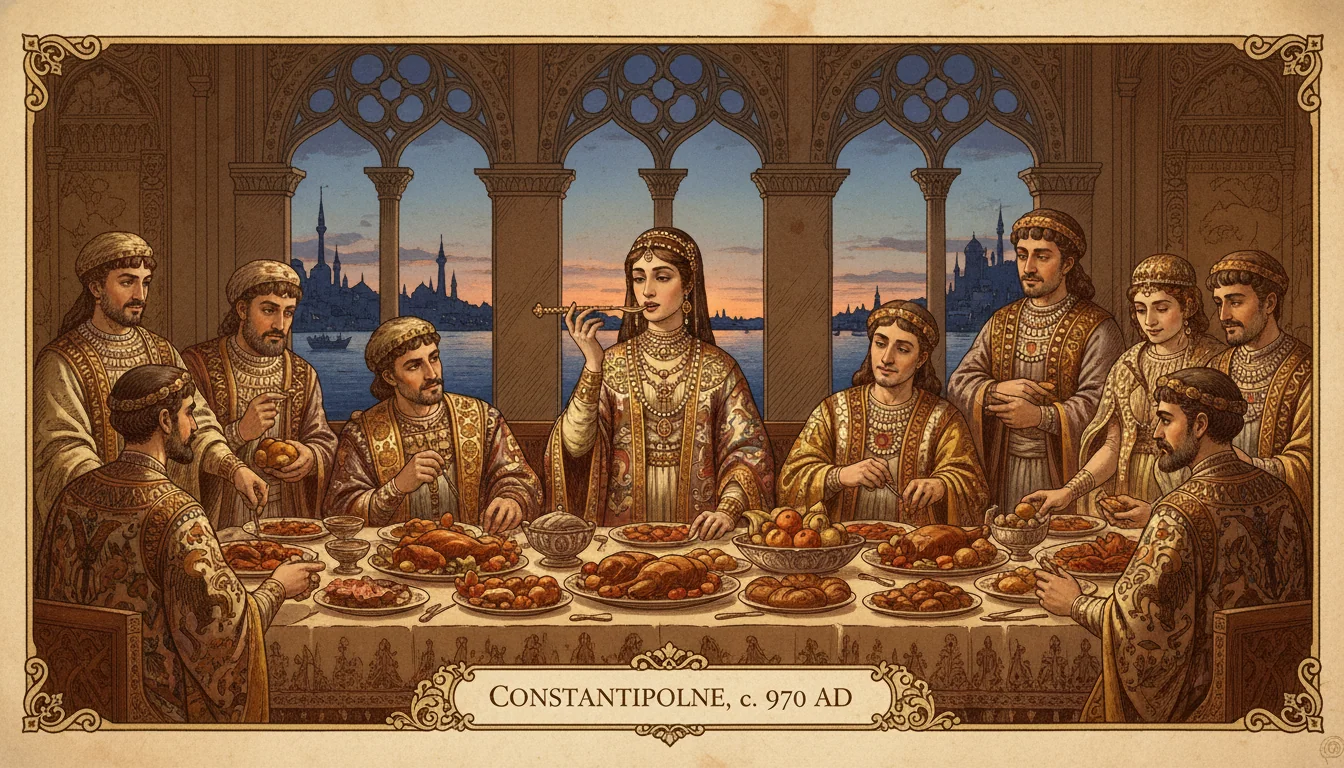
The history of the fork goes back approximately 4,000 years if you count the large bronze serving implements the Egyptians used to extract meat from cooking vessels. It is approximately 1,000 years old if you count the personal table fork used by an individual to bring food to their own mouth. The gap between those two dates is the story: one of the longest adoption lags in the history of useful technology, driven not by engineering difficulty but by a remarkable coalition of moral philosophy, religious doctrine, and social anxiety.
The fork waited while people ate with their hands, their knives, and their spoons. It waited while the Roman Empire rose and fell. It waited while every other major piece of tableware arrived and settled into normal use. When it finally arrived at the European dinner table, a significant portion of the continent greeted it with something between suspicion and disgust.
The ancient fork: a kitchen tool, not a table one
Long before anyone considered eating with a fork, cooks used them. Bronze two-tined forks appear in Egyptian archaeological contexts as early as 2400 BCE, used to hold and turn large joints of meat over fire and to extract cuts from deep cauldrons. Greek and Roman kitchens had similar implements. Roman carving forks for ceremonial sacrifice - bronze or iron, two or three tines, long handle - appear in dozens of archaeological assemblages from across the empire.
What these objects share is function: they belong to the cook and the carver, not the diner. The act of bringing individual bites to your own mouth with a pointed implement had no place in the Western table tradition for most of ancient and medieval history. You ate with your right hand, in the manner your culture had determined was polite. Bread served as a scooping tool for liquid dishes. Knives handled anything requiring cutting. Spoons covered everything liquid. Fingers handled the rest, and social codes determined how many fingers, in what manner, and after what sort of hand-washing ritual preceded the meal.
This was not considered primitive. It was considered correct. A 10th-century Byzantine writer listing the requirements of polite dining did not include a personal fork because the absence of the fork was not yet legible as an absence. The object did not exist in the dining context. Its non-existence required no explanation.
Byzantium: where the fork first sat down to eat
The personal table fork appears earliest in the Byzantine Empire - the eastern continuation of the Roman world centered on Constantinople. Byzantine court ceremonial by the 9th and 10th centuries included gold and silver dining implements of considerable variety, and small personal forks with two tines appear among them in chronicle references and surviving artistic depictions from the period.
The Byzantine relationship with the fork was not revolutionary but evolutionary. A court that maintained elaborate dining protocol naturally extended that protocol to individual utensils over time. Whether the Byzantine fork was a continuous survival from late Roman table culture or a separate development is not certain from available sources, but its presence in Constantinople before the year 1000 CE is reasonably well-attested.
The fork traveled west in a specific and documented event that became notorious precisely because of the reaction it provoked.
The Venice scandal, around 1004
Around 1004 CE, a Byzantine princess named Theodora Doukaina married the son of Pietro II Orseolo, the Doge of Venice. She brought with her the customs of the Byzantine court, including the practice of eating with a small golden fork.
The chronicler Peter Damian, a Benedictine monk who later became a cardinal, recorded the incident with withering condemnation. He described how she had refused to touch food with her hands, "touching it only with little golden forks with two prongs," and had her servants cut her food into small pieces before she brought it to her lips. He declared this an offense against divine order, noted that God had given humans fingers for precisely this purpose, and reported with evident satisfaction that Theodora died of plague not long afterward - which he appears to have regarded as the appropriate consequence of such excess.
The message was unmistakable: the fork was not merely unfamiliar, it was immoral. Not because it caused harm, but because it represented a rejection of the natural and God-given means of eating. It was effeminate. It was excessive. It was suspiciously Byzantine, which in the Latin Christian worldview of 1004 meant suspiciously Greek, which meant suspiciously soft.
Venice, the port closest to the Byzantine world, did not adopt the fork immediately even after this introduction. But the object was now known in the Latin West, and knowledge, even scandalous knowledge, tends to persist.
Italy: slow adoption, century by century
Over the following two centuries, table forks appear gradually in Italian inventories and records, first in the wealthy merchant cities with Byzantine trading connections - Venice, Genoa, Pisa - then slowly inland. By the 13th century, a fork in an Italian aristocratic household was no longer shocking. By the 14th century, records from Tuscany and northern Italian city-states include forks as components of high-status dining sets.
The Italian adoption was still elite. A table fork in 1350 was a luxury object, made of silver or gilded metal, owned by the wealthy and used at formal dinners. Common people in 14th-century Italy ate without forks, as did common people everywhere.
The merchant class spread the object northward slowly, via trade routes and diplomatic gifts. Catherine de Medici, who left Florence for France in 1533 to marry the future Henri II, is sometimes credited - inaccurately - with introducing the fork to France. She certainly brought Italian table customs with her and refined their practice at the French court. But French royal household records indicate forks were already present there before her arrival. Catherine popularized and systematized their use; she did not originate it.
Northern Europe: the long refusal
North of the Alps and the Loire, the fork met sustained resistance that persisted well into the 17th century. The objections were layered and reinforced each other.
The religious objection never quite died. The argument that God's design included fingers and the fork was therefore an affront was stated, restated, and refined across several centuries. It did not require sophisticated theology: it simply held that the natural order of the body was sufficient for the natural act of eating, and to interpose an artificial instrument was to express dissatisfaction with divine provision. This argument carried particular weight in northern Protestant cultures that associated Italian refinement - elaborate ceremony, artificial elegance, softness - with both papist excess and moral corruption.
The social objection had a different but complementary form: the fork was identified with effeminacy. English writers of the late 16th century mocked men who ate with forks as foppish Italians incapable of eating straightforwardly. Thomas Coryat, who traveled through Italy in 1608 and wrote about its customs in Coryat's Crudities, described table forks with a tone of cautious admiration and is often credited with introducing the fashion to England. He was mocked by contemporaries with the nickname "Furcifer" - a Latin pun that served simultaneously as "fork-bearer" and a term of abuse meaning a scoundrel or slave.
The practical objection was also real: a knife and a piece of bread served the same function. People who had eaten with knife, spoon, and fingers for their entire lives did not experience a deficiency that required correction.
By the mid-17th century, the English and French courts had forks. By the late 17th century, forks were moving down the social scale in England, France, and the Netherlands. By 1700, a prosperous European merchant household owned a set of them, and the argument about whether it was effeminate to use them had been settled in the fork's favor largely by social pressure from above.
America: the last holdout in the Western tradition
Colonial America was genuinely late. The first personal fork recorded in Massachusetts was reportedly owned by Governor John Winthrop, who carried it as a single item. Two-tined forks were imported luxury goods through most of the 17th century. Spoons and knives remained the standard implements for the overwhelming majority of colonial households.
By the mid-18th century, forks were common enough in wealthy colonial households to appear in estate inventories as routine items. American silversmiths began producing them domestically. The establishment of Sheffield steel production and eventually American silverware factories in the 19th century brought the fork to the ordinary American household - not as an exotic luxury but as one piece in a standardized set.
The four-tine fork became standard in the mid-19th century, pushing out earlier two- and three-tine designs. The reason was partly practical - four tines hold food more reliably - and partly the codification of formal table settings that the Victorian era pursued with great enthusiasm.
What got remembered, what got lost
The codified dinner table that emerged from the 19th century - fork left, knife right, spoon outside - was presented as though it had always existed, as though the proper table setting was a natural arrangement rather than the outcome of a millennium of cultural negotiation, moral argument, and slow attrition.
Peter Damian's objection - that God had given humans fingers and the fork was therefore an affront - sounds absurd today. But it was made seriously, by an intelligent man, and it reflected a coherent worldview about nature and the dangers of artificial refinement. The counterarguments that prevailed were not philosophical. They were social: the fork spread because powerful people adopted it, and powerful people's behavior becomes, eventually, what counts as correct.
Theodora Doukaina, the Byzantine princess who scandalized Venice around 1004 by eating with a small golden fork, was not wrong about the convenience of the instrument. She was simply about six hundred years early for the market she had arrived in. The fork that caused Peter Damian such distress is now the first thing a Western child is taught to pick up.
From the Venice scandal to the American factory took approximately 1,000 years. That is not the slowest technology adoption rate on record. But it is certainly the most morally argued.
Quick Answers
Common questions about this topic
When was the fork invented?
Forks as cooking and serving tools appear in ancient Egypt, Greece, and Rome - pointed implements for spearing large cuts of meat over fire or extracting food from vessels. The personal table fork, used by an individual to bring food to their own mouth, is a much later development. The first well-documented personal table forks appear in the Byzantine court by the 9th or 10th century CE.
Who brought the fork to Western Europe?
The most documented early transmission occurred when the Byzantine princess Theodora Doukaina married the son of the Doge of Venice around 1004 CE and brought a small golden fork with her. The chronicler Peter Damian reported her use of it with evident disapproval. The incident caused a sensation of moral outrage, not admiration. It took another two centuries before table forks began appearing in Italian inventories with any regularity.
Why did northern Europe resist the fork so long?
Multiple reasons converged. Religious argument held that God had given humans fingers and the fork was an affront to divine order. Social argument identified the fork with the perceived effeminacy of southern European refinement. Practical argument noted that a knife and a piece of bread served the same function. Northern European courts did not adopt the fork as a standard table tool until well into the 17th century.
When did Americans start using forks?
Forks reached colonial America in the late 17th century but were uncommon outside wealthy households until the 18th century. John Winthrop, governor of the Massachusetts Bay Colony, reportedly owned one of the first forks in New England, a single item he carried with him. Mass production of silverware in the 19th century made the fork an ordinary household object for most Americans.

Ask the Inventors Themselves
Chat with the people who were there when familiar things began.
Create your free account →No card required. Talk to anyone in history with 8 free credits a day. Some features require a paid plan.
Join the HistorIQly Club
Get smarter about the past.
Weekly stories, deep dives, and exclusive content straight to your inbox.