Origins of the Library: Where the Idea Was Actually Invented
The origins of the library trace to 7th century BC Assyria, not Alexandria. Ashurbanipal's collecting mission at Nineveh predates the famous library by four centuries.
Read Wikipedia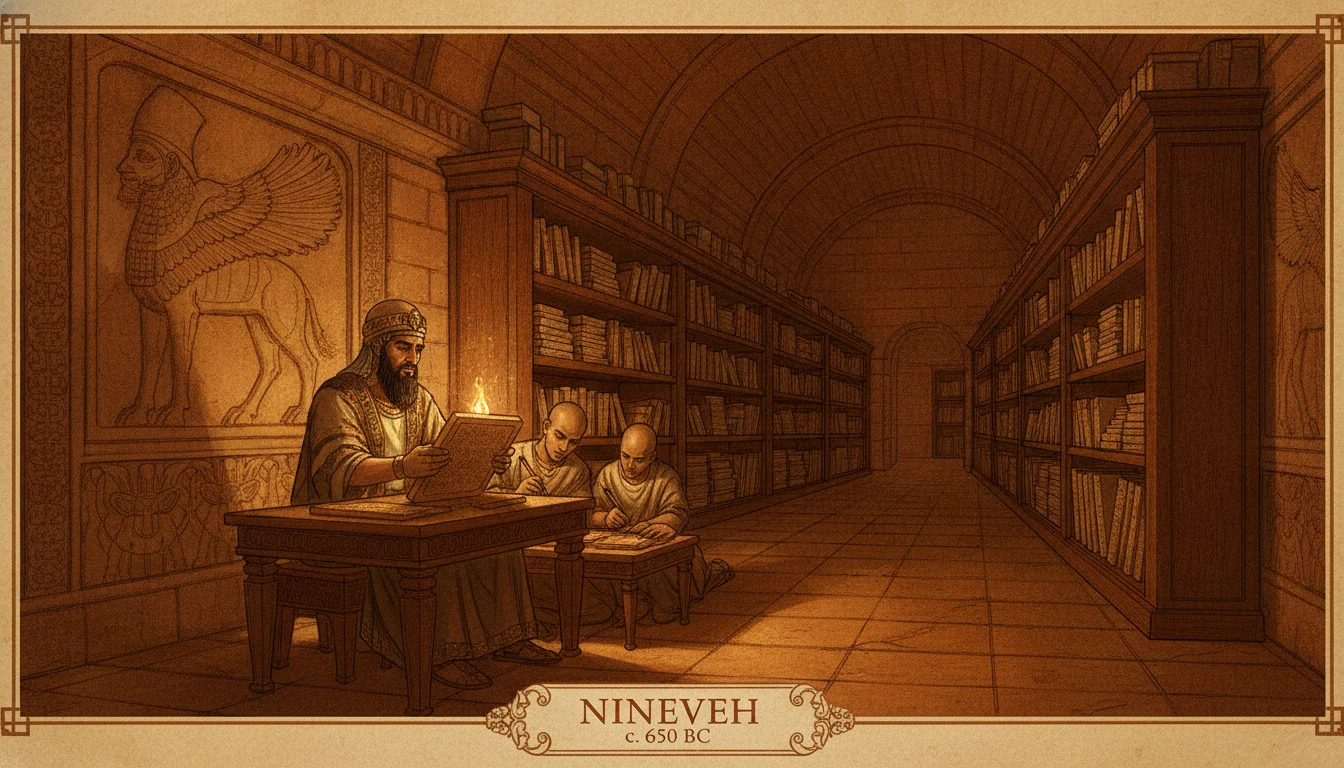
The Library of Alexandria gets blamed for almost everything. Every time a large body of human knowledge seems irretrievably lost, someone mentions it. Julius Caesar burned it. The Christians burned it. The Arabs burned it. The story shifts depending on the century and the cultural anxieties of whoever is doing the telling.
Almost all of these stories are wrong, and the library itself - extraordinary as it was - was not the first of its kind. It was the third or fourth, depending on how you count.
The origins of the library are a history of three distinct ideas that did not all arrive at the same time: the archive, the collection, and the catalog. The Library of Alexandria eventually had all three. Getting to that point took roughly two thousand years.
Phase one: the archive
The earliest libraries were not libraries. They were tax offices.
The edubba, the "tablet house" of the Sumerian city-states of the 3rd millennium BC, was a school and an administrative archive simultaneously. Scribes were trained there, and the texts they produced were stored there. Those texts were overwhelmingly economic: grain tallies, land contracts, receipts, debt records. Literary texts also appear - the earliest versions of the stories about Gilgamesh were found in temple and palace archives - but they were incidental to the administrative function. Nobody was trying to preserve knowledge for future readers. They were trying to keep track of barley.
The discovery of the palace archive at Ebla in northwestern Syria in the 1970s gave archaeologists a vivid example of what a large administrative archive of the 3rd millennium BC looked like. More than 17,000 cuneiform tablets were found in situ in palace rooms, organized on wooden shelves by subject and size, including correspondence with neighboring kingdoms, legal texts, and a multilingual vocabulary list in Sumerian and Eblaite that stands among the earliest known reference tools. Someone at Ebla, around 2300 BC, was already trying to help scribes look things up.
But this was still an archive, not a library. The question of who had the right to read it, and for what purpose, had not yet been posed.
Phase two: the first collecting mission
Around 668 BC, Ashurbanipal became king of the Neo-Assyrian Empire, the largest and most administratively sophisticated empire the ancient Near East had produced. He was literate, which was unusual for a king of his period - scribal learning was typically a professional specialization kept distinct from the warrior-aristocracy. He was also obsessive about texts in a way that distinguished him from other powerful rulers of the period.
Ashurbanipal sent agents throughout Mesopotamia with specific instructions: find, acquire, and copy every text they could locate. The instructions were detailed. He wanted the canonical series texts - the long compositions in Sumerian and Akkadian that served as the foundation of Mesopotamian scholarly tradition - as well as omen collections, medical texts, lexical lists, hymns, and literary compositions. He wanted variant versions where they existed. He wanted everything.
The letters from his agents survive, including one that has been quoted by historians ever since as the first known library acquisition policy: "Search out for me the rare tablets which are known to you and which do not exist in Assyria, and send them to me." This is a collecting mission, not a bureaucratic accumulation.
The library that resulted occupied the palace complex at Nineveh, the Assyrian capital on the Tigris River near modern Mosul in Iraq. British archaeologists excavating the site in the 1840s and 1850s found more than 30,000 cuneiform tablet fragments in what they came to understand as a systematic library. The tablets were organized by subject in different rooms: divination texts in one area, medical texts in another, literary compositions in a third. Tablets were labeled and numbered as parts of larger series.
Among the tablets was the Epic of Gilgamesh in its most complete ancient version - a poem about a king's search for immortality that predates Homer by at least a millennium, and that was entirely unknown to the modern world until these tablets were deciphered in the 1870s. The existence of a systematic library at Nineveh is the reason this text survived at all. Ashurbanipal's agents had copied it carefully. The system he built preserved it.
Nineveh was destroyed in 612 BC when a coalition of Babylonians and Medes sacked the city. The tablets survived because they were clay: the fires that destroyed the palace baked them harder. They were mixed with rubble and waited more than two thousand years for someone to excavate them.
Phase three: the catalog
The Library of Alexandria is the most famous library in history and the most mythologized. Founded under Ptolemy I Soter in the late 4th or early 3rd century BC, and built into a major institution under Ptolemy II Philadelphus, it was attached to the Mouseion - the "shrine of the Muses" that is the ancestor of the word museum - and functioned as a royally funded research center at the heart of Ptolemaic Alexandria.
The Ptolemaic acquisition policy was direct and occasionally ruthless. Ships docking at Alexandria were boarded and their scrolls examined. If books were found that the library did not hold, they were confiscated for copying. The originals sometimes came back. Sometimes they did not. The most famous case involved Athens, which agreed to loan the official state copies of the plays of Aeschylus, Sophocles, and Euripides to Alexandria, accepting a deposit of 15 talents as a guarantee of return. Alexandria copied the texts, kept the originals, and returned the copies. It considered the 15 talents a reasonable price for having the originals. Athens did not have leverage.
At its peak, the library held a quantity of scrolls that ancient sources estimated variously at hundreds of thousands - figures that are probably exaggerated but that indicate an institution of unprecedented scale. What made it usable rather than merely large was the work of one man.
Callimachus of Cyrene, a poet and scholar who worked at the library in the early 3rd century BC, compiled the Pinakes - literally "tablets," in Greek. This was a 120-volume bibliography of the entire known corpus of Greek literature, organized by subject and author, including biographical notes on writers, notices about disputed attributions, and information about variant manuscript versions of the same work. The Pinakes itself is lost, but its existence established the concept of systematic bibliography: a library needs not just books but a record of what it has and how those works relate to each other.
Callimachus created the catalog not as a bureaucratic tool but as a scholarly one. His Pinakes answered the question that any large collection eventually forces: not "do we have this?" but "what do we actually know?" This is the question that distinguishes a library from an archive.
The destruction myths
The Library of Alexandria did not burn in a single catastrophic event. It declined.
Julius Caesar's fire in 48 BC is real but limited. A fire set during fighting near the harbor - the historical context was Caesar's seizure of ships and possibly stored goods - burned a warehouse or dockyards containing books awaiting export. Contemporary sources do not describe the main library as destroyed. The institution continued to function for two more centuries.
The destruction of the Serapeum by Bishop Theophilus in 391 AD eliminated the library's daughter collection, housed in the temple of Serapis in a different part of the city. This was a genuine loss. But the main library had by this point already contracted significantly from its Ptolemaic peak, through the progressive loss of royal funding, the death of the scholars' institutional network, and the general deterioration of the administrative infrastructure that had once sustained it.
The story that the Arab general Amr ibn al-As, after the conquest of Alexandria in 641 AD, ordered all books not consistent with the Quran to be burned, appears for the first time in a text written more than five hundred years after the supposed event, by the Syrian Christian writer Bar Hebraeus. Modern historians consider it a fabrication. By 641, whatever remained of the ancient Library of Alexandria would not have sustained the city's baths for six months - which is the scale the legend requires - because there was not that much left. The story served the rhetorical needs of later Christian writers better than the historical record warrants.
Rome: the library becomes public
The Library of Alexandria demonstrated that systematic collection and cataloging of knowledge was worth funding at state expense. Julius Caesar, before his assassination, had commissioned the scholar Varro to organize Rome's first public library. The project died with Caesar. Augustus built two public reading libraries in Rome. Gaius Asinius Pollio, a statesman and general, is credited by ancient sources with opening the city's first such institution in 39 BC. At its height Rome had roughly two dozen public libraries where citizens could enter and read texts on site.
What the archive, the collection, and the catalog gave the world
The library's actual legacy is not any single text preserved or lost. It is the concept it demonstrated: that the systematic collection, organization, and preservation of human knowledge is a public function worth institutional support.
The Carnegie library program, which funded more than 2,500 public libraries between 1883 and 1929, is a democratic descendant of a Ptolemaic institution built by a Macedonian king who sent agents to seize scrolls from arriving ships. Ashurbanipal's clay tablets and Callimachus's 120-volume catalog stand at the beginning of the same lineage. The idea passed through Roman libraries, through the Islamic scholarly world that translated Greek texts and added to them, through medieval monasteries and universities, and landed eventually in a building on a street corner where anyone could walk in and borrow a book for free.
The desire to gather all knowledge in one place and make it findable turns out to be very human and very old. Every library built since is still trying to do what Ashurbanipal's agents set out to do in the 7th century BC: find everything, bring it back, and put it in order.
Quick Answers
Common questions about this topic
Where was the first library?
The first known systematically organized library with a deliberate collecting mission was the Royal Library of Ashurbanipal at Nineveh, the Assyrian capital near modern Mosul in Iraq. Ashurbanipal, who ruled from around 668 to 627 BC, sent agents throughout Mesopotamia to find, copy, and collect texts. More than 30,000 cuneiform tablet fragments were recovered from the site by British archaeologists in the 19th century.
Was the Library of Alexandria really destroyed in one event?
No. The Library of Alexandria declined gradually over centuries through underfunding, political instability, and the loss of royal patronage. The fire set by Julius Caesar in 48 BC burned a warehouse near the harbor, not the main library. The destruction of the Serapeum by Bishop Theophilus in 391 AD affected the daughter collection. The story attributing the final destruction to Arab conquerors in 641 AD appears in a source written more than 500 years after the supposed event and is rejected by modern historians.
What was the Pinakes?
The Pinakes was a 120-volume bibliographic catalog of all known Greek literature, compiled by the scholar Callimachus of Cyrene at the Library of Alexandria in the 3rd century BC. It organized texts by subject and author, included biographical notes, and noted disputed attributions and variant manuscript versions. The Pinakes itself is lost, but it established the concept of systematic bibliography that Western library practice still follows.
When did public lending libraries appear?
Public lending libraries, where ordinary citizens could borrow books to read at home, developed primarily in the 19th century. Ancient Rome had public libraries where readers could consult texts on site. The modern lending model was popularized by the mechanics' institute libraries of early industrial Britain and then scaled by Andrew Carnegie's library-building program, which funded roughly 2,500 public libraries between 1883 and 1929.

Ask the Inventors Themselves
Chat with the people who were there when familiar things began.
Create your free account →No card required. Talk to anyone in history with 8 free credits a day. Some features require a paid plan.
Join the HistorIQly Club
Get smarter about the past.
Weekly stories, deep dives, and exclusive content straight to your inbox.