Origins of the Olympic Games: What the Ancient Records Actually Show
The origins of the Olympic Games predate 776 BC. The sanctuary at Olympia is far older, women's games ran separately for centuries, and the prize was a crown of wild olive.
Read Wikipedia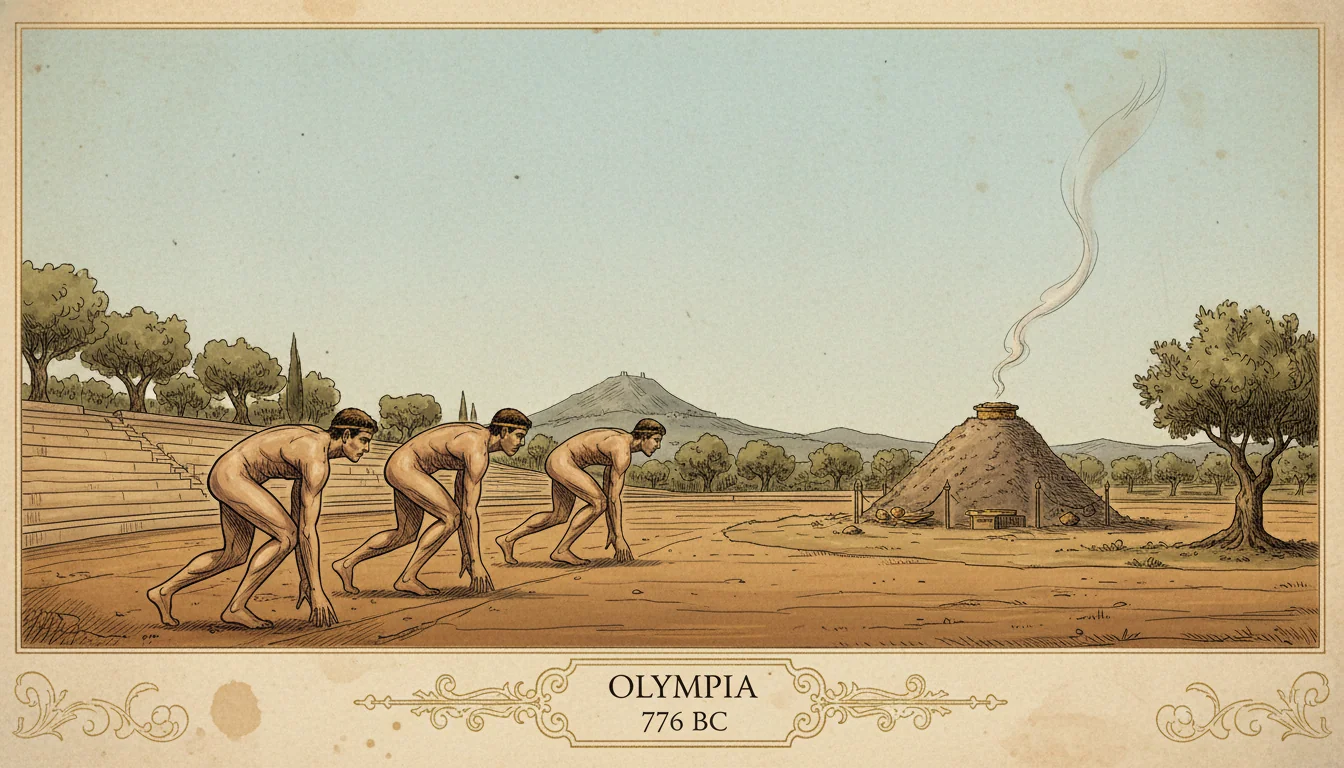
Sometime in the 19th century, the Olympic story acquired its tidy founding date. The games began in 776 BC, the textbooks said, at the sanctuary of Zeus in the western Peloponnese, where a man named Coroebus of Elis won a footrace and received a crown of olive branches. The date was authoritative, the origin was clean, and the story moved briskly from there to Pheidias's great gold and ivory statue of Zeus, the Sacred Truce, the naked athletes, and 1,169 years of continuous tradition before a Roman emperor's decree snuffed it out.
Almost none of that framing survives serious archaeological scrutiny.
The games of 776 BC were not the beginning of anything. They were a record-keeping exercise. What actually began at Olympia goes back much further, is stranger than the textbook version, and involves a women's athletics tradition that the familiar narrative almost completely ignores.
Olympia before the Olympics
The sanctuary of Olympia is not a city. It is not even a town. It sits in a flood-prone river valley at the confluence of the Alpheus and Kladeos rivers in the region of Elis, in the northwestern Peloponnese. No one lived there permanently. It was a sacred precinct, the Altis, enclosed by a wall and dedicated to religious purposes.
Archaeological work at Olympia has recovered votive offerings - bronze figures, terracotta objects, ash deposits from sacrifice - dating back to at least the 10th century BC and possibly into the Bronze Age. The ash mound at the center of the Altis, which ancient sources describe as a great heap of accumulated sacrificial ash on the altar of Zeus, represents centuries of regular, intense religious use before any athletic record begins. The games grew out of an existing cult site, not the other way around.
The 776 BC date was reconstructed around 400 BC by Hippias of Elis, a sophist who compiled a list of Olympic victors from records maintained at the sanctuary. Hippias's victor list is the source of the conventional founding date. But Hippias himself was working with incomplete evidence, and he acknowledged that the earliest records were fragmentary. The 776 BC date marks the oldest entry his sources could confirm, not the earliest games held.
Greek tradition itself was less certain than the modern textbook. Multiple origin myths circulated. Pindar, writing in the 5th century BC, attributed the foundation to Heracles, who supposedly established the festival and the sacred olive tree after cleaning the Augean stables. Other traditions credited Pelops, the hero whose mythological chariot race against Oenomaus for the hand of Hippodameia was commemorated in the elaborate pediment sculptures of the Temple of Zeus. Still others attributed the reorganization of the games to the Spartan lawgiver Lycurgus in collaboration with the Elean king Iphitus, who supposedly negotiated the first Sacred Truce.
The competing foundation myths suggest an institution old enough that its origins had been lost and needed to be invented.
What the games actually were
Modern observers tend to see the Olympics first as a sporting event and second as a religious one. Ancient Greeks experienced exactly the reverse.
The Olympics was a festival of Zeus Olympios, the highest deity of the Greek pantheon, held every four years at the Altis sanctuary. Athletics were the most important element of the festival program, but they existed within a religious frame that also included processions, sacrifices - including the slaughter of 100 oxen, a hecatomb, on the third day of the festival - communal feasting, and the ceremonial renewal of the god's honor. The hundred oxen burned on the altar of Zeus over five days generated the ash that was mixed with the water of the Alpheus River and packed onto the growing sacred mound.
The athletic events themselves evolved over centuries. The original program, according to ancient sources, consisted only of the stadion race - a single sprint the length of the stadium, roughly 192 meters. Over the following two centuries, additional events were added: the diaulos (two lengths, roughly 384 meters), the dolichos (a long-distance race of 20 to 24 lengths), wrestling, the pentathlon (a five-event combination of running, jumping, discus, javelin, and wrestling), boxing, the pankration (an almost unlimited full-contact grappling and striking event), and eventually equestrian events including chariot racing.
The equestrian events introduced an important asymmetry. In horse and chariot racing, the prize went not to the athlete or jockey but to the owner of the horse. This meant that wealthy aristocrats and later kings could claim Olympic victory without personally competing. Philip II of Macedon, Alexander the Great's father, won three Olympic horse-race victories. His son did not compete at Olympia, perhaps because the only competition worth having was the kind that could not be entered by proxy.
The prize and its consequences
The kotinos - the crown of wild olive cut from the sacred tree near the temple of Zeus - was the official prize at Olympia. At the Pythian Games at Delphi, victors received a laurel crown. At the Isthmian Games, celery. At the Nemean Games, also celery, later changed to parsley.
None of these prizes had material value. This was deliberate. The Panhellenic games were distinguished from the smaller local games by the strict preservation of amateur status - or more precisely, by the preservation of the fiction that victors competed for honor alone.
In practice, the fiction was economically elaborate. A victor returning to his home city could expect free meals in the public dining hall for the rest of his life, front-row seating at all public events, tax exemptions, and in many cities a substantial cash gift presented by the city council. Athens under Solon's laws set the payment for an Olympic victor at 500 drachmas - a figure that represents several years of ordinary wages. Pindar, one of the greatest lyric poets of antiquity, was commissioned and well paid to write victory odes for wealthy Olympic champions. The value of the olive crown lay entirely in what it unlocked.
The Roman period introduced a more direct corruption. Imperial-era athletes received direct cash prizes at many games, and the distinction between the Panhellenic festivals and the local games blurred. By the 2nd century AD, professional athletes who traveled a circuit of games for prize money were a recognized class of person. The olive crown was still awarded at Olympia, but the men receiving it were professionals in everything but formal designation.
The Heraia: the women's games that came first
The festival of Hera at Olympia predated the Olympic Games in its current form, and the women's athletic competition associated with it - the Heraia - may be the older institution. Ancient sources attribute the founding of the Heraia to Hippodameia, the woman whose father Oenomaus was defeated in the chariot race by Pelops. She established a festival of foot races for girls in thanks for her marriage.
The Heraia consisted of foot races divided into three age categories, run on the same stadium track used for the Olympic Games. The prize was an olive crown and a portion of the sacrificial ox. Winners were also allowed to dedicate painted portraits of themselves in the Heraion, the temple of Hera - one of the oldest buildings at Olympia.
The Heraia ran on the same four-year cycle as the Olympic Games and was held at Olympia before or after the men's festival. Women victors received public honors comparable to men in their home communities. The institution is attested from at least the 6th century BC and continued through the Roman period.
The Olympic Games themselves excluded women from competition and, in most reconstructions of the ancient sources, excluded married women from attendance as spectators as well. Pausanias, writing a geographical and historical account of Greece in the 2nd century AD, states that the penalty for a married woman caught watching the games was to be thrown from the cliff of Mount Typaion. Whether this was ever enforced, or merely a ritual prohibition, is debated. Unmarried girls were apparently permitted to watch. A single ancient tradition names a woman named Kallipateira (or Pherenike in some versions) who disguised herself as a trainer to watch her son compete, was discovered, and was acquitted because her male relatives had all been Olympic champions.
The end
The games ran, by the conventional count, for 293 Olympiads - a span of roughly 1,172 years from 776 BC to 393 AD. This makes them the longest-running athletic competition in documented human history by a considerable margin.
The end came through religion, which is appropriate given that religion was the reason for the beginning. Emperor Theodosius I, a committed Christian who had spent his reign systematically dismantling the legal status of pagan practice in the Roman Empire, issued a series of edicts in the early 390s AD banning sacrifices and pagan religious assemblies. The Olympic Games were, formally and structurally, a festival of Zeus. The hecatomb sacrifice on the altar was not incidental to the event; it was the central act of the entire program. Without the sacrifice, the games had no religious basis.
The sanctuary at Olympia declined rapidly after the ban. The great chryselephantine statue of Zeus by Pheidias, one of the Seven Wonders of the ancient world, was reportedly removed to Constantinople and destroyed there in a fire in the 5th century AD. Earthquakes in the 6th century AD collapsed the colonnade of the Temple of Zeus. Subsequent floods from the Alpheus River gradually buried the Altis under several meters of alluvial silt, preserving the site in extraordinary condition for later excavation by German archaeologists beginning in the 1870s.
Those excavators found the stadium, the temples, the treasuries of the Greek city-states, the workshop where Pheidias had made his Zeus, and the accumulated evidence of a thousand years of athletic and religious activity. The olive tree from which the kotinos crowns were cut was gone. The altar ash that had taken centuries to accumulate had washed away. What remained was enough to establish, beyond any reasonable doubt, that the conventional origin story was the least interesting thing about what had happened at Olympia. The world those athletes inhabited is reconstructed in our guide to ancient Sparta, and the political ideas they competed to represent are traced in the origins of democracy.
Quick Answers
Common questions about this topic
When did the Olympic Games begin?
The traditional Greek date for the first Olympiad is 776 BC, recorded by the astronomer Hippias of Elis around 400 BC from earlier lists of victors. But the sanctuary at Olympia predates this by centuries, with votive offerings going back at least to the 10th century BC and possibly earlier. The 776 BC date marks the first recorded winner, not the founding of the sanctuary or the start of athletic competition.
What did ancient Olympic athletes win?
The official prize at Olympia was the kotinos - a crown woven from a branch of wild olive cut from the sacred tree beside the temple of Zeus. There was no cash award and no silver or gold medal. However, victors returned home to massive rewards: free meals for life, front-row seats at public events, tax exemptions, and sometimes significant cash gifts from their home city. Pindar was paid handsomely to write victory odes.
Why were women not allowed at the ancient Olympics?
The Olympic Games were a religious festival in honor of Zeus, and Greek religious custom restricted many Panhellenic sanctuaries to men of free citizen status. Married women were specifically barred from even attending as spectators, though unmarried girls appear to have been permitted. Women had their own separate games at Olympia - the Heraia, in honor of Hera - which predated the male Olympic Games in some accounts and ran on a similar four-year cycle.
When did the ancient Olympics end?
The last well-documented ancient Olympiad was the 293rd, held in 393 AD. Shortly afterward, Emperor Theodosius I issued edicts banning pagan religious festivals, which the Olympic Games formally were - a festival of Zeus. The exact last games are debated, with some scholars placing the final celebration in 393 AD and others as late as 426 AD. The sanctuary at Olympia was subsequently damaged by earthquakes and floods and gradually buried.

Ask the Inventors Themselves
Chat with the people who were there when familiar things began.
Create your free account →No card required. Some figures and features require a paid plan.
Join the HistorIQly Club
Get smarter about the past.
Weekly stories, deep dives, and exclusive content straight to your inbox.