Origins: How Democracy Was Invented
Who invented democracy? Cleisthenes of Athens built it in 508 BC not from idealism but necessity - the accident that became Western civilization's defining idea.
Read Wikipedia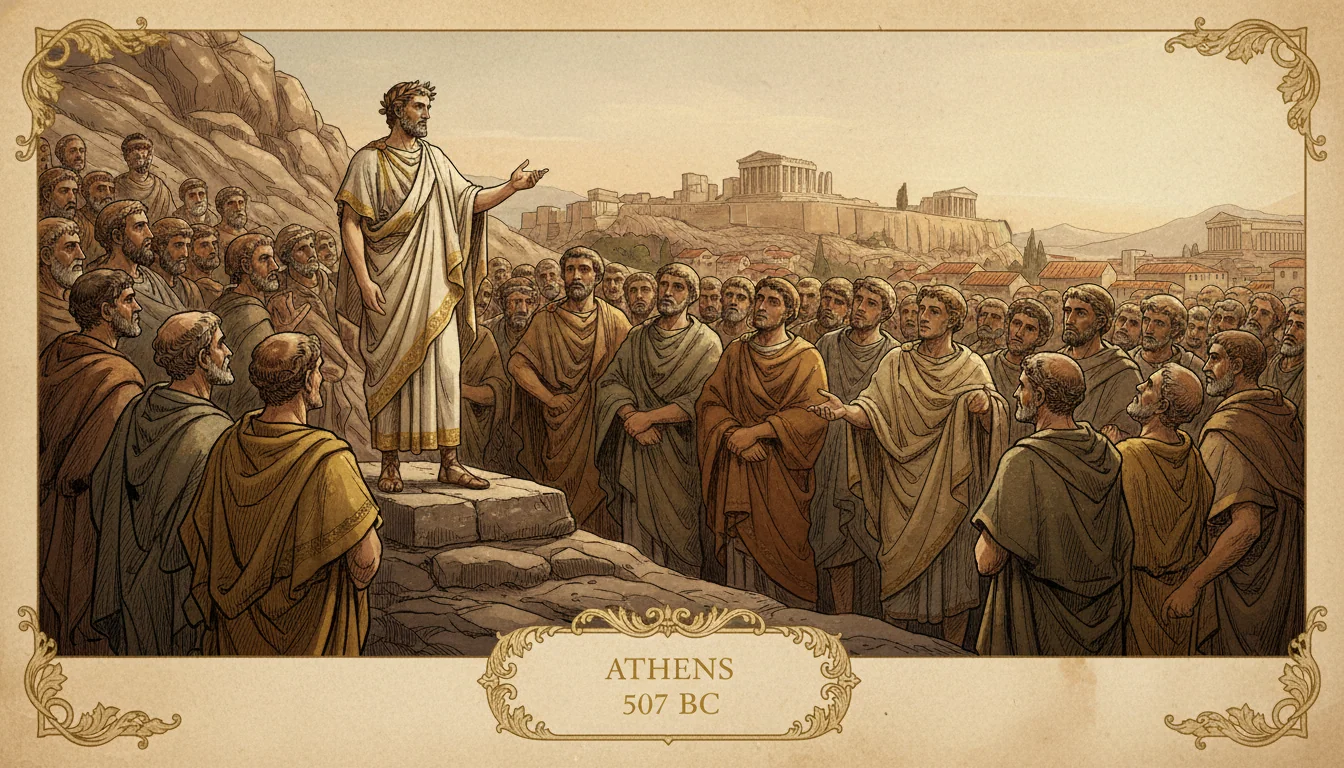
The word "democracy" is one of the most successful political exports in history - a Greek coinage from around 500 BC that now appears in the constitutions of authoritarian states, in the names of political parties across the entire ideological spectrum, and in virtually every official description of a legitimate government anywhere on Earth. The history of how the word and the institution came to exist is considerably stranger than their universal adoption suggests.
The popular narrative
The story most people absorbed runs roughly like this: the ancient Greeks, specifically the Athenians, invented democracy around 500 BC. Ordinary citizens got to vote for the first time. This produced a golden age of philosophy, art, and naval power. The Romans adapted the model. Modern nations inherited it.
This account contains truth. It elides everything interesting.
Before Athens
Athenian democracy did not arrive in a vacuum. It was preceded by generations of Athenian political struggle and by forms of collective governance elsewhere that political historians argue deserve the name proto-democratic, even if they lacked Athens' specific machinery.
Solon, 594 BC. The reformer Solon, elected archon - chief magistrate - around 594 BC, addressed a debt crisis that had reduced many Athenian citizens to effective slavery. He cancelled debts, banned debt slavery, and reorganized the Athenian constitution along property-based rather than purely hereditary lines. Under Solon's system, citizens of modest means could participate in the Assembly and serve on juries. Major power still resided with the wealthy. But the hereditary aristocracy's absolute lock on political participation was broken.
Dracon's laws, 621 BC. A generation before Solon, Dracon produced Athens' first written legal code, replacing oral traditions and aristocratic discretion with documented rules that, in principle, everyone could know. Written law is a prerequisite for any democratic system: it makes the rules visible outside the closed circle of those with direct access to the judge. Dracon's laws were famously severe - the word "draconian" has carried that memory for twenty-six centuries - but their significance was that they were public.
Peisistratos, 561-527 BC. The tyrant Peisistratos consolidated power in Athens through three separate periods of rule. By most accounts he governed competently, supported trade and culture, and did not systematically oppress ordinary citizens. But he was a tyrant. His sons, Hippias and Hipparchus, were less capable. After Hipparchus was assassinated in 514 BC, Hippias became increasingly paranoid and brutal. The aristocratic Alcmaeonid family, which had been in exile, conspired with Sparta to force him out. Hippias was expelled in 510 BC.
This is where Cleisthenes enters - and where the story becomes genuinely unexpected.
The accident of political necessity
Cleisthenes was an Alcmaeonid. He had maneuvered Hippias out partly for the benefit of his own family. He expected, reasonably, to consolidate Alcmaeonid influence in the aftermath.
His rival was Isagoras, another aristocratic faction leader. For a period in 508-507 BC, Isagoras gained the upper hand with Spartan backing, and Cleisthenes was briefly exiled from Athens.
What Cleisthenes did next is the decisive moment in this story. He returned to Athens and took his constitutional reform proposals not to the Council of Aristocrats but to the demos - the ordinary citizens of Attica. He appealed to the only constituency available to him, the one Isagoras had not bothered to cultivate.
The demos supported him. The Spartan garrison backing Isagoras was besieged and expelled. Cleisthenes enacted his reforms between 508 and 507 BC. He did not do this because of a philosophical commitment to popular sovereignty. He did it because popular sovereignty was the only instrument he had. The accident of that political moment became one of the foundational ideas of Western civilization.
The reforms that created it
Cleisthenes' democratic architecture had several interlocking components, each designed to break the specific patronage networks through which the old aristocracy maintained control.
The deme system. He divided Attica into approximately 139 local communities called demes - demoi. Your citizenship was now attached to your deme of origin, your neighborhood or village, rather than to your family's aristocratic network. A man whose grandfather had been dependent on a powerful noble for legal protection and political standing was now a citizen of Acharnae or Alopece in his own right, independent of that relationship. The client-patron chains that had sustained aristocratic dominance for generations were structurally severed.
The ten tribes. He reorganized all Athenian citizens into ten new phylai - tribes - each deliberately constructed to include citizens from three different geographic zones: the city, the coastal areas, and the inland region. You could not form a tribe around a regional interest, a kinship network, or a factional loyalty. The scrambling was intentional. A man from a coastal deme sat in the same tribal unit as a man from an inland farming village and a man from the city, and they had to function together in civic institutions.
The Council of Five Hundred. Each tribe contributed fifty members to a new deliberative council, the Boule, selected by lot from eligible male citizens. This body prepared the business of the full Assembly - setting the agenda, reviewing legislation, managing administration. It met regularly throughout the year. Selection by lot rather than election was itself a democratic statement: the position should be accessible to any citizen, not just those with the wealth, connections, or rhetorical skill to win an election.
The Assembly. The Ekklesia - the full Assembly of all eligible male citizens - was the supreme decision-making body. On the Pnyx hill outside Athens, any citizen could speak and any citizen could vote on legislation, declarations of war, peace, financial matters, and the conduct of officials. On a full quorum day, thousands of citizens were present. The Assembly was not a representative body. It was direct participation.
Ostracism. The Athenians later attributed this practice to Cleisthenes, though the first documented use came around 487 BC. Each year, citizens could vote to exile any person they considered a threat to the democracy for ten years - without that person necessarily having committed a crime. It was a blunt anti-tyranny instrument: a way of removing anyone who seemed to be accumulating dangerous personal power before they used it. Themistocles, the architect of the naval victory at Salamis, was eventually ostracized. So was Aristides, who earned the epithet "the Just." The mechanism did not distinguish carefully.
What it was not
Athenian democracy excluded women, who had no formal political role. It excluded slaves, who made up a substantial portion of the population of Attica. It excluded metics - resident foreigners, some of whose families had lived in Athens for generations - who could not acquire citizenship regardless of their economic contribution or cultural integration.
Eligible voters represented something in the range of 10 to 20 percent of the total population, depending on how the estimates are constructed. Athens was a democracy for Athenian men. This is a historical fact, not a comfortable myth, and the history of democratic practice since 508 BC is largely the history of arguing about and expanding who belongs in the category of "the people."
This is not ancient Greece's unique contradiction. The American republic in 1789 excluded women, enslaved people, and men without property. British parliamentary democracy in 1832 represented a tiny fraction of the population. Every historical democracy started with a restricted demos and fought, over generations, over who counted.
Pericles and the institutional peak
Cleisthenes built the framework. Pericles, effectively the dominant figure in Athens from roughly 461 to 429 BC, built the institutions to full scale.
Pericles introduced pay for jury service - a transformation that meant poor citizens could afford to participate rather than having to choose between civic duty and feeding their family. He funded the construction of the Parthenon and the broader rebuilding of the Acropolis from the tribute of the Delian League. He extended Athenian naval power and created the conditions in which the city's intellectual culture flourished.
The democracy Pericles presided over produced Sophocles, Euripides, Herodotus, and Thucydides within a single generation. It also voted to send the disastrous Sicilian Expedition in 415 BC, which destroyed much of Athens' naval capacity. It executed Socrates in 399 BC, on charges of impiety and corrupting youth, after the democracy had been briefly overthrown by the Thirty Tyrants in 404-403 BC and then restored.
Democratic Athens was not a reliably liberal or tolerant place. It was a place where collective decisions had real power and where that power was sometimes used catastrophically. The Assembly that voted for Salamis was the same kind of Assembly that voted for the massacre of the Melians. The institution did not guarantee good outcomes. It guaranteed accountability - which is a different and more modest claim.
The gap between myth and record
The collapse of Athenian democracy came not from internal failure but from external conquest. Philip II of Macedon defeated the combined Athenian and Theban force at Chaeronea in 338 BC. The Assembly continued to meet under Macedonian hegemony, but real decision-making power no longer resided there. Alexander's successors formalized the arrangement. The experiment was over.
The idea survived. Aristotle's Politics, written around 350-330 BC, categorized and analyzed different forms of government with Athens' experiment as a central reference point. Roman political writers engaged with the concept even as Rome moved toward empire. Medieval Italian city-states revived versions of popular governance in limited urban contexts. When the drafters of the American and French constitutions in the 1780s and 1790s reached for language and precedent, they reached for Athens.
Cleisthenes did not design a system for export. He designed a system for a political crisis in a city-state of perhaps 300,000 people on the Aegean coast in 508 BC. He appealed to the demos because the demos was the only constitutency that Isagoras had not locked up.
That accident of political necessity became the word and concept that now appears in the founding documents of nations not yet imagined in 508 BC. The chain of transmission runs back to a specific hill in Attica and a specific crisis that forced a specific aristocrat to try something he would not otherwise have tried.
For time-travel perspective on the societies democracy competed with, see our guides to ancient Sparta in 450 BC and ancient Rome in 44 BC.
Quick Answers
Common questions about this topic
Who invented democracy?
Cleisthenes of Athens is credited with the foundational reforms that created Athenian democracy around 508-507 BC. He reorganized Athenian citizens into ten geographic tribes, established the Council of Five Hundred (Boule), and made the Assembly (Ekklesia) the supreme decision-making body. His predecessor Solon (594 BC) had created important preconditions, but Cleisthenes built the functional democratic institutions.
What does 'democracy' mean?
The word democracy comes from two Greek words: demos (the people) and kratos (power or rule). Literally it means 'rule by the people.' The term was coined in Athens to describe the political system created by Cleisthenes' reforms. It initially applied to a system that included only adult male citizens, excluding women, slaves, and resident foreigners.
Was Athenian democracy really democratic?
By modern standards, no. Athenian democracy excluded women, who had no political role; slaves, who made up a substantial portion of the population; and metics (resident foreigners). Eligible voters represented perhaps 10 to 20 percent of the total population of Attica. The history of democracy is partly the history of expanding who counts as 'the people.'
How long did Athenian democracy last?
Athenian democracy functioned for roughly 150 years from Cleisthenes' reforms until the Macedonian conquest following Philip II's victory at Chaeronea in 338 BC. The Assembly continued to meet afterward but real power had shifted to Macedonian authority. The democracy was briefly overthrown by the Thirty Tyrants in 404-403 BC and then restored, showing both its fragility and its resilience.

Ask the Inventors Themselves
Chat with the people who were there when familiar things began.
Create your free account →No card required. Some figures and features require a paid plan.
Join the HistorIQly Club
Get smarter about the past.
Weekly stories, deep dives, and exclusive content straight to your inbox.