Origins: When Passports Were Invented
The history of passport documents runs from Nehemiah's Persian safe-conduct in 450 BC to the League of Nations booklet of 1920. Younger than you think.
Read Wikipedia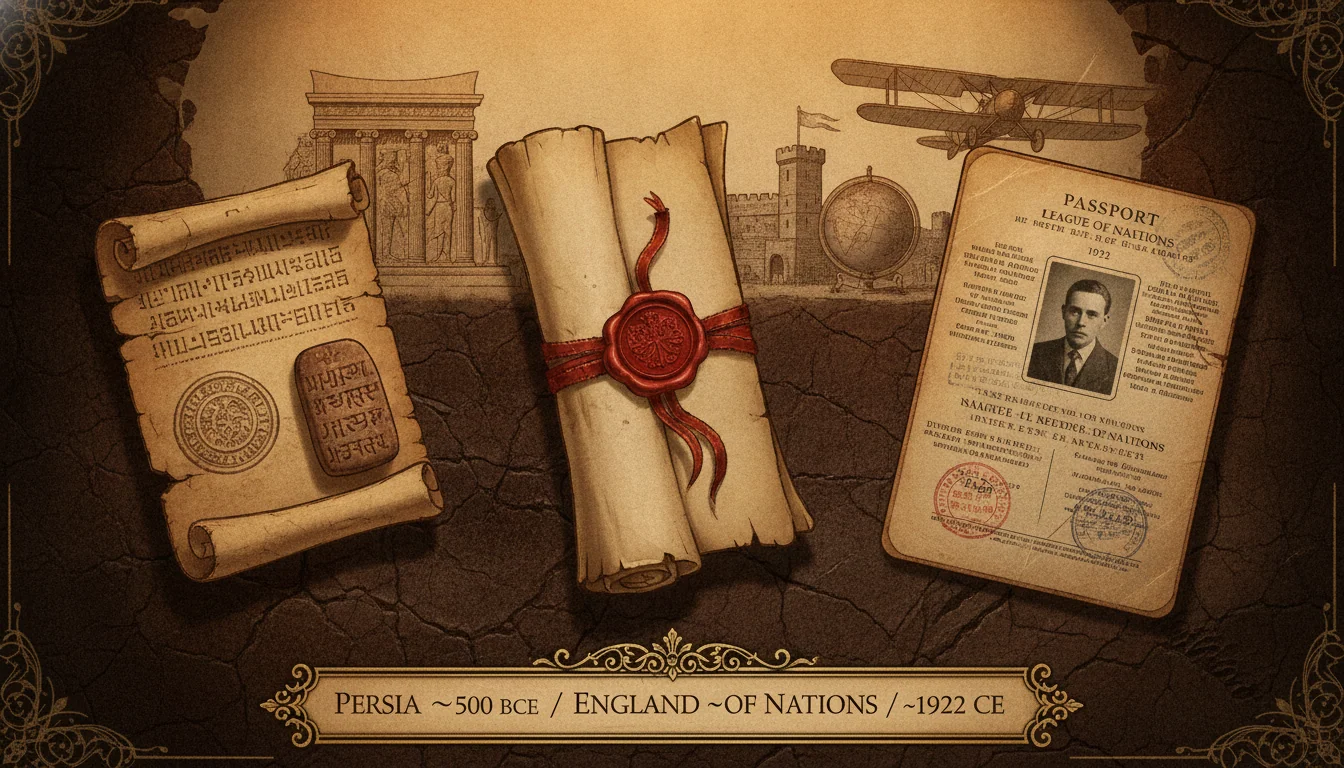
Most people assume passports are ancient. The mental image involves Roman legions checking tablets at provincial gates, or medieval guards demanding letters of introduction from anyone approaching a walled city. The document itself feels archaic - formal, stamped, bearing the seal of a sovereign authority reaching back into deep history.
The modern passport booklet, with its photograph and machine-readable strip, was standardized by the League of Nations in 1920. Biometric chips were added under international standards in the early 2000s. Your oldest living relative was almost certainly born before the format that governs international travel today was invented. Most of your grandparents' grandparents crossed borders without anything resembling what you carry in your jacket pocket.
This is not to say that the idea of state-authorized travel is modern. It is very old, and the history of how it evolved is considerably more interesting than the laminated document it produced.
The letter from a Persian king
The oldest document routinely identified as a passport precursor is not a booklet or even a physical object that survives. It is a sentence in the Hebrew Bible.
The Book of Nehemiah, composed in the 5th century BC, describes how Nehemiah, a Jewish official serving the Persian king Artaxerxes I, requested permission to travel to Judah to oversee the rebuilding of Jerusalem's walls. The king granted it. More importantly, Artaxerxes gave Nehemiah letters addressed to the governors of the provinces along his route, instructing them to grant him safe passage, and a separate letter to the keeper of the royal forest authorizing him to take timber for the construction.
This transaction, dating to around 450 BC, contains the functional kernel of what a passport does: a central authority issues documentation that other authorities along a route are expected to honor. Nehemiah's letters are a one-off royal favor, not a standardized system. But the mechanism - here is a document from a power you recognize; let this person through - is recognizable.
The Persians were systematic administrators and this practice was not unusual. The Achaemenid Empire, which stretched from the Aegean to the Indus at its greatest extent, maintained a sophisticated road network called the Royal Road, along which officials and couriers traveled using sealed parchment or clay authorizations that specified their route, their authority, and their ration entitlements at each relay station. The system was closer to an internal pass than to an international passport, but the concept of documented state authorization for travel was clearly developed.
Rome's bronze tablets
The Roman Empire extended the idea into something more systematically bureaucratic. The diplomata - from the Latin for "things folded double" - were official documents issued to soldiers on discharge and to officials authorizing use of the cursus publicus, the imperial road and relay system. A retiring legionary's diploma recorded his name, unit, years of service, citizenship grant, and privileges. Forgery was common enough that Roman administrators developed authentication methods involving specific design elements and counter-signatures.
The cursus publicus required sealed passes called evectionis specifying what resources - horses, food, shelter - a traveler was entitled to claim at each relay station. Both realities, the legitimate document and the forged one, shaped Roman administrative law on travel authorization for centuries.
When the Western Roman Empire collapsed in the 5th century, these systems fragmented. The medieval period replaced standardized documentation with case-by-case letters of safe conduct issued by monarchs, bishops, and local lords. A merchant crossing territories sought a letter from whoever held authority over the destination, and the letter's protection was only as reliable as the political relationship between its issuer and the people reading it.
Henry V and the English statutory moment
The word "passport" appears in English by the mid-15th century, from the French "passer" (to pass) and "port" (a gate or entry point). Henry V's Parliament in 1414 introduced legislation providing for formal safe-conduct documents for travel, which some historians identify as the earliest English statutory passport provision. The context was practical: England and France had been in nearly continuous conflict for a century, and controlling cross-border movement mattered. Henry's safe-conduct letters were issued case by case and functioned as royal endorsements rather than identity papers - they authenticated the bearer's relationship to the crown, not the bearer's identity.
France went further, issuing laissez-passer documents by the late 17th century to track the internal movement of workers and the rural poor. This interior passport system is the ancestor of internal identity documents rather than international travel papers.
The 19th century and the era without passports
One of the less intuitive facts about passport history is that much of the 19th century had no significant requirement for them at all. The relative stability of the post-Napoleonic order, the enormous expansion of rail travel, and the broadly liberal economic consensus of the mid-19th century led most European and North American governments to abolish or simply stop enforcing border documentation requirements between roughly 1850 and 1914.
A British citizen in 1880 could travel through France, Germany, Austria-Hungary, and Italy without a passport. The standard requirement for hotel registration was a letter of introduction or simply a calling card. American citizens going to Europe carried no standardized government document. The only situations that typically required formal documentation were travel to the Ottoman Empire, Russia, or other countries with more intrusive bureaucratic traditions.
This is the world that the First World War destroyed, almost overnight. When European governments mobilized in August 1914, they reimposed border controls immediately, introduced documentation requirements, and began trying to track population movements across frontiers that were suddenly militarily significant. The administrative improvisation was chaotic: different countries required different documents in different formats, photographs were sometimes demanded and sometimes not, visa systems proliferated without coordination. By the armistice, European border bureaucracy had become vastly more complex than it had been in 1913, and nobody was quite sure how to rationalize it.
1920: the Paris Conference and the modern format
In 1920, the newly formed League of Nations convened a conference in Paris specifically to address the passport problem. The Paris Passport Conference produced the first international agreement on a common format: a booklet of specified dimensions, containing a photograph, a standardized block of information about the holder, and blank pages for visa stamps. The 1920 format is directly recognizable as the ancestor of what most people carry today.
The conference did not achieve universal adoption - it was a voluntary framework rather than a treaty with binding force - but it established conventions that most issuing governments gradually adopted because the practical advantages of mutual recognition outweighed the minor sovereignty cost of standardization. By the late 1920s, most Western European governments and their overseas territories were issuing documents that conformed broadly to the 1920 format.
The Nansen passport: stateless in a world of documents
The 1920 conference addressed the needs of ordinary citizens. It left unresolved a specific crisis that the First World War and its aftermath had created: hundreds of thousands of people who had lost, or been stripped of, the citizenship that would entitle them to a passport in the first place.
Russian refugees - displaced by the Revolution of 1917 and the subsequent civil war - numbered perhaps 800,000 by the early 1920s. They had been stripped of Soviet citizenship, could not return, had no nationality that would issue them travel papers, and were being refused entry by countries that required documentation they could not obtain. Armenian survivors of the 1915 genocide were in a similar position. Assyrian refugees, expelled from various parts of the collapsing Ottoman world, added to the total.
Fridtjof Nansen, the Norwegian polar explorer who had become the League of Nations' first High Commissioner for Refugees, addressed this gap directly. In 1922 he designed a travel document that stateless persons could carry and that signatory countries agreed to accept at their borders. It was not a passport issued by any national government. It was a document issued by an international organization, acknowledging the holder's statelessness and requesting safe passage on humanitarian grounds.
About 52 nations eventually recognized the Nansen passport. Later versions were extended to Armenian refugees in 1924, Assyrian and other groups in subsequent years, and by the late 1930s to German and Austrian Jewish refugees from National Socialism. The document was imperfect - not every country recognized it, and holders were sometimes turned back anyway - but it established the principle that stateless persons had a claim on the international system for travel documentation that the issuing state could not satisfy.
The Nansen passport is the direct ancestor of the Convention Travel Document issued to refugees today under the 1951 Refugee Convention. The moral and practical logic of the 1922 design survives in the 2026 implementation.
What you hold today
The International Civil Aviation Organization standardized machine-readable travel documents in 1980, introducing the two-line optical character recognition format that allowed automated reading of nationality, document number, and expiry date. Biometric passports containing a chip with fingerprint and facial data were rolled out under ICAO Document 9303 standards from the early 2000s, with most major issuing countries adopting the format by 2010. By 2026, more than 150 countries issue biometric passports.
The document in your pocket represents roughly 2,500 years of administrative thinking about the same basic problem: how does a state authority give a person permission to pass through territory it does not fully control, in terms that other authorities will recognize and honor? Nehemiah's letters from Artaxerxes, Henry V's safe-conduct writs, Elcano's royal authorization to sail home with the cloves, and your machine-readable biometric chip are different answers across different technologies and different scales of political organization. They solve the same underlying puzzle.
None of them is the final answer. The puzzle of who gets to cross which borders under what conditions is as contested in 2026 as it was in 450 BC, and the document in your pocket is only as good as the agreement between the country that issued it and the country reading it at the gate.
The origins of money tell a parallel story: another administrative technology whose path from ancient convenience to international standard took millennia and several catastrophic disruptions to complete.
Quick Answers
Common questions about this topic
What is the oldest known passport-like document?
The biblical Book of Nehemiah describes letters from the Persian King Artaxerxes I, dating to around 450 BC, granting Nehemiah safe passage through provincial governors along his route to Judah. These are often cited as the earliest recorded travel authorization documents. Ancient Rome's diplomata - bronze identity and travel tablets issued to soldiers and officials - represent the earliest standardized system rather than a one-off royal favor.
Did Henry V invent the passport?
Henry V's Parliament passed legislation in 1414 introducing formal safe-conduct documents, and the word 'passport' appears in English texts by the mid-15th century. But these were case-by-case letters issued by royal authority, not a standardized system. The modern passport - a booklet with a photograph, standardized format, and machine-readable data - emerged from a League of Nations conference in 1920, after the First World War destroyed the 19th century's relatively open border regime.
What was the Nansen passport?
The Nansen passport was an internationally recognized travel document created in 1922 for stateless people, primarily Russian and Armenian refugees who had been displaced by revolution and war and had no functioning state to issue them documents. Named after Fridtjof Nansen, the Norwegian explorer and League of Nations High Commissioner for Refugees, it was accepted by about 52 nations and is the direct ancestor of the Convention Travel Document used for refugees today.
When did passports become internationally standardized?
The 1920 Paris Conference on Passports, convened by the League of Nations, established the first international standards: a specific booklet size, a photograph, and a common format of information. Before 1914, most European countries had abandoned border documentation requirements during the relatively open 19th century. The First World War's mobilization chaos forced governments to reimpose documentation controls, and the 1920 conference created a common framework.

Ask the Inventors Themselves
Chat with the people who were there when familiar things began.
Create your free account →No card required. Some figures and features require a paid plan.
Join the HistorIQly Club
Get smarter about the past.
Weekly stories, deep dives, and exclusive content straight to your inbox.