Origins: How Mail Delivery Was Invented
History of mail delivery: from Persian relay riders and Roman couriers to Rowland Hill's 1840 penny stamp that made the post available to everyone.
Read Wikipedia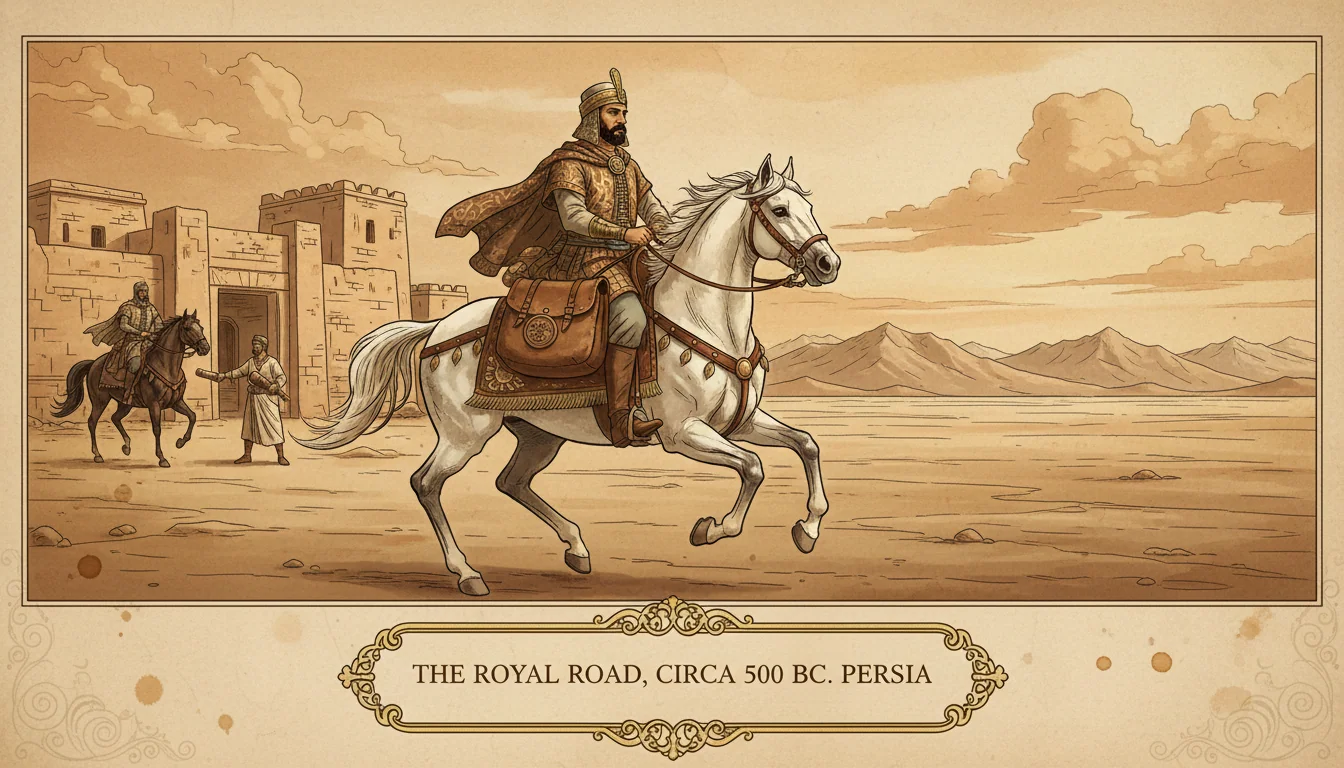
Before there were stamps, before there were post offices, before there were postmen in uniforms walking routes, there was the oldest problem in administration: how do you get a message from one end of a large territory to the other before the information becomes useless? Armies need orders. Governors need instructions. Merchants need contracts. Courts need news. The answer to that problem is a postal system, and every civilization large enough to have the problem eventually arrived at some version of the same solution.
What separates the ancient answer from the modern one is not the technology - horses are horses and roads are roads - but the question of who gets to use the system. For most of human history, organized mail relay was a government monopoly, open to officials and sometimes to wealthy merchants, and closed to everyone else. The idea that any citizen could send a letter anywhere in a country for a standard fee and a small adhesive paper square is astonishingly recent. It dates to 1840, and the person who invented it was a schoolteacher from Kidderminster.
The first organized relays
The earliest documented mail relay system belongs to the Achaemenid Persian Empire under Darius I, who reigned from 522 to 486 BC. Darius was governing the largest empire the world had yet seen, stretching from the Aegean coast to the Indus valley, and he built a road network to match. The Royal Road, the main artery, ran roughly 2,700 kilometers from Susa, the administrative capital, to Sardis in western Anatolia. At regular intervals along the route - approximately every 25 kilometers, matching a comfortable day's ride - Darius placed relay stations stocked with fresh horses, riders, and accommodation.
A dispatch rider entering the relay at Susa would ride to the first station, hand off the message, and rest. A fresh rider on a fresh horse would take the message to the next station. The sequence continued, day and night, until the message reached Sardis. The full 2,700 kilometers could be covered in roughly a week. An ordinary traveler walking or riding continuously took ninety days.
Herodotus, who described the system with evident admiration, wrote that the Persian couriers were stopped by "neither snow nor rain nor heat nor gloom of night." That sentence, in its various translations, would be inscribed roughly 2,400 years later on the James Farley Post Office Building in New York and is commonly misidentified as the official motto of the United States Postal Service. It is not the USPS motto - the USPS has no official motto - but the line has a persistence that Herodotus himself might have appreciated.
The Persian system was not postal in the modern sense. It was an instrument of imperial administration, carrying orders, intelligence, and official correspondence. No private citizen could send a letter through it. But it established the core principle that every subsequent relay system would follow: standardized stations, standardized horses, riders who specialize in speed rather than in knowing the full route.
China and the parallel tradition
China arrived at the same solution independently, and earlier by some accounts. The Qin Dynasty, which unified China in 221 BC, built an extensive network of relay posts as part of its administrative infrastructure. The system used horses for speed, foot messengers for economy, and boat relays along rivers. The Tang Dynasty, eight centuries later, expanded this to roughly 1,600 relay posts across the empire, with recorded standards specifying how many horses each station must maintain and how quickly a message of given urgency must travel.
Rome and the state courier
The Roman cursus publicus, established by Augustus Caesar around 20 BC, was in some ways the most rational version of the relay system the ancient world produced. Augustus was reorganizing an empire after a century of civil war, and reliable communication between Rome and its governors was not optional. He created a network of rest stations - mansiones, from manere, to stay - placed roughly every 25 to 30 Roman miles along the main roads, stocked with fresh horses, vehicles, and accommodation.
The system was sophisticated enough to distinguish between urgent and non-urgent communications, with different conveyances for each. Official couriers carrying urgent imperial dispatches moved on horseback. Less urgent official correspondence traveled by light vehicle. The whole system was imperial property, maintained at state expense, and reserved entirely for government use.
Private citizens could not send letters through the cursus publicus. Seneca, who was a wealthy man with connections, complained that communicating with people in distant provinces still required finding a traveler going in the right direction and trusting him not to lose the letter. Roman private correspondence moved the way private correspondence had always moved: by hand, through personal networks, at the convenience and risk of the carrier.
The cursus publicus lasted until the Western Empire collapsed in the 5th century AD. When it went, it went completely. Medieval Europe had no equivalent for centuries.
The gap and the improvised solutions
Between the fall of Rome and the early modern period, Europe's communication infrastructure fragmented into improvised substitutes. Monasteries maintained their own messenger networks between houses of the same order. Universities in the 13th and 14th centuries employed official messengers - nuntii - who carried correspondence between scholars and between students and their families. The great Italian merchant firms of the Florentine and Venetian tradition maintained private courier networks connecting their agents across Europe, and the letters that survive from those systems are among the most detailed sources historians have for medieval commercial and political life.
The Holy Roman Emperor Maximilian I built a formal postal relay between his various capitals in 1505, using the Thurn und Taxis family as contractors. That dynasty would operate postal services across Central Europe for more than three centuries, eventually holding monopoly rights over imperial mail until 1867. In 1516, Henry VIII established a royal postal service in England connecting London with the Scottish border - primarily for military intelligence, not for private letters.
By the 17th century, most European monarchies had some version of a state postal system. In 1635, Charles I of England opened the royal mail to private correspondence for a fee, creating what would become the General Post Office. The fee was charged to the recipient, not the sender, and varied by the distance traveled and the number of sheets in the letter.
That last point is important: recipients could, and often did, refuse letters if the fee was too high. A writer sending a long letter to an impoverished correspondent was essentially imposing a tax on them. The sender paid nothing. The system created perverse incentives that were slowly strangling postal communication.
Rowland Hill and the revolution of 1840
Rowland Hill was a schoolteacher and educational reformer who in 1837 published a pamphlet titled Post Office Reform: Its Importance and Practicability. His argument was methodical and devastating. The existing system, Hill calculated, spent most of its administrative cost not on carrying letters but on accounting for them - tracking distances, counting sheets, collecting fees from reluctant recipients, and dealing with refusals. If the fee were made uniform regardless of distance, charged to the sender, and collected in advance through a prepaid adhesive label, the administrative cost would collapse and volume would expand dramatically.
His central insight was that the cost of physically carrying a letter was trivial compared to the cost of managing a variable-rate, recipient-pays system. A uniform penny for any letter under half an ounce, anywhere in Britain, paid by the sender before posting, would lower the per-letter cost enough to quadruple volume and more than compensate for the lower per-letter revenue.
The opposition from Post Office officials was fierce. They predicted financial ruin. Hill was vindicated almost immediately. The Penny Black - the world's first adhesive postage stamp, printed in black with a profile of Queen Victoria - went on sale on May 6, 1840. Within three years, mail volume in Britain had indeed roughly quadrupled. Within a decade, country after country adopted the basic model.
The United States introduced its first adhesive stamps in 1847 - a five-cent stamp bearing Benjamin Franklin's portrait, who had been appointed first Postmaster General of the Continental Post Office in 1775. Brazil, Switzerland, and several German states introduced stamps in the late 1840s and early 1850s. By 1874, when twenty-two nations signed the Treaty of Bern creating the General Postal Union (later the Universal Postal Union), the stamp-based prepaid uniform-rate system was effectively global.
The gap between myth and record
The comfortable myth of postal history is a straight line from ancient Persian riders to the modern postman, a progressive refinement of the same idea across millennia. The actual history is more fractured. The Persian relay was not a postal service - it was imperial intelligence infrastructure. The Roman cursus publicus was not a postal service - it was a government-only courier network. The medieval church and merchant systems were private and limited. The early modern royal posts were hybrid systems that allowed some private mail but charged recipients and created as many barriers as they removed.
The idea that any person in a country could send a letter anywhere, for a standard small fee, with payment in advance and delivery guaranteed - that idea is a 19th-century invention. It required not just the technology of stamps and routes but a philosophical shift: the post as a public utility rather than a government or private privilege.
That shift happened in 1840 in Britain, and Rowland Hill, a schoolteacher who had never run a postal system in his life, was the one who argued for it with enough clarity that eventually someone listened. The Persian couriers riding through heat and rain got there first, as origin stories often note. But they were carrying the emperor's letters, not yours.
For related origins histories that follow the same pattern of an elite system made universal, see Origins: The Printing Press and Origins: Who Invented Writing?.
Quick Answers
Common questions about this topic
Who invented the postal system?
No single person invented it. The first organized mail relay systems were created by the Persian Achaemenid Empire under Darius I around 500 BC - a network of relay riders on the Royal Road between Susa and Sardis. The Romans developed their own state courier system, the cursus publicus, under Augustus Caesar around 20 BC. The modern public postal service - mail available to anyone, paid in advance with a stamp - was invented by the British reformer Rowland Hill and launched in 1840.
What was the Persian Royal Road mail system?
Darius I of Persia created a network of relay stations along the Royal Road, a 2,700-kilometer highway connecting Susa in Persia to Sardis in western Anatolia. Mounted riders at each station changed horses and continued the message, covering the entire route in roughly a week - a journey that took ordinary travelers three months. Herodotus described the couriers in terms that were later inscribed on the James Farley Post Office Building in New York: 'Neither snow nor rain nor heat nor gloom of night stays these couriers from the swift completion of their appointed rounds.'
What was the Roman cursus publicus?
The cursus publicus was the official state courier system of the Roman Empire, established by Augustus Caesar around 20 BC. It used a network of relay stations - mansiones - stocked with fresh horses and accommodation for riders. The system was reserved for official government correspondence; private citizens could not use it. It was the most efficient communications network in the Western world until the Roman Empire collapsed.
What did the Penny Black change?
The Penny Black, issued by Britain in May 1840 following Rowland Hill's postal reform, was the world's first adhesive postage stamp. Before Hill's reform, the sender did not pay - the recipient paid upon delivery, and the fee varied by distance and number of sheets. Hill's system reversed this: payment in advance, a flat fee regardless of distance, and a prepaid adhesive stamp as proof of payment. This single reform quadrupled mail volume in Britain within three years and became the template for postal systems worldwide.

Ask the Inventors Themselves
Chat with the people who were there when familiar things began.
Create your free account →No card required. Talk to anyone in history with 8 free credits a day. Some features require a paid plan.
Join the HistorIQly Club
Get smarter about the past.
Weekly stories, deep dives, and exclusive content straight to your inbox.