Origins: Did Marco Polo Bring Pasta from China?
Did Marco Polo bring pasta from China? The documentary record says no. Italian pasta predates his return by 16 years, and the real origin trails through Arab Sicily.
Read Wikipedia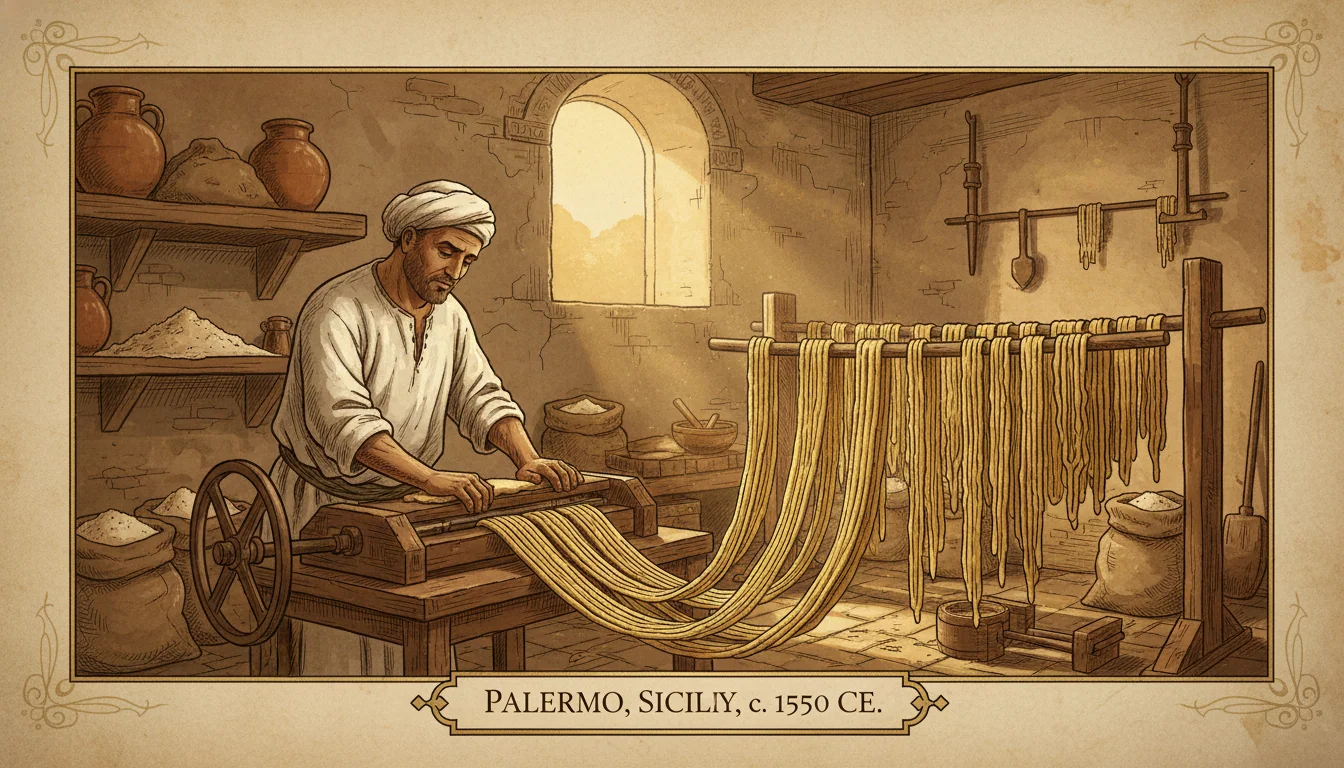
The story goes like this: Marco Polo traveled to China in the late 13th century, stayed for seventeen years at the court of Kublai Khan, saw the Chinese eating noodles, and brought the idea back to Italy. Italians then invented pasta. Before Polo, there was nothing.
It is one of the most elegantly wrong stories in culinary history.
The problem with it is not a matter of scholarly debate or fine interpretation. It is a matter of dates. Italian pasta is documented before Marco Polo came home from China. The story cannot be true on its own timeline.
The document that ends the myth
In 1279, a Genoese soldier named Ponzio Bastone was dying. A notary was called to inventory his estate. Among his possessions, recorded in the plain contractual Latin of a medieval Ligurian notary, was "una bariscella plena de macaronis" - a basket full of macaroni.
Ponzio Bastone owned macaroni. He owned enough of it to include in a formal inventory. It was ordinary enough to list alongside his other household goods.
Marco Polo left Venice for the East around 1271 and did not return until 1295. The Genoese document is dated 1279, sixteen years before Polo came home. Whatever pasta was doing in Ponzio Bastone's house in Genoa, it was not waiting for a Venetian traveler to return from Asia.
The Macaroni Journal - a trade publication of the American pasta industry - printed a short story in 1929 suggesting that Polo brought noodles from China to Italy. The story has no known historical basis and appears to have been invented or embellished for a general readership. It circulated, attached itself to a pre-existing folk tradition, and became one of the most widely repeated food myths in the world.
The documentary record does not support it.
What al-Idrisi wrote in 1154
The oldest clear account of dried pasta production in the Western Mediterranean predates Ponzio Bastone's basket by more than a century and predates Polo's birth entirely.
Muhammad al-Idrisi was an Arab geographer working at the court of the Norman king Roger II of Sicily in Palermo. He was one of the great cartographers and geographers of the medieval world, and his 1154 work commonly called the Book of Roger (Tabula Rogeriana) describes the geography, trade routes, and products of lands from Ireland to the Indian Ocean.
In his description of Sicily, al-Idrisi writes about a place called Trabia, located about thirty kilometers from Palermo. There, he says, the inhabitants make a food from wheat flour "in the form of strings" (the Arabic transliterates as describing something like itriyya, a dried pasta product known from earlier Arab culinary texts). He adds that large quantities of this food are exported by ship to Calabria and to Muslim and Christian lands alike.
A regional industry, producing a standardized dried grain food in bulk for export across the Mediterranean, already existed in Norman Sicily by 1154. Al-Idrisi was not describing a novelty or a curiosity. He was describing a commercial product.
The Arab connection
The word itriyya itself is older than al-Idrisi. It appears in Arabic culinary and medical texts from several centuries earlier. The 9th-century physician Ishaq ibn Sulayman al-Isra'ili mentions itriyya as a food. The 10th-century Arabic cookbook Kitab al-Tabikh includes a recipe for itriyya that describes a dried pasta product made from semolina dough.
The Arab presence in Sicily is the critical link. Arab forces took control of Sicily from the Byzantine Greeks over the course of the 9th century, completing their conquest around 902 CE. They held much of the island until the Norman conquest in the late 11th century, which was completed by 1091 CE. During two centuries of Arab governance, they introduced a range of agricultural and culinary innovations: citrus orchards, sugarcane, refined irrigation, and, critically, expanded cultivation of durum wheat (Triticum durum).
Durum wheat matters because it is the grain that makes dried pasta possible. The high gluten content and low moisture of semolina flour, ground from durum, produces a dough that can be extruded or rolled into shapes and then dried without collapsing. Soft wheat - the kind grown for bread throughout northern Europe - makes a paste that disintegrates when dried. Dried pasta is a southern phenomenon because durum grows best in hot, dry Mediterranean climates, and because the Arab agricultural tradition understood how to cultivate it and use its properties.
The technological package - durum wheat, drying technique, export-oriented production - arrived in Sicily through Arabic-speaking culture and was established well before Norman rule ended Arab presence there.
The Roman and Etruscan angle
Some accounts of pasta's origins skip the Arabs entirely and reach back to ancient Rome. The Romans had a food called laganum, a flat pasta-like preparation described in ancient agricultural and culinary sources. Apicius, the Roman cookbook compiled around the 4th or 5th century CE, includes preparations that involve strips of dough.
The problem with a direct Roman lineage is the missing link. Laganum as described in ancient sources appears to have been a baked preparation - cooked in the oven on heated tiles - rather than boiled. The step from baked flat dough to boiled dried pasta is not a trivial one, and there is no continuous documentary chain connecting Roman laganum to the Sicilian itriyya tradition. The two may share a remote ancestor in the general category of dough preparations, but the specific technology of dried boiled pasta required the Arabic contribution.
The Etruscan theory, which sometimes points to carved tomb reliefs showing what look like rolling pins and other pasta-adjacent tools, has even thinner documentary support. The visual evidence in Etruscan tomb art is ambiguous and has been interpreted by enthusiasts rather than by the weight of archaeological scholarship.
Chinese noodles, separately
The Chinese noodle tradition is ancient and entirely real. In 2005, archaeologists excavating a Bronze Age site at Lajia in Qinghai Province found a pottery bowl preserved under sediment containing the remains of noodles made from millet flour, dated to roughly 2000 BCE. Chinese culinary tradition has documented wheat noodles from at least the Han dynasty. Medieval Chinese manuscripts include noodle preparations of considerable sophistication.
None of this means Marco Polo brought noodles to Italy. It means that a grain-dough-and-water tradition of cooking long thin food arose in multiple places over human history. Noodles appear in Arab culinary tradition, in Chinese culinary tradition, and in ancient Mediterranean culinary tradition as something closer to a convergent cultural development than a single invention transmitted along trade routes.
Marco Polo did describe something resembling pasta in his accounts of China. He called it lagana, using a Latinized word for flat dough sheets - which is also the Latin word that gives modern Italian lasagna its name. But he was a Venetian using the word he already knew for a dough preparation. This is not evidence of surprise at an unfamiliar food. It may be evidence that he already knew what he was looking at.
The Sicily-to-Naples pipeline
The trail from al-Idrisi's Sicilian pasta industry to the global phenomenon of Italian pasta runs through straightforward historical channels. After the Norman kings consolidated Sicily, pasta production remained concentrated in the island's western wheat-growing areas. Dried pasta traveled well by ship - which is the point of drying it - and Sicilian producers supplied the Mediterranean trade routes that ran from Gibraltar to the Levant.
By the 13th century, dried pasta production had spread to the mainland Italian coast, particularly around Naples, Genoa, and the other major port cities with access to Sicilian grain. Genoa is exactly where Ponzio Bastone lived and where his basket of macaroni was inventoried in 1279.
The pasta industry then expanded through the 14th and 15th centuries as commercial wheat farming spread in southern Italy and as the demand from growing cities made preserved food production increasingly profitable. Marco Polo features nowhere in this story except as a traveler who came home from Asia to find pasta already in his neighbor's pantry. For other foods whose origins are more complicated than popular history suggests, see Origins: Bread and Origins: Pizza.
The Macaroni Journal story from 1929 did not invent the myth from nothing - a vague Polo-pasta association had circulated in various forms for decades before that. But it crystallized and popularized it in a form that proved remarkably durable. The myth is more satisfying than the reality: a single dramatic moment of cultural transfer, a great explorer returning with a gift that changed European cuisine. The actual history is slower, less romantic, and more interesting - an Arab geographer, a dead soldier's basket, and a Sicilian wheat industry no one bothered to mythologize because it was just commerce.
Quick Answers
Common questions about this topic
Did Marco Polo really bring pasta to Italy from China?
No. Documented Italian pasta predates Marco Polo's return from China (1295) by at least sixteen years. A Genoese notarial document from 1279 records a basket of macaroni among the possessions of a deceased soldier. The Arab geographer al-Idrisi described dried pasta being produced in Sicily and exported across the Mediterranean as early as 1154. Marco Polo may have encountered noodles in China, but they were already in Italy before he came home.
Where did pasta actually come from?
The most well-supported historical path leads through Arab Sicily. Arabic culinary traditions used a dried pasta product called itriyya, and the Arab presence in Sicily from the 9th through 11th centuries CE introduced both durum wheat cultivation and food-drying techniques suited to pasta preservation. Al-Idrisi's 1154 description of dried pasta production near Trabia in Sicily is the oldest clear documentary evidence for Italian pasta manufacture.
What is the 1279 Genoese document?
In 1279, a Genoese soldier named Ponzio Bastone died and left an estate that was inventoried by a notary. Among his possessions was listed 'una bariscella plena de macaronis' - a basket full of macaroni. Marco Polo did not return from his travels until 1295. The document proves that pasta was already ordinary enough to be left in a will sixteen years before Polo came home.
When were Chinese noodles first documented?
The oldest physical evidence for noodles in China comes from Lajia in Qinghai Province, where archaeologists in 2005 found a bowl of noodles made from millet flour preserved for approximately 4,000 years. Chinese noodle traditions are ancient and distinct from Mediterranean pasta traditions, using different grains and techniques. The two almost certainly developed independently.

Ask the Inventors Themselves
Chat with the people who were there when familiar things began.
Create your free account →No card required. Talk to anyone in history with 8 free credits a day. Some features require a paid plan.
Join the HistorIQly Club
Get smarter about the past.
Weekly stories, deep dives, and exclusive content straight to your inbox.