Origins: Who Invented Playing Cards
Who invented playing cards? Tang China, the Mamluk Sultanate, and medieval Europe each shaped the deck - and only the Joker is American.
Read Wikipedia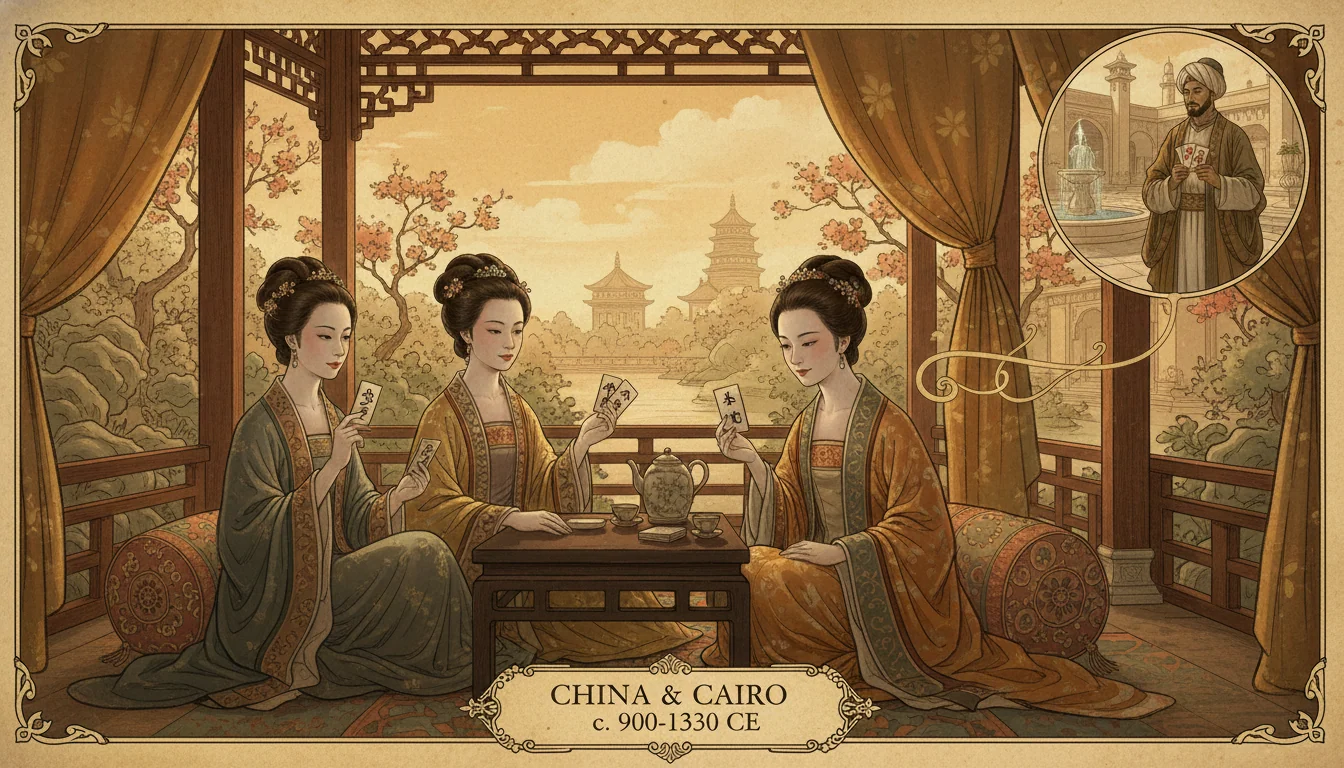
The standard explanation for playing cards in the Western world runs approximately as follows: cards appeared in Europe in the late 14th century, nobody is entirely sure where they came from, and within a century they were everywhere. This explanation is accurate as far as it goes and deeply unsatisfying, because the question it skips over - where the idea of a game played with a numbered, suited deck actually originated - turns out to have a reasonably good answer.
That answer involves Tang dynasty China, the court of the Abbasid Caliphate, an Egyptian bureaucracy, and the obsolete sport of polo.
China: the leaf games
The oldest written reference to playing cards appears in Tang dynasty China in the 9th century CE. A text from around 868 CE mentions the Princess Tongchang playing "leaf games" (yezi xi) with her husband's family. Chinese scholars of the 11th century wrote about the "leaf game," describing it as popular entertainment that involved cards made from thick paper.
What precisely was played on those Tang-era cards, and what the cards looked like, is largely lost. The cards themselves have not survived - paper does not last fourteen centuries in a hostile climate without extraordinary luck. What has survived are the texts that mention them and the later Chinese card traditions that appear to descend from them.
By the Song dynasty (960-1279 CE), something more clearly identifiable as playing cards was in widespread use in China. These included number cards, paper money cards, and cards associated with various games involving combinations and scores. The principle of a ranked, numbered deck organized into categories had been established.
The pathway from these early Chinese cards to the deck recognizable today is not a straight line. It involves multiple transformations, the most significant of which happened not in China but somewhere along the trade and diplomatic routes connecting the Tang and later Song world to the Islamic empires to the west.
The Mamluk transformation
By the 13th or 14th century, card games of some kind had reached the Islamic world, and the Mamluk Sultanate of Egypt - which ruled from Cairo over Egypt, the Levant, and the Hejaz from 1250 to 1517 - had developed a distinct card tradition of its own.
The Mamluk deck is where the four-suit system that underlies modern Western playing cards becomes recognizable. Mamluk cards were organized into four suits: cups (kas), coins (dinar), swords (sayf), and polo sticks (jawkhan). Each suit contained fourteen cards: ten numbered cards and four court cards. The court cards were not depicted with faces - Islamic artistic tradition at the time generally avoided figurative representation - but were identified by title: malik (king), na'ib malik (deputy king), thani na'ib (second deputy).
The polo stick suit is the most revealing detail in the entire chain of transmission. Polo was a Persian and Central Asian sport that had become fashionable among the Mamluk military elite. It had limited meaning as a suit symbol anywhere beyond the culture that knew and valued the game. When cards traveled westward into Europe, the polo sticks needed a new identity.
The earliest surviving substantial example of a Mamluk deck is held in the Topkapi Palace Museum in Istanbul - a set of cards from the 15th century, elaborately decorated with strapwork patterns and inscriptions. It is the missing link between the Chinese card tradition and the European one, made physical and preserved against the odds.
Arrival in Europe: the 1370s
Playing cards entered the documented European historical record in the early 1370s. A 1367 ordinance from Bern, Switzerland may reference cards; by 1371 there are clear records in Catalonia and Aragon; and in 1377 a German monk named Johannes von Rheinfelden wrote a description of card games being played in multiple European cities, including a detailed account of the deck's structure that is unmistakably the Mamluk four-suit system rendered into European terms.
The speed of spread was remarkable. Cards went from first documentation to continent-wide prohibition attempts in roughly a decade. Civic authorities in Florence, Paris, and Augsburg moved to ban card games in the 1370s and 1380s, which is a reliable indicator that cards had already become deeply popular before anyone in authority noticed.
The entry routes were almost certainly multiple. The Iberian peninsula, where Moorish and Christian cultures had maintained generations of complex contact, is the obvious candidate for one major pathway. Venice and Genoa, whose trading networks penetrated the Levant and Egypt, are equally plausible as independent points of entry. By the time European authorities began noticing cards enough to write about them, the idea had taken hold too firmly to root out.
Europe remakes the deck
Early European cards retained the Mamluk suit structure but translated it into locally meaningful symbols. The polo sticks became batons or clubs in Italian and Spanish decks, a substitution that preserved the stick shape while replacing the game with something European audiences understood. Cups, coins, and swords required no translation.
The court cards - where Mamluk tradition had avoided faces - became illustrated figures in European hands almost immediately. Kings, knights, and knaves (later queens, in some traditions) appeared with faces, regional dress, and eventually standardized identities. French cardmakers in the 15th and 16th centuries assigned specific historical and legendary figures to the court cards: Alexander the Great for the King of Clubs, Caesar for Diamonds, David for Spades, and Charles for Hearts. These assignments were not universal and varied by region and era.
The French made the most consequential structural change: they replaced the four original suit symbols with a new set. Hearts, diamonds, clubs, and spades were simpler to reproduce with woodblock printing than the earlier symbols, and cheaper printing meant cheaper cards. The French deck, standardized in the 16th century, became the international standard not because of any inherent superiority but because French and later British colonial and commercial networks carried it everywhere that European commerce reached.
The Ace of Spades gets complicated
In England, the Ace of Spades acquired a particular significance that has nothing to do with the card's original design. In 1765, the British government introduced a tax on playing cards and required that the Ace of Spades bear the duty stamp as proof of payment. Card manufacturers were required to use an official Ace of Spades supplied by the Stamp Office. The ace became, in effect, a government revenue document.
The elaborate printed Ace of Spades - with its decorative flourishes, its royal emblems, and its distinct typography - became traditional even after the duty was abolished in 1960. Modern decks still typically feature a more decorative Ace of Spades than the other suits, a vestige of eighteenth-century British tax enforcement.
The Joker's American origin
The Joker is the one card in the standard deck with a cleanly documented origin, and it is not ancient. It was introduced in the United States in the 1860s for the game of Euchre, which required a highest trump card called the Best Bower. "Bower" became "Bauer" (the German word for farmer, used in German card games), which was anglicized to something that sounded similar - "Joker" being one account of the derivation. Another account suggests the name came from the game itself, Euchre being spelled "euker" in some forms, and the card called the "Jucker" being corrupted to Joker.
Either way, the Joker is an American invention of the post-Civil War era, added to a deck whose other components had been traveling and transforming for roughly a thousand years.
What got remembered, what got lost
The popular Western account of playing cards typically begins with medieval Europe, occasionally mentions that they "came from the East," and proceeds immediately to the history of European games and gambling regulations. The Tang dynasty leaf games, the Mamluk polo sticks, the Abbasid trading routes, and the generations of transmission that carried the concept from a Chinese princess's family gathering to a Venetian trading counter are reduced, in most tellings, to a vague gesture toward the Orient.
The actual sequence is more specific and more interesting: paper cards as entertainment originated in Tang China, the four-suit numbered deck was formalized in the Mamluk Sultanate of Egypt, and the illustrated face cards and simplified suit symbols were European contributions. Each civilization that touched the deck left something identifiable behind. The Joker alone is purely American.
The next time you pick up a standard deck, the suits remember an Egyptian bureaucrat's salary structure, the court cards remember Italian and French workshop conventions of the 1400s, and the Ace of Spades remembers a British tax collector's stamp.
For more on origins that traveled further than expected, read our pieces on the invention of coffee and the origin of chess.
Quick Answers
Common questions about this topic
Where were playing cards invented?
Playing cards were first developed in Tang dynasty China, probably during the 9th century CE. The earliest references to 'leaf games' (yezi xi) in Chinese texts date to this period. The specific form of the cards - their suits, their number system, their images - evolved considerably as the concept traveled westward through Central Asia and the Islamic world before reaching Europe in the 14th century.
How did playing cards reach Europe?
Playing cards arrived in Europe via the Mamluk Sultanate of Egypt and the eastern Mediterranean trade routes. The earliest documented European playing cards appear in the historical record in the 1370s, in cities including Florence, Barcelona, and Regensburg. They likely arrived through Spanish Moorish connections and Italian trade with the Levant.
What are the oldest surviving playing cards?
The oldest nearly complete surviving deck is a Mamluk card set held in the Topkapi Palace Museum in Istanbul, dating to the 15th century. In Europe, scattered individual cards from the 1390s-1420s survive in museum collections. The elaborate hand-painted Visconti-Sforza tarot deck, created for the Milanese court in the 1440s, is among the oldest substantially complete European card sets.
Why do playing cards have four suits?
The four-suit system was inherited from Mamluk cards, which had cups, coins, swords, and polo sticks. Europeans adapted the fourth suit variously - Italian and Spanish decks kept polo sticks as batons or clubs; the French renamed and reshaped all four into the hearts, diamonds, clubs, and spades that became standard internationally. The French suits became dominant largely through the efficiency of French printing and the colonial reach of French and British trade.

Ask the Inventors Themselves
Chat with the people who were there when familiar things began.
Create your free account →No card required. Talk to anyone in history with 8 free credits a day. Some features require a paid plan.
Join the HistorIQly Club
Get smarter about the past.
Weekly stories, deep dives, and exclusive content straight to your inbox.