Origins: How Police Were Invented
The origins of police trace to Paris in 1667 and London in 1829, not ancient Rome. What they were built to protect - and for whom - is part of the institutional design.
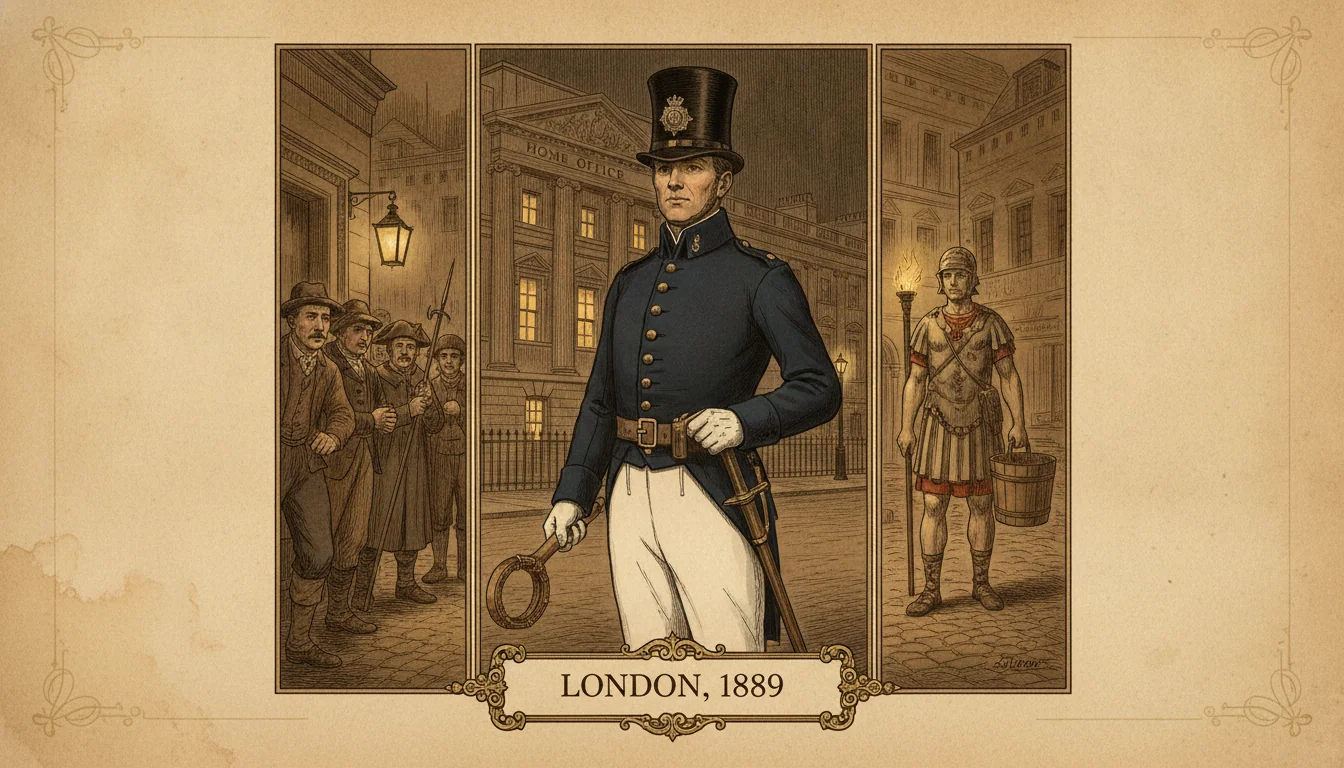
The popular assumption is that police have always existed. That any settled society with laws and property needed someone to enforce the first and protect the second, and that someone was eventually called police. This is plausible as theory and largely wrong as history.
The professional, salaried, uniformed constabulary that modern people mean when they say "the police" was invented roughly two hundred years ago. It was invented in specific cities for specific reasons, by specific people who argued for it against substantial public resistance - because the people arguing against it had noticed that the nearest existing models were either arms of the military or tools of authoritarian royal control, and they did not want either of those things wearing civilian clothes and walking their streets.
The history of how the police were invented is also the history of what, precisely, they were invented to protect.
Ancient order-keeping and its limits
Every complex settled society developed some mechanism for maintaining public order. In ancient Mesopotamia, city administrators employed watchmen to guard warehouses and city gates. In Egypt, specialized guards protected royal granaries, mining sites, and quarries. In ancient Athens, the city used a corps of publicly owned enslaved Scythian Archers to maintain order in the Agora - a corps of enslaved people managed by the state to police free citizens, an arrangement that captures something important about how ancient "policing" actually worked.
None of these institutions had investigative functions, crime prevention mandates, or accountability to a public. They were guards for specific assets and locations, not services for the population at large.
The Roman vigiles are the most persistently cited ancient precursor to modern police, and they deserve to be examined accurately. Augustus established the vigiles around 6 AD after a series of devastating urban fires. Rome was a city of around a million people, overwhelmingly built from timber and packed together at densities that made fire the single most catastrophic civic risk. The vigiles were his response: seven cohorts of roughly 560 men each, assigned to Rome's fourteen districts, tasked primarily with firefighting.
They patrolled at night with buckets, hooks, and matting for smothering flames. They could detain suspects and hand them to the city's senior magistrates. They caught runaway enslaved people, which was a secondary function of enormous economic importance to Roman slaveholders. Their nighttime presence meant they occasionally encountered crimes in progress and had authority to intervene.
But they were firefighters. Comparing them to modern police is roughly analogous to calling a 21st century fire department with auxiliary security duties a police force. The vigiles had no investigative capacity, no crime prevention mandate in the modern sense, and answered ultimately to imperial authority. They kept order as a byproduct of keeping watch for fires.
The medieval gap and the private solution
Between Rome and modernity, European urban order was managed through a patchwork of overlapping and competing arrangements that shared almost nothing except their inconsistency.
Night watchmen were employed by city guilds to guard commercial districts and gates. They typically worked for private employers, had authority limited to those employers' property or specific designated areas, and were poorly paid and irregularly reliable. Town constables in England were appointed by parishes - unpaid local appointments often treated as a civic burden, with authority limited to their home district and few tools to enforce even that.
The marechaussee in France was a mounted corps that originated in military camp policing and expanded over the 16th and 17th centuries into rural crime suppression. It had genuine reach in the countryside but minimal presence in cities. In England, the parish constable system was supplemented in London by the Bow Street Runners, established in 1749 by magistrate Henry Fielding as a fee-for-service detective operation - investigators who worked for whoever could pay their fees, not for the public.
The underlying structure of this system was private and market-based. Criminal investigation was initiated by the victim. The victim identified a suspect, paid to have them brought before a magistrate, and paid again to prosecute the case. If you were poor, you could not afford justice. If you were wealthy, you could afford several competing forms of it. The system did not pretend to serve everyone equally. It did not pretend to serve everyone at all.
Paris, 1667: the absolutist model
The first recognizable modern experiment in professional urban policing began in Paris in 1667, when Louis XIV created the office of Lieutenant General of Police of Paris and appointed Nicolas de La Reynie to fill it.
Louis's motivations were not idealistic. Paris in the 1660s was, by most contemporary accounts, ungovernable - a city of about 500,000 people with no effective central authority for order, full of criminal networks that controlled entire neighborhoods, and lit so poorly that Parisians generally did not venture out after dark. The disorder was bad for commerce and bad for royal prestige. A solution was needed.
La Reynie held the office until 1697 - thirty years of sustained reform - and remade Paris in ways that were both genuine improvements and unambiguous tools of authoritarian control. He installed oil streetlamps on major thoroughfares, making Paris the first European capital with systematic public lighting. He regulated night trades, broke up organized gangs, established regular patrols, and built the administrative infrastructure for tracking a large urban population. Under his direction Paris became dramatically safer to walk through after dark.
He also monitored political dissent systematically, maintained paid informants throughout the city, controlled printing and publication, and ran a system of arbitrary detention that could remove inconvenient people from public life without trial. His office answered to the King, not to any judicial process or public body. The safety he created was real. So was the surveillance state it rested on.
The Paris model proved widely admired and widely imitated. By the early 18th century, versions of La Reynie's office had appeared in French provincial cities and been studied by administrators across Europe. The idea that a city needed a dedicated, professional, government-employed authority for maintaining order had gone from novel to obvious within a generation. What remained unresolved - what would remain contested for another century - was who that authority actually answered to, and whose interests it was designed to serve.
London, 1829: the civilian invention
The institution that most directly anticipates modern police was Robert Peel's Metropolitan Police Force, established by the Metropolitan Police Act of 1829.
Peel had been trying for years to convince Parliament that London needed a professional force. The city's existing order-keeping was fragmented across dozens of parish constable jurisdictions, the Bow Street Runners, a handful of river police, and private watchmen hired by wealthy residents. It was expensive, duplicative, riddled with corruption, and ineffective at preventing crime rather than occasionally detecting it after the fact.
The argument that finally worked was about prevention rather than detection. Peel proposed a force that would patrol continuously, in uniform, on defined beats, visibly present throughout the city. The theory was that visible, consistent patrol would deter crime before it happened. No previous institution had been designed around that principle.
The Metropolitan Police opened with roughly 3,000 officers in blue frock coats - deliberately not military red, intended to signal civilian rather than military authority - carrying a truncheon, a rattle for raising the alarm, and handcuffs. They were paid a salary. They were subject to a code of conduct and could be fired for violating it. They were supervised through a command structure answerable to the Home Secretary.
Peel's accompanying philosophy - articulated in what later became codified as the "Peelian Principles" - held that the police exist to serve the public, that their power derives from public consent, and that their success is measured not by arrests but by the absence of crime. The most quoted version is: "The police are the public and the public are the police." The exact wording was assembled after Peel's time, but the philosophy was genuine to his design.
The reality of the early Metropolitan Police was more complicated than the philosophy. Its earliest decades were dominated by suppressing labor unrest, managing crowds, and protecting the commercial and property interests of the classes who had supported the force's creation. Officers were drawn from the working class but used primarily to manage it. The neutral crime-prevention mandate and the class-interested reality of early policing were in tension from the beginning.
What "police" were actually invented to do
The pattern across the Roman vigiles, the Paris lieutenancy, and Peel's Metropolitan Police reveals something consistent: each institution was created primarily in response to threats to property and commercial order, and each was designed to serve the interests of the class with sufficient political power to fund and shape it.
This is not a revisionist reading. The primary arguments for Peel's force, recorded in Parliamentary debates, were about property crime, commercial confidence, and the middle-class Londoner's fear of the criminal underworld. The argument that a professional police force would protect the poor from crime as effectively as it protected the wealthy from the poor was made by reformers, not by the parliamentary majority that passed the bill.
The gap between what police forces were designed to be and what they actually were - between the "public servants in uniform" of Peel's philosophy and the property-protection agencies that the political economies of their founding cities required - is not a later corruption of an originally pure institution. It was a founding tension, built into the design by the competing pressures of the people who created the institution and the people who were going to fund it.
Understanding where the police came from helps explain what they were built to do. It does not resolve the question of what they should do. That argument, between the Peelian ideal and the institutional reality, is still being had. The same gap between an institution's stated purpose and its actual founding interests runs through the origins of democracy and shows up in stark relief in Victorian London crime investigations like the Jack the Ripper murders, which tested the new Metropolitan Police's investigative capacity and found it wanting.
Quick Answers
Common questions about this topic
When were police first invented?
Professional public police forces in the modern sense - uniformed, salaried, state-employed, with a crime-prevention mandate - emerged in the early 19th century. Robert Peel's Metropolitan Police, established by the Metropolitan Police Act of 1829, is the institution most historians point to as the first modern professional police force.
What did the Roman vigiles do?
The vigiles were established by Augustus around 6 AD primarily as a firefighting corps. They also performed night-watch duties including catching runaway enslaved people and enforcing curfews, but fire suppression was their main function. They were not a criminal investigation service and bear little resemblance to modern police beyond wearing a uniform and patrolling at night.
Who was Nicolas de La Reynie?
Nicolas de La Reynie was the first Lieutenant General of Police of Paris, appointed in 1667 by Louis XIV. He held the post until 1697 and transformed Paris from one of Europe's most chaotic capitals into something approaching an ordered city. He introduced street lighting, regulated trades, suppressed unlicensed printing, and built the administrative infrastructure for urban order - though his methods were those of an absolutist state official, not a civilian constabulary.
Why was Robert Peel's Metropolitan Police considered a new idea?
Peel's force, established in 1829, was the first police organization explicitly designed around crime prevention through visible patrol, rather than reaction after a crime occurred or military suppression of riots. His articulation of policing philosophy - that police are citizens in uniform, accountable to law rather than patron - was genuinely novel, even if the reality of the force's early operations fell short of the principle.

Ask the Inventors Themselves
Chat with the people who were there when familiar things began.
Trace It to the SourceJoin the HistorIQly Club
Get smarter about the past.
Weekly stories, deep dives, and exclusive content straight to your inbox.