Origins: How the Prison Was Invented
The origins of prison as a punishment are recent, less than 250 years old. Before 1790, confinement was a waiting room for execution, flogging, or debt, not a sentence.
Read Wikipedia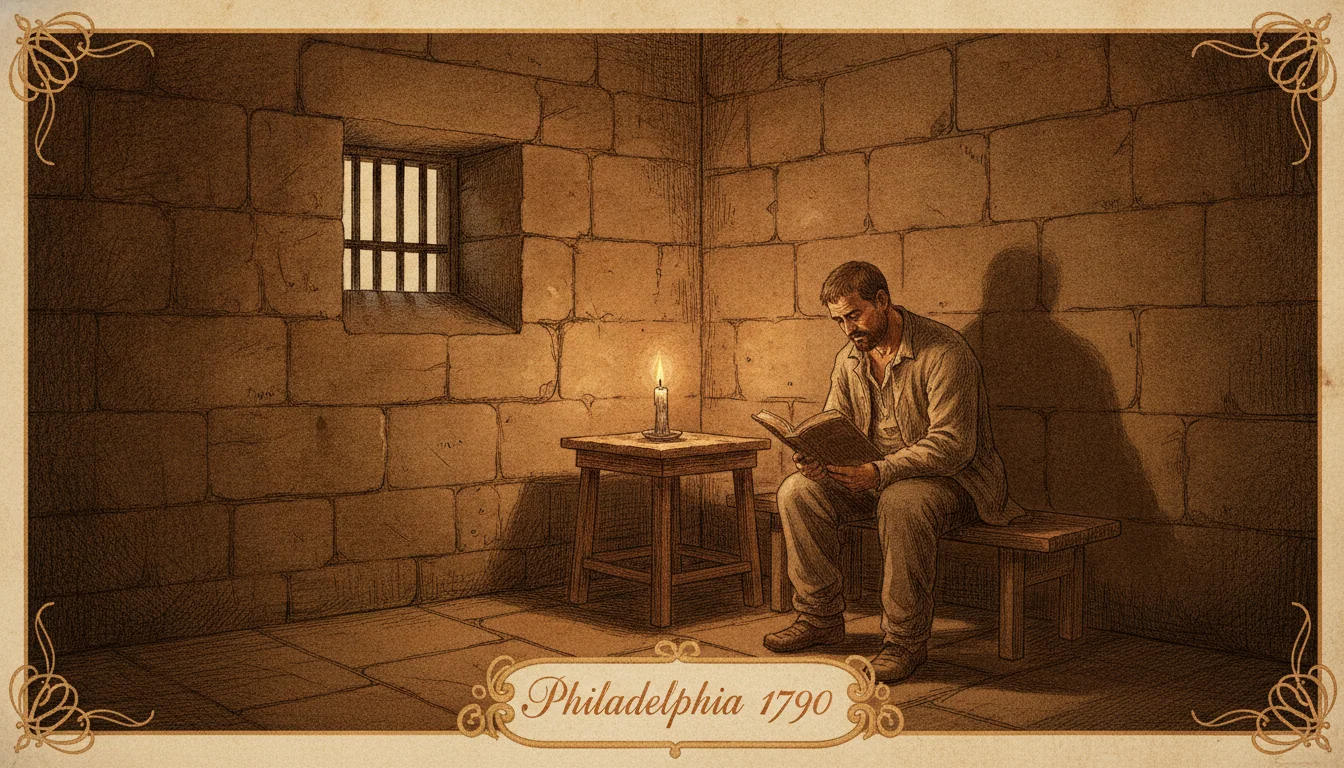
Walk into any medium-security prison built in the last century and you are inside an institution that is, by historical standards, very young. The idea that society should respond to serious crime by confining an offender in a supervised facility for a fixed number of years - not as a holding measure before the real punishment, but as the punishment itself - is approximately 230 years old. Before the late 18th century, across virtually every legal tradition on earth, it did not exist.
What existed instead were warehouses for people who were waiting for something else to happen to them.
The ancient holding pen
The ancient Greeks had a word for a place where people were confined: desmoterion, a bond-place. Socrates spent his final days in one. The Athenian state prison was a real institution, used for people awaiting execution after trial. But no Athenian court sentenced a person to spend ten years in the desmoterion as a punishment. Confinement was a logistical measure, not a legal one. You were held until the real consequence could be administered.
Rome operated similarly. The Mamertine prison in Rome, a cramped underground structure near the Forum, held prisoners of war and condemned men awaiting execution. Vercingetorix, the Gallic chieftain who surrendered to Julius Caesar at Alesia in 52 BC, was kept there for six years before Caesar's triumph gave the occasion for his execution - but those six years were not his sentence. His sentence was death. The holding was ceremonial and logistical.
Across the ancient world, the default responses to crime were death, mutilation, flogging, fines, and exile. Confinement without one of these outcomes attached was not a thing courts typically imposed. The cost of keeping a person alive and fed for years was obvious; the justification for doing so as a penalty was not. The origins of prison as a penalty in its own right lie not here, but in a specific intellectual shift more than a thousand years later.
Medieval confinement and its purposes
The medieval period produced some of the most famous prisons in Western history - the Tower of London, the Bastille, the Castel Sant'Angelo in Rome - but these institutions operated on pre-modern logic. They existed primarily for political prisoners, ransomable hostages, and debtors.
The debtor's prison deserves particular attention because it reveals how different the underlying philosophy was. A debtor confined in a medieval or early modern prison was not being punished in the modern sense. He was being held as leverage - a human guarantee that debts would be paid, either by him, by his family, or by his creditors negotiating with each other over his body as the stake. The moment the debt was settled or discharged, he left. There was no sentence to serve beyond the fact of the debt itself.
Political confinement worked the same way. Enemies in towers were not there because their crime warranted years of suffering. They were there because confinement was useful: it neutralized a threat, created leverage, and bought time. Release was always possible. So was execution.
The gap between these institutions and the modern prison is not mainly architectural. It is philosophical. Ancient and medieval confinement was instrumental - it served a purpose beyond itself. The modern prison claims to be the purpose.
The Enlightenment changes the question
The shift begins in the 18th century with a change in how educated Europeans thought about crime. For most of history, crime was understood primarily as sin, as a violation of the divine and social order that required a proportionate visible response. Public execution and corporal punishment were not just deterrents; they were rituals of restoration, demonstrations that the order had been violated and had been avenged.
The Enlightenment thinkers who challenged this did so on grounds of utility and proportion. Cesare Beccaria, a Milanese philosopher, published his treatise on crimes and punishments in 1764 and argued that punishment's cruelty bore no relationship to its deterrent effect, that certainty of punishment mattered more than severity, and that criminal law existed to protect society rather than to avenge it.
Beccaria's argument implied something that had not been widely considered: if you were removing a person from society for a period - protecting society against them temporarily rather than permanently - you could do that with confinement. The confinement was the punishment. You did not also need to flog them, brand them, or execute them. Confinement over time was, in itself, a serious deprivation.
John Howard, a Bedfordshire sheriff who spent the 1770s touring prisons across Europe, translated this abstract argument into an empirical one. His 1777 account of prison conditions in England and Wales documented in exhaustive detail the disease, filth, corruption, and casual brutality of facilities that were run as semi-private enterprises by jailers who charged inmates for their accommodation. Howard was not just describing the problem. He was implicitly describing what a better system would look like: a state-managed facility with sanitation, supervised labor, and some attention to the moral condition of the confined.
Philadelphia, 1790: the first penitentiary
The Walnut Street Jail in Philadelphia, built in 1773 as a standard holding facility, was converted into something new in 1790 under the influence of Quaker reformers who had been thinking about incarceration as moral reform for a generation. A new cell block was added behind the main building. Serious offenders were placed in individual cells, given work to perform, denied contact with other prisoners, and expected to contemplate their crimes in silence.
The word chosen for the new institution was significant: penitentiary, from the Latin for penitence. The theory was explicit and earnest. Solitary confinement, Bible reading, and supervised labor would produce genuine remorse. The prisoner would emerge reformed, not merely punished. The penitentiary was not a warehouse; it was a factory for the reconstruction of the human soul.
The theory was sincere and the practice was sometimes brutal. Long-term solitary confinement drove many prisoners mad. The Quaker reformers were aware of the problem and argued, usually unsuccessfully, that the mental deterioration was evidence that the system was not being applied correctly rather than that the system was wrong. What they had created was both an institution and a problem that the next century of prison reform would spend itself trying to solve.
The Auburn and Pennsylvania debate
By the 1820s, the American prison system had divided into two competing models, both claiming to be the true application of penitentiary principles.
The Pennsylvania model, exemplified by Eastern State Penitentiary in Philadelphia, which opened in 1829, prescribed complete solitary confinement for every prisoner. Inmates worked in their cells. They exercised in individual walled yards. When moved through the facility, they wore hoods so they could not see other prisoners or be seen. Human contact was limited to chaplains and officials. The principle was total isolation as total moral reconstruction.
The Auburn model, developed at Auburn State Prison in New York in the 1820s, took a different approach. Prisoners slept in separate cells at night but worked together in silence during the day. They ate together without speaking. Talking was punishable by flogging. The system was based on silence rather than isolation - shared presence with forbidden communication. It also had an economic advantage the Pennsylvania model lacked: congregate labor could produce manufactured goods. Auburn prisons paid for themselves. Pennsylvania prisons were expensive.
The Auburn system won. It became the dominant model in the United States and heavily influenced European prison development throughout the 19th century. The Pennsylvania system produced documented psychological damage on a scale that even its supporters found difficult to defend, and its economic unproductivity was fatal in a period when governments were looking for ways to make punishment self-financing.
The Panopticon that was never built
Jeremy Bentham proposed his Panopticon in 1791: a circular prison with cells arranged around the perimeter, each cell permanently visible to an inspector in a central tower. The key innovation was uncertainty. The inspector might be watching any cell at any moment; the prisoner could never know when observation was occurring. Constant visibility - or the possibility of it - would produce self-regulation. The prisoner would eventually behave as though always watched, even when not watched.
Bentham spent nearly twenty years and a considerable personal fortune lobbying the British government to build his design, with himself as the contract manager. He never got the contract. The site he was promised in Millbank was eventually used for a conventional prison. A government commission studying the question in 1811 concluded that the design was unworkable.
The Panopticon as built never existed. The concept traveled further. The architectural principle of radial surveillance - central observation point, radiating cell blocks - appeared in various 19th-century prisons. The theoretical argument that visibility produces behavioral control became foundational for later thinking about institutions and power, most famously for the French philosopher Michel Foucault, who used Bentham's unbuilt prison as the central metaphor of his 1975 analysis of modern disciplinary society.
What was actually invented
The prison, in the form that 2026 recognizes, is a product of the Enlightenment's attempt to make punishment rational, proportionate, and reformatory. It replaced a set of practices - public execution, corporal punishment, transportation, debtor's confinement - that operated on older assumptions about crime, sin, and social order.
The replacement has not worked better in the ways its inventors hoped. Recidivism rates in modern prison systems do not suggest widespread moral reconstruction, and the financial and human costs remain enormous.
What the prison did accomplish was to make punishment legible and administrable. A sentence could be measured in years, varied to match the seriousness of the offense, and shortened as an incentive for good behavior. The minor offender could be distinguished from the serious one without resorting to physical mutilation.
The Quaker reformers of Philadelphia who thought they were building a machine for the reformation of souls were actually building something more durable and more ambiguous: a machine for the management of people that states have found, across two-plus centuries, too convenient to abandon, even as the reformatory theory that justified its invention remains as unverified as it was in 1790.
For more on the origins of institutions that feel ancient but aren't, see our account of how hotels were invented and the surprising youth of the national flag.
Quick Answers
Common questions about this topic
When was prison invented as a form of punishment?
Prison as a punishment - as a sentence served in confinement for a defined period - was invented in the late 18th century. The Walnut Street Jail in Philadelphia, converted into the first true penitentiary in 1790, is the generally accepted starting point. Before that, confinement was a holding measure, not the punishment itself.
What did ancient societies use instead of prison?
Ancient societies used execution, corporal punishment, fines, banishment, and enslavement. Holding facilities existed but were for people awaiting trial, awaiting execution, or being held for ransom. Keeping someone alive and fed for years as the punishment itself would have struck most ancient legal thinkers as wasteful and philosophically incoherent.
What was the Auburn System?
The Auburn System, developed at Auburn State Prison in New York in the 1820s, required prisoners to work together in silence during the day and sleep in separate cells at night. Silence was enforced by flogging. It became the model for most American prisons in the 19th century because it was economically productive - the prison could sell its manufactured goods.
Was Bentham's Panopticon ever built?
Not as Bentham designed it. Jeremy Bentham spent nearly two decades and a significant portion of his personal fortune trying to get his circular surveillance prison built in Britain without success. Prison reformers adopted the surveillance principle in various forms, and several 19th-century prisons incorporated circular or radial designs, but the pure Panopticon - with Bentham as contract manager - never got off the ground.

Ask the Inventors Themselves
Chat with the people who were there when familiar things began.
Create your free account →No card required. Some figures and features require a paid plan.
Join the HistorIQly Club
Get smarter about the past.
Weekly stories, deep dives, and exclusive content straight to your inbox.