Origins: When the Restaurant Was Invented
When was the restaurant invented? The answer begins in 1760s Paris, where a disputed bowl of broth launched a legal battle that created the modern dining format.
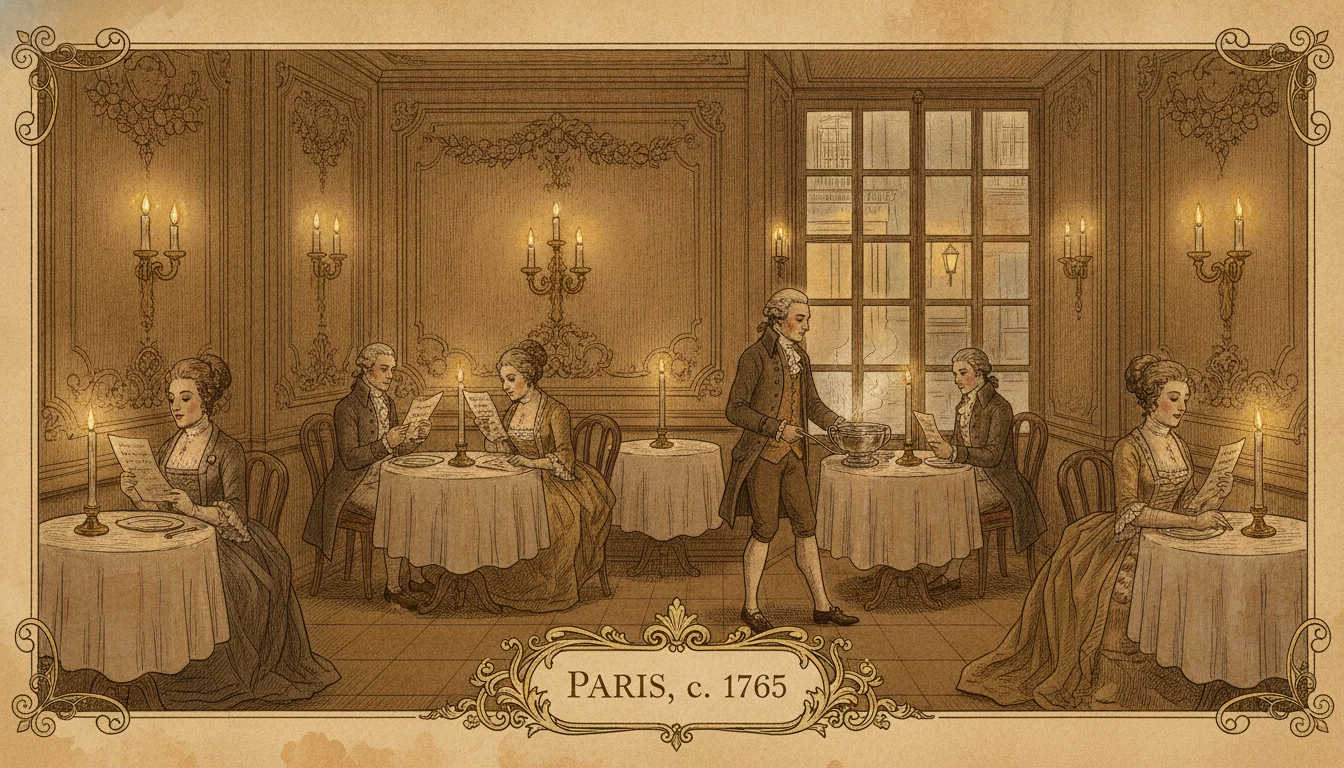
Before 1765, if you were hungry in Paris and not eating at someone's home or at an inn's communal table, your options were limited and mostly controlled by guilds. The rôtisseurs could roast meat. The traiteurs sold prepared dishes you carried away. The charcutiers handled pork products. Each guild held a legal monopoly over its slice of the food trade, and each zealously policed the others' encroachments.
The idea of walking into a place, sitting at your own individual table, reading a list of available dishes with individual prices, choosing one, and being served at a time of your own choosing - this did not exist as a commercial format. It had to be invented.
It was invented in Paris. It required the French Revolution to scale it. And the word we use globally today describes not the place but the broth that started the whole legal argument.
The Boulanger question
The canonical founding myth of the restaurant centers on a man remembered primarily by his occupation: Boulanger, which means baker, though he does not appear to have been one. Around 1765, according to accounts written several decades after the fact, he opened a shop on the Rue des Poulies in Paris offering a single item: sheep's feet simmered in white sauce, which he marketed as a "restaurant" - a restorative preparation for weak stomachs and troubled digestions.
The traiteur guild, which held the monopoly on prepared meat dishes, took him to court. He had violated their territory by selling a prepared food item that the guild claimed fell within its jurisdiction. According to the story, Boulanger won the case on the legal technicality that his dish was a soup rather than a ragout - the specific category the guild's monopoly covered. He emerged from the lawsuit famous, opened a proper establishment, and is now cited in nearly every history of the restaurant as its originator.
The problem with this story is that the documentary evidence is thin. The court case may well have happened. The legal distinction may have been the operative argument. But the precise details appear in sources composed well after the events they describe, and later culinary historians including Rebecca Spang, whose 2000 work The Invention of the Restaurant is the most rigorous examination of the question, have found no contemporary records confirming the Boulanger narrative as it is usually told. The beautiful logic of the story - a guild monopoly defeated by a technicality, opening a new commercial category - is exactly the kind of narrative that gets burnished in retelling until the seams disappear.
What is documented more clearly is Mathurin Roze de Chantoiseau, who opened an establishment in Paris in the 1760s selling restorative bouillons and who, unlike the shadowy Boulanger, appears in contemporary business directories. He is a stronger candidate for the actual innovator, though both men may have been operating similar concepts at the same time, with neither aware they were founding an industry.
What was actually new
The key to understanding what the restaurant invented is distinguishing between new food and a new commercial format.
Paris had taverns, inns, cabarets, and cookshops throughout the medieval and early modern period. Anyone could buy a prepared meal. What you could not do before the mid-18th century was: walk in without prior arrangement, sit at your own private table, receive a written list of available dishes with prices, order one specific thing, and leave when you finished.
The table d'hote - the communal table at a fixed time with a fixed menu at a fixed price per person - was how eating establishments had always operated. You arrived when the food was served. You sat with whoever else was there. You ate what had been prepared. You could not change any of these variables.
The restaurant broke every one of those constraints simultaneously. It introduced the individual table, the printed or written menu, the dish ordered on demand from a list, and service at the customer's chosen hour. These were not culinary innovations. They were commercial and social ones.
What the restaurant invented was the customer as the sovereign over their own meal. The timing was yours. The dish was yours to select. The table was yours for the duration. The price was stated in advance per item rather than per person per sitting. This reorganized the transaction between cook and diner in a way that had no precedent in the guild-controlled food economy.
This is why the guild dispute mattered. The traiteur monopoly on prepared food assumed a fixed relationship: the establishment produced, the customer consumed what was available. An establishment that offered individual dishes on demand, priced per item, to a customer who chose among them was operating on a different commercial logic entirely. And that logic was threatening because it worked.
The Revolution and the restaurant's explosion
Restaurants grew slowly in the 1770s and 1780s. A handful of establishments, concentrated in the Palais-Royal district after the Orleans family converted it to arcaded commercial galleries open to the public, began offering the new format. The Palais-Royal was a significant setting: it was open around the clock, not subject to ordinary police jurisdiction, and attracted a cosmopolitan mix of merchants, tourists, intellectuals, and the merely curious.
Beauvilliers, who opened near the Palais-Royal in the early 1780s, is sometimes cited as the first restaurateur to deliver what we would now recognize as the full experience: printed menu, individual tables, silver service, wine list, high-quality food, and hours not tied to a communal sitting. His establishment was expensive and fashionable and served as a model for what the format could become at its best.
Then the Revolution happened, and the scale changed entirely.
When the revolutionary government dismantled the institutions of the ancien regime from 1789 onward, the aristocratic household as an economic institution collapsed. The great noble families who had employed elaborate kitchen staff were dispossessed, imprisoned, executed, or fled France. Their chefs - trained at the highest level of European culinary culture, skilled in the elaborate preparations of the 18th-century court kitchen - suddenly had no employers.
They opened restaurants.
Within two decades of 1789, Paris went from a handful of experimental establishments to what contemporary observers described as thousands. By the 1820s the Palais-Royal district alone had dozens of major restaurants, each with printed menus, individual tables, wine lists, and specialized cuisines. The democratization the restaurant represented - fine dining now available not only to aristocratic households but to anyone who could pay the bill on the day - was a direct consequence of the Revolution's destruction of those private kitchens. The revolutionary political economy accidentally created the modern restaurant industry by eliminating its principal competition.
The word and the world it made
The word traveled from the dish to the format to a global institution. By the mid-19th century, every European capital had adopted both the format and the vocabulary. London's Rules, which claims an 1798 founding, represents the British adoption of the model. American cities acquired restaurants in the early decades of the 19th century, and the great hotel-restaurant combinations of the Gilded Age - Delmonico's in New York, operating from 1837 - carried the Parisian format to its most ambitious commercial expression and gave the United States its first professionally trained corps of restaurant chefs.
What began as a disputed restorative bouillon sold by a disputed Parisian figure in a disputed year became the dominant format for how human beings eat when they eat outside their homes. The legal argument over whether sheep's feet in white sauce constituted a ragout or a soup - whatever exactly that argument was - turned out to be one of the more consequential commercial disputes in culinary history.
The answer that came back, in whatever form it came, gave us the menu. The same period that gave Paris its restaurants also transformed how Europeans drank: the story of the coffeehouse's origins and the parallel history of how bread moved from subsistence to culture are part of the same broad shift in how people consumed food and sociality outside the home.
Quick Answers
Common questions about this topic
When was the first restaurant opened?
The first establishment widely credited as a restaurant in the modern sense opened in Paris around 1765, associated with a figure known as Boulanger and, more credibly documented, with Mathurin Roze de Chantoiseau. The key innovation was not the food but the format: individual tables, a menu with choices, and service at any hour the customer chose - a complete departure from the guild-controlled eating houses that preceded it.
What does the word 'restaurant' mean?
The word comes from the French verb 'restaurer,' meaning to restore or refresh. Early Parisian establishments sold 'restorants' - restorative broths and bouillons marketed to the sick, the weak-stomached, and the digestion-conscious. The word shifted gradually from describing the restorative dish to describing the establishment that served it.
What was eating out like before restaurants existed?
Before the restaurant format existed, eating out meant a tavern, cabaret, or inn with a fixed communal table (the table d'hote) at fixed hours, serving a fixed menu. French guild monopolies divided the food trade into rigid categories: rôtisseurs sold roast meat, traiteurs sold prepared dishes for takeaway, charcutiers handled pork products. You could not walk in, sit alone, consult a written list of dishes, and order one specific thing. That combination was a genuine commercial invention.
How did the French Revolution change restaurant culture?
When the Revolution dismantled aristocratic households from 1789 onward, it released hundreds of highly trained chefs into Paris's open market. These were cooks who had worked at the highest level of European culinary culture and suddenly had no employers. They opened restaurants. By the 1820s, Paris had thousands of them. The Revolution democratized fine dining by destroying the private kitchens that had previously monopolized it.

Ask the Inventors Themselves
Chat with the people who were there when familiar things began.
Trace It to the SourceJoin the HistorIQly Club
Get smarter about the past.
Weekly stories, deep dives, and exclusive content straight to your inbox.