Origins: Was the Sandwich Actually Invented by the Earl of Sandwich?
The origins of the sandwich predate the Earl by millennia. John Montagu gave it a name, not an invention - filled bread is as old as bread itself.
Read Wikipedia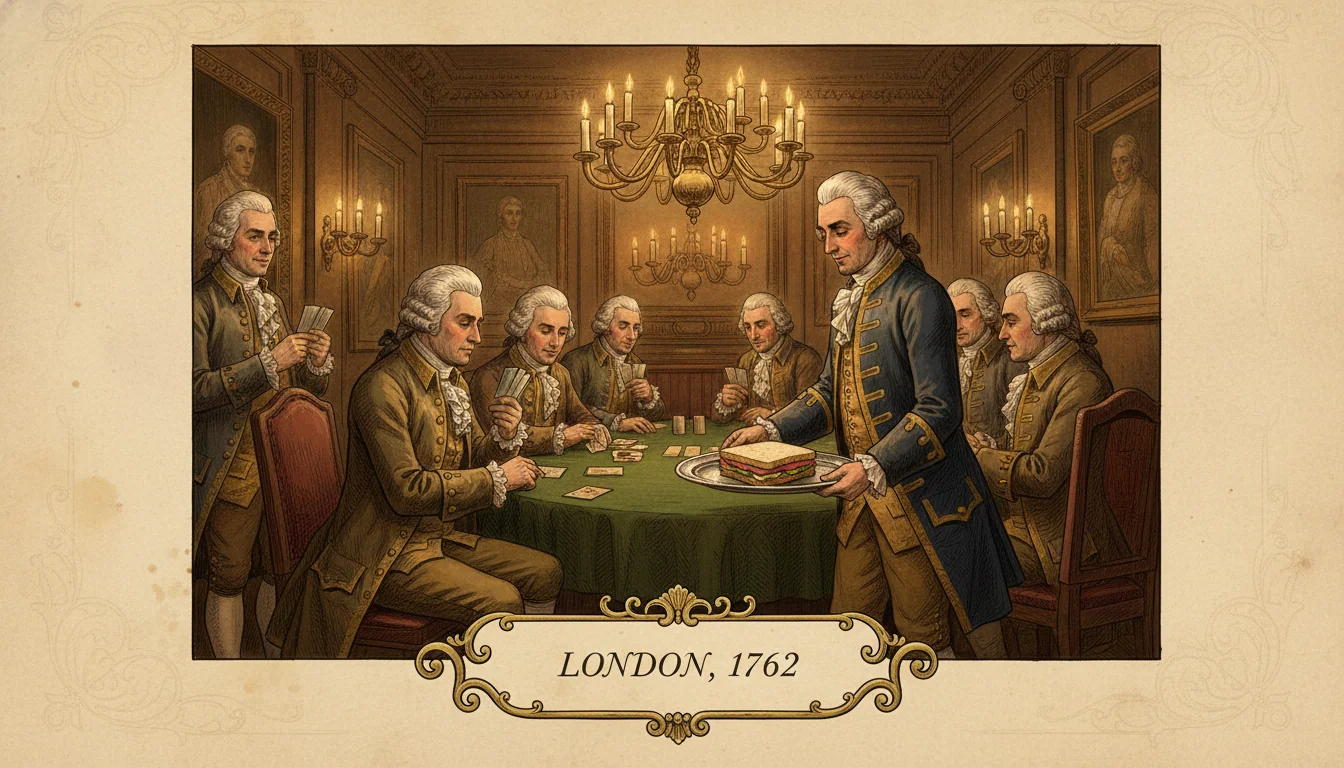
The most famous origin story in culinary history goes like this: in 1762, John Montagu, the 4th Earl of Sandwich and an enthusiastic gambler, refused to leave his card table long enough to eat a proper meal. He asked a servant for a slice of cold roast beef placed between two pieces of bread so he could eat without dirtying his hands or abandoning the game. His fellow gamblers admired the convenience and began ordering "the same as Sandwich." The word entered the language.
It is a satisfying story. It is also, on examination, largely fiction - or at minimum a significant compression of a more complicated history, attached to a man who had a complicated public reputation and a story that fit his image rather well. The bread with filling is not an 18th-century English invention. The origins of the sandwich as a concept predate the Earl by millennia. What John Montagu actually contributed was something smaller and more durable: a name that stuck.
Before the Earl: a very long history of bread and filling
Humans have been putting things between bread since there was bread. The agricultural civilizations of the ancient Near East and Mediterranean ate bread not as a separate course but as the vehicle for everything else - a flatbread or leavened loaf was simultaneously a plate, a spoon, and a wrapper. The distinction between "bread with filling" and "food eaten alongside bread" barely exists in the historical record before modern notions of separate courses and individual serving vessels developed.
The most specific early example is the Hillel sandwich, documented in the Talmud and attributed to the sage Hillel, who lived in the 1st century BC. During the Passover seder, Hillel combined bitter herbs and roasted meat in a wrap of matzo - unleavened flatbread - following a Scriptural instruction he interpreted as requiring those elements to be consumed together rather than separately. This is a documented, named practice of combining a filling with bread. It was a religious ritual rather than a general portable-food concept, but it is the earliest named instance in the surviving written record, recorded roughly 1,800 years before the Earl's gaming club.
Across the ancient Mediterranean the evidence for filled breads is abundant and scattered. Greek and Roman sources describe bread used as an edible vehicle for olives, cheese, and preserved fish. Arab traditions of flatbread with mezze elements are ancient. Scandinavian open-faced smorgasbord preparations of preserved fish and meat on rye predate any English earl by many centuries. The concept of putting food on, in, or between bread does not need invention. It is so basic to human eating that prohibiting it would have required invention. The origins of bread stretch back at least fourteen thousand years, long before any gaming club.
In medieval England, the trencher - a thick slab of day-old bread used as a plate for whatever was served on top of it, soaked with the juices of the meal - was standard practice in households that could not afford ceramic plates. Whether you then ate the trencher itself depended on your social class and the quality of the bread. Poor households ate theirs. Wealthy ones passed the soaked trenchers down the social hierarchy to servants and almshouses. This is not precisely a sandwich. But the conceptual distance is small. The same pattern of everyday foods acquiring aristocratic names appears in the origins of chocolate, which also moved from elite novelty to universal staple.
The actual Earl of Sandwich
John Montagu, 4th Earl of Sandwich, was born in 1718 and died in 1792. He served as First Lord of the Admiralty three separate times, most significantly during the American Revolutionary War - a period in which British naval administration was under enormous pressure, frequently criticized in Parliament, and politically fraught by any measure. His management of the Navy during the American conflict became deeply controversial, with critics in the House of Commons blaming the Navy's failures and losses directly on his stewardship.
He was also, genuinely, a gambler. His membership at the Cocoa Tree club, a noted gaming establishment in St James's Street, is documented. He was a patron of exploration - Captain Cook named the Sandwich Islands, the Hawaiian archipelago, after him in 1778 because Montagu was First Lord of the Admiralty and had backed Cook's voyages. He had a long-running relationship with Martha Ray, a singer who was murdered in 1779 by a rejected suitor in a sensational scandal that dominated London press coverage for weeks.
He was not, in other words, a boring man. He was exactly the kind of aristocrat about whom an origin story involving nocturnal card-playing and carnivorous improvisation would be immediately plausible and enthusiastically repeated.
The first written reference
The earliest known use of "sandwich" as a food term comes from the journal of Edward Gibbon - the historian of the Roman Empire - dated November 24, 1762. Gibbon described an evening at the Cocoa Tree:
"I dined at the Cocoa Tree... That respectable body affords every evening a sight truly English. Twenty or thirty of the first men in the kingdom, in point of fashion and fortune, supping at little tables upon a bit of cold meat, or a Sandwich."
Gibbon did not present this as a novelty or explain the term. He wrote it as a description of an established practice - something he observed and found sufficiently "truly English" to record without definition. His London readers in 1762 evidently needed no explanation. The word was already in circulation among London's upper class.
The gambling table story does not appear until the early 1770s. Pierre Jean Grosley, a French lawyer and traveler who had visited England in 1765, published an account in French that included the card-table origin story. A later English translation circulated the story further, and subsequent French and English writers embellished it with specific details about the card table, the twenty-four-hour gambling session, and the Earl's specific request. The gap between 1762 (when the term was apparently already in use) and the early 1770s (when the gambling origin story first appeared in print) is important: by the time the anecdote was being told as history, it was already mythology.
What the Earl actually contributed
The more coherent picture is less romantic. John Montagu was a man who worked long hours and frequently ate at his desk. His staff and contemporaries noted his diligence - some of his critics complained it was excessive diligence applied to the wrong things, but they agreed he worked hard. He ate convenient food because he worked constantly.
The practice of eating cold meat between bread slices was already common in London clubs and coffeehouses by the early 1760s. What the Earl contributed was status. When a prominent nobleman and cabinet minister ate something in a particular way, that way acquired a name. The name was his title. Calling it a "Sandwich" rather than "bread and cold meat" gave the thing a single convenient word, and that word carried the social prestige of its originator into every club and coffeehouse where it spread.
Names that attach to aristocratic habits become fashionable. Fashionable habits become conventions. Conventions become language. By 1770, the term was crossing into general use. By the 1780s, it appeared in recipe books and household manuals. By the 1790s, it was in America, where its democratic appeal - portable food that requires no table, no cutlery, no particular social setting - would eventually transform it from an aristocratic affectation into a working person's staple and, in the 19th century, an industrial food product.
The gap between myth and record
The historical gap here is not between a false story and a true one in any simple sense. It is between a story that fits - that has the satisfying shape of anecdote, that matches a man's public character, that explains a word in a way that feels like explanation - and a reality that is more diffuse and less dramatic.
Filled bread had no single inventor because it required no invention. It needed only a name attached to a man prominent enough that his habits were worth imitating. John Montagu, 4th Earl of Sandwich, provided that name. He did not invent the concept. He may not have eaten it at a card table. The more likely story is that he was at his desk, running a navy badly during a difficult war, reading dispatches and eating cold beef between bread slices because stopping to eat properly would have meant stopping to eat properly.
The name stayed. The Sandwich Islands eventually became Hawaii, but the sandwich stayed a sandwich across every language that borrowed the word: French sandwich, German Sandwich, Japanese sandoitchi, Mandarin sanmingzhi. A Georgian-era British aristocrat's eating habits became the template for how a significant fraction of humanity talks about the most universal form of portable food. He would almost certainly have found this satisfying, even if the gambling table version of the story would have made him a more charming figure. History, as usual, preferred the mundane explanation over the picturesque one.
Quick Answers
Common questions about this topic
Did the Earl of Sandwich really invent the sandwich?
The Earl of Sandwich did not invent the concept of bread with filling - filled breads existed across the ancient world for millennia. What the 4th Earl of Sandwich, John Montagu, contributed in 18th-century England was the name, and specifically the aristocratic prestige that made the name stick and spread. The gambling table story is almost certainly invented after the fact.
What is the first written reference to the sandwich?
The earliest known written reference is from the journal of the historian Edward Gibbon, dated November 24, 1762. Gibbon described dining at the Cocoa Tree club in London and finding aristocrats 'supping at little tables upon a bit of cold meat, or a Sandwich.' He presented it as an established practice, not a novelty, suggesting the term was already in circulation among London's upper class.
Is the gambling story about the Earl of Sandwich true?
Almost certainly not in its popular form. The gambling table story first appeared in Pierre Jean Grosley's account of his visit to England, published in the early 1770s - at least a decade after the supposed event. The more reliable contemporary picture suggests John Montagu was simply a very busy administrator who ate at his desk. He was First Lord of the Admiralty during one of the most demanding periods in British naval history.
What is the Hillel sandwich?
The Hillel sandwich is a Passover tradition documented in the Talmud, attributed to the sage Hillel who lived in the 1st century BC. During the Passover seder, he wrapped bitter herbs and lamb in matzo, following a Scriptural instruction he interpreted as requiring the elements to be consumed together. It is the earliest documented named practice of combining a filling between layers of bread.

Ask the Inventors Themselves
Chat with the people who were there when familiar things began.
Create your free account →No card required. Talk to anyone in history with 8 free credits a day. Some features require a paid plan.
Join the HistorIQly Club
Get smarter about the past.
Weekly stories, deep dives, and exclusive content straight to your inbox.