Origins: Who Invented School?
Who invented school? The Sumerians, 2,000 years before the Greeks. From Mesopotamian tablet houses to the Jesuit classroom, this is how formal education evolved.
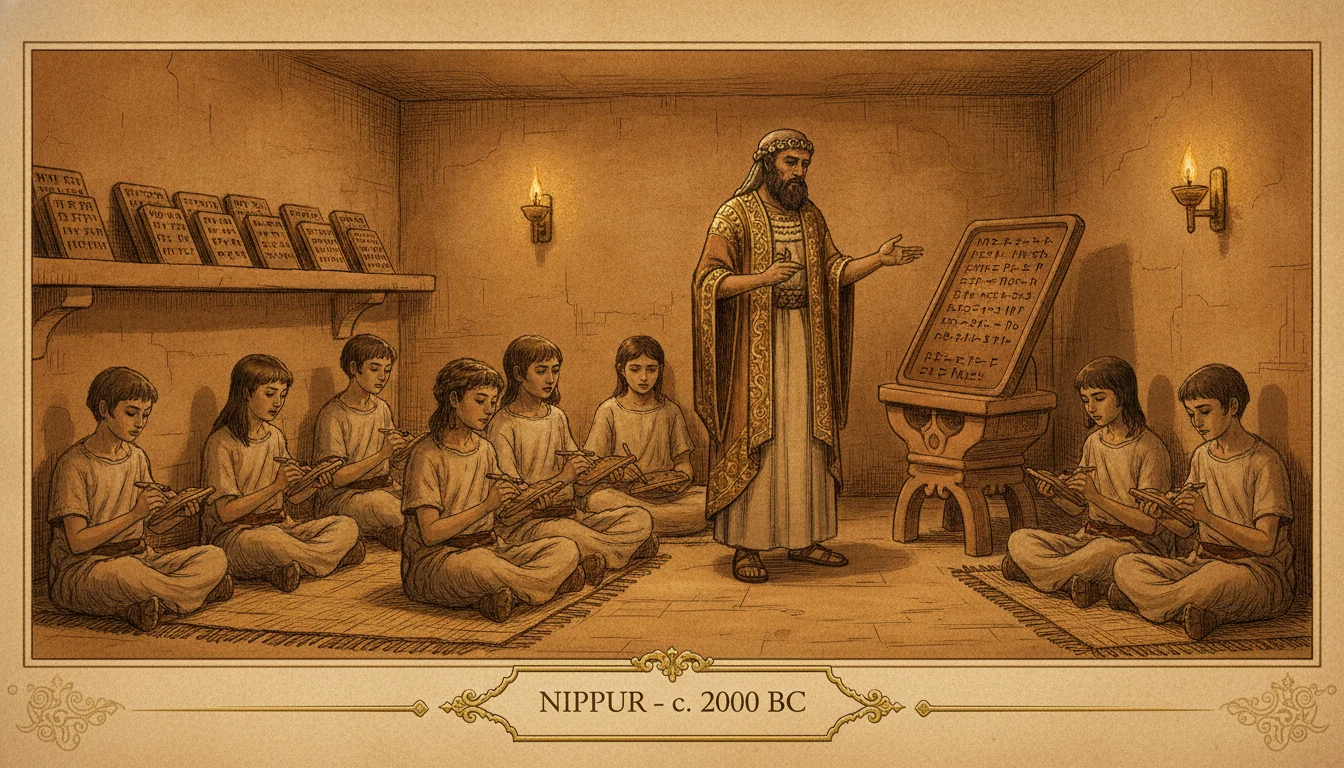
The popular history of education has a convenient founding moment: ancient Greece, Plato's Academy, a group of Athenians debating philosophy in a garden. In this version, school begins with thought, not labor. The curriculum is virtue and mathematics, not bookkeeping.
This story is wrong by about 2,000 years. The true answer to who invented school is considerably less philosophical.
The first schools were training programs for bureaucrats. They existed not to develop citizens or philosophers but to produce literate specialists who could record grain deliveries, draft legal contracts, and maintain the administrative machinery of a complex state. The institution that emerged from this practical need in Mesopotamia sometime around 2500 BC was called the edubba - Sumerian for "tablet house" - and it is the oldest documented form of formal education on the planet. Plato was not born until roughly 427 BC. By that point, the edubba had already been operating for two millennia.
Sumer, 2500 BC: the first classrooms
The city of Nippur in southern Mesopotamia sits in modern Iraq about 100 miles southeast of Baghdad. Excavations there have uncovered buildings that archaeologists identify as edubba institutions, and tens of thousands of clay tablets survive from what were clearly educational contexts: practice texts, teacher-student dialogues, student exercises copying standard reference lists of words, animals, plants, and bureaucratic formulas.
The curriculum of the Sumerian edubba was narrow and practical. Students - boys from elite or administrative families, training for scribal careers - spent years learning to press cuneiform signs into wet clay with enough accuracy and speed to work as professional scribes. The sign list they practiced is known as the lexical tradition, a body of standardized reference material that defined the educated person in Mesopotamian culture for centuries.
We know what the school day looked like because the Sumerians wrote about it. A text known to modern scholars as "Edubba A" or "A Schoolday" is a dialogue between a student and his father that reads, across four thousand years, as immediately familiar. The student wakes late, rushes to school without eating, is beaten by the teacher for tardiness, beaten again for talking out of turn, beaten a third time for slovenly handwriting. He comes home and complains. His father invites the teacher to dinner and gives him gifts. The teacher speaks well of the boy the following day.
The teacher was called the ummia - the expert or master. His assistants supervised specific elements: the sign list, the exercise tablets, the physical discipline. The institution had a social structure, a schedule, and a defined curriculum. It was a school.
Egypt: scribes of the House of Life
Egyptian scribal training was organized through institutions called the Per-Ankh, or House of Life, which were attached to temple complexes and royal administrative centers. These institutions trained the people who maintained Egypt's textual record: scribes who could write hieroglyphic and hieratic scripts, read medical texts, produce legal documents, and compose correspondence for the pharaonic administration.
The curriculum in Egyptian scribal training also included what we would call literature: canonical texts that student scribes copied as exercises and that circulated within the educated class as markers of cultural membership. The Egyptian wisdom literature - texts like the Maxims of Ptahhotep or the Instructions of Amenemhat - were both ethical guides and scribal training tools.
Egypt and Mesopotamia developed their scribal institutions in partial awareness of each other through the diplomatic and trade contacts that linked the ancient Near East, and both systems share the same fundamental logic: formal instruction as a pipeline to professional literacy, serving administrative and economic needs before it serves any philosophical or civic ones.
Greece and Rome: expanding the purpose
By the classical Greek period, the concept of formal education had broadened considerably. The Greek gymnasium was originally an athletic training ground, but by the 5th century BC it had become a center for intellectual as well as physical development. Sophists - itinerant teachers for hire - offered instruction in rhetoric, argument, and civic skill to the sons of wealthy Athenians who could pay their fees.
Plato's Academy, founded around 387 BC near Athens, marked a genuine innovation: an institution dedicated to philosophical research and teaching, organized around ongoing intellectual community rather than immediate professional training. Aristotle's Lyceum followed around 335 BC with a similarly communal, research-oriented structure. These were not schools in the modern sense - no curriculum, no grades, no fixed student cohort - but they established the idea that education could aim at understanding for its own sake rather than professional production.
Roman education formalized the Greek inheritance into a multi-stage structure. Young children received primary instruction from a litterator or ludus magister - an elementary teacher, often Greek, often a slave, who taught reading and basic arithmetic. Older boys attended the grammaticus for literary and language education: Latin and Greek texts, grammar, rhetoric. The most ambitious continued with the rhetor, training in public speaking and argumentation. This three-stage structure - primary, grammar, rhetoric - governed elite Roman education and was transmitted, through the medieval European church, into the early modern world.
Cathedral schools and the first universities
The collapse of Roman administrative infrastructure in Western Europe did not destroy formal education, but it radically contracted it. For several centuries, the most reliable educational institutions in Western Europe were the cathedral schools and monastery schools run by the Church. These were training grounds primarily for clergy, teaching the skills needed to read the liturgy, write correspondence, and administer church property: literacy, basic computation, and the seven liberal arts in their classical formulation (grammar, rhetoric, logic, arithmetic, geometry, music, and astronomy).
From these institutions, in the 11th and 12th centuries, the first European universities emerged. Bologna, recognized as operating by roughly 1088, organized around legal education. Paris, which cohered as an institution during the 12th century, centered on theology and the liberal arts. Oxford began taking recognizable form shortly after. These institutions were not inventions ex nihilo - they emerged from the cathedral school tradition - but they established the corporation of scholars as a new kind of institution: formally recognized, with defined curricula, degrees, and the authority to certify knowledge.
The Jesuits and the modern classroom
The institution that most directly produced the modern school as a global form was the Society of Jesus, founded by Ignatius of Loyola in 1540. The Jesuits understood education as both a spiritual mission and a practical project, and they approached it with unusual systematic rigor. By the mid-16th century they were operating schools across Europe and in missionary territories in Asia and the Americas.
In 1599, they codified their educational method in the Ratio Studiorum - the Plan of Studies. This document established the first comprehensive, standardized educational curriculum in the Western tradition. It defined grade levels with specific content requirements at each stage. It specified teacher qualifications and the methods by which student progress should be assessed. It organized students by age and attainment rather than social status alone. It instituted public examinations and debate as standard pedagogical tools.
The Ratio Studiorum was implemented in more than 200 Jesuit schools across Europe and the Americas within decades of its publication. The organizational model it established - graded levels, standardized content, assessment, progression - is the direct ancestor of the modern school system. The contemporary experience of sitting in a classroom at a defined grade level, studying a defined curriculum assessed by defined examinations, is a Jesuit innovation, arrived at in the late 16th century as a practical solution to the problem of educating large numbers of students efficiently.
Prussia and compulsory education
The final element missing from the modern school system - the idea that the state should require all children to attend - came from 18th-century Prussia. Frederick William I encouraged primary education in the early 18th century, and in 1763 Frederick the Great issued the General School Regulation mandating school attendance for children between roughly five and thirteen years of age. The Prussian system, developed further in the early 19th century, organized education as a state function with teacher training, standardized curriculum, and compulsory attendance enforced by local authorities.
This Prussian model was enormously influential. Educational reformers across Europe and North America in the 19th century traveled to observe Prussian schools and came back with its structure: state funding, compulsory attendance, teacher certification, graded progression, and standardized examinations. The American common school movement, led by figures like Horace Mann, explicitly drew on the Prussian example. The UK Education Act of 1870 established compulsory primary education in England and Wales. By the early 20th century, compulsory mass public education had become the standard expectation of a modern state.
The gap between myth and origin
The popular narrative of school's origin - Greece, philosophy, the life of the mind - is a retrospective construction that flatters the modern educated class. It frames school as having been invented for intellectual flourishing rather than bureaucratic necessity.
The Sumerian edubba does not flatter anyone. It was a professional training institution for a labor market that valued the ability to press signs into clay. It existed because complex states needed a way to produce reliable specialists in literacy and numeracy, and informal apprenticeship was not adequate to that scale. That origin is more honest, and arguably more interesting, than the Academy.
The Jesuits, the Prussians, and the 19th-century reformers gave us the shape of education as we experience it now. The Sumerians gave us the premise: that formal instruction, conducted in a dedicated space by designated teachers, is a legitimate and necessary social institution. They worked that out when the pyramids were still being built, and we have been refining the implementation ever since.
Quick Answers
Common questions about this topic
Who invented school?
Formal schooling was invented by the Sumerians in Mesopotamia around 2500 to 2000 BC. The edubba, or tablet house, was an institution specifically designed to train professional scribes in cuneiform writing. We have actual student exercises and teacher-pupil dialogue texts on clay tablets from Sumerian cities including Nippur and Ur.
What was the first school in history?
The earliest documented schools are the Sumerian edubba institutions of Mesopotamia, dating to roughly 2500 BC. Archaeological excavations at Nippur have uncovered buildings with features consistent with scribal schools, and thousands of student practice tablets survive from this period. The Egyptian 'House of Life' scribal schools appear somewhat later and serve a similar function.
Did the ancient Greeks invent school?
No. The ancient Greeks developed important educational institutions - Plato's Academy (founded around 387 BC) and Aristotle's Lyceum (around 335 BC) are significant milestones - but they arrived roughly 2,000 years after the Sumerian edubba. The Greeks did not invent formal education; they inherited and transformed a tradition already ancient by their time.
Who invented the modern classroom?
The modern age-graded classroom with a standardized curriculum, examinations, and grade progression was largely invented by the Society of Jesus (Jesuits) and codified in their Ratio Studiorum of 1599. This document established the first systematic educational curriculum with defined grade levels, teacher qualifications, and student assessment methods, and was implemented across hundreds of Jesuit schools in Europe and the Americas.

Ask the Inventors Themselves
Chat with the people who were there when familiar things began.
Trace It to the SourceJoin the HistorIQly Club
Get smarter about the past.
Weekly stories, deep dives, and exclusive content straight to your inbox.