Origins: Where Soccer Was Actually Invented
The origins of soccer trace to Han China, where cuju was played centuries before England codified the rules in 1863. The real history is older than most people know.
Read Wikipedia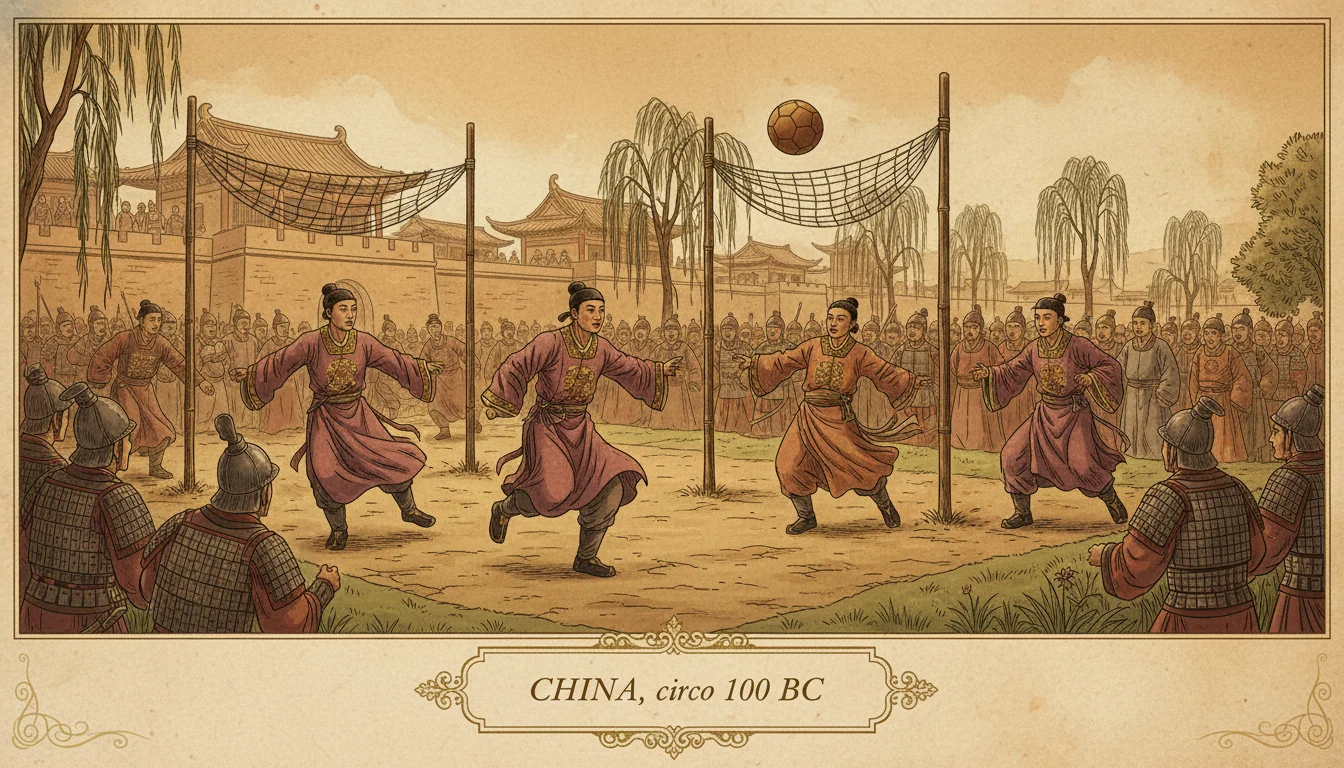
The popular story gives England the credit. In 1863, the Football Association was founded in London, the Laws of the Game were written down, and the world's most popular sport was born. It is a satisfying origin myth for a country that exported both the game and the word for it to most of the world.
The problem is that someone in Han dynasty China was kicking a stuffed leather ball through a net at least two thousand years before the Football Association existed, and the physical and textual evidence for it is considerably better than the anecdote about a Victorian gentleman deciding that carrying the ball was unsporting.
Tracing the origins of soccer requires separating three different things that are easy to conflate: the act of kicking a ball, which is old enough that it has no traceable origin; a structured ball game played with the feet, which appears in multiple ancient cultures; and the specific rules that define modern association football, which are British and belong to 1863. Each of those three things has a different answer to "who invented it."
Cuju: the earliest documented case
The Chinese ball game of cuju - the name roughly translates as "kick the ball" - appears in Chinese written sources from at least the 3rd century BC. The Zhan Guo Ce, a collection of texts recording events and strategies from the Warring States period (475-221 BC), describes cuju as a popular activity in the state of Qi. The historian Sima Qian, writing around 100 BC in his monumental Records of the Grand Historian, mentions cuju in passing as an entertainment familiar to his readers.
The earliest physical evidence is more ambiguous, as it is for any game played with organic materials on packed earth. But by the Han dynasty (206 BC to 220 AD), cuju was sufficiently institutionalized that it appeared in imperial military training manuals. The Han emperor Wu, who reigned from 141 to 87 BC, was reportedly a devotee. The game was used to train soldiers in footwork and coordination, which is the oldest documented instance of football being used for athletic conditioning.
The ball itself was leather, stuffed with hair and feathers in early forms, and later inflated with an animal bladder to create a more consistent bounce. The goal in early versions was a hole in a cloth net or a gap between poles. By the Tang dynasty (618-907 AD) and especially the Song dynasty (960-1279 AD), cuju had become a sophisticated public sport with professional players, female competitions, and teams of up to sixteen per side competing on a marked field with a bamboo-framed net goal.
Song dynasty cuju resembles modern football in several structural respects: two competing sides, a defined playing area, a net goal, and the prohibition of using hands in normal play. The differences are also significant: there was no offside rule, the game was less physically combative than medieval European forms, and the competitive scoring system differed from the modern version. But if you are looking for the moment when humans first organized the basic idea of football as a team sport, the Song dynasty cuju competitions of the 10th through 13th centuries are a more defensible candidate than anything happening in England until much later.
FIFA, the international governing body of football, formally recognized cuju as the earliest known precursor to the modern game in 2004.
Other ancient ball games
Cuju is not the only ancient ball game played with the feet, and the others complicate any single-origin narrative.
The Japanese game of kemari, first mentioned in Japanese court records in 644 AD in the Nihon Shoki, was almost certainly imported from China via Korea. Kemari is cooperative rather than competitive: players stand in a circle and try to keep a leather ball aloft without letting it touch the ground, using feet, knees, and other body parts except hands and arms. It was an aristocratic and religious pastime rather than a sport, and its goal - keeping the ball airborne rather than putting it in a net - makes it a cousin of football rather than a precursor.
The ancient Greek game of episkyros and the Roman game of harpastum are sometimes cited in football histories. Episkyros was a handling game with elements of wrestling, played with a small hard ball, and bore more resemblance to rugby than to association football. Harpastum, which Roman soldiers played to maintain fitness on campaign, similarly involved more handling and grappling than kicking. Neither game produced a rule tradition that connects directly to the modern sport.
The Mesoamerican ballgame, played from at least 1600 BC across what is now Mexico and Central America, used a solid rubber ball and featured stone rings as goals. Players struck the ball with their hips, buttocks, and thighs - not their feet - making it technically distinct from any form of football, though it was indisputably a sophisticated competitive ball sport with enormous cultural significance.
The honest answer is that humans playing competitive ball games involving feet is not a culturally specific invention. It is something humans do. The invention is not kicking a ball but agreeing on which rules make the kicking into a game worth watching.
Medieval European football: the ungoverned version
The ball games that developed in medieval Europe from roughly the 11th century onward were not organized sport. They were organized chaos. What English sources call "folk football" or, for the Shrovetide games still played in a few English towns today, mob football, involved entire villages against entire villages, the ball was any kind of inflated bladder, the goal was getting the ball to a designated point in the opposing team's territory, and the rules - such as they were - mainly prohibited killing.
The first documented ban on football in England came in 1314, when Edward II issued a proclamation prohibiting it in London because of the disorder, property damage, and occasional injury it caused. The Scottish Parliament passed similar legislation in 1424. These bans were ignored with remarkable consistency. Football in medieval and early modern Europe was not a game that polite society approved of. It was a game that people played anyway.
The interesting thing about mob football is not its violence but its persistence. Despite repeated legal prohibition and the contempt of most educated commentators, versions of it survived in English market towns from the 13th century to the 19th, when the British public school system finally formalized the game.
The British codification
In the 19th century, English public schools transformed mob football into something teachable and spectatable. The process was long, contested, and produced multiple competing codes. Eton College had its own rules. Rugby School had its own rules, in which the boys' tradition of picking up and running with the ball was considered legitimate. Harrow, Shrewsbury, and Winchester all played different games.
The first serious attempt at a unified code came with the Cambridge Rules of 1848, drawn up by representatives of several schools meeting at Cambridge University. These rules permitted some handling but prohibited hacking, tripping, and the running game that Rugby School preferred. Sheffield FC, founded in 1857 and generally recognized as the world's oldest surviving football club, developed its own Sheffield Rules, which differed again on several points.
The decisive moment came on October 26, 1863, when representatives of eleven London clubs met at the Freemasons' Tavern on Great Queen Street and founded the Football Association. The resulting Laws of the Game, finalized over several meetings that autumn, established two defining prohibitions: players could not run with the ball in their hands, and they could not trip or hack opposing players.
The clubs that objected to these prohibitions, particularly the prohibition on the running game, separated and eventually formed the Rugby Football Union. The clubs that accepted them had created association football. The word "soccer" - British slang for "assoc." with the characteristic Victorian "-er" suffix - became the informal name for the new game within years of its founding.
What got remembered, what got forgotten
The gap between the popular history and the documentary record follows a pattern common to founding myths: the thing that was formalized and exported became the thing that was "invented," and the things that preceded it became curiosities.
Cuju appears in FIFA's official history because enough Chinese historians pushed for its inclusion. Kemari is a footnote in most English-language accounts. The Mesoamerican ballgame is discussed extensively by archaeologists but rarely mentioned in histories of football. The Cambridge Rules of 1848 get less credit than the Football Association of 1863, even though the Cambridge meeting was arguably more consequential for establishing the no-handling rule.
The actual sequence is this: humans have been kicking spherical objects for competitive purposes since before any surviving written record. Chinese and possibly other ancient cultures developed structured versions of this into organized ball sports well before the Christian era. Medieval Europeans played a violent and ungoverned version for centuries. British schoolboys in the 19th century formalized the specific rules that define modern association football. The Football Association of 1863 created the institutional framework that allowed the codified game to spread globally.
What England gave soccer was not the idea. It was the contract: a set of agreed rules that made the game the same everywhere, so that a team from one city could play a team from another without a thirty-minute argument about which version they were playing.
That is a smaller and more precise contribution than inventing a sport. It is also, given what happened next with global football, not a small thing. The same pattern of one culture formalizing what many cultures practiced runs through the history of the Olympic Games and the history of democracy - both credited to ancient Greece, both with predecessors that the founding-myth version conveniently omits.
Quick Answers
Common questions about this topic
Where was soccer originally invented?
Versions of the game existed independently in multiple cultures, but the earliest documented ball game played with the feet and an actual goal is cuju, from ancient China. Textual evidence places cuju in China from at least the 3rd or 2nd century BC, and FIFA has officially recognized it as the earliest known precursor to modern football.
What is cuju?
Cuju (also written 'tsu' chu') was a Chinese ball game played with a round leather ball stuffed with hair. Early versions involved kicking the ball against a target or over a net strung between poles. By the Song dynasty (960-1279 AD), it had developed into a competitive sport with two teams, a designated playing area, and a goal consisting of a net on a bamboo frame. The name means roughly 'kick the ball.'
Did the British invent soccer?
The British did not invent kicking a ball, but they did codify the specific rules that define modern association football. The Football Association, founded in London on October 26, 1863, established the Laws of the Game that separated association football from rugby. The choice to prohibit carrying the ball and handling it (except for the goalkeeper) was the founding decision of modern soccer.
Why is it called soccer?
The word 'soccer' is British slang derived from 'association football,' specifically from the abbreviation 'assoc.' The suffix '-er' was a common British informal word-formation pattern. The term was in widespread use in Britain in the 1880s and 1890s. It fell out of fashion in Britain while becoming the standard term in the United States, Australia, and other English-speaking countries that also played rugby or American football and needed to distinguish between them.

Ask the Inventors Themselves
Chat with the people who were there when familiar things began.
Create your free account →No card required. Some figures and features require a paid plan.
Join the HistorIQly Club
Get smarter about the past.
Weekly stories, deep dives, and exclusive content straight to your inbox.