Origins: Who Invented Eyeglasses
Who invented eyeglasses? Not Roger Bacon, not China, and the real inventor's name was suppressed to protect a trade secret. Here is what the evidence shows.
Read Wikipedia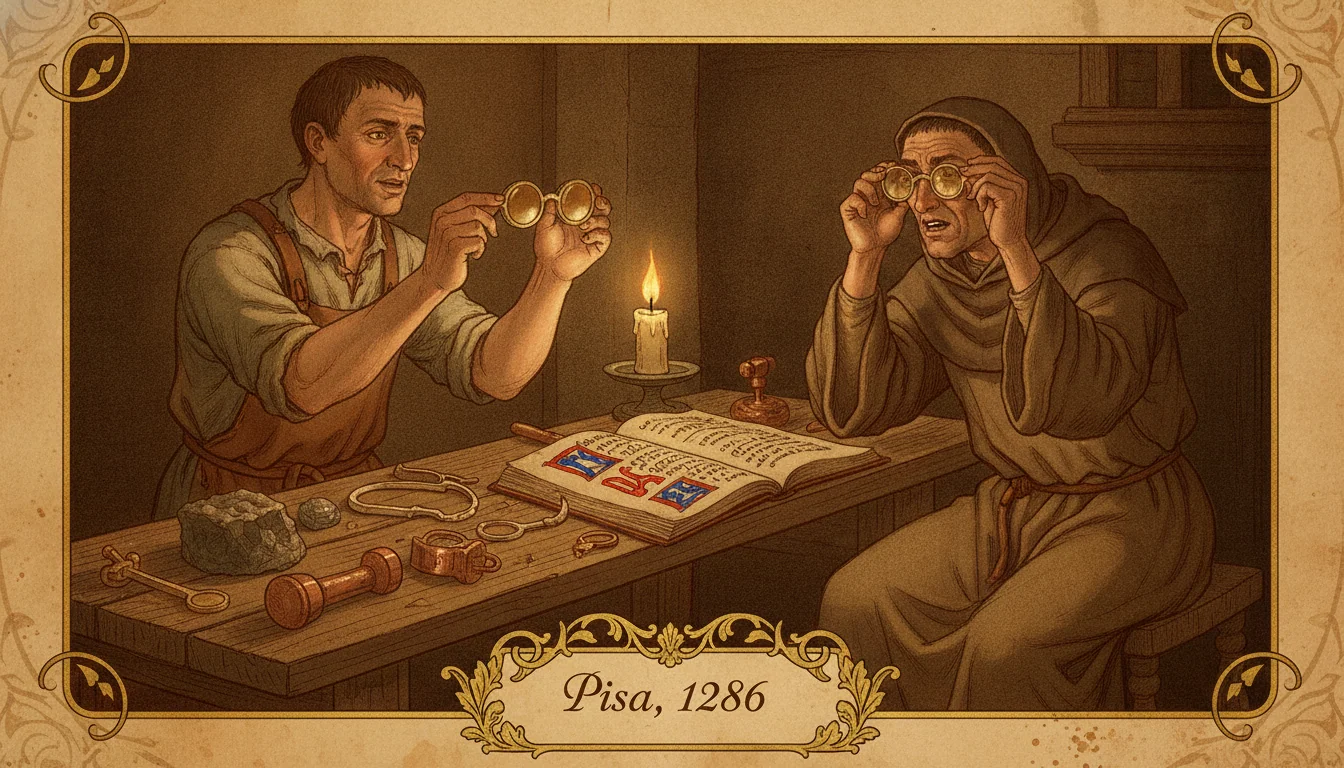
The popular account of how eyeglasses were invented usually involves either Roger Bacon, the 13th-century English friar who wrote extensively about optics, or a vague reference to Chinese invention, or occasionally a monument in Florence to one Salvino d'Armate degli Armati, whose grave inscription once credited him with inventing spectacles in 1317. The Salvino story collapses on inspection - the grave inscription was a 17th-century fabrication, and d'Armate appears to have been invented wholesale by a genealogist with a client to flatter. The Chinese origin is a 19th-century myth with no primary-source support. The Bacon connection is closer to the evidence but still wrong.
The actual origin of eyeglasses is less tidy than any of these stories. It happened in central Italy in the 1280s, the inventor's name was probably suppressed on purpose, and the device spread with remarkable speed through the literate communities of medieval Europe because it solved a problem that no previous technology had addressed: the slow destruction, as people aged past forty, of the ability to read.
The problem before the solution
In the pre-spectacle world, losing close vision was losing one or two productive decades. A copyist, a scholar, a merchant, a legal professional, or a craftsman who worked with fine materials typically found that somewhere in their forties their ability to read text or work at fine scale deteriorated enough to limit or end their professional life. Lenses for magnification existed - polished crystal or glass hemispheres had been used as magnifying aids at least since antiquity, and there are references to Roman scholars using glass spheres filled with water to read fine text. But these were devices you held, used at arm's length, and worked with for specific tasks. They were not wearable. They did not free both hands.
The invention of spectacles solved this by creating a frame that held two lenses in front of the eyes and balanced or rested on the face. This sounds obvious from our vantage point. It was apparently not obvious to anyone working in optics for the roughly twelve centuries between late Roman glass technology and the 1280s. The step from "a lens can magnify" to "a pair of lenses in a frame can be worn on a face" required someone to see the problem as a wearable-device problem rather than a tool problem.
The Fra Giordano sermon
The earliest datable reference to wearable spectacles is a sermon delivered in Florence on February 23, 1306 by a Dominican friar named Fra Giordano da Pisa. The sermon has survived. In it, Fra Giordano says: "It is not yet twenty years since there was found the art of making eyeglasses, which make for good vision, one of the best arts and most necessary that the world has." He adds that he himself had met the man who first made them.
This is an unusually precise piece of testimony. "Not yet twenty years" before 1306 places the invention between roughly 1286 and 1290. Fra Giordano says the inventor was still alive when he knew him or had recently been. He does not name the inventor. He says "it is one of the best and most necessary arts" with a directness suggesting he considered the achievement extraordinary.
A second Florentine document from 1305 - a sermon note by the same friar, discovered by scholars in the 20th century - contains a similar reference, also undated but placed in the same period. The internal consistency of two independent notes from the same witness strengthens the 1286-1290 dating considerably.
The location implied is Pisa or the broader Tuscany region, where glassmaking trade and medical optics had overlapping communities. Venice was already the center of northern Italian glassblowing, but Pisa had its own glass industry, and the early spectacle trade centered in the Pisan orbit before the Venetians absorbed and eventually dominated production.
The deliberate suppression of the inventor's name
A guild document from Venice, dating to 1300, contains an early reference to vitreos ab oculis ad legendum - glasses for reading - and simultaneously records attempts by the guild to restrict the technique from spreading. This is significant not as a reference to the invention itself but as evidence of the commercial logic that suppressed the inventor's name.
In the 13th-century Italian trade economy, a craftsman who developed a genuinely new technique had limited formal intellectual property protection. The practical protection was secrecy. If you kept your process inside your workshop and your immediate circle, you maintained a competitive advantage for as long as the secret held. Revealing the inventor's name publicly was, in this context, counterproductive - it directed attention to the individual, who could then be questioned, recruited, or copied.
The deliberate anonymization of technological invention was not unusual in medieval Italian trade. The Murano glassblowers, who would become the dominant force in spectacle production by the early 14th century, operated under strict guild rules that included exile or worse for anyone who shared proprietary glassblowing techniques with outsiders. The invisibility of the spectacle's inventor is consistent with this commercial culture.
What this means for attribution is that the name may simply be unrecoverable. The man Fra Giordano met has left no signed document, no will, no guild registration that says "I, the maker of spectacles." His contribution was among the most consequential of any craftsman in medieval history, and he apparently preferred, or was persuaded, to remain anonymous.
What Roger Bacon actually did
Roger Bacon's contribution to the spectacle story is real but misattributed. In his Opus Majus, written around 1267, Bacon gives a clear and sophisticated account of how curved glass surfaces refract light and how this principle could be used to make small letters appear larger to the eye. He writes explicitly that "aged men and those with weak eyes" could benefit from such lenses. He understood convex lenses and their potential for correcting presbyopia - the age-related loss of close vision - before anyone had translated that understanding into a device.
What Bacon did not do is make spectacles. There is no evidence he assembled lenses into frames. There is no contemporary source that credits him with a physical device. His work is optics theory, written in the analytical tradition of Islamic scholars including Ibn al-Haytham, whose 11th-century Book of Optics had established the foundational understanding of how light behaves through refracting media.
The gap between Bacon's theoretical description in the 1260s and the first documented spectacles in the 1280s is about twenty years. Whether the Italian craftsman who made the first pair had read Bacon, had read translations of Ibn al-Haytham's work, had worked it out independently from experimentation with glass, or had been pointed toward the solution by a specific practical problem is not known. The theoretical groundwork was in place. Someone made the leap from theory to wearable device.
The spread through Europe
From the Italian centers of production in the late 1280s and 1290s, spectacles spread with remarkable speed. A 1300 Venetian guild document, the 1306 Giordano sermon, and a 1305 inventory from the estate of a Florentine merchant that lists spectacles among his possessions together mark the early diffusion. By the first decade of the 14th century the device had reached France and Germany.
The limiting factor was cost. Early spectacles required glass of unusually high clarity, free of bubbles and the greenish tint that iron impurities gave to most medieval glass. Venetian production scaled through the first half of the 14th century, and costs fell correspondingly. By mid-century, reading glasses were within reach of prosperous merchants and professionals, and by the early 15th century they appeared commonly in portraits of scholars, clerics, and scribes across western Europe.
The earliest spectacles were rivet-joined frames balanced on the nose. Wire frames came later. Temples - the arms that hook over the ears - did not appear until the early 18th century. For roughly four centuries, European spectacle wearers held their glasses or balanced them rather than wearing them.
What the invention changed
Before spectacles, presbyopia - the loss of close vision after roughly age 45 - ended the working life of scholars, scribes, glassmakers, jewelers, and manuscript copyists within a few years of onset. Spectacles extended productive working life by roughly two decades for the literate and fine-craft populations of medieval Europe. A scribe who might have been unable to read by 50 could continue to 70. The effect on accumulated expertise, on the transmission of knowledge, and on specialist craft production was substantial.
Some historians have argued that the spectacle was a prerequisite for the printing press. Gutenberg's invention in the 1440s produced books cheap enough to be owned by professionals across the social spectrum. Many of those readers were past 45 and would have been unable to read small printed text without correction. The mass literate audience that made the printing press economically viable was, in part, a population of middle-aged people with presbyopia who could now see.
The gap between popular memory and the record
The comfortable version of the spectacle's invention involves a named inventor, a satisfying moment of discovery, and an origin that maps cleanly onto one cultural tradition or another. None of these things exist.
What exists is a sermon from 1306 by a friar who had met the inventor, a cluster of northern Italian commercial documents from the late 1290s to 1305, and a theoretical framework in Bacon and before him in Ibn al-Haytham that provided the optical understanding the craftsman needed. The inventor's name is gone, probably deliberately, into the commercial culture of medieval Tuscany.
The myth of Salvino d'Armate was a 17th-century invention. The claim that China had spectacles first is a 19th-century invention. Roger Bacon's claim to the device is a modern misreading of what he actually did. The real inventor - whoever he was, working in Pisa or nearby around 1286 - left behind him the most consequential single piece of glass technology in the history of literacy, and apparently made no fuss about it.
For more origins stories where the credit went to the wrong person, see Origins: Who Invented the Printing Press and Origins: Who Invented the Compass.
Quick Answers
Common questions about this topic
Who invented eyeglasses?
The first recorded reference to wearable spectacles appears in a sermon by Fra Giordano da Pisa in 1306, where he states that the invention had been made 'not yet twenty years' earlier, placing it around 1286 to 1290. The inventor was working in Pisa or the surrounding area. The name was never publicly disclosed, apparently to protect a commercial advantage, and the question of individual credit remains open.
Did Roger Bacon invent glasses?
No. Roger Bacon's writings from the early 1260s describe the optical properties of lenses and their potential use for magnification, but this is optics theory, not a description of wearable spectacles. Bacon understood how lenses worked; he did not assemble them into frames that could be worn on a face. The spectacle as a device is documented first in Italy, roughly twenty years after Bacon's optical writings.
Did China invent eyeglasses before Europe?
No. Chinese eyeglasses appear in records from the early 15th century, introduced from the Islamic world or from European trade via the Silk Road. The earliest Chinese descriptions of spectacles treat them as foreign novelties. The popular claim that China had eyeglasses in ancient times or before Europe has no archaeological or documentary support.
When did eyeglasses become widely available?
Spectacles spread from northern Italy through Europe during the late 13th and early 14th centuries. By around 1300 they were being manufactured in Venice. By the mid-14th century they appeared in German and French records. Mass affordability followed the development of wire-framed glasses and improvements in glass quality, with reading glasses becoming common among literate Europeans by the early 15th century.

Ask the Inventors Themselves
Chat with the people who were there when familiar things began.
Create your free account →No card required. Some figures and features require a paid plan.
Join the HistorIQly Club
Get smarter about the past.
Weekly stories, deep dives, and exclusive content straight to your inbox.