Origins: The History of Mirrors
The history of mirrors runs from obsidian blades in 7500 BCE through polished bronze, Venetian mercury glass, a French industrial heist, and a German chemist's silver nitrate solution.
Read Wikipedia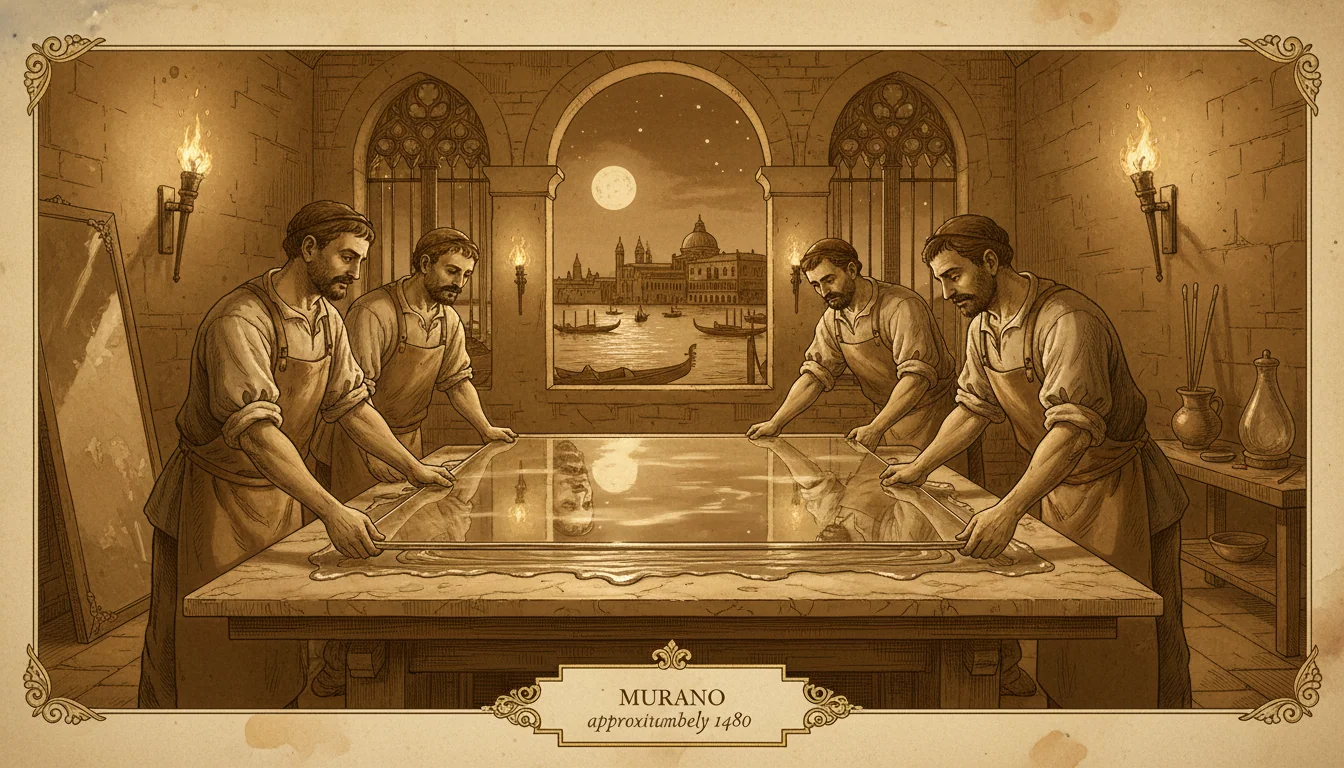
The popular story of the mirror involves a vain person staring into still water and discovering their reflection. It is a serviceable myth, which is why Narcissus has been telling it for two thousand years. The actual history of mirrors is less poetic and considerably stranger: a story of volcanic glass, toxic metal amalgams, state-sponsored industrial espionage, assassination threats, and a German chemist who solved the problem with silver nitrate and accidentally created the modern bathroom.
Humans have been looking at themselves for approximately ten thousand years, and the technology required to do it clearly has been refined, stolen, regulated, and revolutionized in almost every century since.
Obsidian: the first reflective surface
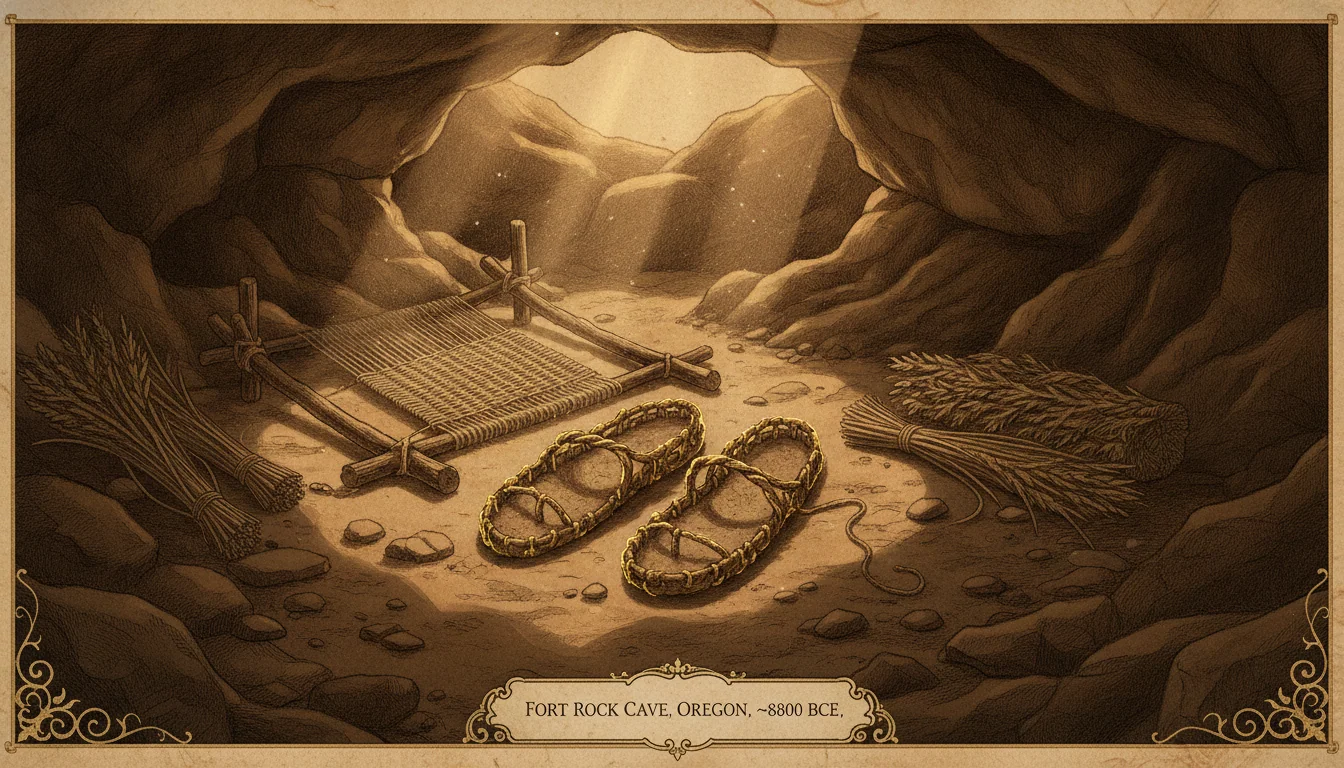
The oldest confirmed mirrors are polished obsidian discs excavated at Catalhoyuk, the Neolithic settlement in central Anatolia that represents one of the earliest large human settlements on record. The site dates to approximately 7500 to 5700 BCE, and among the artifacts recovered are carefully ground and polished volcanic glass surfaces with reflective qualities sufficient to show a face.
Obsidian, the natural volcanic glass formed when silica-rich lava cools rapidly, was among the most valuable trade materials in the ancient Near East. Catalhoyuk itself appears to have been a center of obsidian trade, positioned to exploit nearby volcanic deposits. The obsidian mirrors found there are not crude: they were ground to a smooth, slightly curved surface and polished to a finish that required sustained skilled labor. They were luxury objects, not accidental discoveries.
Bronze and copper: the long middle period
For most of recorded ancient history, mirrors were made of polished metal. Copper mirrors appear in Egyptian and Mesopotamian archaeological records from roughly 4000 to 3000 BCE, typically circular discs with handles and surfaces polished to a high sheen. The reflection in polished copper is warm and reddish, flattering in the way that golden light is flattering, and adequate for grooming purposes even if it would fail modern cosmetic standards.
Bronze mirrors followed copper as bronze metallurgy spread across the ancient world. In ancient China, bronze mirrors (tong jing) became objects of exceptional cultural significance from the Shang dynasty onward - their backs were elaborately cast with cosmological symbols, mythological scenes, and geometric patterns that were as important as the reflective surface on the front. Chinese bronze mirrors were believed to possess protective and magical properties, and they appear in elite burials, religious contexts, and diplomatic gifts across a span of roughly two thousand years.
Ancient Greek and Roman mirrors were also polished bronze, typically hand-held, with images on the reverse. The Roman world had glass technology sufficient to make small containers, lenses, and windows, but glass mirrors were a different problem: to work as a mirror, glass needed a reflective backing, and the Romans' attempts in this direction produced something barely functional.
Pliny the Elder, writing in the 1st century CE, describes Roman glass mirrors as being made by blowing a glass bubble, cracking it open while molten, and pouring molten lead into the interior. The resulting object was small (the glass bubble could only be so large before it became uncontrollable), convex (following the curve of the bubble), and produced a distorted, dark reflection. Pliny notes that the best mirror glass came from Sidon, in what is now Lebanon. Even the best Sidonian glass mirror of the ancient world was a dim, curved, unreliable reflection by any modern standard.
The most familiar image of a pre-modern glass mirror in European art is the convex disc visible in Jan van Eyck's "Arnolfini Portrait" of 1434, reflecting the room behind the two subjects in a circular fish-eye view bordered by tiny painted scenes from the Passion. Van Eyck painted this as a marker of wealth and as a technical tour de force demonstrating his own eye for detail. The mirror itself, in the world of the painting, was an expensive luxury. Its convex form was the technological limit of the day.
Venice and the mercury revolution
The flat glass mirror with a clear, accurate reflective surface was a Venetian invention of the late 15th century, and the Venetians spent the better part of a century treating it as a state secret with the seriousness reserved today for nuclear weapons design.
The Venetian Republic had concentrated its glass industry on the island of Murano in the Venetian lagoon since 1291, both to reduce fire risk to the main city and to make it easier to control who left the island with what knowledge. Murano glassworkers were among the most skilled in the world, and their techniques for producing flat, clear glass panels were closely guarded.
The breakthrough was the development of a tin-mercury amalgam as a backing for flat glass. The process involved grinding a sheet of glass optically flat - a feat of labor in itself - and then laying it carefully onto a thin, perfectly smooth layer of tin foil coated with liquid mercury. The mercury and tin bonded chemically to the glass, creating a bright, silvery reflective surface that showed a face in sharp detail without the distortion of convex glass or the dark warmth of polished bronze.
The resulting mirror was extraordinary. A large Venetian mirror in 17th-century France was reportedly worth more than a painted portrait of equivalent size - and a painted portrait by a major artist was worth a great deal. The cost reflected both the skill of the Murano glassworkers and the deliberate scarcity maintained by Venetian export policy. Venice controlled who received mirrors, in what quantities, and at what price.
The Council of Ten, Venice's security and intelligence body, treated the mirror secret accordingly. Murano glassworkers were given social privileges unavailable to most Venetian subjects - their daughters could marry into the nobility, their sons received preferential treatment - and in exchange, leaving the island without permission was punishable by death. This was not a metaphor. Multiple historical sources record that glassworkers who defected to foreign powers could expect agents of the Council to follow them with instructions to prevent the knowledge from spreading.
The French heist
Jean-Baptiste Colbert, Louis XIV's finance minister and the architect of French economic policy in the 1660s and 1670s, understood that a country that made its own mirrors had a fundamental economic advantage over a country that bought them from Venice. French nobles were spending fortunes importing Venetian glass. That money was leaving France. Colbert intended to stop it.
He sent agents to Murano. The recruitment operation, conducted through intermediaries, offered Venetian glassworkers exceptional wages, housing, and safety to come to France and establish a comparable manufacturing operation. Several agreed. By 1665 the Manufacture Royale des Glaces de Miroirs had been established in Paris under royal charter, with transplanted Venetian expertise at its core.
The Venetian Council of Ten reportedly sent its own agents to recover or eliminate the defectors. At least one account describes poisoning attempts. Whether the assassination attempts succeeded or failed in specific cases, the French manufacturing operation survived and developed. Within a decade, French mirror production had reached sufficient scale to supply the domestic luxury market.
The political demonstration came in 1684, when Louis XIV completed the Hall of Mirrors at the Palace of Versailles. The gallery stretches 73 meters and contains 357 mirrors arranged in 17 arched mirror panels opposite tall windows. It was the largest assembly of mirrors ever installed in a single room at that point in history, and it was built from French mirrors. Every foreign ambassador who visited Versailles understood the message: France could do what Venice could do, and France could do it at a scale Venice could not match.
The Venetian monopoly on mirror-making effectively ended with the Hall of Mirrors. The French had industrialized the process.
Justus von Liebig and the silver solution
The mercury-tin mirror, despite its reflective excellence, had problems. The amalgam process used liquid mercury, which is toxic; working with it was dangerous for the craftspeople who applied it. The resulting backing was also somewhat fragile and could develop dark spots and clouding over time as the amalgam deteriorated.
The modern solution came from Justus von Liebig, a German chemist working in Giessen, who in 1835 developed a chemical reduction process that deposited metallic silver onto glass from a silver nitrate solution. The silver-coating process was cleaner, more stable, and safer than the mercury amalgam, and it produced a brighter and more consistent reflective surface.
Liebig's silvering process became the basis for mass-produced mirrors in the 19th century and remains the foundation of mirror manufacturing today, though industrial production now uses aluminum vapor deposition for most applications, sputtering metallic aluminum onto glass in a vacuum at a scale and speed that Liebig's bench chemistry could not approach.
What got remembered, what got forgotten
The myth of the vain person discovering themselves in water persisted because it offers a satisfying narrative: the mirror as a window into vanity, or into self-knowledge, or into the soul. Ancient Egyptians, Greeks, and Romans all associated mirrors with the gods of love and beauty. European folklore tied them to truth-telling (mirrors show reality, which is why they reveal vampires' absence of soul) and to the future (hence the magic mirror of folklore, from the Brothers Grimm's queen to the medieval scrying tradition).
The actual history runs from a Neolithic trade settlement in Turkey to the Hall of Mirrors at Versailles to a German chemistry laboratory to the aluminum-coated glass rectangle that most people glance at every morning without a thought about the nine thousand years of technical development behind it. The mirror is one of the few objects in daily life with a genuinely unbroken lineage connecting the Neolithic world to the present - the same basic function, the same desire to see clearly, and a sequence of increasingly effective technologies developed to satisfy it.
The obsidian mirror and the bathroom mirror are solving the same problem. The technology between them took ten thousand years to work out.
For similar deep dives into how everyday objects came to be, see the origins of glass and the alphabet.
Quick Answers
Common questions about this topic
When was the mirror invented?
The oldest known mirrors are polished obsidian discs from Anatolia dating to around 7500 BCE. Polished copper mirrors appear in Egypt and Mesopotamia around 4000 to 3000 BCE. The first flat glass mirrors with a clear reflective backing were developed in Venice around the late 15th century. The modern silver-backed mirror was invented by German chemist Justus von Liebig in 1835.
How did the Venetians make their mirrors?
Venetian glassworkers on the island of Murano developed a process of backing flat blown glass with an amalgam of tin and mercury, which produced a clear, flat reflection unlike the small convex mirrors made earlier. The process required grinding the glass perfectly flat, a technique the Venetians guarded as a state secret for over a century.
Why were mirrors so expensive historically?
For most of history, mirrors required either laboriously polished metal, which degraded quickly and reflected poorly, or the Venetian glass-and-mercury process, which required skilled glassworkers, expensive materials, and a monopoly that kept supply constrained. A large Venetian mirror in 17th-century France reportedly cost more than a painted portrait of equivalent size by a major artist.
Who broke Venice's mirror monopoly?
French finance minister Jean-Baptiste Colbert, acting under Louis XIV, sent agents to Venice in the 1660s to recruit Venetian glassworkers. Several were persuaded to come to France, reportedly with threats of assassination from the Venetian Council of Ten following them. The Manufacture Royale des Glaces de Miroirs was established in France by 1665, and the Hall of Mirrors at Versailles, completed in 1684, demonstrated France's new technological independence.

Ask the Inventors Themselves
Chat with the people who were there when familiar things began.
Create your free account →No card required. Some figures and features require a paid plan.
Join the HistorIQly Club
Get smarter about the past.
Weekly stories, deep dives, and exclusive content straight to your inbox.