The Radium Girls: The Factory Workers Who Glowed in the Dark and Paid for It
The Radium Girls hand-painted radium onto watch dials, pointing their brushes with their lips. Their employer knew the danger and let them die anyway.
Read Wikipedia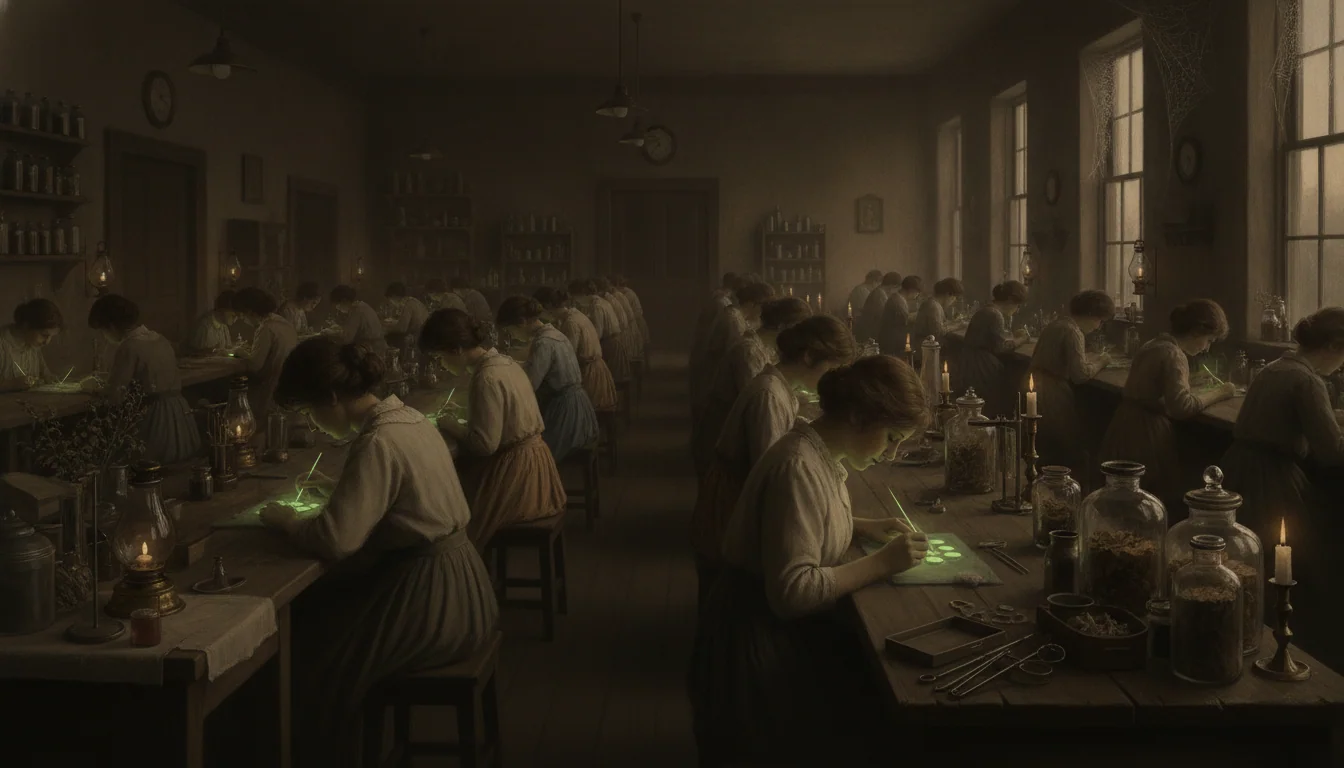
A supervisor in a New Jersey paint studio taught teenage girls a trick in 1917: to get a fine enough point on your brush, touch it to your lips, twist, then dip it back in the glowing paste. The paste was radium mixed with zinc sulfide, and the girls who used it to paint luminous numbers onto watch dials would glow faintly themselves by the end of a shift, hair and collars dusted with sparkling powder. Workers nicknamed themselves the "ghost girls" and sometimes painted their nails or teeth with the leftover paint for fun, to surprise a date in a dark movie theater. It was steady, well-paid work in wartime America. It was also, though almost nobody involved understood this yet, a slow-motion poisoning delivered one paintbrush at a time.
A wartime job that made you glow
The dial-painting industry existed because of a genuine military need. Instruments and wristwatches that could be read in a dark trench or an aircraft cockpit at night were valuable enough that the United States Radium Corporation, based in Orange, New Jersey, built a business around a paint it branded Undark. Similar operations opened at the Radium Dial Company in Ottawa, Illinois, and at a dial-painting shop in Waterbury, Connecticut. Demand held after World War One ended, since consumers wanted glow-in-the-dark watches and clocks for the home, and dial painting became one of the better jobs available to young working-class women in those towns.
The technique that made the work dangerous was called lip pointing, and it was taught deliberately by supervisors as the fastest way to keep a brush tip fine enough for tiny numerals. A skilled painter might point her brush this way dozens of times an hour, hundreds of times a day, swallowing a trace of radium paint with each pass. Company chemists in the same buildings, working with the same radium in bulk, wore lead aprons and used tongs and screens to handle it. The women applying it directly to their mouths wore no protection at all.
The element everyone believed was medicine
To understand why nobody sounded an alarm sooner, it helps to remember what radium meant to the public in the 1910s and 1920s. Marie and Pierre Curie's discovery of radium had made it the most famous substance in science, and a wave of quack and semi-legitimate commerce followed. Radium was marketed in tonic waters, cosmetics, and toothpaste as an energizing, even curative, ingredient. Spas advertised radium-infused baths. A radioactive glow was popularly associated with vitality rather than danger, and the idea that swallowing trace amounts of it might be harmful ran against the spirit of the age rather than with it.
Dial-painting supervisors were not villains inventing a lie from nothing. They were repeating what much of the public, and a fair number of scientists, believed at the time: that radium in small doses was, if anything, good for you. The tragedy was that the companies employing these women were simultaneously handling radium at industrial scale, closely enough to know what large or sustained doses did to living tissue, and did not extend that caution to the women swallowing it daily.
The jaw that came apart in a dentist's chair
The first deaths were strange and localized. A dial painter named Mollie Maggia began complaining of a toothache in the early 1920s, and the tooth extraction healed poorly. Within months her jawbone was disintegrating, abscess after abscess, until a doctor could reportedly lift sections of dead bone out with his fingers. She died within the year from a hemorrhage after an artery in her decaying jaw ruptured. Her death certificate listed syphilis as the cause.
More dial painters began arriving at dentists' offices with the same symptoms: loose teeth, jaw pain that would not heal, and bone that seemed to be rotting from within even as the surrounding gum tissue looked normal. Some doctors suspected phosphorus necrosis, a disfiguring jaw disease long associated with match factory workers, since the two conditions could look similar on the surface. Others reached for syphilis or poor hygiene as an explanation, both of which carried a moral judgment the phosphorus comparison did not. Dentists who pulled the affected teeth or cut away necrotic bone often made the underlying damage worse, since the jaw simply could not heal.
The breakthrough came from Harrison Martland, an Essex County medical examiner in New Jersey, who worked out that the women's bodies were still radioactive years after they had stopped working with the paint. Radium behaves chemically almost identically to calcium, so the body had stored it in bone alongside the calcium it needed, and it had stayed there, irradiating the jaw and marrow from the inside continuously since the day it was swallowed. Martland developed methods to detect radium in exhaled breath and in bone, turning a mystery illness into a measurable, provable case of industrial poisoning.
Blaming the women for what the company did
Every outbreak needs a scapegoat, and this one was no exception. In the mid-1920s, United States Radium Corporation commissioned an outside study of conditions at its own plant, conducted by a Harvard physiologist named Cecil Drinker. The Drinker study reportedly found serious radium contamination throughout the workspace and evidence linking it to the workers' declining health. The company did not release those findings. Instead, it circulated an altered report crediting the same investigation with a clean bill of health, while the original conclusions stayed buried for years.
When women who worked at the plant began dying anyway, company-affiliated physicians offered explanations that shifted the blame onto the victims. Some suggested the women had syphilis, an accusation calculated to discourage public sympathy for young unmarried women in the 1920s. Others blamed poor dental hygiene, personal carelessness, or "hysteria," a catch-all diagnosis regularly applied to women's medical complaints in this era regardless of the underlying physical cause. Local newspapers in company towns were often slow to challenge this framing. The dial painters, mostly teenagers and women in their twenties from working-class immigrant families, made an easy target precisely because they had little social or financial power to push back.
The lawsuit that outlived the statute of limitations
Grace Fryer, a former dial painter growing sicker by the year, spent roughly two years searching for a lawyer willing to take on United States Radium Corporation before an attorney named Raymond Berry agreed to the case. Fryer and four other former painters sued in New Jersey in 1927. New Jersey's statute of limitations required claims to be filed within two years of the exposure that caused an injury, not two years from diagnosis, and the delay in recognizing radium poisoning as an occupational disease had already pushed some potential plaintiffs past that window. The Fryer case survived on a technicality of timing and became a media sensation once reporters saw the women's condition in court, visibly crippled, some unable to raise their arms to take an oath. The company settled in 1928, shortly before trial, reportedly for a modest lump sum plus a small annual pension and paid medical care for each woman's remaining life.
A second front opened in Illinois roughly a decade later, where dial painters at the Radium Dial Company in Ottawa organized around a former painter named Catherine Wolfe Donohue, who filed a workers' compensation claim as her own health collapsed. The Illinois Industrial Commission ruled in the workers' favor in 1938, the state's courts upheld the decision, and the United States Supreme Court declined to hear a further appeal in 1939, closing off the company's options. The press reportedly took to calling the surviving Ottawa painters the Society of the Living Dead, a grim nickname for women in their twenties and thirties who had already outlived their own medical prognosis by years.
The scientific record these cases produced turned out to matter beyond the two companies involved. Physicist Robley Evans, tracking surviving dial painters for decades afterward, used their measured body burdens of radium to help define what became known as a tolerance dose, an early attempt to set a numeric limit on safe radiation exposure. That work fed directly into the radiation safety standards adopted soon after by the American nuclear industry, meaning the women who sued over glow-in-the-dark watch dials ended up shaping the safety rules used to build atomic reactors and handle nuclear material for generations that followed.
Generations later, the Radium Girls remain one of the most retold stories in American labor history, alongside episodes like the Triangle Shirtwaist Fire, the subject of bestselling books, a stage adaptation, and a steady churn of viral retellings online, and it is not hard to see why. It has the shape of a true-crime story: an ordinary-looking product, a company that knew and said nothing, and a small group of young women who forced a reckoning through nothing but persistence and a court date they very nearly missed.
Quick Answers
Common questions about this topic
What actually caused the Radium Girls' illnesses?
Dial painters were trained to shape their paintbrushes into a fine point with their lips, ingesting small amounts of radium-laced paint dozens of times a day. Radium behaves chemically like calcium, so the body stored it in bone, where it irradiated the jaw, marrow, and skeleton continuously from the inside for years after exposure.
How were the sick dial painters treated by doctors?
Early cases were misdiagnosed as phosphorus necrosis, syphilis, or ordinary dental infection, and dentists often pulled teeth or cut away jawbone, which only exposed more tissue to infection and made things worse. It took a New Jersey medical examiner developing a way to measure radium in exhaled breath and bone before doctors understood they were looking at internal radiation poisoning.
Who did the radium companies blame for the deaths?
Company physicians and hired consultants publicly suggested the women had syphilis, poor dental hygiene, or hysteria, and one company sat on an internal study that had already found dangerous conditions in its own plant. The workers, mostly young, working-class, and female, made a convenient scapegoat for a hazard the companies had been warned about.
What finally stopped the radium dial-painting poisonings?
A lawsuit brought by five New Jersey women in the late 1920s and a separate Illinois case led by Catherine Wolfe Donohue in the 1930s forced settlements, and in 1939 the U.S. Supreme Court declined to hear the company's final appeal, leaving the workers' court victory intact. The medical data the cases generated also became a foundation for the radiation exposure limits used in nuclear industries afterward.

Consult the Physicians
Chat with the healers and survivors who lived through history's outbreaks.
Create your free account →No card required. Some figures and features require a paid plan.
Join the HistorIQly Club
Get smarter about the past.
Weekly stories, deep dives, and exclusive content straight to your inbox.