Tesla vs. Edison: The War of the Currents
In the Tesla vs. Edison War of the Currents, Edison's Pearl Street DC lit New York first, but Tesla's AC, bankrolled by George Westinghouse, won in the end.
Read Wikipedia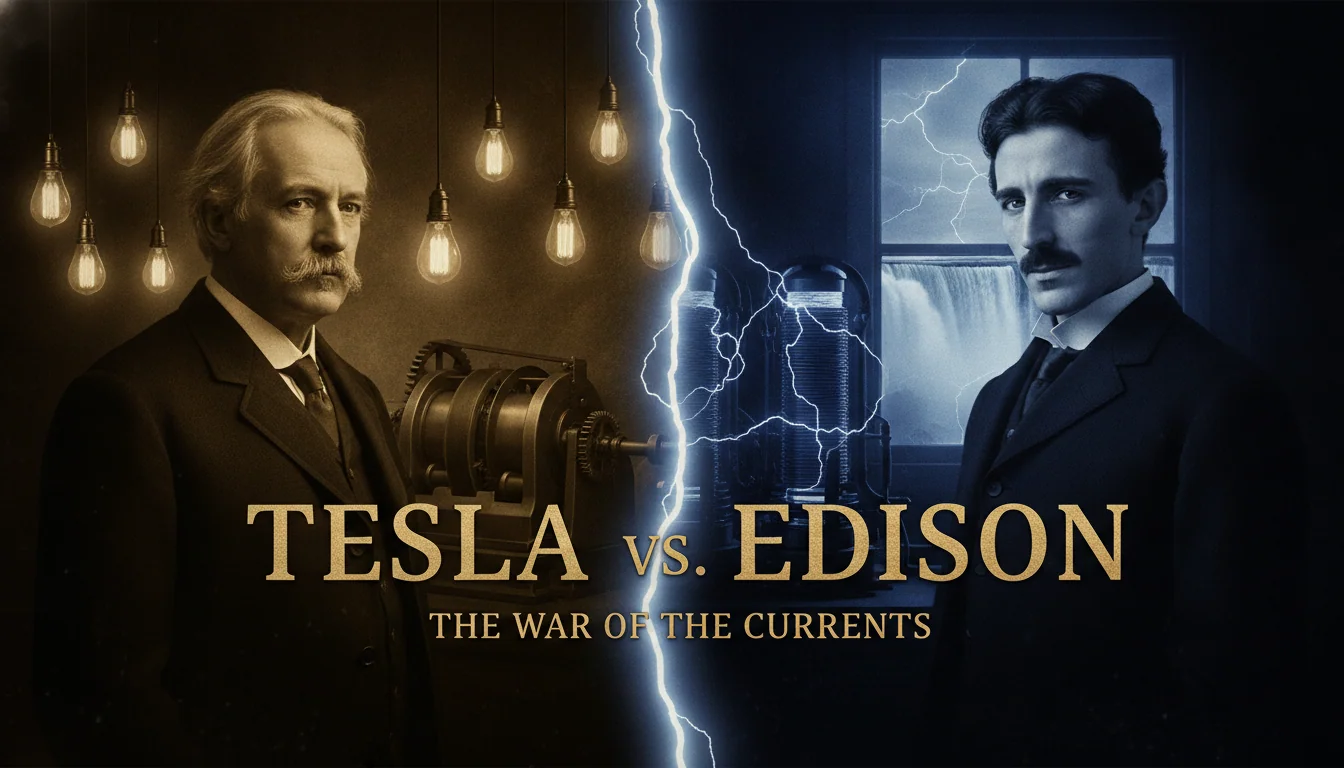
By the late 1880s, the fight over how electricity would reach American homes had narrowed to a single technical question with enormous money behind it: alternating current or direct current. Thomas Edison had already built the country's first commercial power system, and Nikola Tesla, a young engineer who had briefly worked for him, believed Edison's approach could never scale past a few city blocks. What followed became known as the Tesla vs. Edison War of the Currents, and it pulled in a wealthy industrialist, a state execution, and a lot of unlucky dogs before it decided what kind of power grid the world would run on.
What They Were Actually Fighting About
Direct current flows steadily in one direction, and in 1882 Edison used it to light part of lower Manhattan from his Pearl Street generating station. It was safe at household voltage and easy to understand, but it had a serious flaw: it could not be easily converted to a higher or lower voltage, so power stations had to sit within about a mile of every customer they served. Alternating current reversed direction many times a second, which meant it could pass through a transformer, jump to very high voltage for the trip across the countryside, then step back down to something safe once it reached a house. That single feature let one AC power station serve an entire region instead of a single neighborhood.
The commercial stakes were enormous. Whichever system became the standard would supply the generators, the wiring, and the patents for every electric customer in the country for decades to come. Edison had already staked his fortune and his public reputation on direct current, and he was not going to give up the argument quietly.
Edison's Case for Direct Current
Edison's position deserves a fair hearing. He had built the first working power system in the country and proved that central electric generation could actually work, at a time when most people still lit their homes with gas. Direct current ran at a low, familiar voltage that matched the batteries and motors already in wide use, and it did not require sending thousands of volts down city streets and into people's basements.
Edison also had a genuine, not merely self-serving, safety argument. High voltage is more dangerous than low voltage, and the voltages needed to make AC transmission worthwhile were far higher than anything running through a typical American home at the time. Edison and his engineers were not wrong that a system built around dangerous voltage carried real risk if it was poorly insulated or badly installed, which in the 1880s it sometimes was. He had also sunk his own money and the capital of investors into direct current infrastructure, and he stood to lose a great deal if the standard shifted out from under him. Whatever else drove his campaign against AC, he was defending a system he had built with his own hands and believed in.
Tesla and Westinghouse's Case for Alternating Current
Tesla arrived in the United States in 1884 and took a job at Edison's own company, working on improvements to Edison's direct current generators. He left within about a year, after a pay dispute that Tesla later described in detail: by his own account, Edison had promised him a large bonus, reportedly $50,000, for the improvements, then dismissed the offer as a joke about American humor when Tesla asked to be paid. Edison's side always told the story differently, and there is no independent way to settle whose version is more accurate.
What is not in dispute is that Tesla went on to design a practical alternating current induction motor and a full polyphase AC system, and that he licensed the patents to George Westinghouse, an established manufacturer with the capital to build on them, in the late 1880s. Westinghouse and Tesla argued that the transformer solved AC's only real disadvantage. A utility could build one large power station instead of dozens of small ones, run high voltage over long transmission lines, and step it down safely near the customer. That meant lower costs, wider service, and a system that could grow with a country that was rapidly electrifying farms, factories, and towns far from any existing power plant. Safety, they argued, was a matter of engineering, insulation, and design standards, not a reason to abandon the only system that could realistically scale.
The Clashes
The fight moved from boardrooms into public spectacle. After Westinghouse began building AC systems, Edison's camp launched a campaign to brand alternating current as inherently deadly. Edison's laboratory assisted an engineer named Harold P. Brown, who staged public electrocutions of dogs and other animals using AC current to demonstrate its lethality, and the campaign popularized the grim slang verb "to Westinghouse," meaning to be killed by electric shock.
That same campaign pushed New York State toward adopting electrocution as a method of execution, using AC generators to make the point that the technology was too dangerous for ordinary use. Westinghouse refused to sell equipment directly for the purpose, so Brown obtained Westinghouse generators through intermediaries. The first electrocution under the new law, of a convicted murderer named William Kemmler, took place on August 6, 1890, and it went badly, requiring a second, longer jolt after the first failed to kill him. The gruesome reports that followed embarrassed both sides rather than settling the argument, and if anything they turned public opinion against the practice of electrocution itself rather than against AC.
Despite the smear campaign, Westinghouse kept winning contracts. Underbidding Edison's own company, Westinghouse secured the deal to light the World's Columbian Exposition in Chicago, and when the fair opened in 1893, Tesla's polyphase AC system illuminated the fairgrounds known as the White City in front of millions of visitors. That same year, Westinghouse and Tesla's system won the contract to harness Niagara Falls, and by the mid-1890s the plant was sending power to Buffalo, roughly twenty miles away, a distance that direct current simply could not have covered economically. It was the clearest possible demonstration that AC could move real power over real distance at a real price.
Even Edison's own side of the table was shifting under him. In 1892, his financiers merged Edison General Electric with a rival company, Thomson-Houston Electric, to form General Electric. The new company dropped Edison's name from its title and pivoted toward alternating current, effectively pushing Edison out of the electrical business he had founded.
The Verdict: Who Won, and What It Cost
As engineering and as commerce, alternating current won decisively. The transformer-based, high-voltage transmission model pioneered by Tesla and built out by Westinghouse became the basis of power grids worldwide, and it remains so today. Even the small pockets of holdout direct current service, including some low-voltage DC customers Con Edison kept serving in parts of Manhattan for well over a century, eventually converted to AC.
But winning cost each side something. Westinghouse the businessman nearly went bankrupt doing it: the low bids that won the Columbian Exposition and Niagara Falls contracts strained his company badly, and a financial panic in 1893 pushed him close to losing control of it. Tesla was technically vindicated, but by most accounts he later tore up or renegotiated the per-horsepower royalty on his AC patents to help Westinghouse survive a subsequent financial crunch, giving up what could have been one of the largest fortunes in American history. Tesla spent his later decades on ambitious, underfunded projects and died in 1943 largely alone in a New York hotel room. Edison, forced out of the electric utility business bearing his own name, remained wealthy and famous, pivoted to motion pictures, phonographs, and other ventures, and is remembered by the public today as history's quintessential inventor, arguably a bigger cultural winner than the man who was actually right about the technology.
It's a familiar shape in history's rivalries: like Newton and Leibniz's fight over who invented calculus or Scott and Amundsen's race to the South Pole, the technical winner and the cultural winner turned out to be two different people.
So the current itself has a clear winner. The men behind it do not. Alternating current took over the world's power grids, Westinghouse nearly ruined himself proving it could be done, Tesla gave away the fortune that should have come with being correct, and Edison lost the argument but kept the myth. That is roughly how it still nets out today, whenever the fight gets relitigated online: everyone agrees AC won, and everyone still argues about who deserves the credit for it.
Quick Answers
Common questions about this topic
Who won the War of the Currents between Tesla and Edison?
Alternating current won. The transformer let AC step voltage up for long-distance transmission and back down for safe household use, something direct current could not do, and by the mid-1890s AC had become the standard for power grids. George Westinghouse, who held Tesla's key patents, backed the winning side.
What were Tesla and Edison actually fighting about?
Whether alternating current or direct current would become the standard for distributing electricity across the United States. Edison had already built a direct current system in New York, while Tesla's AC patents, licensed to George Westinghouse, promised to deliver power much farther and more cheaply.
Did Edison really have animals electrocuted to attack AC?
Yes. Edison's laboratory assisted an engineer named Harold P. Brown in public electrocutions of dogs and other animals using AC current, part of a campaign meant to brand alternating current as lethal. The same campaign helped push New York to adopt AC in its new electric chair.
Were Tesla and Edison ever friends?
Not really. Tesla worked for Edison's company for about a year in the mid-1880s before a pay dispute drove him out, and the two were rarely on warm terms afterward. Later in life they showed occasional public respect for each other but were never close.

Hear Both Sides
Chat with history's fiercest rivals and decide who was right.
Create your free account →No card required. Some figures and features require a paid plan.
Join the HistorIQly Club
Get smarter about the past.
Weekly stories, deep dives, and exclusive content straight to your inbox.